You've probably done some version of this already. You wrote a few blog posts, added service pages, maybe paid for a keyword tool, and watched impressions or visits creep up. Then you checked the numbers that matter: calls, quote requests, booked jobs, product sales, and the lift wasn't there.
That's the trap.
Most small businesses don't fail at SEO because they ignore keyword research for small business. They fail because they pick keywords like a publisher chasing pageviews instead of an owner chasing profit. They go after broad phrases, celebrate traffic, and end up attracting people who were never going to buy.
A small business doesn't need more random visitors. It needs the right searches from the right people at the right moment. That changes how you build your keyword list, how you judge opportunities, and what you publish first.
Table of Contents
- Stop Chasing Traffic and Start Winning Customers
- Uncovering Keywords by Thinking Like a Customer
- Qualifying Keywords A Simple Vetting Process
- The Profit Priority Matrix Which Keywords to Target First
- Turning Keywords into Content and Conversions
- Your First 90 Days of Keyword-Driven Growth
Stop Chasing Traffic and Start Winning Customers
Much SEO advice pushes small businesses toward the wrong scoreboard. It tells you to find high-volume terms, publish more content, and grow traffic. That sounds sensible until you realize traffic can rise while revenue stays flat.

Traffic can hide a bad strategy
A local service business can rank for broad, educational terms and still struggle to get leads. An online store can publish top-of-funnel guides that bring readers who are curious, not ready. A clinic can attract people researching symptoms while missing the searches from people looking to book.
That's why raw traffic is a vanity metric unless it connects to a business outcome.
The better question is simple: does this keyword bring someone who is likely to call, book, request a quote, start a cart, or compare providers seriously?
Practical rule: If a keyword doesn't align with a service, product, or profitable next step, it belongs lower on the list, no matter how attractive the volume looks.
Small businesses usually waste time here. They target broad words because the numbers feel bigger. But bigger isn't better if the searcher's intent is vague.
Profit-first keywords change the game
The strongest keyword research for small business starts with buying signals, not ego. Long-tail keywords are where this becomes obvious. According to AIOSEO's analysis of keyword research for small businesses, long-tail keywords typically have 3 to 5 or more words, can convert up to 2.5 times better than short-tail terms, and account for approximately 70% of all search traffic.
That matters because long-tail searches usually reveal what the person wants. “Plumber” is broad. “Emergency hot water heater repair Denver” is specific, urgent, and commercial. One keyword inflates your impression count. The other can bring a customer.
A profit-first approach changes your filter:
- Choose buyer language: Use phrases that signal need, urgency, comparison, or action.
- Ignore vanity volume: A keyword with lower volume can still be the better business asset if the searcher is ready.
- Tie SEO to money pages: Prioritize terms that map to services, product collections, category pages, or quote pages.
- Accept smaller audiences: A smaller search pool with clear intent often beats a large pool with mixed motives.
The right ten keywords can outperform a giant list of weak ones because they attract people who want help now, not someday.
Uncovering Keywords by Thinking Like a Customer
A homeowner wakes up to a leaking water heater, grabs a phone, and searches the way stressed people search. Fast. They do not care what you call the service internally. They care about the problem, the cost, how soon you can help, and whether you serve their area.
That is the starting point for useful keyword discovery.
Small business owners often begin with a service list. That creates tidy spreadsheets, but it misses the language customers use when they are ready to act. Profit-first keyword research starts closer to the sale. Pull terms from the moments when real buyers ask for help.
Mine the words customers already use
Your best keyword source is usually sitting in plain sight. Check contact form submissions, call transcripts, live chat logs, estimate requests, emails, reviews, and sales notes. Those phrases come from people with a real need, which makes them far more useful than a generic brainstorm.
Look for patterns like these:
- Problem language: “water heater leaking,” “toilet won't stop running,” “drain backing up”
- Urgency language: “same day,” “emergency,” “open now,” “after hours”
- Cost language: “how much,” “quote,” “price,” “cost to replace”
- Location language: neighborhood names, city names, “near me”
Write them down exactly as customers say them.
Do not rewrite “hot water tank busted” into a cleaner industry term just because it sounds better on a service menu. Searchers rarely use your polished internal wording. They use the words they would say on the phone when they need a fix today.
A simple process works well. Review the last 20 to 30 customer conversations, highlight repeated phrases, and group them by theme. You are not trying to build a master keyword file yet. You are trying to catch buying language before it gets buried under SEO jargon.
Study direct competitors without copying them
Competitor research is useful when you treat it as pattern spotting, not imitation. Pick 2 or 3 businesses that target the same customers, then search your core services and open the pages that appear again and again.
Check for specifics:
- Which services have their own pages
- Which words show up in title tags and headings
- Which city or neighborhood modifiers they use
- Which customer questions they answer on service pages
- Which profitable services are missing or poorly covered
This part matters because competitors often reveal what the market already responds to. If every strong local player has dedicated pages for emergency repair, same-day service, and water heater replacement, that is a signal. If none of them have a focused page for a higher-margin service you offer, that gap may deserve attention before you chase broader terms.
Use their coverage to sharpen your list. Do not copy their wording line by line. You want market clues, not duplicate pages.
Customers search for the outcome they want, the problem they have, or the urgency they feel.
Use Google's results pages as free keyword research
Good early-stage keyword research does not require expensive software. Google gives small businesses enough raw material to build a solid starting list if you know where to look.
Type a service into search and pay attention before you even hit enter. Autocomplete shows common phrasing. After that, scan the results page for useful variations and intent clues:
- People Also Ask: question-based searches and objections
- Related searches: modifiers, alternatives, and adjacent needs
- Titles of ranking pages: common wording that matches demand
- Local pack listings: city and service combinations Google keeps surfacing
For a local service business, searches like these usually expose strong variations:
Core service plus city
“water heater repair denver”Problem plus urgency
“emergency plumber for burst pipe”Service plus qualifier
“best drain cleaning near me”Cost question
“cost to replace water heater”
The goal here is not to collect hundreds of phrases. A bloated list makes prioritization harder, especially for a small business with limited time and budget. Build a short list of terms tied to real customer language, clear problems, and services you want to sell more of.
That gives you a keyword pool with a much better chance of producing revenue, not just traffic.
Qualifying Keywords A Simple Vetting Process
A raw keyword list is noisy. Some phrases fit your business perfectly. Others look promising but attract the wrong audience. The fastest way to clean the list is to run every keyword through three filters: relevance, intent, and competition.

Relevance comes first
This is the filter that is frequently skipped.
A keyword can have decent search volume and still be a bad target if it doesn't connect to a core service, profitable product line, or meaningful next step. Relevance asks one blunt question: if someone lands on your site from this term, can you serve them well and profitably?
For a plumber, “how does a water heater work” may be loosely related. “water heater replacement near me” is directly relevant. One searcher wants education. The other may want a job booked.
Use this quick relevance check:
- High relevance: directly tied to a service or product you want more of
- Medium relevance: adjacent topic that supports a buying journey
- Low relevance: loosely related, broad, or unlikely to create business value
If relevance is low, discard it. Don't rescue weak keywords with hope.
Intent tells you who is close to buying
Intent is where keyword research for small business stops being academic and starts getting useful. The same topic can produce very different searchers.
The four intent types are simple in practice:
| Intent type | What the searcher wants | Common modifiers |
|---|---|---|
| Informational | Learn or understand | how, why, guide, tips |
| Navigational | Find a brand or website | brand names, login, company names |
| Commercial | Compare options before acting | best, top, vs, review |
| Transactional | Take action now | buy, quote, near me, book, repair |
Commercial and transactional terms usually deserve first attention because they're closer to revenue. Informational terms still matter, but they work best when they support a core service or product path.
Working test: Search the keyword in Google. If the results are mostly service pages, product pages, or comparison pages, the intent is probably valuable. If the results are mostly general blog posts, the keyword is likely earlier-stage.
Competition decides whether the keyword is worth your effort
Plenty of small businesses choose the right intent and still lose because they chase terms that are too competitive for their current site.
Search volume and difficulty become useful at this stage. According to Macmillan Design's guide to keyword research for small businesses, keywords balancing 100 to 1,000 monthly searches and difficulty scores under 40 offer the highest ranking success rates for small businesses, up to 60% higher than high-competition terms.
That's a practical benchmark, not a law. But it's a strong default if you don't have a large site, a powerful backlink profile, or a big content budget.
Use free or entry-level tools like Google Keyword Planner or Ubersuggest to sense-check demand and competition. Then ask:
- Can I publish a better page than what's ranking?
- Does this keyword fit a page that could generate revenue?
- Is the competition realistic for my site today, not in theory?
A keyword with modest volume and manageable difficulty often beats a glamorous term dominated by strong sites. Small businesses win by being precise, not by picking fights they can't finish.
The Profit Priority Matrix Which Keywords to Target First
Once you've qualified your list, the next problem appears fast. You still can't do everything.
A small business needs a ranking system that answers one practical question: what gets worked on first? The cleanest way to do that is a simple matrix using two axes, commercial intent and competition.
How to place a keyword in the matrix
Take each qualified keyword and ask two questions.
First, how likely is this searcher to become a lead or sale if they land on the right page?
Second, how realistic is it for your site to compete for that term in the near term?
That creates four buckets.
| Quadrant | Keyword Profile | Strategic Action |
|---|---|---|
| Quick Wins | High intent, low competition | Build or optimize these first. They have the fastest path to leads. |
| Core Targets | High intent, high competition | Keep these in your plan, but support them with stronger pages, internal links, and related content over time. |
| Content Plays | Low intent, low competition | Use selectively for trust-building and supporting the buyer journey. |
| Avoid | Low intent, high competition | Skip these unless they serve a very specific strategic purpose. |
This matrix keeps you from treating every keyword as equally valuable. They aren't.
What to do in each quadrant
Quick Wins are your best first moves. Think local service terms, product-specific modifiers, or urgent problem phrases with clear buying intent. If you only have a few hours each week, spend them here first.
Core Targets matter, but they need patience. These are often broader service phrases or stronger commercial terms that bigger sites also want. They deserve a page, but not at the expense of easier revenue opportunities.
Content Plays can still be useful when they support a sale. A cost question, comparison query, or common objection can help someone move toward action if you connect it to your service or product naturally.
Avoid is the quadrant where time disappears. Broad educational phrases with heavy competition often look attractive because they seem important. For many small businesses, they create work without creating pipeline.
Here's a fast example for a local plumbing company:
- Quick Win: “emergency water heater repair denver”
- Core Target: “plumber denver”
- Content Play: “cost to replace a water heater”
- Avoid: broad DIY queries unrelated to booked work
Pick the keywords that can pay you back soonest. Authority grows faster when early pages bring real business results.
The matrix also keeps your content mix honest. You can still publish informational pieces, but they stop taking over the strategy. Revenue-led pages stay at the center.
Turning Keywords into Content and Conversions
Keywords don't make money by sitting in a spreadsheet. They need a destination, a page built for the right searcher, with the right message, and a clear next step.
Match page type to search intent
Many small businesses leak value during this stage of the process. They find a strong transactional keyword, then target it with a blog post. Or they chase an informational query with a thin service page. The mismatch weakens rankings and conversions.
Use this mapping instead:
- Transactional keywords belong on service pages, product pages, collection pages, or booking pages.
- Commercial keywords often fit comparison pages, buyer guides, or tightly written landing pages.
- Informational keywords belong on blog posts, FAQs, and resource pages that support the sales path.
- Navigational keywords usually belong to brand and core site architecture, not campaign content.
For example, “emergency plumbing repair near me” should point to a conversion-focused service page. “Water heater repair cost” can support that page as an informational article that answers a common buying question and links naturally into the service page.
Use clusters to build authority around buying topics
A single isolated page rarely does enough. Small businesses get better traction when they group related keywords under a parent topic and build a small content silo.
According to Leadpages' keyword research guidance for small businesses, small businesses applying keyword clustering see 3.2x faster ranking, often under 90 days, and 25% to 40% traffic growth in 6 months. The same source notes that clustering related terms such as “emergency plumber” and “24/7 hot water repair” helps build topical authority.
That matters because Google doesn't just evaluate a single page in isolation. It looks at whether your site shows depth around a topic. A cluster helps you send that signal without producing random content.
A practical cluster for a local plumber could look like this:
- Primary service page: emergency plumber in your city
- Supporting service page: water heater repair
- Support article: signs your water heater needs repair
- Support article: repair vs replacement questions
- FAQ page: after-hours plumbing questions
The key is focus. Don't build clusters around anything vaguely related to your industry. Build them around topics that connect back to booked work or sales.
A simple content map for a small business website
If you want keyword research for small business to stay manageable, map each target phrase to one page and one goal.
Here's a practical model:
Homepage
Use a broad brand and category signal. Keep the messaging clear about who you help and where.Core service or product pages
Target your highest-intent priority keywords. These pages should answer the main need quickly and make the next action obvious.Supporting pages
Build out related commercial terms, niche services, and local variations where relevant.Blog and FAQ content
Cover objections, cost questions, comparisons, and educational queries that help the buyer move forward.
A useful internal rule is simple. If a keyword signals action, send it to a money page. If it signals research, support the money page with content that earns trust and links inward.
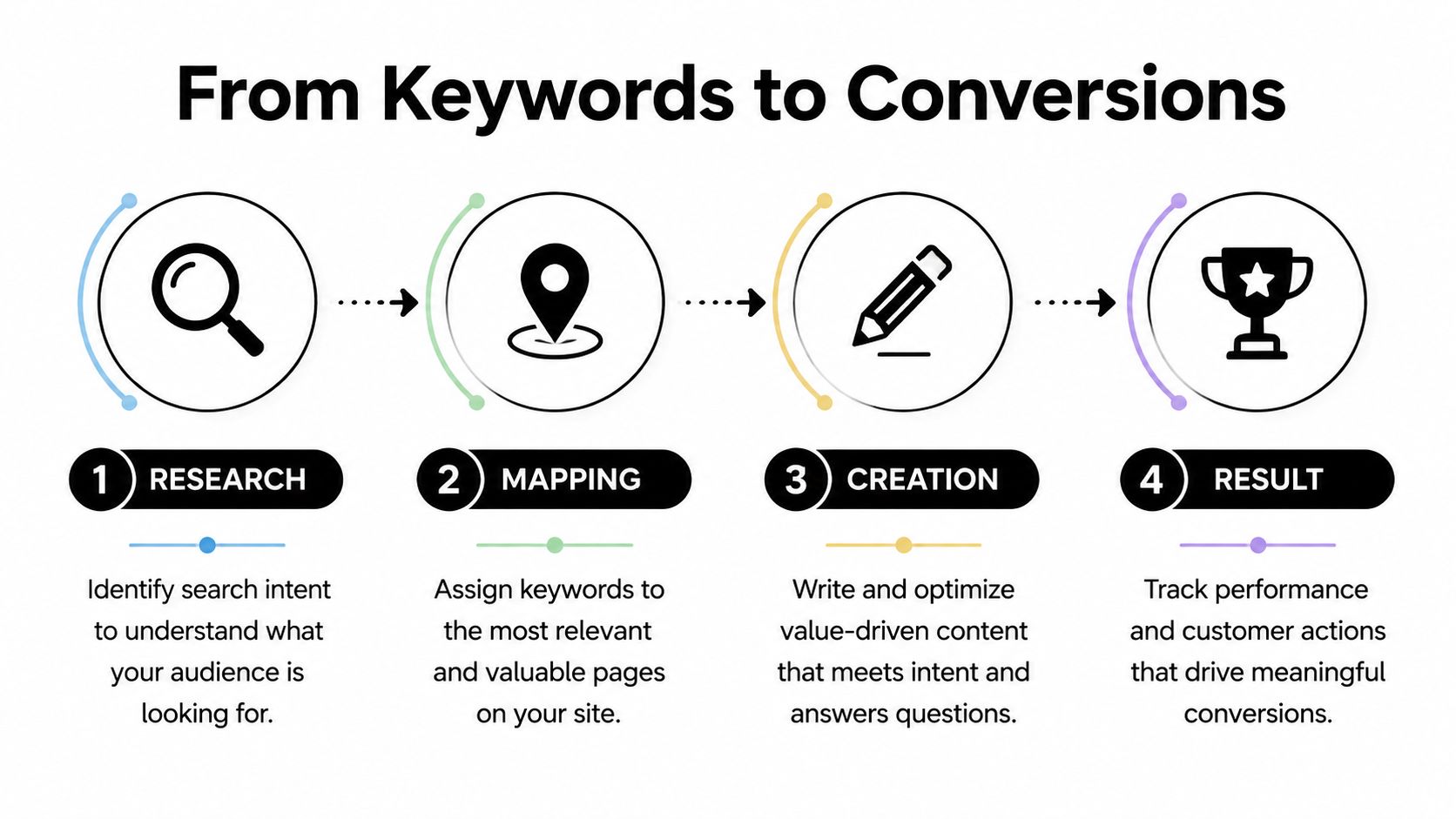
Done well, this turns SEO into a system. Keywords feed pages. Pages feed leads. New customer questions feed the next round of content.
Your First 90 Days of Keyword-Driven Growth
A small business owner blocks off a Saturday to “work on SEO,” opens a keyword tool, and ends the day with a spreadsheet full of terms that will never produce a sale. Ninety days later, nothing has changed because the work was aimed at traffic instead of revenue.
The first 90 days should do one job. Prove that keyword research can turn into leads, booked calls, and sales without draining your time or budget.
A practical 90-day plan
Start with five keywords, not fifty.
Use the research and vetting process above to choose your top five Quick Win opportunities. Keep the filter tight. Each one should match a real service or product, show clear buying intent or strong pre-buying intent, and be realistic for your site to compete on. If a keyword looks attractive in a tool but has weak commercial value, leave it alone.
Next, build or improve one page for each keyword. Put your best effort into a small set of pages instead of publishing a pile of thin content. Transactional terms belong on service or product pages. Research-driven terms belong on support content that helps the buyer make a decision and pushes them toward the right money page.
Then measure outcomes that matter to the business. Rankings are useful feedback, but they are not the scorecard. Watch calls, form submissions, quote requests, booked appointments, demo requests, and sales tied to those pages.
A simple operating loop keeps this manageable:
- Research gives you the language buyers use
- Focused pages capture high-intent searches
- Sales calls, emails, and customer questions reveal new keyword opportunities
- Those opportunities shape the next batch of pages
That cycle is how a small company builds search growth on a limited budget. It stays practical because every step connects back to profit.
What success should look like
In the first 90 days, success looks like traction, not volume.
A few pages that attract the right visitors and produce action are worth far more than a large blog archive that brings in the wrong audience. I would rather see a local service business publish three pages that generate quote requests than thirty articles that never influence a sale.
A small site grows faster when every page has a job.
Once the first pages start producing qualified leads, the next decisions get easier. Expand into the next tier of Core Targets. Build a tighter cluster around the service that is already converting. Fix pages that attract visits but fail to produce calls or inquiries. In practice, that usually means the keyword was weak, the page intent was mismatched, or the offer was not clear enough.
That is the profit-first version of SEO. You stop asking what might bring more traffic and start asking which keyword has the best chance of producing business value next.
Building a keyword-driven growth engine works because it compounds over time. If you want a faster, agency-free way to put this process into practice, Agency Secrets is built for that job. It shows small business owners how to find buyer-intent keywords, publish useful content, build authority, and turn SEO into a repeatable growth channel without hiring an expensive consultant or assembling a large team.
Leave a Reply