Most new pages take 6 to 12 months to reach Google's top 10, and the average page in the number one spot is about 5 years old. That's the honest baseline, but it isn't a sentence. If you control the right variables, you can move faster than the average and use the waiting period to build authority instead of hoping rankings appear on their own.
A lot of articles about how long to rank on google stop at “it depends.” That's technically true and practically useless. Small business owners don't need a shrug. They need a roadmap that shows what slows rankings down, what speeds them up, and which actions effectively change the timeline.
The good news is that SEO isn't random. Google is cautious, not mysterious. New sites and new pages pay a trust tax first. Businesses that target the wrong keywords, publish inconsistently, and ignore backlinks usually wait a long time and get very little. Businesses that publish focused content, build topical depth, and earn authority signals give Google reasons to move them up sooner.
That's the difference between passively waiting and actively ranking.
Table of Contents
- The Honest Answer to How Long It Takes to Rank
- The Ranking Reality Why Google Makes New Sites Wait
- The 7 Levers That Dictate Your Ranking Speed
- The Agency Secrets Roadmap to Rank in Months Not Years
- How to Track Progress Before Hitting Page One
- Stop Waiting and Start Ranking
- Frequently Asked Questions About Google Ranking Times
The Honest Answer to How Long It Takes to Rank
The answer is slower than many expect, but faster than many businesses plan for.
According to Ahrefs' 2025 analysis summarized here, most new web pages take 6 to 12 months to reach Google's top 10, only 1.74% of newly published pages achieve top 10 rankings within their first year, and the average page ranking in position one is approximately 5 years old. That tells you two things at once. First, fast rankings are the exception. Second, older pages dominate because they've had time to accumulate trust, links, and relevance.
That's the honest baseline for a small business site. If you publish a page today and expect first-page rankings next week, you're setting yourself up to misread the process.
Why the average is not your destiny
Averages hide the variables that matter.
A local service page targeting a narrow buyer-intent search can move much sooner than a brand-new ecommerce category page trying to outrank major retailers. A detailed article on a low-competition problem can gain traction while a broad “best software” page sits buried for months. The timeline changes when you change the inputs.
Practical rule: Don't ask only “how long does SEO take?” Ask “what am I doing that makes Google trust this page faster?”
The businesses that beat the average usually do a few things well:
- They choose winnable topics instead of chasing the biggest keywords first.
- They publish around a topic, not as one-off blog posts with no structure.
- They build authority signals through internal linking, site quality, and backlinks.
- They keep improving pages instead of treating publishing as the finish line.
What works and what doesn't
What works is a system. What doesn't is dabbling.
Publishing a handful of articles, waiting, and checking rankings every few weeks is the slowest way to do SEO. Google needs repeated evidence that your site deserves more visibility. Small businesses win when they compound that evidence. That means consistent content, clear search intent, and a deliberate authority-building process.
If you understand that ranking is earned in layers, the timeline starts to make sense. You're not waiting for luck. You're stacking proof.
The Ranking Reality Why Google Makes New Sites Wait
Google treats new pages like unknown vendors in a bidding process. It doesn't hand them the contract because they showed up. It asks for proof.
That's why many small business owners feel like they're stuck in a sandbox. They publish solid content, but established competitors still hold the top spots. The delay isn't arbitrary. Google is managing risk.
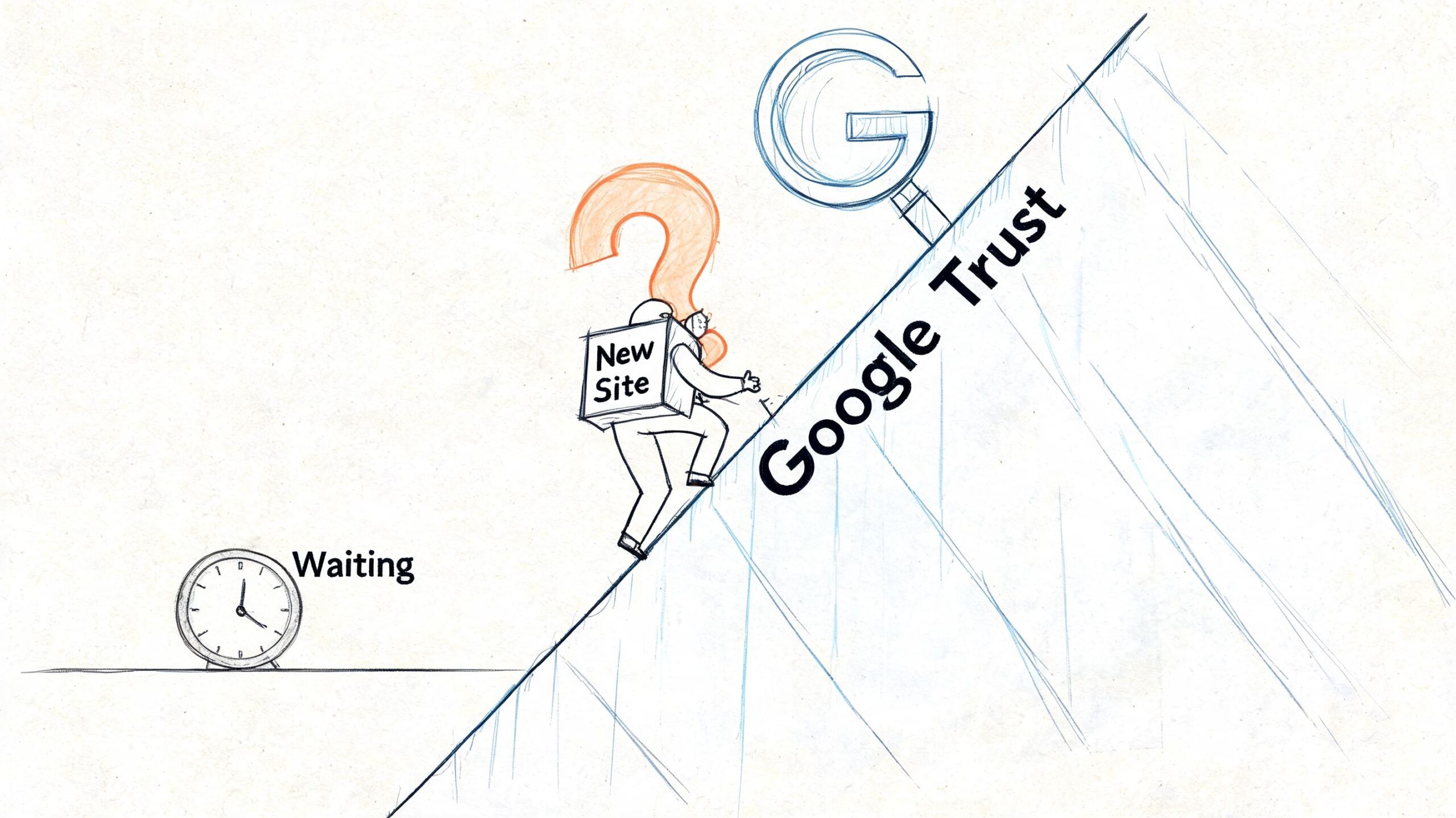
The trust tax on new content
Google increasingly leans on E-E-A-T and historical performance signals when it decides which pages deserve visibility. As Ahrefs explains in this analysis, that's a key reason behind the so-called sandbox effect. New pages lack the link velocity and behavioral signals that established domains have, so Google prioritizes crawling and ranking pages with a stronger history of trustworthiness.
For a business owner, that means your new page isn't just competing on wording. It's competing on reputation.
Google wants to know:
- Does this site regularly publish useful information
- Do other sites reference it
- Do searchers seem satisfied when they click
- Has this domain shown consistency over time
A new site usually can't answer those questions strongly yet.
Why “good content” often isn't enough
A lot of owners hear “create great content” and assume the page will rank if the writing is strong. That advice is incomplete.
A well-written page on a weak site still has to overcome uncertainty. If Google has two pages that both answer the query, it usually leans toward the one backed by a stronger reputation profile. That reputation comes from age, backlinks, topic depth, and past performance.
Google isn't punishing your new page. It's asking for more evidence than your competitors have to provide.
That's also why random publishing rarely works. Ten unrelated posts don't signal authority the way a focused cluster does. One page with no links looks thin compared with a site that has supporting articles, internal links, and relevant mentions elsewhere on the web.
The business-friendly way to think about it
Think of ranking as a reputation interview.
Your content is the answer you give in the interview. Your site history, internal structure, and backlinks are the references checking your story. If those references are weak or missing, the interview takes longer.
That's frustrating, but it's also useful. Once you stop expecting instant trust, the SEO playbook becomes much clearer. You don't need tricks. You need to reduce uncertainty.
The 7 Levers That Dictate Your Ranking Speed
The ranking timeline isn't fixed. It bends around a handful of variables you can influence. I think of them as levers, because each one can shorten or extend how long it takes to get meaningful visibility.
Lever 1 and 2 choose the right keyword and match intent
The first lever is keyword competition. If you go after broad, high-stakes searches too early, you'll wait longer and burn budget. A newer site has a better shot with specific, lower-competition phrases tied to clear intent.
The second lever is search intent alignment. Google doesn't rank pages just because they contain the right phrase. It ranks pages that match what the searcher expects to find. If someone searches for a comparison, a service page often won't win. If they want a local provider, a generic informational post won't satisfy them.
A simple mistake here can add months.
| Business Scenario | Keyword Competition | Estimated Time to Top 10 |
|---|---|---|
| New local service site targeting specific long-tail service queries | Low | Faster end of the normal range |
| New ecommerce store targeting broad product category terms | High | Slower end of the normal range |
| Established niche site publishing detailed buyer-intent guides | Medium | Moderate if authority already exists |
| New business blog publishing unfocused general topics | Mixed | Unpredictable and often slow |
| Site with topic clusters and relevant backlinks targeting long-tail terms | Low to Medium | Faster than a site publishing isolated pages |
Lever 3 and 4 build authority with content depth
The third lever is domain authority, or more plainly, how much trust your site has earned. A newer domain has less room for error. An established one can rank pages faster because Google already knows the site and crawls it more confidently.
The fourth lever is content quality and volume, but these two have to work together. One excellent article helps. A body of related, well-structured content helps more because it gives Google context.
Often, small businesses make a bad trade-off. They either publish thin content frequently, or they write one polished article every few months and stop. Neither approach creates momentum. The better path is consistent, useful publishing around a topic, with strong structure, clear answers, and supporting pages that reinforce each other.
Working rule: Publish for topical depth, not for the illusion of activity.
Lever 5 6 and 7 earn trust and remove friction
The fifth lever is your backlink profile. Relevant links from reputable sites still matter because they act like independent validation. They don't replace good content, but they make Google more comfortable promoting it.
The sixth is technical SEO health. If your site is slow, messy, hard to crawl, or poorly structured, you make Google work harder to understand it. That delays movement. Clean architecture, logical internal linking, mobile-friendly pages, and proper indexing remove unnecessary friction.
The seventh lever is crawl and indexing signals. If Google isn't discovering pages efficiently, the clock starts late. You want pages crawled, indexed, and revisited as your site grows. Internal links, updated sitemaps, and consistent publication patterns all help reinforce that.
Here's how these levers affect the timeline in practice:
- Keyword choice sets difficulty
- Intent match determines relevance
- Authority sets your starting position
- Content depth builds topical confidence
- Backlinks accelerate trust
- Technical health removes drag
- Indexing signals help pages enter the race sooner
A business owner can't control Google's clock directly. But you can control whether you're fighting uphill on every lever at once.
The Agency Secrets Roadmap to Rank in Months Not Years
The fastest SEO campaigns don't rely on one magic page. They rely on a workflow that compounds. That workflow is simple on paper and hard to execute manually at a consistent pace: choose the right keywords, publish enough focused content to build topical authority, and earn enough authority signals to move the site out of the “unknown” category.
That's where systems outperform one-off effort.
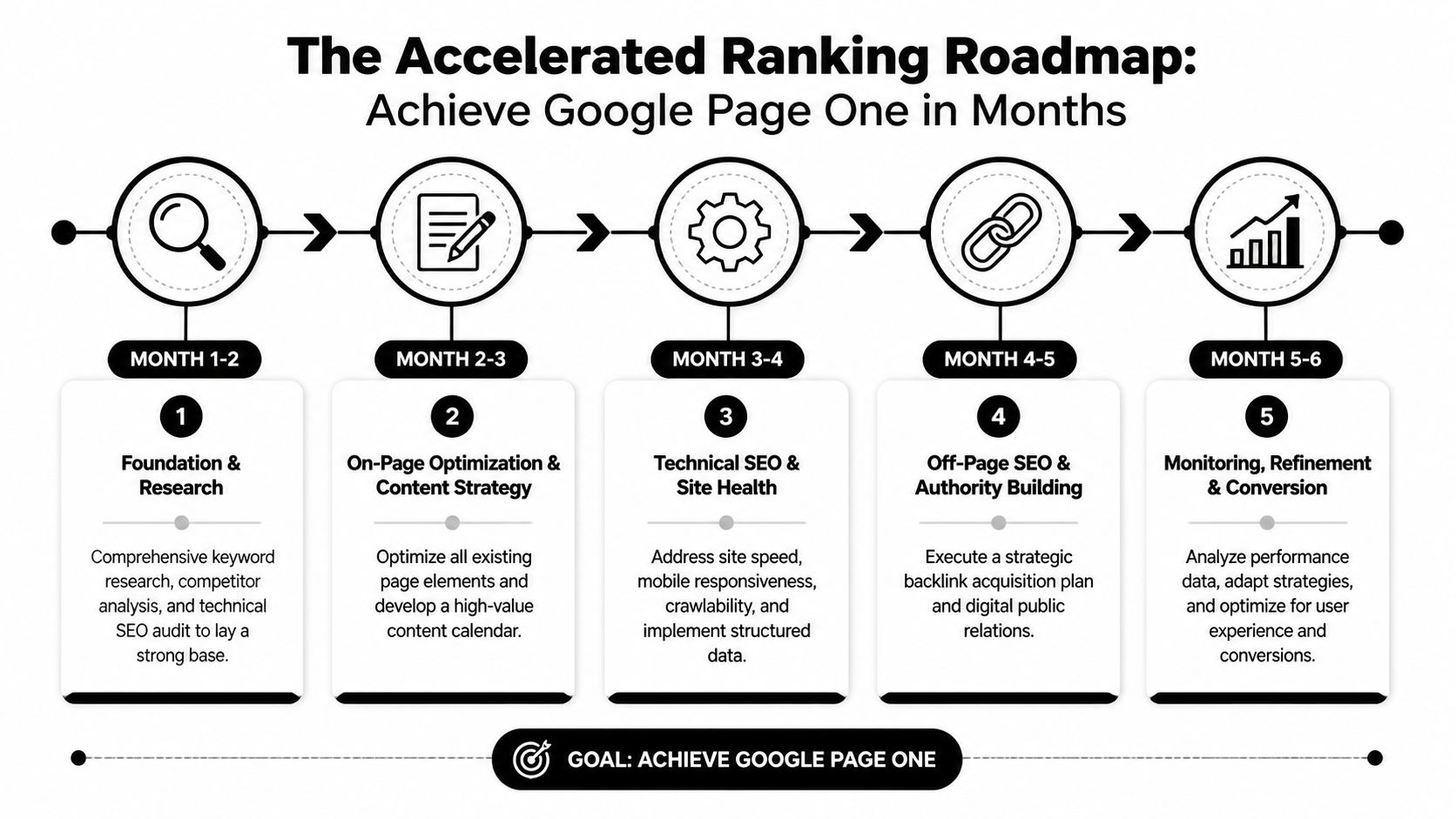
One useful benchmark comes from this review of AI-assisted SEO workflows, which notes that while traditional SEO often takes 6 to 12 months, platforms generating 30+ optimized articles per month with integrated keyword research and backlink acquisition can cut timelines to 2 to 4 months for low-competition keywords. That doesn't mean every page will rank that fast. It means the process can be accelerated when content production and authority building happen together instead of in scattered bursts.
Month 1 start with precision not volume
The first month isn't about publishing everything you can. It's about narrowing the field.
Start with buyer-intent and problem-aware keywords. A small business usually gets better results from specific searches than broad vanity terms. “Emergency dentist open Saturday” is more useful than trying to own “dentist.” “Best inventory software for small boutique” is more realistic than “inventory software.”
Your workflow should include:
- Keyword clustering so related searches support one another
- Competitor review to see what currently ranks and what format wins
- Site structure planning so every new page fits into a topic map
- Technical cleanup to make sure the site is crawlable and organized
The mistake here is publishing before you know where each page belongs. That creates content sprawl. Sprawl slows rankings because Google sees fragments instead of a coherent area of expertise.
A visual overview helps keep the process grounded:
Month 2 and 3 publish clusters not isolated posts
Most momentum is built here.
Instead of writing one article and hoping it carries the topic, publish a set of related pages that answer adjacent questions, comparisons, objections, and use cases. If you run a local clinic, that might mean service pages, symptom guides, aftercare content, and cost or eligibility explainers. If you run an ecommerce store, that could mean category support pages, buying guides, and comparison content.
This is also where a platform like OutRank changes the economics of SEO for a small team. The manual version of this workflow is slow. Research takes time. Drafting takes time. Internal linking gets skipped. Publishing cadence breaks. An automated workflow keeps the engine running by handling keyword research, article generation, and publication at a pace most small businesses can't sustain manually.
The advantage isn't just speed. It's consistency across the exact activities Google uses to build trust over time.
When done right, each new page strengthens the rest of the cluster. That's how waiting time becomes asset-building time.
Month 4 and beyond add authority signals
Content without authority often stalls. Once your base is in place, start reinforcing it with backlinks and steady optimization.
That means:
- Earning relevant links from reputable sites in or near your niche.
- Improving internal links so important pages receive support from across the site.
- Refreshing pages that show movement but haven't broken through yet.
- Expanding winning clusters once Google starts rewarding a topic.
What doesn't work is treating backlinks as a separate campaign disconnected from content. The strongest SEO motion happens when authority points to pages inside a real topical system.
For small businesses, this is the practical playbook. Don't try to rank overnight. Build enough content depth and trust signals that ranking becomes the natural next step.
How to Track Progress Before Hitting Page One
Most businesses get discouraged too early because they measure the wrong thing. They look only for page-one rankings and miss the signals that show the campaign is working before it gets there.
That's risky. A Semrush study on ranking persistence found that over 92% of domains with content in the top 100 eventually fall out entirely. Visibility is fragile. If you want to stay out of that group, you need to track early signals and keep improving instead of assuming a single ranking jump means the job is done.
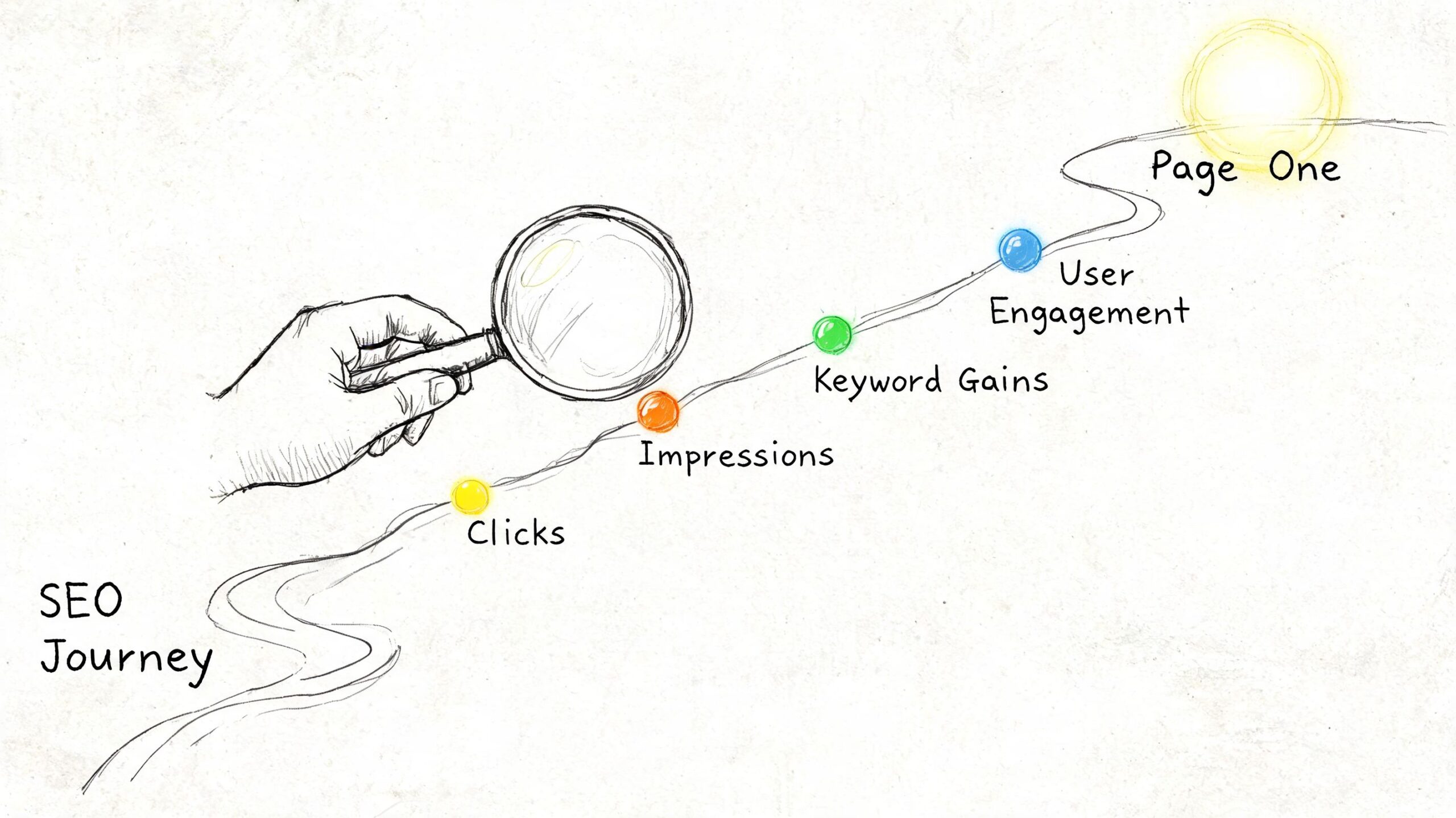
What to watch inside Google Search Console
Google Search Console is the simplest place to monitor movement.
You want to see whether Google is discovering, indexing, and testing your pages more often. A page can be far from page one and still show strong forward motion.
Watch for these signs:
- Impressions rising for target queries, even if clicks are still low
- More pages being indexed as your content footprint expands
- Average positions improving from deep rankings into more competitive territory
- New query variations appearing because Google is understanding the page more broadly
These are leading indicators. They tell you the page is entering the conversation.
Useful benchmark: A page that moves from obscurity to visible impressions is often closer to a breakthrough than its current ranking suggests.
What progress usually looks like
Ranking growth rarely happens in a straight line. One week a page appears for several long-tail queries. Then it disappears. Then it returns higher. That pattern is normal while Google tests relevance.
For a small business, the practical interpretation is simple:
| Signal | What it usually means | What to do |
|---|---|---|
| Impressions increase but clicks stay low | Google is testing the page | Improve title and meta positioning |
| Indexed pages are growing | Crawl and discovery are healthy | Keep publishing related content |
| Positions improve slowly | Relevance is building | Add internal links and strengthen supporting content |
| Rankings stall after initial movement | The page needs more trust or better alignment | Refresh the page and build authority around it |
A page doesn't go from nowhere to number three in one smooth move. It tends to climb in stages, and those stages matter.
If you only check rankings every month and ignore the rest, you'll miss the evidence that your campaign is gaining traction. Search Console gives you those mile markers. Use them.
Stop Waiting and Start Ranking
The wrong mindset is “SEO takes a long time, so I'll publish something and see what happens.” That mindset creates slow, fragile results.
The stronger mindset is “SEO takes time, so I need a system that compounds every month.” That's how small businesses beat competitors with bigger teams and bigger budgets. They don't try to brute-force the biggest terms first. They target buyer intent, build topic coverage, strengthen internal links, and earn authority signals steadily.
If you remember one thing, remember this: the timeline is real, but it's also negotiable.
You probably won't outrank entrenched domains in a week. You can, however, shorten the path by removing the mistakes that make Google hesitate. Pick better keywords. Build clusters instead of isolated posts. Support promising pages with backlinks and updates. Track impressions and indexing so you know when to push harder.
SEO rewards businesses that keep stacking proof.
A site that publishes with precision and consistency becomes easier for Google to trust. A site that treats each page as part of a larger authority system gets stronger with every month of effort. That's why the goal isn't to “get one page ranking.” The goal is to build an engine that keeps producing rankings.
Frequently Asked Questions About Google Ranking Times
Can a new website rank quickly
Yes, but “quickly” usually means on the easier end of the search environment, not across the board.
A new site can gain traction faster on narrow, lower-competition terms with clear intent. It usually won't move as fast on broad, commercially aggressive queries where older domains have deeper authority. If you're asking how long to rank on google for a new site, the best answer is that some pages can move early, but the strongest results come from focused execution over time.
Do backlinks still matter
Yes. They still matter because they help validate your site beyond your own publishing.
According to Neil Patel's data-driven study, pages with approximately 25 referring domains can reach top positions in as little as 100 days, even on lower-authority sites. That doesn't mean every page needs the same number or will follow the same path, but it does show why quality backlinks can meaningfully shorten the ranking timeline.
Should you update content if it is not ranking
Usually, yes.
If a page gets indexed but stalls, that's a signal to review keyword targeting, intent match, page structure, supporting internal links, and authority around the topic. Some pages don't need to be replaced. They need to be sharpened. Updating is often more effective than abandoning a page too early.
Is publishing more content enough on its own
No. More content helps only when it is connected, targeted, and useful.
Publishing random articles adds noise. Publishing a focused cluster builds relevance. The difference is whether the pages support one another and reinforce a clear area of expertise. Volume without structure is busywork. Volume with intent and internal linking is an asset.
What is a realistic expectation for a small business
A realistic expectation is steady movement before major wins.
Expect indexing first, then impressions, then ranking improvements, then stronger visibility on the right terms. Competitive keywords often take longer. Narrower buyer-intent topics can move sooner. The best campaigns don't rely on one breakthrough page. They create multiple opportunities for traffic by building a topic footprint that grows stronger over time.
If you want the practical path, start with pages that are close to revenue, publish enough supporting content to make those pages credible, and build authority around the topics that matter most.
If you want a practical way to apply this playbook without hiring an agency, Agency Secrets shows business owners how to do it. Their approach centers on precise keyword research, consistent publication, authority-building backlinks, and evergreen content that compounds. If you want to turn SEO from a waiting game into a repeatable system, it's a smart place to start.
Leave a Reply