Tag: buyer intent keywords

  • Buyer Intent Keywords: A Guide to Finding Terms That Sell

    Buyer Intent Keywords: A Guide to Finding Terms That Sell

    You publish blog posts, service pages, maybe a few location pages. Traffic starts to climb. Google Search Console shows more impressions. Analytics says people are landing on your site.

    But the phone doesn't ring more often. Demo requests stay flat. Product sales don't move.

    That usually means you didn't attract the wrong amount of traffic. You attracted the wrong kind of traffic. A visitor searching “how does payroll software work” behaves very differently from someone searching “best payroll software for small business pricing.” One is learning. The other is shopping.

    Buyer intent keywords are the difference between visibility and revenue. They help you target searches made by people who are actively comparing options, narrowing vendors, checking pricing, or trying to buy. For a small business, that matters more than winning broad vanity terms that look good in a report and produce little else.

    Most guides stop at a list of modifiers like “best,” “buy,” and “price.” That's useful, but incomplete. In real SEO work, a keyword only matters if the live search results confirm that Google sees it as a money term. That's the missing piece most small businesses never get taught.

    Table of Contents

    Why High Traffic Does Not Equal High Sales

    A lot of SEO campaigns fail for one simple reason. They target keywords that are easy to publish on, not keywords tied to buying behavior.

    A plumbing company might rank for “why is my water pressure low.” A skincare brand might rank for “how often should you exfoliate.” A software company might rank for “what is CRM.” Those terms can bring visitors, and some of those visitors may convert later, but most aren't ready to choose a provider today.

    That gap is where small businesses get frustrated. They invest time into content, see movement in traffic, and assume sales should follow automatically. They usually don't.

    Traffic can be high quality or low intent

    A search visit only matters if it aligns with the action you want. If you want a booked estimate, a product sale, or a demo request, then search terms tied to comparison and purchase behavior deserve more attention than broad education queries.

    The easiest way to think about it is this:

    • Low-intent traffic fills the top of the funnel. It teaches, introduces, and warms up.
    • Buyer-intent traffic sits closer to revenue. It compares, evaluates, and converts.
    • Mismatched traffic wastes effort because the visitor lands on a page that doesn't fit what they want next.

    Practical rule: If a keyword brings visitors who still need basic education, don't expect that page to behave like a sales page.

    This doesn't mean informational content is useless. It means many small businesses overproduce it because it's easier to write and easier to imagine ranking for. They underproduce the pages that help a buyer make a decision.

    What small businesses usually get wrong

    The common mistakes aren't technical. They're strategic.

    • Chasing broad topics: Broad keywords feel attractive because they seem bigger, but broad often means vague.
    • Publishing blog posts for everything: Some searches don't need a blog post. They need a pricing page, a comparison page, or a service page.
    • Ignoring the SERP: Business owners judge intent by the words in the query and skip the search results entirely.
    • Reporting on traffic alone: Rankings and clicks don't tell you whether the keyword has commercial value.

    Buyer intent keywords fix this because they force you to ask a sharper question. Not “Can I rank for this?” but “If I rank for this, will the visitor be closer to buying?”

    Decoding Searcher Intent with Keyword Modifiers

    Search intent isn't one bucket. Industry-standard guidance breaks it into informational, navigational, commercial, and transactional. In practice, the strongest buyer intent usually sits in the commercial and transactional categories, and modifiers like “best,” “compare,” “vs,” “buy,” and “price” are widely used to identify them, as explained in Semrush's guide to buyer keywords.
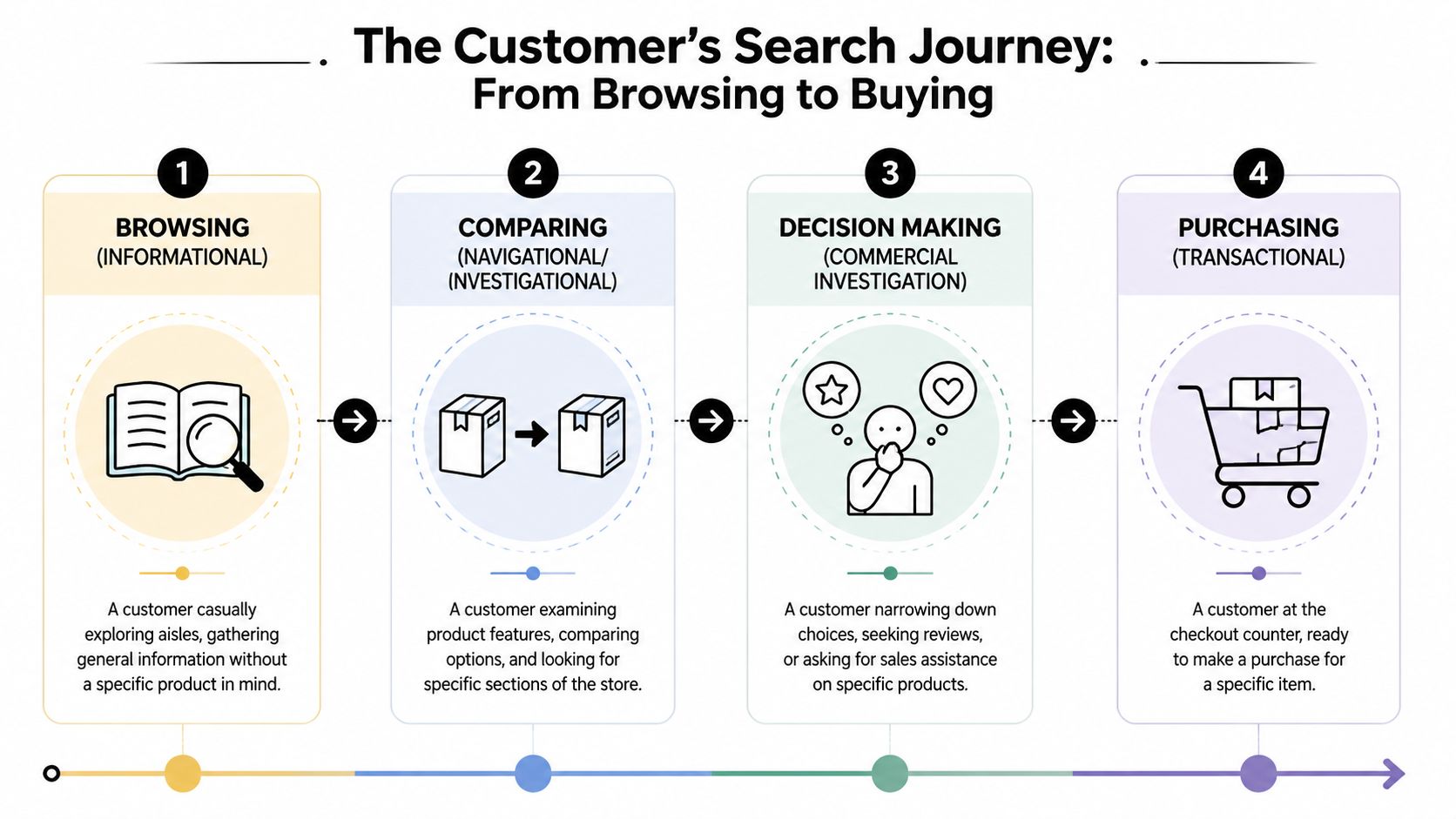
    A four-step infographic illustrating the customer search journey from initial browsing to the final product purchase.

    The four intent buckets in plain English

    Think of search like a customer walking through a store.

    An informational search is the person still wandering the aisles. They're trying to understand the problem or learn the basics. Searches often include phrases like “what is,” “how to,” or “why does.”

    A navigational search is the person looking for a specific brand, product line, or destination. They already know the store section they want. Searches may include brand names or exact product names.

    A commercial search is the customer holding two boxes and comparing them. They haven't paid yet, but they're evaluating options. During this evaluation, terms like “best,” “review,” “compare,” and “vs” become useful.

    A transactional search is the customer at the checkout line. They want to buy, book, order, or get pricing. Queries often include “buy,” “price,” “discount,” “coupon,” or direct purchase language.

    The wording matters, but the buyer's mindset matters more. Modifiers are clues to what the searcher wants next.

    What modifiers reveal about buying readiness

    Keyword modifiers aren't magic words. They're signals.

    When someone adds “best” to a query, they're usually trying to narrow choices. When they add “vs,” they're comparing finalists. When they add “price” or “pricing,” they want cost information before committing. When they add “buy,” they want a page that lets them act now.

    Here's a practical way to read them:

    • Early-stage modifiers: “what is,” “how to,” “guide,” “tips”
    • Mid-stage modifiers: “best,” “review,” “top,” “compare,” “vs”
    • Late-stage modifiers: “pricing,” “quote,” “demo,” “trial,” “buy,” “order,” “near me”

    Many businesses get sloppy when they see a valuable modifier and assume they should write a blog post. That often fails. A search for “CRM pricing” doesn't want a general article about customer relationship management. It wants a pricing page or a page that directly addresses plan differences.

    Why modifiers help but don't settle the question

    Modifiers give you a strong starting point. They don't tell the full story on their own.

    The same phrase can behave differently depending on industry, geography, and the current search results. “Best accountant for small business” may reward review-style pages. “Buy office chairs” may be dominated by ads, shopping results, and category pages. The words are helpful, but Google's current interpretation is what decides the page type that can win.

    That's why a serious buyer intent keyword strategy starts with modifiers and ends with validation.

    A Step-by-Step Workflow for Finding Buyer Keywords

    Most small businesses don't need a giant keyword list. They need a short list of terms that lead to calls, checkouts, bookings, and demos.
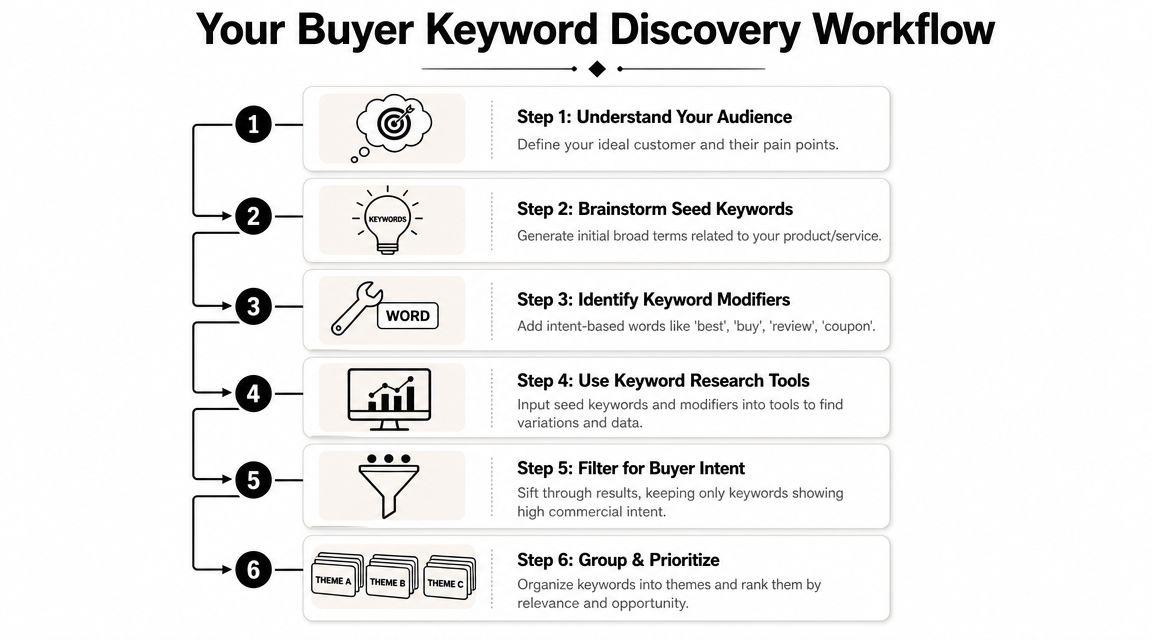
    A six-step workflow infographic illustrating the process of discovering and prioritizing effective buyer intent keywords.

    Start with products problems and real customer language

    Start from the business, not the tool.

    Write down your core offers. Then list the customer problems each offer solves. A dentist might list “teeth whitening,” “Invisalign,” and “emergency dentist.” A software company might list “inventory management,” “invoice automation,” and “client portal.” An HVAC company might list “AC repair,” “furnace replacement,” and “duct cleaning.”

    Then create three seed groups:

    1. Product or service terms
      These are the obvious head terms tied to what you sell. Think “bookkeeping service,” “meal delivery service,” or “standing desk.”

    2. Problem-solution terms
      These often convert better than broad educational topics because the searcher already feels the pain. Examples include “fix low water pressure,” “software for late invoice payments,” or “CRM for missed follow-ups.”

    3. Brand and comparison terms
      These are often neglected and often valuable. Include your brand, competitor names, and alternative language such as “[brand] vs [brand],” “[competitor] alternatives,” or “[your service] pricing.”

    Expand with tools then validate in the SERP

    Once you have seeds, use a keyword research tool to expand them. Semrush, Google Keyword Planner, and Keyword Insights can all help generate variations. Use intent labels if the tool offers them, but treat them as a draft, not a final answer.

    Then do the part most articles skip. Search the keyword and inspect the live results.

    According to Keyword Insights on buyer intent keyword validation, strong commercial signals include ads appearing in the SERP, plus a results page filled with product pages, listings, pricing pages, or comparison pages. The same source notes that high CPC bids in paid search are often used as a proxy for sales intent because advertisers bid harder on keywords tied to revenue.

    Look for these signs:

    • Ads at the top: Advertisers usually don't spend aggressively on terms with weak purchase intent.
    • Page type concentration: If most results are pricing, product, service, or comparison pages, Google sees buying value in that query.
    • Shopping or local features: These often push a term closer to action, especially for ecommerce and local services.
    • Weak content fit: If the SERP is dominated by page types you can't realistically create, skip it for now.

    Here's the embedded walkthrough if you want a visual overview of the research process.

    Reality check: A keyword isn't a buyer keyword because a list online says it is. It's a buyer keyword when the SERP shows that Google and advertisers treat it like one.

    Mine your own data before chasing new terms

    If your site already gets traffic, your best keyword source may be your own data.

    Look at Google Search Console queries tied to pages that already generate leads or sales. Check which landing pages lead to contact form submissions, booked calls, purchases, or demo requests. First-party conversion behavior tells you more than a giant export from a third-party tool.

    This is especially useful for small businesses with limited time. Instead of starting from zero, you can identify the searches already associated with revenue and expand from there.

    A practical workflow looks like this:

    • Open your conversion pages: Pull your service pages, product pages, pricing page, and demo page.
    • Check query data: Find the searches already bringing impressions and clicks to those pages.
    • Add close variants: Build out related phrases around modifiers like “pricing,” “quote,” “trial,” “near me,” and “alternative.”
    • Review competitors manually: Look at title tags, comparison pages, and menu structure. Competitors often reveal categories and comparison angles you haven't built yet.
    • Scan Google features: Autocomplete, related searches, and People Also Ask often surface buyer language your internal team doesn't use.

    What doesn't work is collecting hundreds of keywords and treating them equally. Small businesses win when they narrow down to terms with obvious business value and clear SERP confirmation.

    Mapping Keywords to Your Content and Sales Funnel

    Finding buyer intent keywords is only half the job. The page has to match what the searcher expects to see.

    If the keyword signals learning, an educational article fits. If it signals evaluation, a comparison page or use-case page usually fits better. If it signals purchase readiness, Google often expects a product, service, pricing, or demo page.

    Match the page type to the search

    User intent determines content format. Guidance summarized by SalesMotion on buyer intent data notes that informational terms like “what is” work with educational articles, while commercial and transactional modifiers such as “pricing,” “buy,” “demo,” and “trial” indicate purchase readiness and require product, comparison, or pricing pages.

    A lot of weak SEO programs fail on this exact issue. They target a comparison query with a generic blog post, or they target a pricing query with a homepage, or they target a demo query with a feature article. The keyword may be right, but the page format is wrong.

    If someone searches with buying language, don't send them to a page that still acts like they just discovered the category.

    Keyword intent to content map

    Intent Type Funnel Stage Example Modifiers Content Type
    Informational Top of funnel what is, how to, why, guide Educational article, glossary page, explainer post
    Navigational Brand-aware brand name, product name, login, location Homepage, brand page, product page, location page
    Commercial Middle to lower funnel best, compare, vs, review, alternatives Comparison page, roundup, category page, solution page
    Transactional Bottom of funnel pricing, buy, quote, demo, trial, order, near me Pricing page, service page, product page, booking page, demo page

    A few practical matches:

    • “Best payroll software for restaurants” usually belongs on a comparison or use-case page.
    • “Payroll software pricing” belongs on a pricing page.
    • “Bookkeeping services near me” belongs on a local service page.
    • “QuickBooks alternative for contractors” belongs on a competitor-alternative page if you can make a credible case.

    The stronger the buying signal, the less patience the visitor has for detours. They want proof, pricing clarity, features, trust elements, and a clear next step.

    How to Prioritize and Track Your Winning Keywords

    Once you have a list, don't ask which keyword is “best” in the abstract. Ask which keyword gives your business the clearest path to rankings and revenue.

    A hand organizing sticky notes related to project management software keyword strategy on a desk

    Use a simple decision filter

    For SMBs, three factors matter most:

    • Business relevance
      Can this keyword lead to a product sale, a booked call, or a qualified lead for something you sell?

    • Reasonable opportunity
      Can you realistically create the page type Google is already rewarding?

    • Enough demand to matter
      You don't need the biggest term. You need terms that can generate meaningful business activity.

    Live SERP analysis becomes your priority filter. Prospeo's analysis of buyer intent keyword lists makes the key point that intent changes by SERP context, and that the strongest signal of true buyer intent is the live SERP. If ads and product pages dominate, the query is transactional. The practical takeaway is that the keyword matters less than the page type Google rewards today.

    That changes how you prioritize. If you can produce a strong comparison page and the SERP rewards comparison pages, that keyword moves up. If the SERP is dominated by giant marketplaces, heavy ad placement, and product feeds you can't compete with, that keyword moves down.

    A simple scoring pass works well:

    • High priority: Strong business fit, SERP matches your page type, and the topic supports direct action
    • Medium priority: Good fit, but the SERP is mixed or you need stronger authority first
    • Low priority: Weak fit, unclear conversion path, or SERP mismatch

    Track revenue signals not vanity metrics

    Rankings matter. They're just not enough.

    Track the chain from keyword to outcome:

    What to track Why it matters
    Landing page impressions and clicks Shows whether the keyword is gaining visibility
    Rankings for priority terms Helps spot momentum or loss
    Form submissions or booked calls from landing pages Connects traffic to leads
    Sales, demos, or purchases from those pages Confirms commercial value
    Assisted conversions Captures keywords that influence later action

    A keyword that ranks fifth and brings qualified leads beats a keyword that ranks first and brings students, researchers, or casual browsers.

    Review your priority terms regularly because SERPs change. A query that once rewarded articles may shift toward product pages or local packs. When that happens, your content strategy needs to change with it.

    Automate Your Buyer Intent Workflow with OutRank

    Manual buyer intent research works. It also takes time most owners don't have.

    The slowest part isn't finding a few modifiers. It's doing the full loop well. You need to generate seed ideas, expand them, inspect the SERP, decide which page type fits, look at competitors, write the right content, publish it consistently, and then keep the whole system moving.
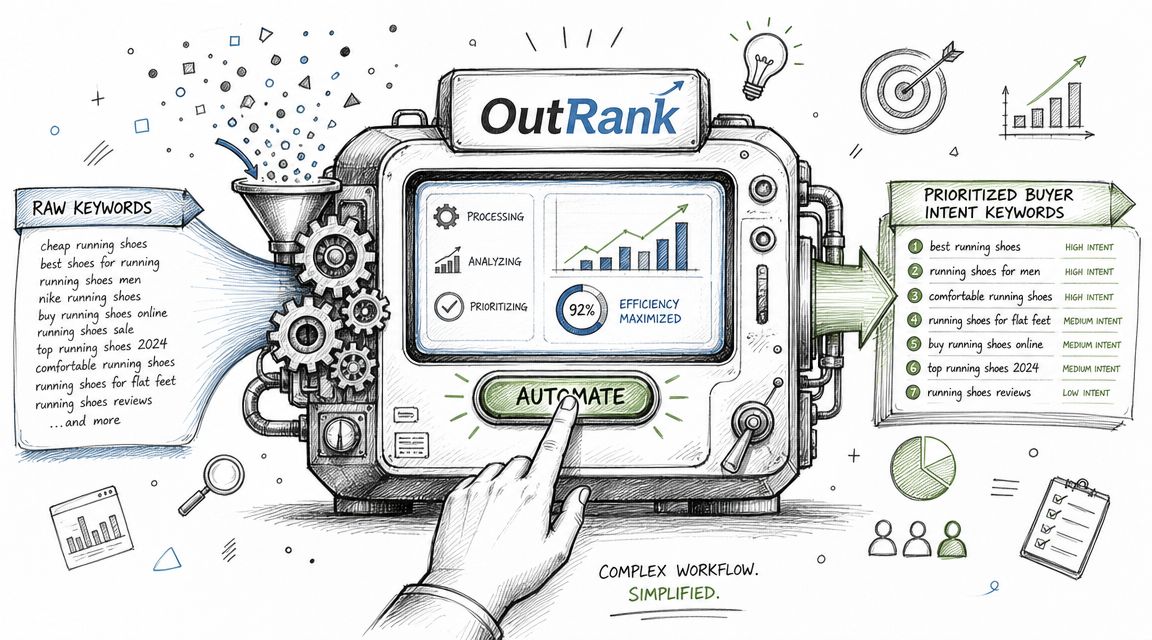
    A conceptual illustration of the OutRank automated machine converting raw keyword data into prioritized buyer intent keywords.

    What takes the most time manually

    Small businesses usually hit the same bottlenecks:

    • Research bottleneck: Too many keywords, not enough clarity on which ones tie to revenue
    • Content bottleneck: Good topics found, but no time to turn them into well-structured pages
    • Consistency bottleneck: A few articles go live, then the process stalls
    • Competitive bottleneck: Rivals publish faster and cover more comparison and bottom-funnel topics

    That creates a familiar problem. You know what should be done, but the workflow breaks under day-to-day operational pressure.

    Where automation actually helps

    The right automation doesn't replace strategy. It removes repetitive work from the strategy.

    OutRank helps by handling the tasks that usually slow execution down:

    • Keyword discovery: It surfaces search opportunities so you don't start every cycle from a blank spreadsheet.
    • Content production: It generates SEO-focused articles mapped to target topics, which helps teams maintain publishing velocity.
    • Competitor analysis: It gives context on what rivals are doing, which makes prioritization easier.
    • Ongoing execution: It reduces the stop-start pattern that kills most SMB SEO efforts.

    For a business owner, that's the core value. You still decide what matters commercially. The tool makes it easier to turn that judgment into a repeatable publishing system.

    If your current process depends on occasional bursts of keyword research followed by inconsistent writing, you don't need more theory. You need a workflow that keeps producing pages aligned with buyer intent.


    If you want a practical SEO system without hiring an agency, Agency Secrets shows small business owners how to target buyer intent, publish consistently, earn stronger backlinks, and use OutRank to automate the heavy lifting. It's built for operators who want search-driven growth without turning SEO into a full-time job.

  • Keyword Research for Small Business: A Profit-First Guide

    Keyword Research for Small Business: A Profit-First Guide

    You've probably done some version of this already. You wrote a few blog posts, added service pages, maybe paid for a keyword tool, and watched impressions or visits creep up. Then you checked the numbers that matter: calls, quote requests, booked jobs, product sales, and the lift wasn't there.

    That's the trap.

    Most small businesses don't fail at SEO because they ignore keyword research for small business. They fail because they pick keywords like a publisher chasing pageviews instead of an owner chasing profit. They go after broad phrases, celebrate traffic, and end up attracting people who were never going to buy.

    A small business doesn't need more random visitors. It needs the right searches from the right people at the right moment. That changes how you build your keyword list, how you judge opportunities, and what you publish first.

    Table of Contents

    Stop Chasing Traffic and Start Winning Customers

    Much SEO advice pushes small businesses toward the wrong scoreboard. It tells you to find high-volume terms, publish more content, and grow traffic. That sounds sensible until you realize traffic can rise while revenue stays flat.

    A man in a suit holding a small bucket while standing before a large, cascading waterfall.

    Traffic can hide a bad strategy

    A local service business can rank for broad, educational terms and still struggle to get leads. An online store can publish top-of-funnel guides that bring readers who are curious, not ready. A clinic can attract people researching symptoms while missing the searches from people looking to book.

    That's why raw traffic is a vanity metric unless it connects to a business outcome.

    The better question is simple: does this keyword bring someone who is likely to call, book, request a quote, start a cart, or compare providers seriously?

    Practical rule: If a keyword doesn't align with a service, product, or profitable next step, it belongs lower on the list, no matter how attractive the volume looks.

    Small businesses usually waste time here. They target broad words because the numbers feel bigger. But bigger isn't better if the searcher's intent is vague.

    Profit-first keywords change the game

    The strongest keyword research for small business starts with buying signals, not ego. Long-tail keywords are where this becomes obvious. According to AIOSEO's analysis of keyword research for small businesses, long-tail keywords typically have 3 to 5 or more words, can convert up to 2.5 times better than short-tail terms, and account for approximately 70% of all search traffic.

    That matters because long-tail searches usually reveal what the person wants. “Plumber” is broad. “Emergency hot water heater repair Denver” is specific, urgent, and commercial. One keyword inflates your impression count. The other can bring a customer.

    A profit-first approach changes your filter:

    • Choose buyer language: Use phrases that signal need, urgency, comparison, or action.
    • Ignore vanity volume: A keyword with lower volume can still be the better business asset if the searcher is ready.
    • Tie SEO to money pages: Prioritize terms that map to services, product collections, category pages, or quote pages.
    • Accept smaller audiences: A smaller search pool with clear intent often beats a large pool with mixed motives.

    The right ten keywords can outperform a giant list of weak ones because they attract people who want help now, not someday.

    Uncovering Keywords by Thinking Like a Customer

    A homeowner wakes up to a leaking water heater, grabs a phone, and searches the way stressed people search. Fast. They do not care what you call the service internally. They care about the problem, the cost, how soon you can help, and whether you serve their area.

    That is the starting point for useful keyword discovery.

    Small business owners often begin with a service list. That creates tidy spreadsheets, but it misses the language customers use when they are ready to act. Profit-first keyword research starts closer to the sale. Pull terms from the moments when real buyers ask for help.

    Mine the words customers already use

    Your best keyword source is usually sitting in plain sight. Check contact form submissions, call transcripts, live chat logs, estimate requests, emails, reviews, and sales notes. Those phrases come from people with a real need, which makes them far more useful than a generic brainstorm.

    Look for patterns like these:

    • Problem language: “water heater leaking,” “toilet won't stop running,” “drain backing up”
    • Urgency language: “same day,” “emergency,” “open now,” “after hours”
    • Cost language: “how much,” “quote,” “price,” “cost to replace”
    • Location language: neighborhood names, city names, “near me”

    Write them down exactly as customers say them.

    Do not rewrite “hot water tank busted” into a cleaner industry term just because it sounds better on a service menu. Searchers rarely use your polished internal wording. They use the words they would say on the phone when they need a fix today.

    A simple process works well. Review the last 20 to 30 customer conversations, highlight repeated phrases, and group them by theme. You are not trying to build a master keyword file yet. You are trying to catch buying language before it gets buried under SEO jargon.

    Study direct competitors without copying them

    Competitor research is useful when you treat it as pattern spotting, not imitation. Pick 2 or 3 businesses that target the same customers, then search your core services and open the pages that appear again and again.

    Check for specifics:

    • Which services have their own pages
    • Which words show up in title tags and headings
    • Which city or neighborhood modifiers they use
    • Which customer questions they answer on service pages
    • Which profitable services are missing or poorly covered

    This part matters because competitors often reveal what the market already responds to. If every strong local player has dedicated pages for emergency repair, same-day service, and water heater replacement, that is a signal. If none of them have a focused page for a higher-margin service you offer, that gap may deserve attention before you chase broader terms.

    Use their coverage to sharpen your list. Do not copy their wording line by line. You want market clues, not duplicate pages.

    Customers search for the outcome they want, the problem they have, or the urgency they feel.

    Use Google's results pages as free keyword research

    Good early-stage keyword research does not require expensive software. Google gives small businesses enough raw material to build a solid starting list if you know where to look.

    Type a service into search and pay attention before you even hit enter. Autocomplete shows common phrasing. After that, scan the results page for useful variations and intent clues:

    • People Also Ask: question-based searches and objections
    • Related searches: modifiers, alternatives, and adjacent needs
    • Titles of ranking pages: common wording that matches demand
    • Local pack listings: city and service combinations Google keeps surfacing

    For a local service business, searches like these usually expose strong variations:

    1. Core service plus city
      “water heater repair denver”

    2. Problem plus urgency
      “emergency plumber for burst pipe”

    3. Service plus qualifier
      “best drain cleaning near me”

    4. Cost question
      “cost to replace water heater”

    The goal here is not to collect hundreds of phrases. A bloated list makes prioritization harder, especially for a small business with limited time and budget. Build a short list of terms tied to real customer language, clear problems, and services you want to sell more of.

    That gives you a keyword pool with a much better chance of producing revenue, not just traffic.

    Qualifying Keywords A Simple Vetting Process

    A raw keyword list is noisy. Some phrases fit your business perfectly. Others look promising but attract the wrong audience. The fastest way to clean the list is to run every keyword through three filters: relevance, intent, and competition.

    A hand holds a sieve filtering gold nuggets labeled relevance, intent, and competition from small stones.

    Relevance comes first

    This is the filter that is frequently skipped.

    A keyword can have decent search volume and still be a bad target if it doesn't connect to a core service, profitable product line, or meaningful next step. Relevance asks one blunt question: if someone lands on your site from this term, can you serve them well and profitably?

    For a plumber, “how does a water heater work” may be loosely related. “water heater replacement near me” is directly relevant. One searcher wants education. The other may want a job booked.

    Use this quick relevance check:

    • High relevance: directly tied to a service or product you want more of
    • Medium relevance: adjacent topic that supports a buying journey
    • Low relevance: loosely related, broad, or unlikely to create business value

    If relevance is low, discard it. Don't rescue weak keywords with hope.

    Intent tells you who is close to buying

    Intent is where keyword research for small business stops being academic and starts getting useful. The same topic can produce very different searchers.

    The four intent types are simple in practice:

    Intent type What the searcher wants Common modifiers
    Informational Learn or understand how, why, guide, tips
    Navigational Find a brand or website brand names, login, company names
    Commercial Compare options before acting best, top, vs, review
    Transactional Take action now buy, quote, near me, book, repair

    Commercial and transactional terms usually deserve first attention because they're closer to revenue. Informational terms still matter, but they work best when they support a core service or product path.

    Working test: Search the keyword in Google. If the results are mostly service pages, product pages, or comparison pages, the intent is probably valuable. If the results are mostly general blog posts, the keyword is likely earlier-stage.

    Competition decides whether the keyword is worth your effort

    Plenty of small businesses choose the right intent and still lose because they chase terms that are too competitive for their current site.

    Search volume and difficulty become useful at this stage. According to Macmillan Design's guide to keyword research for small businesses, keywords balancing 100 to 1,000 monthly searches and difficulty scores under 40 offer the highest ranking success rates for small businesses, up to 60% higher than high-competition terms.

    That's a practical benchmark, not a law. But it's a strong default if you don't have a large site, a powerful backlink profile, or a big content budget.

    Use free or entry-level tools like Google Keyword Planner or Ubersuggest to sense-check demand and competition. Then ask:

    • Can I publish a better page than what's ranking?
    • Does this keyword fit a page that could generate revenue?
    • Is the competition realistic for my site today, not in theory?

    A keyword with modest volume and manageable difficulty often beats a glamorous term dominated by strong sites. Small businesses win by being precise, not by picking fights they can't finish.

    The Profit Priority Matrix Which Keywords to Target First

    Once you've qualified your list, the next problem appears fast. You still can't do everything.

    A small business needs a ranking system that answers one practical question: what gets worked on first? The cleanest way to do that is a simple matrix using two axes, commercial intent and competition.

    How to place a keyword in the matrix

    Take each qualified keyword and ask two questions.

    First, how likely is this searcher to become a lead or sale if they land on the right page?

    Second, how realistic is it for your site to compete for that term in the near term?

    That creates four buckets.

    Quadrant Keyword Profile Strategic Action
    Quick Wins High intent, low competition Build or optimize these first. They have the fastest path to leads.
    Core Targets High intent, high competition Keep these in your plan, but support them with stronger pages, internal links, and related content over time.
    Content Plays Low intent, low competition Use selectively for trust-building and supporting the buyer journey.
    Avoid Low intent, high competition Skip these unless they serve a very specific strategic purpose.

    This matrix keeps you from treating every keyword as equally valuable. They aren't.

    What to do in each quadrant

    Quick Wins are your best first moves. Think local service terms, product-specific modifiers, or urgent problem phrases with clear buying intent. If you only have a few hours each week, spend them here first.

    Core Targets matter, but they need patience. These are often broader service phrases or stronger commercial terms that bigger sites also want. They deserve a page, but not at the expense of easier revenue opportunities.

    Content Plays can still be useful when they support a sale. A cost question, comparison query, or common objection can help someone move toward action if you connect it to your service or product naturally.

    Avoid is the quadrant where time disappears. Broad educational phrases with heavy competition often look attractive because they seem important. For many small businesses, they create work without creating pipeline.

    Here's a fast example for a local plumbing company:

    • Quick Win: “emergency water heater repair denver”
    • Core Target: “plumber denver”
    • Content Play: “cost to replace a water heater”
    • Avoid: broad DIY queries unrelated to booked work

    Pick the keywords that can pay you back soonest. Authority grows faster when early pages bring real business results.

    The matrix also keeps your content mix honest. You can still publish informational pieces, but they stop taking over the strategy. Revenue-led pages stay at the center.

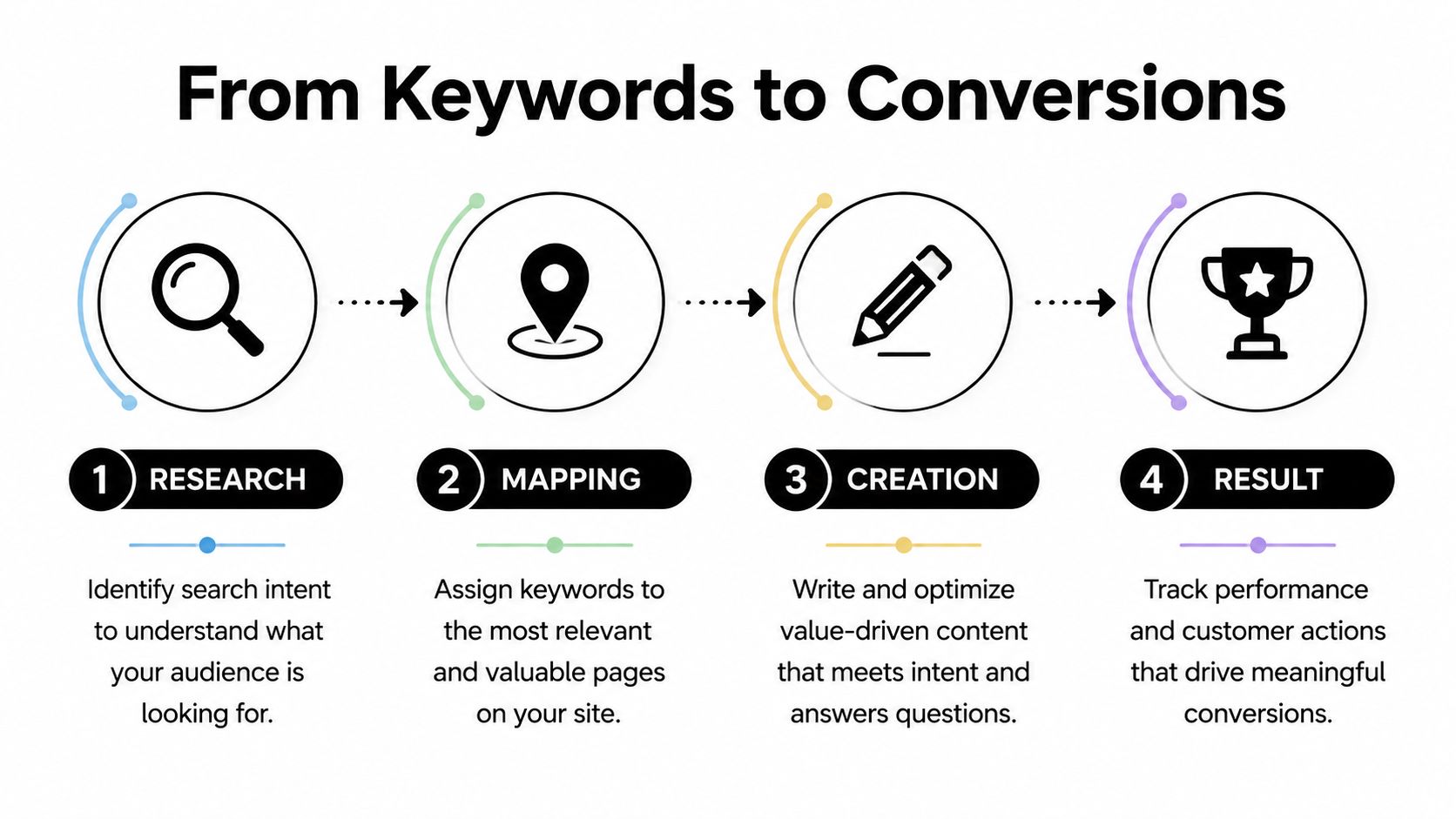
    Turning Keywords into Content and Conversions

    Keywords don't make money by sitting in a spreadsheet. They need a destination, a page built for the right searcher, with the right message, and a clear next step.

    A four-step infographic illustrating the process from keyword research to achieving website conversions.

    Match page type to search intent

    Many small businesses leak value during this stage of the process. They find a strong transactional keyword, then target it with a blog post. Or they chase an informational query with a thin service page. The mismatch weakens rankings and conversions.

    Use this mapping instead:

    • Transactional keywords belong on service pages, product pages, collection pages, or booking pages.
    • Commercial keywords often fit comparison pages, buyer guides, or tightly written landing pages.
    • Informational keywords belong on blog posts, FAQs, and resource pages that support the sales path.
    • Navigational keywords usually belong to brand and core site architecture, not campaign content.

    For example, “emergency plumbing repair near me” should point to a conversion-focused service page. “Water heater repair cost” can support that page as an informational article that answers a common buying question and links naturally into the service page.

    Use clusters to build authority around buying topics

    A single isolated page rarely does enough. Small businesses get better traction when they group related keywords under a parent topic and build a small content silo.

    According to Leadpages' keyword research guidance for small businesses, small businesses applying keyword clustering see 3.2x faster ranking, often under 90 days, and 25% to 40% traffic growth in 6 months. The same source notes that clustering related terms such as “emergency plumber” and “24/7 hot water repair” helps build topical authority.

    That matters because Google doesn't just evaluate a single page in isolation. It looks at whether your site shows depth around a topic. A cluster helps you send that signal without producing random content.

    A practical cluster for a local plumber could look like this:

    • Primary service page: emergency plumber in your city
    • Supporting service page: water heater repair
    • Support article: signs your water heater needs repair
    • Support article: repair vs replacement questions
    • FAQ page: after-hours plumbing questions

    The key is focus. Don't build clusters around anything vaguely related to your industry. Build them around topics that connect back to booked work or sales.

    A simple content map for a small business website

    If you want keyword research for small business to stay manageable, map each target phrase to one page and one goal.

    Here's a practical model:

    1. Homepage
      Use a broad brand and category signal. Keep the messaging clear about who you help and where.

    2. Core service or product pages
      Target your highest-intent priority keywords. These pages should answer the main need quickly and make the next action obvious.

    3. Supporting pages
      Build out related commercial terms, niche services, and local variations where relevant.

    4. Blog and FAQ content
      Cover objections, cost questions, comparisons, and educational queries that help the buyer move forward.

    A useful internal rule is simple. If a keyword signals action, send it to a money page. If it signals research, support the money page with content that earns trust and links inward.

    Done well, this turns SEO into a system. Keywords feed pages. Pages feed leads. New customer questions feed the next round of content.

    Your First 90 Days of Keyword-Driven Growth

    A small business owner blocks off a Saturday to “work on SEO,” opens a keyword tool, and ends the day with a spreadsheet full of terms that will never produce a sale. Ninety days later, nothing has changed because the work was aimed at traffic instead of revenue.

    The first 90 days should do one job. Prove that keyword research can turn into leads, booked calls, and sales without draining your time or budget.

    A practical 90-day plan

    Start with five keywords, not fifty.

    Use the research and vetting process above to choose your top five Quick Win opportunities. Keep the filter tight. Each one should match a real service or product, show clear buying intent or strong pre-buying intent, and be realistic for your site to compete on. If a keyword looks attractive in a tool but has weak commercial value, leave it alone.

    Next, build or improve one page for each keyword. Put your best effort into a small set of pages instead of publishing a pile of thin content. Transactional terms belong on service or product pages. Research-driven terms belong on support content that helps the buyer make a decision and pushes them toward the right money page.

    Then measure outcomes that matter to the business. Rankings are useful feedback, but they are not the scorecard. Watch calls, form submissions, quote requests, booked appointments, demo requests, and sales tied to those pages.

    A simple operating loop keeps this manageable:

    • Research gives you the language buyers use
    • Focused pages capture high-intent searches
    • Sales calls, emails, and customer questions reveal new keyword opportunities
    • Those opportunities shape the next batch of pages

    That cycle is how a small company builds search growth on a limited budget. It stays practical because every step connects back to profit.

    What success should look like

    In the first 90 days, success looks like traction, not volume.

    A few pages that attract the right visitors and produce action are worth far more than a large blog archive that brings in the wrong audience. I would rather see a local service business publish three pages that generate quote requests than thirty articles that never influence a sale.

    A small site grows faster when every page has a job.

    Once the first pages start producing qualified leads, the next decisions get easier. Expand into the next tier of Core Targets. Build a tighter cluster around the service that is already converting. Fix pages that attract visits but fail to produce calls or inquiries. In practice, that usually means the keyword was weak, the page intent was mismatched, or the offer was not clear enough.

    That is the profit-first version of SEO. You stop asking what might bring more traffic and start asking which keyword has the best chance of producing business value next.

    Building a keyword-driven growth engine works because it compounds over time. If you want a faster, agency-free way to put this process into practice, Agency Secrets is built for that job. It shows small business owners how to find buyer-intent keywords, publish useful content, build authority, and turn SEO into a repeatable growth channel without hiring an expensive consultant or assembling a large team.