You shipped the product. A few early users love it. Then growth stalls.
Your homepage gets some direct traffic, branded search is tiny, and every “we should do content” conversation dies the same way: no one knows what to write, who should write it, or how long it will take before it matters. So the blog becomes a dumping ground for feature updates, generic thought pieces, and posts targeting keywords your biggest competitors already own.
That approach burns time and teaches founders the wrong lesson. Content marketing for startups doesn't fail because content is slow. It fails because startups treat it like a side project instead of a system.
The version that works is narrower, sharper, and far less glamorous. You pick a specific buyer. You target a small pocket of demand that bigger companies ignore. You publish content that solves one expensive problem at a time. Then you turn every winning topic into an evergreen asset that keeps pulling in qualified visitors long after publication.
Table of Contents
- Your Content Marketing Engine Starts Here
- Pinpoint Your Audience Before Writing a Word
- Find Topics That Win Customers Not Just Clicks
- Create High-Impact Content on a Startup Budget
- A Smart Distribution Strategy for Zero-Audience Startups
- Measure What Matters and Prove Content ROI
- Scale Your Success with an Evergreen Content System
Your Content Marketing Engine Starts Here
Most founders don't need more marketing ideas. They need fewer moving parts.
The trap is familiar. You publish when you have time. You choose topics that sound important in meetings. You hope SEO will sort itself out. A few months later, nothing compounds because nothing connects. The audience is vague, the topics are broad, distribution is improvised, and measurement starts and ends with pageviews.
That's why content feels expensive even when you're doing it in-house.
A startup needs a repeatable engine, not a content calendar full of disconnected posts. The engine is simple:
- Define a narrow audience with a real buying problem.
- Find high-intent topics inside underserved micro-segments.
- Create useful, authoritative content that earns trust.
- Distribute it deliberately instead of waiting for traffic.
- Measure business impact so you keep what works and kill what doesn't.
- Systemize the winners into an evergreen library.
Practical rule: If a topic can't be tied to a specific buyer problem and a likely next action, it probably doesn't belong on an early-stage startup blog.
This approach also matches where the market is going. Content investment is growing, with 54% of businesses planning to increase spending in 2024, and businesses investing $4,000 or more per content piece are 2.6 times more likely to report their strategy as “very successful” than lower-spend brands, according to Reboot's content marketing statistics summary. The lesson for startups isn't “spend recklessly.” It's that thoughtful, high-quality content beats cheap volume.
If you're resource-constrained, that's good news. You don't need a giant team. You need discipline. One article that targets a real buying question can outperform ten posts written for “awareness” that never influence a decision.
Pinpoint Your Audience Before Writing a Word
The fastest way to waste a quarter is writing for “small businesses,” “marketers,” or “founders” as if those are usable audiences.
They aren't. Those labels are too broad to guide headlines, examples, calls to action, or SEO decisions. Startups that skip audience work usually produce content that sounds polished but misses the buyer's actual problem.

Research backs this up. 60% of corporate marketers lack understanding of best practices for buyer persona development, and buyers review an average of 13 pieces of content before making a purchase decision, according to Proven SaaS on startup content marketing. If your content doesn't line up with the buyer's context, those interactions don't build momentum. They just add noise.
Build a minimum viable persona
You don't need a bloated persona deck. You need a working profile you can use in editorial decisions this week.
Focus on these inputs:
- Role and context who the buyer is inside the company or household
- Trigger problem what happened that made them look for a solution
- Buying stage whether they're problem-aware, comparing options, or ready to choose
- Language the exact phrases they use to describe friction
- Constraints what makes switching, buying, or implementing hard
A useful persona sounds like this:
| Element | Weak version | Useful version |
|---|---|---|
| Audience | Small business owner | Multi-location clinic owner struggling to manage inbound leads |
| Goal | Get more customers | Increase qualified bookings without hiring another admin |
| Pain point | Marketing is hard | Existing website gets traffic but doesn't convert local service intent |
| Search behavior | Searches for SEO help | Searches for terms tied to compliance, local visibility, and service-specific demand |
That level of specificity changes everything. It tells you what examples to use, which objections to address, and what kinds of keywords deserve attention.
Run interviews that produce usable insights
Good audience research doesn't require a research department. It requires curiosity and a repeatable script.
The proven-saas methodology recommends using surveys, phone interviews, in-person conversations, web analytics, and exit surveys. It also suggests conducting at least 10 to 15 customer interviews per persona, which is realistic if you treat it as part of sales and customer success, not a separate research project.
Ask questions that reveal decision logic:
- What was happening right before you started looking for a solution?
- What did you try first that didn't work?
- What nearly stopped you from buying?
- What wording would you type into Google if you had to solve this again?
- What alternatives were you comparing us against?
Avoid asking what content people want. Most buyers won't tell you directly. They will tell you their frustrations, hesitations, and decision criteria. That's more valuable.
A strong walkthrough helps if your team hasn't done this before.
Turn audience research into editorial decisions
Many teams stall at this stage. They gather notes, then return immediately to writing generic posts.
Don't summarize interviews into fluffy persona paragraphs. Convert them into a simple editorial filter.
Buyers don't care that you published. They care that you understood the job they're trying to get done.
Use these decisions:
- Choose one persona per article. Mixed audiences produce muddled writing.
- Map one pain point to one content format. Comparisons for evaluation. How-to content for active problem solving. Checklists for implementation friction.
- Write in the buyer's vocabulary. If customers say “missed appointments,” don't rewrite it as “operational inefficiency.”
- Attach every article to a stage. Awareness, consideration, or decision.
Startups don't have the budget for unfocused content. Persona work isn't a branding exercise. It's the difference between publishing into the void and publishing something a buyer can recognize as relevant.
Find Topics That Win Customers Not Just Clicks
Broad keywords look impressive in a spreadsheet and terrible in practice.
If you're a startup, trying to rank for a huge generic term is usually a vanity project. The traffic is broad, the competition is entrenched, and the search intent is messy. You can spend months chasing visibility that never turns into trials, demos, or sales conversations.
The better move is to hunt where larger companies rarely bother: micro-underserved segments.

According to Invoke Media on underserved market segments, long-tail, intent-driven keywords can drive 3–5× more conversions than broad generic terms. That's exactly why content marketing for startups should focus less on reach and more on precision.
Start with purchase intent not search volume
A high-intent keyword usually contains one or more of these signals:
- Specific audience qualifiers such as industry, company size, or use case
- Problem qualifiers that imply pain, urgency, or friction
- Solution qualifiers like software type, compliance need, or workflow requirement
- Comparison language that signals active evaluation
Examples:
- inventory management for Etsy jewelry sellers
- CRM for small therapy practices
- local SEO for emergency plumbers
- appointment reminder software for dental clinics
- HIPAA-compliant client intake forms for solo practices
None of these are glamorous trophy terms. That's the point. They attract people with context, not idle curiosity.
How to spot a micro-niche worth serving
Good startup topics sit at the overlap of three conditions.
First, the audience is narrow enough that the problem is described clearly. Second, the pain is expensive enough that people will act. Third, the competition is too broad or too lazy to build dedicated content around it.
Use this quick decision framework:
| Question | Good sign | Bad sign |
|---|---|---|
| Is the audience named clearly? | “Texas HVAC contractors” | “Businesses” |
| Is the pain specific? | “Low visibility in map results” | “Needs more growth” |
| Is there buyer intent? | “Best scheduling app for mobile detailing” | “What is scheduling” |
| Can your product plausibly help? | Yes, directly | Only through a vague brand story |
If a topic fails any of those tests, it probably belongs later, not now.
Build a topic map your competitors won't bother with
Large competitors tend to publish horizontally. They want the biggest category terms. Startups win vertically.
That means taking one niche and building a stack of related evergreen articles around it. For example, if you serve small clinics, your cluster might include:
- Decision content comparing tools for patient intake or reminders
- Operational content solving booking, follow-up, or no-show issues
- Compliance content addressing regulated workflows
- Local visibility content tied to geography or service lines
Pick a niche where you can sound like an insider. Outsiders can rank briefly. Insiders build trust.
Use low-cost tools like Google Search Console, Google autocomplete, competitor title tags, and support ticket language to find these phrases. Then group topics by buyer stage instead of publishing random one-offs.
That's the moat. Not more content. Better fit.
Create High-Impact Content on a Startup Budget
Lean content is often misunderstood. Founders hear “lean” and think cheap, fast, and disposable.
That's backward. For startups, lean content means protecting limited resources by creating fewer pieces with a better chance of ranking, being shared, and influencing a buying decision. The worst use of a small budget is high-output mediocrity.
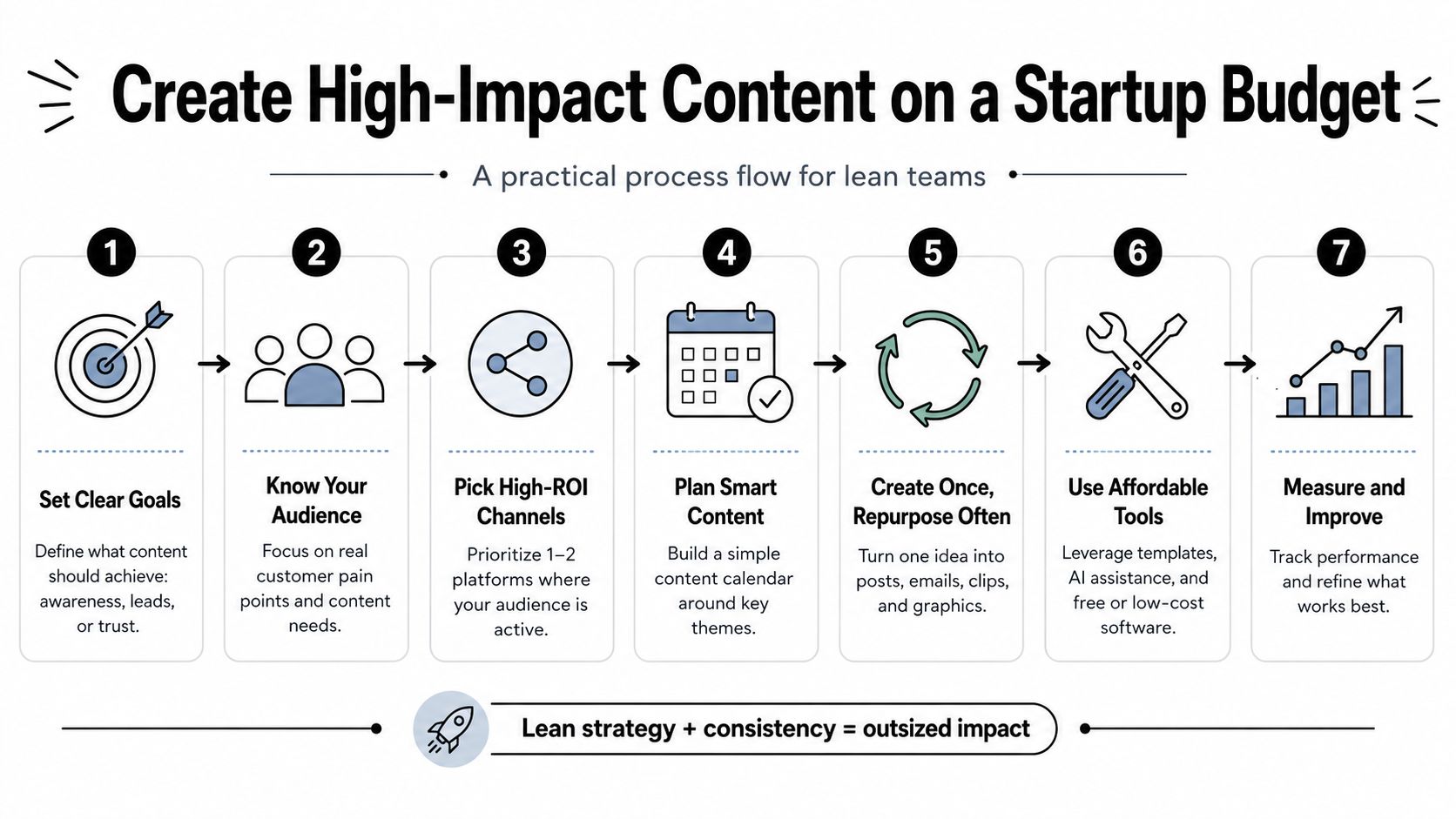
The market is already moving toward a hybrid workflow. 72% of people used generative AI tools for content tasks in 2024, while 47% of organizations use AI for content creation and 51% use it for real-time optimization, according to BYYD's overview of content marketing trends citing Statista data. For startups, that matters because it cuts production friction without removing human judgment.
Why one strong article beats a pile of weak ones
A startup article needs to do more than exist. It should answer the search intent cleanly, show practical expertise, and move the reader toward a next step.
That usually means:
- a direct answer near the top
- examples grounded in a real use case
- structure that makes scanning easy
- internal links to related resources
- a call to action matched to buyer stage
Short, generic posts often fail on all five.
There's also a quality threshold issue. From the startup content pitfalls covered by Technical.ly, articles over 1,000 words generate significantly more leads than very short content, but composition still matters more than raw length. The takeaway isn't “make everything longer.” It's “earn the reader's attention with substance.”
Use AI like a production assistant not a replacement
AI is useful at the parts of content creation that drain time but don't require your sharpest strategic thinking.
Use it for:
- Outline generation based on a target query and buyer stage
- Angle expansion when you need supporting subtopics
- First-draft assembly from your notes, transcript, or brief
- Optimization passes for clarity, heading structure, and coverage gaps
- Repurposing a pillar article into email, FAQ, or social snippets
Don't hand it the entire job.
What still needs a human:
- deciding whether the topic deserves to exist
- injecting product and customer insight
- cutting generic filler
- checking claims and examples
- aligning the article with brand voice and sales reality
AI speeds up production. It doesn't create authority. Your experience, customer context, and editorial judgment still do that.
Teams often go wrong here. They publish AI drafts that sound competent but say nothing distinctive. Search engines and buyers both recognize that quickly.
A lean editorial workflow that actually ships
The easiest way to keep quality high is to standardize the process. Not every article needs a full editorial board. It does need checkpoints.
A practical startup workflow looks like this:
Brief the article clearly
Define the target query, persona, stage, and desired next action. If you can't explain why the article should exist in two sentences, kill it early.Collect proprietary input
Pull in sales call notes, support questions, onboarding friction, and implementation examples. This is the material competitors can't easily copy.Draft fast
Use Google Docs, Notion, or an AI-assisted writing workflow to build the first version. Speed matters at this stage because perfectionism kills consistency.Edit for utility
Remove repeated points, simplify jargon, and make sure the opening answers the query immediately.Optimize structure
Clean H2s and H3s, useful internal links, concise title, and a CTA that matches buyer intent.Publish and refresh
Evergreen articles shouldn't be treated as finished. Update examples, tighten weak sections, and add links as your library grows.
Here is the trade-off many organizations face: content quality typically increases when the founder or operator provides insight, but publishing frequency typically increases when the task is delegated. The solution is not to pick one. The solution is to separate insight from production. Founders provide raw material. Editors and tools shape it.
That division is what makes content marketing for startups sustainable instead of exhausting.
A Smart Distribution Strategy for Zero-Audience Startups
Publishing is not distribution. It's inventory creation.
A new startup blog has no authority, no audience habit, and no built-in amplification. If you hit publish and wait for search traffic, you'll probably wait a long time. Early distribution has to be active, targeted, and tied to places where your buyers already pay attention.
Borrow trust before you try to build it
The fastest route to early visibility is borrowed authority.
That means showing up in niche environments where your audience already asks questions and evaluates vendors. Depending on your market, that could be Reddit communities, Slack groups, LinkedIn comment threads, industry newsletters, association sites, or partner audiences.
A simple priority order works well:
- Communities first because they already contain buyer conversations
- Partnership distribution second through co-marketing, guest contributions, or vendor ecosystems
- Founder-led distribution third through personal LinkedIn posts, email replies, and direct outreach
- Organic social last unless you already have audience traction
Don't drop links and vanish. Quote the key point from the article, answer a specific question, then link only when it helps.
Turn every article into an email asset
Email matters more than most startup teams admit because it's the one distribution channel you own.
Every strong article should create at least one email use case:
| Content type | Email angle | Goal |
|---|---|---|
| How-to guide | Teach one tactic and link to full article | Re-engage subscribers |
| Comparison post | Summarize decision criteria | Support evaluation |
| Checklist | Offer a practical takeaway | Drive clicks and saves |
| Evergreen FAQ | Answer a common objection | Move hesitant leads forward |
Buyers rarely convert after one touch. A strong article gives you something useful to send in onboarding, nurture, reactivation, and sales follow-up.
The distribution mistakes that waste the most time
Most startup teams don't fail because they ignore distribution completely. They fail because they engage in distribution with low impact that feels productive.
Common mistakes:
- Posting everywhere at once instead of going deep in the few channels where buyers spend time
- Rewriting the same generic social caption for every article
- Treating backlinks like a separate SEO project instead of a byproduct of useful, promotable assets
- Ignoring sales and customer success even though those teams already know what content prospects ask for
Technical.ly's framework on startup content pitfalls emphasizes that channel-specific distribution playbooks matter, and that the “build-it-and-they-will-come” assumption hurts even strong content. That's exactly right. A post without a distribution routine is just a document on your website.
The early goal isn't mass reach. It's getting the right article in front of the right small group often enough that it starts generating feedback, links, and pipeline influence.
Measure What Matters and Prove Content ROI
A lot of startup content reporting is theater.
Traffic is up. Impressions increased. Time on page looks decent. None of that answers the only question leadership cares about: did this content help create qualified demand?
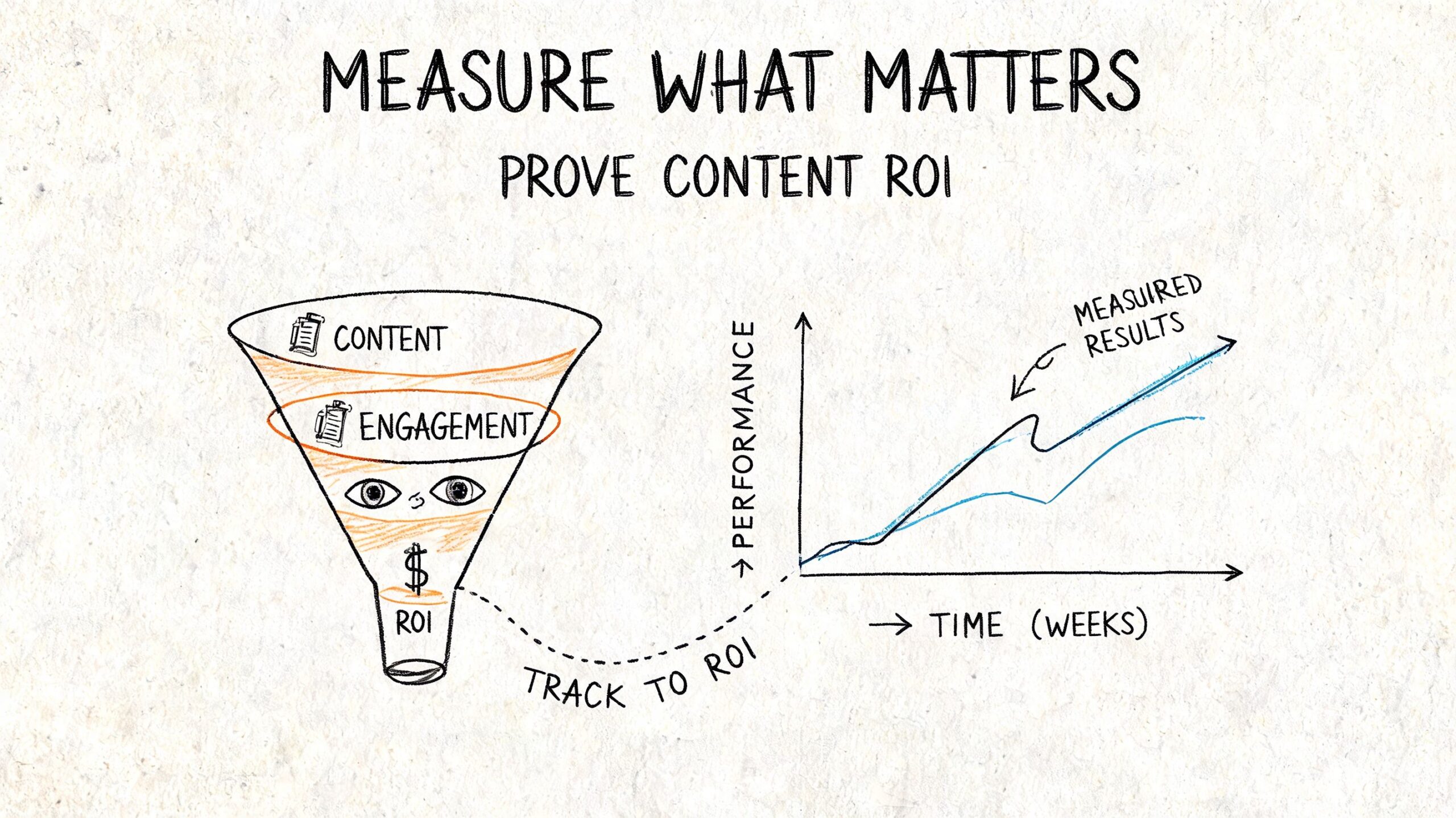
Disciplined startups can outperform larger teams by avoiding common pitfalls. 85% of B2B marketing leaders fail to connect content activities to measurable business outcomes, and 56% cite data quality and completeness as the primary obstacle, according to Technical.ly's breakdown of startup content marketing pitfalls. If you measure cleanly from the start, you don't just make better decisions. You create internal credibility.
Traffic is useful but it is not the scoreboard
Traffic matters because it shows whether distribution and SEO are working. It does not tell you whether the topic attracts the right people.
A startup should treat traffic as an input metric, not the final result.
If an article brings visitors who never subscribe, start a trial, request a demo, or assist a sales conversation, it may be winning in analytics and losing in the business.
That's why vanity metrics are dangerous. They reward broad topics, catchy headlines, and weak-fit visitors. Early-stage companies can't afford that distortion.
A simple startup measurement model
You don't need a giant attribution stack. You need a clean chain from content to commercial signal.
Track content using four levels:
Visibility
Search impressions, clicks, rankings, and referral visits. This tells you whether people can find the piece.Engagement quality
Scroll depth, time on page, CTA clicks, and return visits. This shows whether the content is doing its job once someone lands.Lead capture
Email signups, demo requests, free trial starts, or contact form submissions tied to the article.Pipeline influence
Whether the article appears in journeys that lead to opportunity creation or closed business.
A basic review table helps:
| Metric type | Ask this question | Keep or kill signal |
|---|---|---|
| Visibility | Is the article getting discovered? | If no, improve title, linking, and distribution |
| Engagement | Are readers consuming the core message? | If no, tighten intro and structure |
| Conversion | Does it create a next action? | If no, fix CTA and intent match |
| Influence | Does it show up in buyer journeys? | If no, topic may be attracting the wrong audience |
How to review content without fooling yourself
Set a review cadence and use the same questions every time.
Look for patterns such as:
- articles that rank but don't convert
- articles that convert but need stronger distribution
- topics that attract the wrong ICP
- clusters where one page performs and related pages lag behind
When you find a winner, don't celebrate and move on. Update it, link to it from newer articles, add FAQs from sales calls, and turn it into related assets. When you find a loser, be honest. Some topics are bad fits, even if they sound smart in strategy meetings.
Good measurement makes content less political. It shifts the conversation from opinions about what feels valuable to evidence about what moves buyers.
Scale Your Success with an Evergreen Content System
One-off campaigns create activity. Evergreen systems create compounding returns.
That's the shift most startups need to make after the first few wins. Stop thinking article by article. Start thinking in terms of assets that can be improved, linked together, repurposed, and redistributed without starting from zero every time.
According to Averi's guide to content marketing for startups, content marketing generates 3x more leads at 62% lower cost than traditional marketing, yet few teams build low-maintenance systems designed to keep paying off over time. The startups that do usually organize around pillars, clusters, refresh cycles, and reuse.
Build once improve repeatedly
An evergreen engine has a few characteristics:
- Pillar pages that cover a core topic in depth
- Cluster articles that address narrow variations, objections, and use cases
- Internal linking that moves readers and authority through the library
- Refresh routines so strong pages stay current
- Repurposing workflows that turn one article into email, sales enablement, and community posts
Automation earns its place. Not as a shortcut for replacing expertise, but as a system for reducing repetitive production work.
What the engine looks like in practice
A practical engine looks like this in operation:
A buyer question appears in sales calls. That question becomes a tightly scoped article. If the article performs, you build related pieces around adjacent pain points, comparisons, and implementation issues. Those pieces link together. The strongest page gets refreshed and redistributed. Over time, that cluster becomes the default resource center for a narrow problem your larger competitors still treat generically.
That's how content marketing for startups stops being a blog and starts becoming infrastructure.
If you want a practical way to run this playbook without hiring an agency or building a large in-house team, Agency Secrets is worth a look. It's built for operators who want better keyword targeting, stronger evergreen content, and a simpler path to sustainable organic growth.
Leave a Reply