
Law firms that invest in SEO see an average 526% return over three years, according to First Page Sage's law firm SEO statistics. That number changes the conversation. SEO for law firms isn't a branding exercise or a nice-to-have website project. It's a client acquisition system.
Most firm owners don't need another abstract marketing lecture. They need a practical way to turn search demand into consultations, signed matters, and a steadier pipeline of cases. That means focusing on the work that creates an advantage, ignoring vanity metrics, and treating your website like a business asset instead of an online brochure.
The firms that win in search usually don't win because they “do more marketing.” They win because they make better operational decisions. They target the right case types, publish the right pages, tighten their local visibility, and build trust in ways both Google and potential clients can verify.
Table of Contents
- Why SEO Is a Non-Negotiable Investment for Growth
- The Keyword Research Blueprint for Attracting Cases
- Building Your Digital Foundation with Local and Technical SEO
- Creating Content That Converts Visitors into Clients
- Building Authority with Backlinks Reviews and Directories
- Implementing E-E-A-T and Schema for Maximum Trust
- Your SEO Playbook Measuring Success and Optimizing for 2026
Why SEO Is a Non-Negotiable Investment for Growth
About 96% of people seeking legal advice use a search engine during their process. For a partner or small firm owner, that matters for one reason. Search visibility influences who reaches intake first, how many qualified consultations the firm books, and what it costs to win the next case.
The budget question is straightforward. Does SEO bring in profitable matters at a lower acquisition cost than referrals, PPC, or legal directories over a 12 to 36 month window? For many firms, it does. As noted earlier, law firm SEO can produce strong long-term returns, especially in practice areas where one retained client covers months of work.
The reason is simple. SEO compounds.
A paid campaign shuts off the day the spend stops. An optimized practice area page, a well-managed Google Business Profile, and earned authority from credible mentions can keep producing consultations long after the initial build. That changes the economics of growth. Instead of renting attention every month, the firm builds an asset that can lower cost per lead over time.
The business case is stronger than many partners assume
Clients do not search in marketing language. They search by problem, city, urgency, and confidence that the lawyer can handle the matter. If the firm is absent in those moments, intake volume shifts to another office.
That is why SEO belongs in the same conversation as hiring, intake performance, and practice area expansion. It affects revenue capacity. A family law firm trying to grow uncontested divorce work, or a business litigation firm targeting higher-value disputes, needs a reliable path to demand that is not dependent on personal referrals alone.
The strongest programs usually line up with four realities of legal demand:
- Timing matters: Search activity spikes when a legal issue becomes immediate.
- Local intent matters: Firms usually need visibility in specific cities, counties, or regions.
- Trust matters: Prospects compare attorney profiles, reviews, results, and page quality before they contact anyone.
- Economics matter: One retained matter can justify focused investment in a high-value practice area.
Practical rule: If a service line drives firm revenue, it deserves its own search plan, page set, and intake path.
What earns cases and what wastes budget
The firms that win from SEO usually do the unglamorous work consistently. They publish strong service pages, keep location signals accurate, improve site speed and mobile usability, and give prospects a clear path from search to consultation.
The firms that underperform usually have an execution problem, not a visibility problem alone. Common examples show up fast in an audit:
- Thin service pages: One broad page rarely ranks well or answers the concerns of a specific case type.
- Content without commercial intent: Articles that never connect to a practice area or consultation path consume time and produce little pipeline value.
- Reporting without accountability: Traffic charts do not help a partner decide where to put the next dollar. Signed cases, qualified leads, and cost per retained matter do.
- Stop-start investment: Firms that pause every few months reset momentum and extend the time to results.
The opportunity in seo for law firms is operational. Treat it as a growth system with owners, timelines, and revenue targets, and it becomes much easier to budget, delegate, and measure against actual firm goals.
The Keyword Research Blueprint for Attracting Cases
Most keyword research fails because firms start with traffic, not cases. A better approach starts with commercial intent. Ask a simpler question. What would someone type into Google right before they call a lawyer?
That's the center of your keyword strategy. Not every search deserves a page, and not every page deserves ongoing investment. A firm owner should separate terms that attract research-mode visitors from terms that signal hiring intent.

Think like intake, not like publishing
A useful analogy is the first consultation. Some callers want education. Others want representation now. Your keyword portfolio should reflect that difference.
“DUI penalties in Texas” is often an information query. “DUI defense lawyer Austin” is a buyer-intent query. Both can matter, but they shouldn't get equal weight. The second term usually deserves the stronger page, the stronger internal links, and the clearer call path.
Here's a practical matrix you can use.
| Intent Type | Example Keyword | Client Mindset | Content Goal |
|---|---|---|---|
| High intent | divorce lawyer near me | Ready to speak with counsel | Drive consultation request |
| Service specific | business litigation attorney Chicago | Comparing firms for a defined matter | Show fit, experience, next step |
| Problem aware | what to do after a truck accident | Concerned, gathering direction | Build trust and route to service page |
| Process aware | how long does probate take | Evaluating complexity and timing | Educate and introduce representation |
| Brand search | smith law criminal defense | Already knows your firm | Confirm trust and convert quickly |
Build a keyword portfolio by practice area
Don't build one giant list. Build small portfolios tied to revenue lines. If you handle personal injury, family law, and estate planning, each practice area should have its own set of primary and supporting terms.
Use this sort order:
Core money terms
These are your “hire a lawyer” phrases. They usually combine service plus geography, such as “estate planning attorney Denver.”Case-specific variants
These narrow the service into a matter type. Examples include custody disputes, wrongful death, or contract disputes.Question terms with commercial relevance
These support the main pages. Good examples are questions people ask before hiring, not broad legal trivia.Local modifiers
Add city, county, neighborhood, and “near me” intent where it matches your service footprint.
A good keyword list should tell you what pages to build next. If it doesn't, it's research without operational value.
What to prioritize first
If your time is limited, start with the pages most likely to turn into signed matters:
- Main practice area pages: One page per service line.
- Location pages: Only for places you actively serve.
- Urgent FAQ pages: Questions that surface right before contact.
- Attorney bio pages: Especially for branded and trust-driven searches.
What I usually advise against is chasing broad educational terms too early. They can help later, but they rarely carry the same immediate business value as high-intent local keywords.
A firm owner doesn't need a giant SEO spreadsheet. They need a short list of terms tied to revenue, matched to real pages, with a clear decision on which pages deserve the next round of investment.
Building Your Digital Foundation with Local and Technical SEO
Your site is your digital office. If it loads slowly, confuses visitors, or sends mixed location signals, you lose business before intake gets a chance. That's why the foundation matters more than most firms think.
Organic search drives 53% of all law firm traffic, 46% of Google searches have local intent, and a fully optimized Google Business Profile influences 32% of local map pack ranking potential, according to Grow Law's legal SEO statistics. For local legal work, your visibility in map results isn't secondary. It's part of your front door.

Treat your site like your front office
A partner wouldn't accept a receptionist who leaves callers on hold, gives inconsistent office information, and forgets to return messages. Yet many firm websites do the equivalent every day.
Start with the basics that affect search visibility and client experience:
- Mobile usability: Most prospects will first see your site on a phone. Buttons must be tappable, forms short, and phone numbers clickable.
- Page speed: Slow pages create drop-off before visitors even read the first paragraph.
- Site structure: Practice areas, attorney bios, locations, reviews, and contact paths should be easy to find.
- Technical hygiene: Broken pages, duplicate titles, and crawl confusion dilute performance.
The Core Web Vitals benchmarks often used for law firm sites are qualitative in practice even when the targets are technical. A good standard is to keep main content loading quickly, reduce layout shifts, and make forms responsive. Use PageSpeed Insights and Lighthouse to identify the pages where poor performance interferes with intake.
Own your local visibility
For many firms, local SEO is the most impactful part of seo for law firms. The map pack gets attention because it combines convenience, trust, and intent in one result.
Your Google Business Profile should be complete and actively managed. That includes accurate categories, office hours, contact details, service descriptions, photos, and regular updates. Just as important, the firm's name, address, and phone information should match across your website and major legal directories.
This is the type of video I'd want a law firm owner to watch before delegating local SEO, because it clarifies what matters operationally:
Fix the pages that quietly lose consultations
Not every technical issue deserves attention. Some are cosmetic. Others cost you leads. Focus on the pages where buyer intent is highest.
A useful review order looks like this:
Home page and top practice pages
Make sure they load cleanly, communicate location clearly, and show the next step without forcing visitors to hunt.Contact and consultation pages
Check form friction, mobile usability, and click-to-call visibility.Location pages
Each should include unique local relevance, not spun copy with swapped city names.Attorney bio pages
These often decide whether a prospect trusts the firm enough to call.
A slow practice area page is the online version of a locked office door.
A technically clean site doesn't win on its own. But without it, the rest of your SEO work gets harder, more expensive, and less reliable.
Creating Content That Converts Visitors into Clients
Content should do legal work. It should answer questions, reduce hesitation, show authority, and move a prospect toward contact. If it only fills space, it's overhead.
The structure and quality of content directly affect performance. Sites with proper heading structures can rank up to 38% higher, and pages featuring testimonials can see a 34% lift in conversions, as noted in the earlier local SEO research. That's the difference between content that sounds competent and content that helps generate matters.

Build practice area pages first
If I had to choose one content asset to get right for a law firm, it would be the practice area page. On these pages, search intent, trust, and conversion usually meet.
A strong practice area page should include:
- A direct opening: State what the firm handles and who it helps.
- A plain-English explanation: Describe the issue without legal padding.
- Common scenarios: Show the kinds of cases or matters the firm takes.
- Process clarity: Explain what happens next if the prospect contacts you.
- Trust proof: Attorney credentials, testimonials, representative outcomes if appropriate, and local relevance.
- Clear calls to action: Phone, form, consultation request, and next steps.
Many firms bury the answer under generic copy. Don't. Lead with the service, the geography, and the practical next move.
Clients don't read legal marketing the way lawyers write it. They scan for fit, risk, credibility, and what to do next.
Use supporting content to answer objections
Blog posts, FAQs, and guides aren't secondary when they serve a conversion role. They work best when they support a core service page and help a prospect get comfortable enough to reach out.
Examples of useful supporting content include:
- Decision-stage FAQs: “Do I need a lawyer for a first DUI offense?”
- Timeline content: “What happens after filing for divorce in [city]”
- Cost and expectation pages: Explain process and variables without promising outcomes.
- Evidence of experience: Articles tied to recurring case patterns, procedural issues, or common mistakes.
Heading structure matters. A page with logical H2s and H3s is easier for both search engines and visitors to process. It also forces clearer thinking. If a page can't be outlined well, it usually isn't answering the client's question thoroughly.
Content that sounds authoritative versus content that converts
These aren't always the same thing. Law firms often produce copy that sounds polished but avoids specificity. Prospects notice.
A better editorial standard is this:
| Weak content habit | Better approach |
|---|---|
| Broad claims about experience | Name practice focus, jurisdictions, and types of matters handled |
| Dense paragraphs | Break pages into scannable sections with clear headings |
| Generic reassurance | Use testimonials and practical process explanations |
| Vague calls to action | Ask for a consultation, case review, or phone call clearly |
The pages that convert well tend to feel calm, direct, and useful. They don't try to impress other lawyers. They help potential clients make a decision.
Building Authority with Backlinks Reviews and Directories
A law firm's reputation doesn't come only from its own website. Search engines look for external validation. Potential clients do too. That's why backlinks, reviews, and legal directory listings matter. They're the digital version of professional referrals and public credibility.
A lot of firms approach this backwards. They chase link volume, buy placement on junk sites, or treat reviews as something that “just happens.” That approach usually creates noise, not authority.
Backlinks are professional referrals in digital form
The best backlinks come from relevant, credible sources that make sense in a practical context. If a bar association resource page, local university program, legal publication, chamber of commerce site, or respected community organization mentions your firm, that's stronger than a pile of random directory links.
The practical ways to earn them are usually straightforward:
- Publish something worth citing: A thorough local guide, a plain-English explainer, or a resource page for a specific legal problem.
- Contribute expertise: Write guest commentary for local publications, legal associations, or business groups.
- Support community institutions: Sponsorships, scholarships, and event participation can create legitimate mention opportunities.
- Build professional relationships: Vendors, partner professionals, and local organizations often have sensible linking opportunities.
What doesn't work well is mass outreach with templated emails and generic “guest post” offers. Those campaigns waste time and often attract low-quality sites.
If a backlink wouldn't help your reputation offline, it probably won't help much online either.
Reviews and directory consistency shape trust
For local service firms, reviews often influence both rankings and conversion behavior. A prospect searching for legal help may compare only a few firms before deciding who gets the first call. Reviews can break that tie.
A good review process has three parts:
Ask consistently
Don't wait for perfect moments. Build review requests into closing, post-matter follow-up, or client care workflows.Respond professionally
Thank positive reviewers. Handle negative reviews carefully and ethically, without disclosing client details.Spread trust signals Keep profiles current on Google, Avvo, FindLaw, Justia, and other relevant directories where your market looks.
Directory work is rarely glamorous, but it cleans up trust signals. If your firm name, phone number, categories, or attorney details conflict across platforms, search engines and prospects both get mixed signals.
A practical standard for firm owners is simple. Keep one master record for core business information, update it everywhere, and review it on a recurring schedule. The firms that do this well don't obsess over every listing on the internet. They keep the important ones accurate and active.
Implementing E-E-A-T and Schema for Maximum Trust
E-E-A-T can sound abstract until you translate it into legal terms. Search engines want evidence that a firm has real experience, real expertise, recognized authority, and trustworthy presentation. In law, that's not a branding trick. It's your actual professional standing.
Schema solves a related problem. It helps search engines interpret who your attorneys are, what services you offer, where you operate, and how those entities connect.
Translate credentials into search signals
Most firms have stronger credibility than their websites show. Bar admissions, speaking engagements, publications, awards, clerkships, professional memberships, and case-specific experience often sit buried in PDFs or half-finished bio pages.
Bring those details into visible, structured page elements:
- Attorney bios: Include jurisdictions, practice concentration, education, associations, and published work.
- Firm pages: State service areas, office locations, contact details, and practice scope clearly.
- Editorial standards: Show who wrote or reviewed substantive legal content.
- Trust pages: Use testimonials, awards, and media mentions where ethically appropriate.
Legal search is high-trust search. A personal injury prospect, a business owner facing litigation, or a parent in a custody dispute isn't looking for “content.” They're looking for signs that the lawyer behind the page is real, qualified, and relevant to the problem.
Use schema to make your firm easier to understand
Implementing legal-specific schema can lift click-through rates by 20% to 30%, according to the D.C. Bar discussion of SEO fundamentals for lawyers. In practical terms, schema helps your firm earn richer search presentation and clearer local visibility.
For law firms, the most useful schema types are usually:
- Attorney schema: Connects individual lawyers to bios, practice areas, reviews, locations, and profiles.
- LegalService schema: Defines the services the firm provides.
- LocalBusiness schema: Reinforces location, hours, and contact information.
A sound implementation approach looks like this:
| Schema element | What it should clarify |
|---|---|
| Attorney | Who the lawyer is and what they handle |
| LegalService | Which legal services the firm offers |
| LocalBusiness | Where the office is and how to contact it |
| Review-related markup | What public trust signals are associated with the firm |
You don't need to turn this into a giant development project. JSON-LD is usually the cleanest format. Validate it with Google's Rich Results Test and inspect how search engines see the pages in Search Console.
Why E-E-A-T and schema work better together
E-E-A-T is the credibility layer humans and algorithms both care about. Schema is the structured language that makes that credibility easier to parse. One without the other leaves value on the table.
If your attorney bios are thin, your service pages generic, and your structured data absent, Google has to infer too much. If your credentials are clear and your schema is properly mapped, your firm becomes easier to classify, trust, and display.
That's the point. In seo for law firms, the firms that win trust usually make it easy to verify.
Your SEO Playbook Measuring Success and Optimizing for 2026
Law firm owners do not need more marketing reports. They need a short operating dashboard tied to consultations, signed cases, and practice areas that justify more investment.
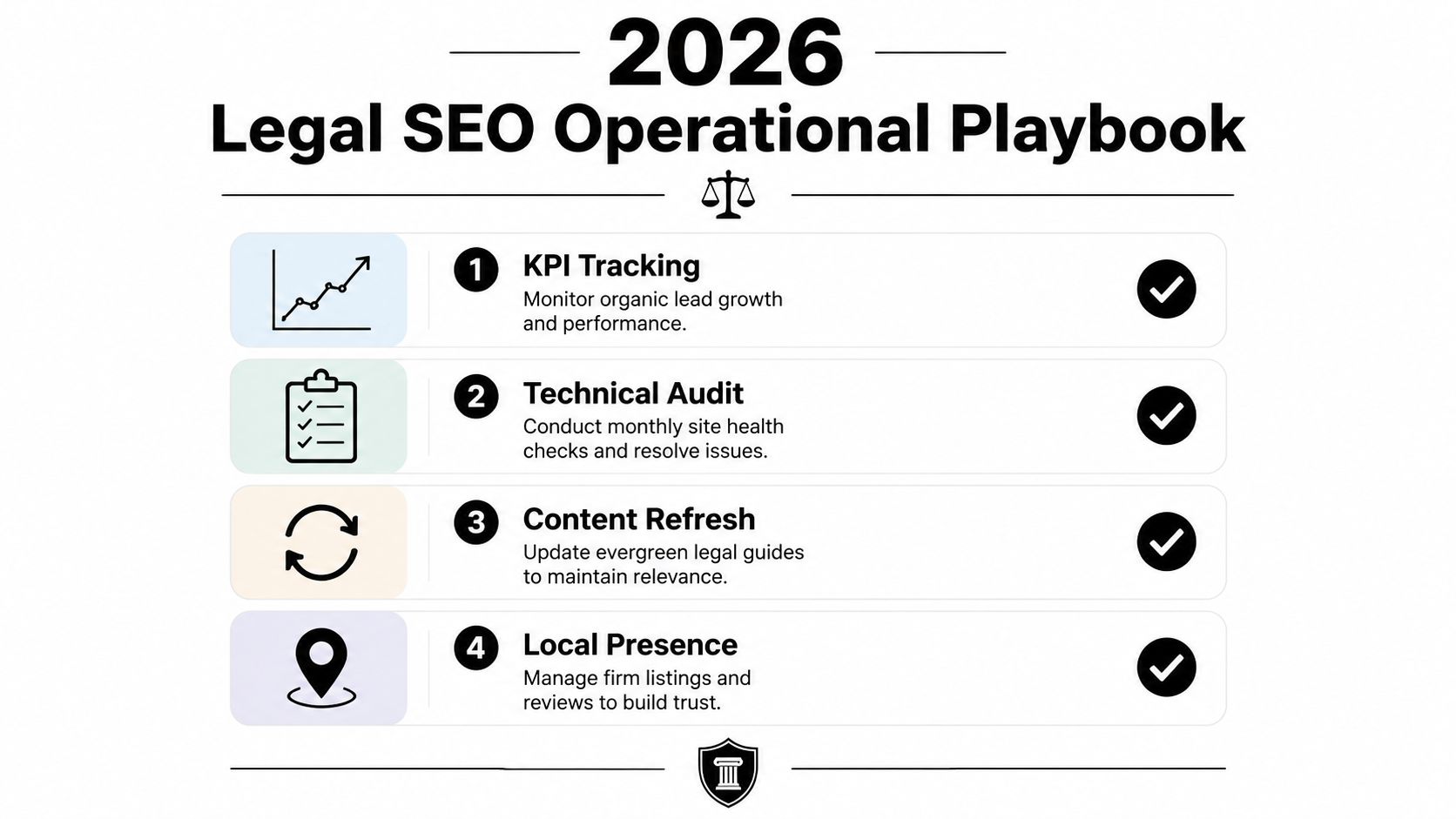
SEO usually pays off over time, not in a single quarter. Earlier benchmarks in this article showed a long break-even window for law firms, which is why the right management model rewards consistency, disciplined review, and better intake tracking instead of weekly reactions to ranking swings.
Measure the few numbers that matter
A useful dashboard for a managing partner or small firm owner should answer three business questions fast:
- Are qualified prospects finding the firm through search?
- Are those prospects booking consultations?
- Which practice areas are producing profitable cases from organic traffic?
Use Google Analytics, Google Search Console, call tracking, and your intake or CRM system to track:
Organic leads by practice area
Count phone calls, form fills, and consultation requests that came from organic search, then break them down by service line.Non-branded organic traffic
This shows whether your visibility is growing beyond people who already know the firm name.Buyer-intent rankings
Track terms tied to case demand, such as service-plus-location searches, instead of celebrating broad informational phrases that rarely produce signed matters.Page-level conversion behavior
Identify which pages produce calls and forms, and which ones lose attention before a prospect takes action.Signed matters from organic search
This is the metric that should influence budget decisions, even if attribution will never be perfect.
SEO reporting should support a decision. If it does not help you shift budget, fix a bottleneck, or expand a winning practice area, it is overhead.
Run a simple quarterly operating rhythm
Firms that get real ROI from SEO usually review it the same way they review referral sources or intake performance. On a schedule.
A practical quarterly review looks like this:
- Month one
- Check technical health: Review indexing, broken pages, mobile usability, page speed issues that affect conversions, and key contact paths.
- Review local presence: Update Google Business Profile, office details, and major legal directories.
- Month two
- Refresh high-value pages: Improve practice area pages, attorney bios, and location pages that attract traffic but underperform on leads.
- Strengthen internal links: Push authority toward the pages that generate consultations and signed cases.
- Month three
- Review lead quality: Compare organic inquiries against signed matters by practice area.
- Choose the next priorities: Expand what is producing profitable demand, cut low-value work, and assign resources based on case value, not traffic alone.
This cadence solves two common problems. Some firms ignore SEO until lead flow softens. Others spend too much time on minor edits that never change case volume.
What to prioritize for 2026
For 2026, keep the plan tight.
First, protect local visibility. Reviews, accurate office data, and strong map presence still influence who finds your firm and who gets the call. Second, improve the conversion performance of your core money pages before publishing more content. A stronger personal injury page in one city usually has more value than four weak blog posts. Third, make attorney credibility easy to verify with stronger bios, visible authorship, and structured data that supports what prospects already see on the page. Fourth, build content around direct, high-intent questions because search results are giving users faster answers and pushing firms to earn trust earlier in the click path.
The firms that win over the next cycle will usually be the ones with cleaner operations. Better intake attribution. Better service pages. Better review generation. Better follow-up on organic leads.
If you want seo for law firms to become predictable, manage it like a case pipeline. Define the matters you want, build pages that attract those searches, track what happens after the click, and improve the bottlenecks every quarter.
If you want a simpler way to execute this playbook without hiring an agency, Agency Secrets shows business owners how to handle keyword research, content, backlinks, and evergreen SEO systems in-house. It's a practical resource for operators who want more organic leads and less marketing overhead.
Leave a Reply