Tag: smb marketing

  • Keyword Research for Small Business: A Profit-First Guide

    Keyword Research for Small Business: A Profit-First Guide

    You've probably done some version of this already. You wrote a few blog posts, added service pages, maybe paid for a keyword tool, and watched impressions or visits creep up. Then you checked the numbers that matter: calls, quote requests, booked jobs, product sales, and the lift wasn't there.

    That's the trap.

    Most small businesses don't fail at SEO because they ignore keyword research for small business. They fail because they pick keywords like a publisher chasing pageviews instead of an owner chasing profit. They go after broad phrases, celebrate traffic, and end up attracting people who were never going to buy.

    A small business doesn't need more random visitors. It needs the right searches from the right people at the right moment. That changes how you build your keyword list, how you judge opportunities, and what you publish first.

    Table of Contents

    Stop Chasing Traffic and Start Winning Customers

    Much SEO advice pushes small businesses toward the wrong scoreboard. It tells you to find high-volume terms, publish more content, and grow traffic. That sounds sensible until you realize traffic can rise while revenue stays flat.

    A man in a suit holding a small bucket while standing before a large, cascading waterfall.

    Traffic can hide a bad strategy

    A local service business can rank for broad, educational terms and still struggle to get leads. An online store can publish top-of-funnel guides that bring readers who are curious, not ready. A clinic can attract people researching symptoms while missing the searches from people looking to book.

    That's why raw traffic is a vanity metric unless it connects to a business outcome.

    The better question is simple: does this keyword bring someone who is likely to call, book, request a quote, start a cart, or compare providers seriously?

    Practical rule: If a keyword doesn't align with a service, product, or profitable next step, it belongs lower on the list, no matter how attractive the volume looks.

    Small businesses usually waste time here. They target broad words because the numbers feel bigger. But bigger isn't better if the searcher's intent is vague.

    Profit-first keywords change the game

    The strongest keyword research for small business starts with buying signals, not ego. Long-tail keywords are where this becomes obvious. According to AIOSEO's analysis of keyword research for small businesses, long-tail keywords typically have 3 to 5 or more words, can convert up to 2.5 times better than short-tail terms, and account for approximately 70% of all search traffic.

    That matters because long-tail searches usually reveal what the person wants. “Plumber” is broad. “Emergency hot water heater repair Denver” is specific, urgent, and commercial. One keyword inflates your impression count. The other can bring a customer.

    A profit-first approach changes your filter:

    • Choose buyer language: Use phrases that signal need, urgency, comparison, or action.
    • Ignore vanity volume: A keyword with lower volume can still be the better business asset if the searcher is ready.
    • Tie SEO to money pages: Prioritize terms that map to services, product collections, category pages, or quote pages.
    • Accept smaller audiences: A smaller search pool with clear intent often beats a large pool with mixed motives.

    The right ten keywords can outperform a giant list of weak ones because they attract people who want help now, not someday.

    Uncovering Keywords by Thinking Like a Customer

    A homeowner wakes up to a leaking water heater, grabs a phone, and searches the way stressed people search. Fast. They do not care what you call the service internally. They care about the problem, the cost, how soon you can help, and whether you serve their area.

    That is the starting point for useful keyword discovery.

    Small business owners often begin with a service list. That creates tidy spreadsheets, but it misses the language customers use when they are ready to act. Profit-first keyword research starts closer to the sale. Pull terms from the moments when real buyers ask for help.

    Mine the words customers already use

    Your best keyword source is usually sitting in plain sight. Check contact form submissions, call transcripts, live chat logs, estimate requests, emails, reviews, and sales notes. Those phrases come from people with a real need, which makes them far more useful than a generic brainstorm.

    Look for patterns like these:

    • Problem language: “water heater leaking,” “toilet won't stop running,” “drain backing up”
    • Urgency language: “same day,” “emergency,” “open now,” “after hours”
    • Cost language: “how much,” “quote,” “price,” “cost to replace”
    • Location language: neighborhood names, city names, “near me”

    Write them down exactly as customers say them.

    Do not rewrite “hot water tank busted” into a cleaner industry term just because it sounds better on a service menu. Searchers rarely use your polished internal wording. They use the words they would say on the phone when they need a fix today.

    A simple process works well. Review the last 20 to 30 customer conversations, highlight repeated phrases, and group them by theme. You are not trying to build a master keyword file yet. You are trying to catch buying language before it gets buried under SEO jargon.

    Study direct competitors without copying them

    Competitor research is useful when you treat it as pattern spotting, not imitation. Pick 2 or 3 businesses that target the same customers, then search your core services and open the pages that appear again and again.

    Check for specifics:

    • Which services have their own pages
    • Which words show up in title tags and headings
    • Which city or neighborhood modifiers they use
    • Which customer questions they answer on service pages
    • Which profitable services are missing or poorly covered

    This part matters because competitors often reveal what the market already responds to. If every strong local player has dedicated pages for emergency repair, same-day service, and water heater replacement, that is a signal. If none of them have a focused page for a higher-margin service you offer, that gap may deserve attention before you chase broader terms.

    Use their coverage to sharpen your list. Do not copy their wording line by line. You want market clues, not duplicate pages.

    Customers search for the outcome they want, the problem they have, or the urgency they feel.

    Use Google's results pages as free keyword research

    Good early-stage keyword research does not require expensive software. Google gives small businesses enough raw material to build a solid starting list if you know where to look.

    Type a service into search and pay attention before you even hit enter. Autocomplete shows common phrasing. After that, scan the results page for useful variations and intent clues:

    • People Also Ask: question-based searches and objections
    • Related searches: modifiers, alternatives, and adjacent needs
    • Titles of ranking pages: common wording that matches demand
    • Local pack listings: city and service combinations Google keeps surfacing

    For a local service business, searches like these usually expose strong variations:

    1. Core service plus city
      “water heater repair denver”

    2. Problem plus urgency
      “emergency plumber for burst pipe”

    3. Service plus qualifier
      “best drain cleaning near me”

    4. Cost question
      “cost to replace water heater”

    The goal here is not to collect hundreds of phrases. A bloated list makes prioritization harder, especially for a small business with limited time and budget. Build a short list of terms tied to real customer language, clear problems, and services you want to sell more of.

    That gives you a keyword pool with a much better chance of producing revenue, not just traffic.

    Qualifying Keywords A Simple Vetting Process

    A raw keyword list is noisy. Some phrases fit your business perfectly. Others look promising but attract the wrong audience. The fastest way to clean the list is to run every keyword through three filters: relevance, intent, and competition.

    A hand holds a sieve filtering gold nuggets labeled relevance, intent, and competition from small stones.

    Relevance comes first

    This is the filter that is frequently skipped.

    A keyword can have decent search volume and still be a bad target if it doesn't connect to a core service, profitable product line, or meaningful next step. Relevance asks one blunt question: if someone lands on your site from this term, can you serve them well and profitably?

    For a plumber, “how does a water heater work” may be loosely related. “water heater replacement near me” is directly relevant. One searcher wants education. The other may want a job booked.

    Use this quick relevance check:

    • High relevance: directly tied to a service or product you want more of
    • Medium relevance: adjacent topic that supports a buying journey
    • Low relevance: loosely related, broad, or unlikely to create business value

    If relevance is low, discard it. Don't rescue weak keywords with hope.

    Intent tells you who is close to buying

    Intent is where keyword research for small business stops being academic and starts getting useful. The same topic can produce very different searchers.

    The four intent types are simple in practice:

    Intent type What the searcher wants Common modifiers
    Informational Learn or understand how, why, guide, tips
    Navigational Find a brand or website brand names, login, company names
    Commercial Compare options before acting best, top, vs, review
    Transactional Take action now buy, quote, near me, book, repair

    Commercial and transactional terms usually deserve first attention because they're closer to revenue. Informational terms still matter, but they work best when they support a core service or product path.

    Working test: Search the keyword in Google. If the results are mostly service pages, product pages, or comparison pages, the intent is probably valuable. If the results are mostly general blog posts, the keyword is likely earlier-stage.

    Competition decides whether the keyword is worth your effort

    Plenty of small businesses choose the right intent and still lose because they chase terms that are too competitive for their current site.

    Search volume and difficulty become useful at this stage. According to Macmillan Design's guide to keyword research for small businesses, keywords balancing 100 to 1,000 monthly searches and difficulty scores under 40 offer the highest ranking success rates for small businesses, up to 60% higher than high-competition terms.

    That's a practical benchmark, not a law. But it's a strong default if you don't have a large site, a powerful backlink profile, or a big content budget.

    Use free or entry-level tools like Google Keyword Planner or Ubersuggest to sense-check demand and competition. Then ask:

    • Can I publish a better page than what's ranking?
    • Does this keyword fit a page that could generate revenue?
    • Is the competition realistic for my site today, not in theory?

    A keyword with modest volume and manageable difficulty often beats a glamorous term dominated by strong sites. Small businesses win by being precise, not by picking fights they can't finish.

    The Profit Priority Matrix Which Keywords to Target First

    Once you've qualified your list, the next problem appears fast. You still can't do everything.

    A small business needs a ranking system that answers one practical question: what gets worked on first? The cleanest way to do that is a simple matrix using two axes, commercial intent and competition.

    How to place a keyword in the matrix

    Take each qualified keyword and ask two questions.

    First, how likely is this searcher to become a lead or sale if they land on the right page?

    Second, how realistic is it for your site to compete for that term in the near term?

    That creates four buckets.

    Quadrant Keyword Profile Strategic Action
    Quick Wins High intent, low competition Build or optimize these first. They have the fastest path to leads.
    Core Targets High intent, high competition Keep these in your plan, but support them with stronger pages, internal links, and related content over time.
    Content Plays Low intent, low competition Use selectively for trust-building and supporting the buyer journey.
    Avoid Low intent, high competition Skip these unless they serve a very specific strategic purpose.

    This matrix keeps you from treating every keyword as equally valuable. They aren't.

    What to do in each quadrant

    Quick Wins are your best first moves. Think local service terms, product-specific modifiers, or urgent problem phrases with clear buying intent. If you only have a few hours each week, spend them here first.

    Core Targets matter, but they need patience. These are often broader service phrases or stronger commercial terms that bigger sites also want. They deserve a page, but not at the expense of easier revenue opportunities.

    Content Plays can still be useful when they support a sale. A cost question, comparison query, or common objection can help someone move toward action if you connect it to your service or product naturally.

    Avoid is the quadrant where time disappears. Broad educational phrases with heavy competition often look attractive because they seem important. For many small businesses, they create work without creating pipeline.

    Here's a fast example for a local plumbing company:

    • Quick Win: “emergency water heater repair denver”
    • Core Target: “plumber denver”
    • Content Play: “cost to replace a water heater”
    • Avoid: broad DIY queries unrelated to booked work

    Pick the keywords that can pay you back soonest. Authority grows faster when early pages bring real business results.

    The matrix also keeps your content mix honest. You can still publish informational pieces, but they stop taking over the strategy. Revenue-led pages stay at the center.

    Turning Keywords into Content and Conversions

    Keywords don't make money by sitting in a spreadsheet. They need a destination, a page built for the right searcher, with the right message, and a clear next step.
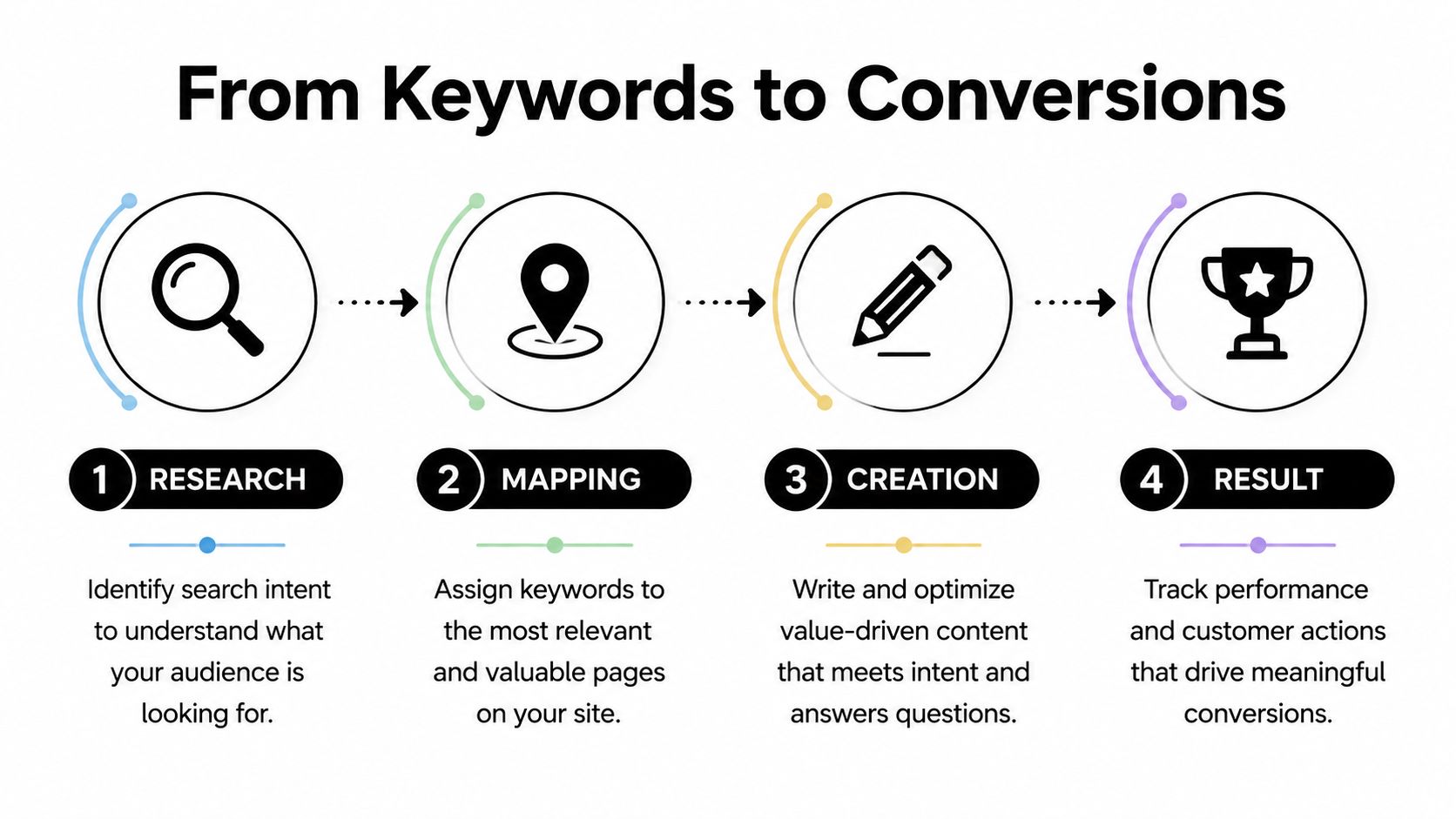
    A four-step infographic illustrating the process from keyword research to achieving website conversions.

    Match page type to search intent

    Many small businesses leak value during this stage of the process. They find a strong transactional keyword, then target it with a blog post. Or they chase an informational query with a thin service page. The mismatch weakens rankings and conversions.

    Use this mapping instead:

    • Transactional keywords belong on service pages, product pages, collection pages, or booking pages.
    • Commercial keywords often fit comparison pages, buyer guides, or tightly written landing pages.
    • Informational keywords belong on blog posts, FAQs, and resource pages that support the sales path.
    • Navigational keywords usually belong to brand and core site architecture, not campaign content.

    For example, “emergency plumbing repair near me” should point to a conversion-focused service page. “Water heater repair cost” can support that page as an informational article that answers a common buying question and links naturally into the service page.

    Use clusters to build authority around buying topics

    A single isolated page rarely does enough. Small businesses get better traction when they group related keywords under a parent topic and build a small content silo.

    According to Leadpages' keyword research guidance for small businesses, small businesses applying keyword clustering see 3.2x faster ranking, often under 90 days, and 25% to 40% traffic growth in 6 months. The same source notes that clustering related terms such as “emergency plumber” and “24/7 hot water repair” helps build topical authority.

    That matters because Google doesn't just evaluate a single page in isolation. It looks at whether your site shows depth around a topic. A cluster helps you send that signal without producing random content.

    A practical cluster for a local plumber could look like this:

    • Primary service page: emergency plumber in your city
    • Supporting service page: water heater repair
    • Support article: signs your water heater needs repair
    • Support article: repair vs replacement questions
    • FAQ page: after-hours plumbing questions

    The key is focus. Don't build clusters around anything vaguely related to your industry. Build them around topics that connect back to booked work or sales.

    A simple content map for a small business website

    If you want keyword research for small business to stay manageable, map each target phrase to one page and one goal.

    Here's a practical model:

    1. Homepage
      Use a broad brand and category signal. Keep the messaging clear about who you help and where.

    2. Core service or product pages
      Target your highest-intent priority keywords. These pages should answer the main need quickly and make the next action obvious.

    3. Supporting pages
      Build out related commercial terms, niche services, and local variations where relevant.

    4. Blog and FAQ content
      Cover objections, cost questions, comparisons, and educational queries that help the buyer move forward.

    A useful internal rule is simple. If a keyword signals action, send it to a money page. If it signals research, support the money page with content that earns trust and links inward.

    Done well, this turns SEO into a system. Keywords feed pages. Pages feed leads. New customer questions feed the next round of content.

    Your First 90 Days of Keyword-Driven Growth

    A small business owner blocks off a Saturday to “work on SEO,” opens a keyword tool, and ends the day with a spreadsheet full of terms that will never produce a sale. Ninety days later, nothing has changed because the work was aimed at traffic instead of revenue.

    The first 90 days should do one job. Prove that keyword research can turn into leads, booked calls, and sales without draining your time or budget.

    A practical 90-day plan

    Start with five keywords, not fifty.

    Use the research and vetting process above to choose your top five Quick Win opportunities. Keep the filter tight. Each one should match a real service or product, show clear buying intent or strong pre-buying intent, and be realistic for your site to compete on. If a keyword looks attractive in a tool but has weak commercial value, leave it alone.

    Next, build or improve one page for each keyword. Put your best effort into a small set of pages instead of publishing a pile of thin content. Transactional terms belong on service or product pages. Research-driven terms belong on support content that helps the buyer make a decision and pushes them toward the right money page.

    Then measure outcomes that matter to the business. Rankings are useful feedback, but they are not the scorecard. Watch calls, form submissions, quote requests, booked appointments, demo requests, and sales tied to those pages.

    A simple operating loop keeps this manageable:

    • Research gives you the language buyers use
    • Focused pages capture high-intent searches
    • Sales calls, emails, and customer questions reveal new keyword opportunities
    • Those opportunities shape the next batch of pages

    That cycle is how a small company builds search growth on a limited budget. It stays practical because every step connects back to profit.

    What success should look like

    In the first 90 days, success looks like traction, not volume.

    A few pages that attract the right visitors and produce action are worth far more than a large blog archive that brings in the wrong audience. I would rather see a local service business publish three pages that generate quote requests than thirty articles that never influence a sale.

    A small site grows faster when every page has a job.

    Once the first pages start producing qualified leads, the next decisions get easier. Expand into the next tier of Core Targets. Build a tighter cluster around the service that is already converting. Fix pages that attract visits but fail to produce calls or inquiries. In practice, that usually means the keyword was weak, the page intent was mismatched, or the offer was not clear enough.

    That is the profit-first version of SEO. You stop asking what might bring more traffic and start asking which keyword has the best chance of producing business value next.

    Building a keyword-driven growth engine works because it compounds over time. If you want a faster, agency-free way to put this process into practice, Agency Secrets is built for that job. It shows small business owners how to find buyer-intent keywords, publish useful content, build authority, and turn SEO into a repeatable growth channel without hiring an expensive consultant or assembling a large team.
  • Long Form Content: The SMB Guide to SEO Dominance

    Long Form Content: The SMB Guide to SEO Dominance

    Long form content gets an average of 77.2% more links than short articles. That single number should change how most small businesses think about SEO.

    If you're still publishing thin blog posts because they feel easier to produce, you're choosing the hardest path to growth. Bigger competitors already have stronger domains, larger teams, and more brand recognition. You won't beat them by publishing more noise. You beat them by publishing assets that deserve rankings, links, and leads.

    Long form content works because it gives Google and real buyers what short posts usually don't: complete answers, clear structure, strong internal links, and enough depth to signal authority. For a small business, that's not a branding exercise. It's a distribution strategy. One strong long form system can compound for months without paying an agency, funding nonstop ads, or hiring a full editorial team.

    Table of Contents

    What Is Long Form Content and Why It’s Your SEO Secret Weapon

    Articles in the top results are often long for a reason. Backlinko’s analysis of Google search results found that the average first-page result contains 1,447 words. That does not mean you should chase a word count target. It means search winners usually cover the topic with enough depth to satisfy the search.

    Long form content is a page built to finish the job. It answers the core question, handles the obvious follow-up questions, addresses objections, and gives the reader a clear next step. For an SMB, that could be a service page, buyer’s guide, comparison post, or pillar article. The format matters less than the outcome. The page should reduce uncertainty and move a prospect closer to action.

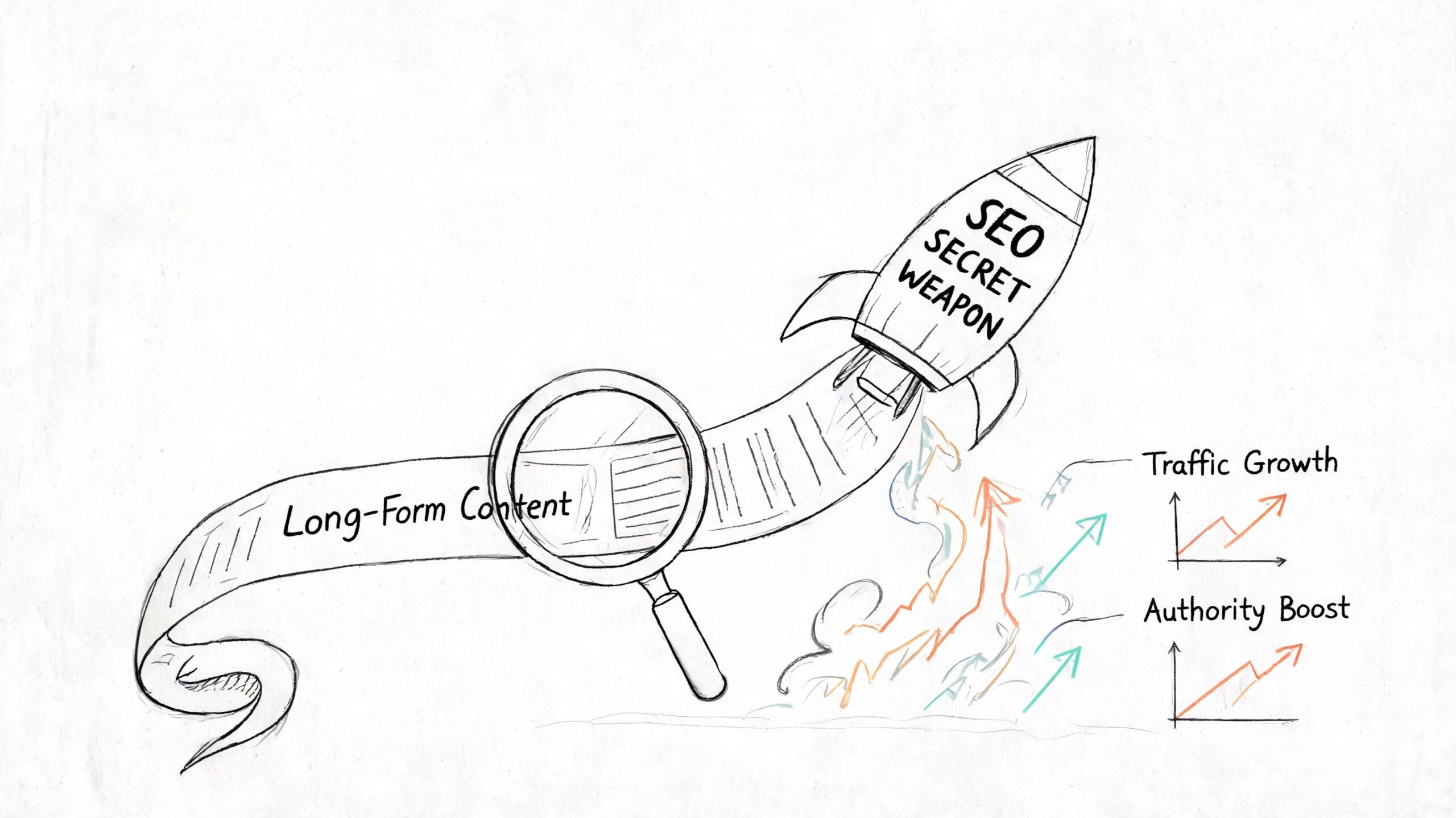
    A hand-drawn illustration showing a rocket labeled SEO Secret Weapon launching from long-form content.

    That is why long form content works so well for SEO. Google rewards pages that solve the search, not pages that hit a cute word count. Readers reward pages that save them another 10 tabs.

    Short posts usually miss on both fronts.

    Why short posts keep losing

    A 600-word post can work for a narrow query. It fails for anything tied to evaluation, comparison, pricing, implementation, or trust. Those searches need substance. If your page only scratches the surface, readers bounce and keep looking.

    Short posts also create an efficiency problem for small teams. You publish more often, but each post has less ranking range, fewer internal link opportunities, and less chance of becoming the page people reference, bookmark, or share. You stay busy without building an asset base.

    Here’s the practical filter:

    • Use short content for updates, announcements, single-answer FAQs, and support docs.
    • Use long form content for topics that influence revenue, require trust, or involve multiple decision points.
    • Prioritize depth anywhere a prospect is comparing options, costs, timelines, risks, or providers.

    If a topic can help someone choose whether to buy, hire, book, or request a quote, give it a serious page.

    Why this matters more for SMBs than big brands

    Big companies can afford wasted content. Small businesses cannot. You need every article to do more than fill a calendar slot. It should rank, support sales, answer repeated customer questions, and create material you can reuse in email, social, and sales conversations.

    That is the genuine advantage of long form content for SMBs. One strong article can become a working asset. Ten strong articles built from the same system can become a lead engine.

    Smaller teams can beat bigger competitors through this approach. You are closer to customer pain points. You hear the same objections on calls. You know what buyers ask before they commit. Put that knowledge into structured long form pages and you can publish content that is sharper than the bland, committee-written pieces larger brands push out.

    The win does not come from writing one heroic 3,000-word article. It comes from building a repeatable system to produce useful long form content every month. That is exactly why tools like OutRank matter for resource-strapped teams. They help you research faster, organize content around real search demand, and keep publishing without hiring an agency or stalling out after three posts.

    Long form content is not a writing style. It is a production model for turning what your business already knows into search traffic, trust, and qualified leads.

    Building Your Strategic Foundation with Topic Clusters

    If you publish random long articles, you'll get random results. You need a structure that tells Google what your site is about and helps readers move from one question to the next.

    That structure is the topic cluster.

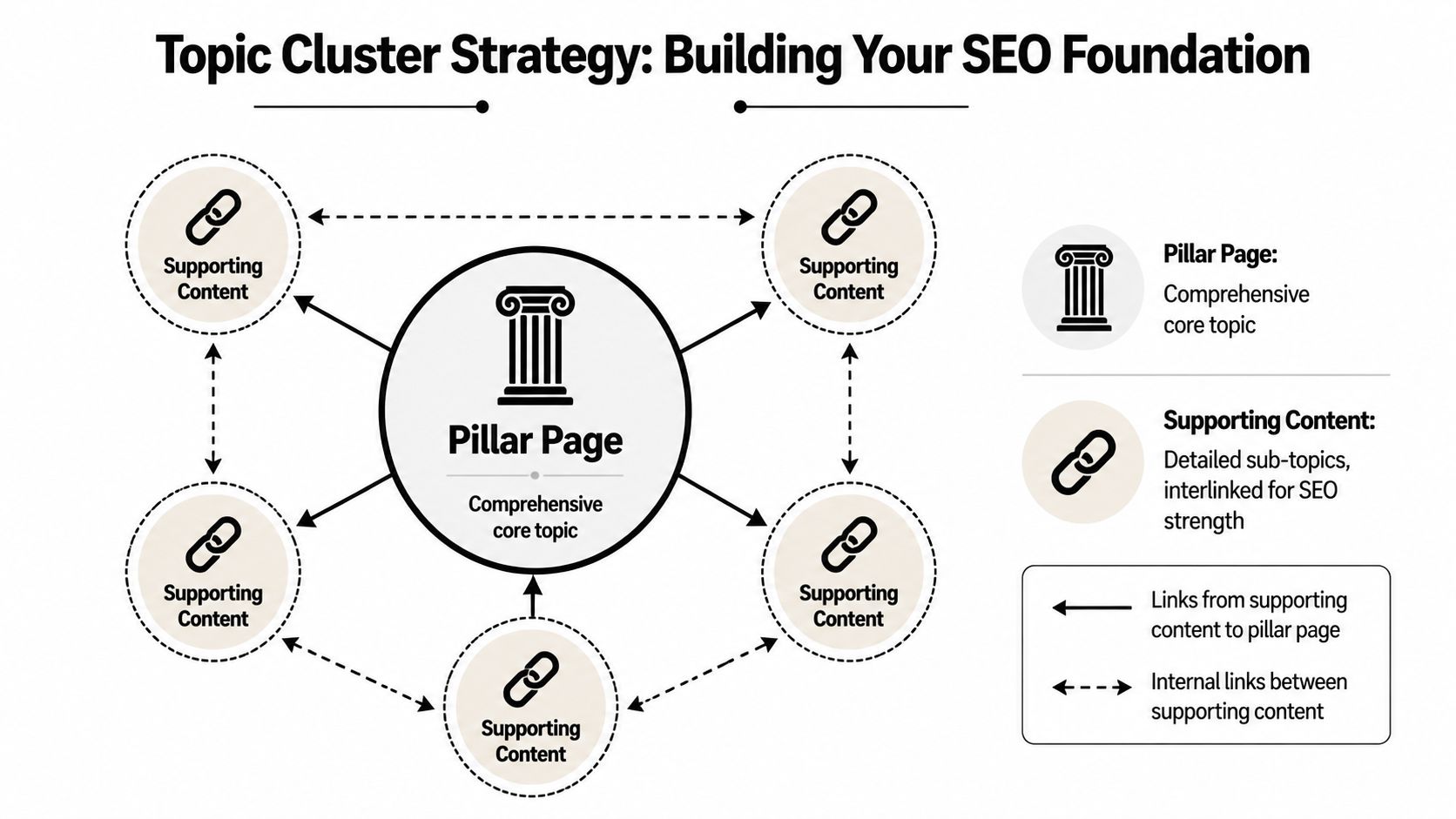
    A diagram illustrating the SEO topic cluster strategy featuring a central pillar page and supporting content pieces.

    Think like a library, not a blog

    A good cluster works like a small reference library. The pillar page is the main book on the shelf. It covers the broad subject in an all-encompassing way. The supporting articles are the specialist volumes. Each one expands a subtopic and links back to the pillar and to related pages.

    That internal structure matters. Search Engine Land’s guide to longform content notes that pillar pages of 2,000 to 5,000 words linking to 10 to 20 supporting articles can yield 40 to 50% higher domain authority scores. That's the kind of advantage small businesses need because it lets one focused content system do more work than disconnected posts ever can.

    Later in the section, watch this breakdown if you want a visual explanation of how clusters support SEO performance.

    What a usable cluster looks like

    Let's say you run a local dental clinic. Don't publish one article on “teeth whitening tips” and call it content strategy. Build a pillar around a broader commercial theme such as cosmetic dentistry or teeth whitening treatments. Then support it with articles that answer the decision-level questions buyers ask.

    A practical cluster might include:

    • Core pillar page: Your complete guide to teeth whitening options, candidates, risks, maintenance, and booking considerations.
    • Comparison article: In-office whitening versus take-home kits.
    • Concern-driven article: How long whitening results last.
    • Local intent article: What to ask a clinic before booking treatment in your city.
    • Eligibility article: Whether whitening works for stains, crowns, or sensitive teeth.

    A cluster gives Google context and gives buyers a path. Both matter.

    Many SMBs overcomplicate things. You don't need fifty topics. You need a few revenue-connected themes and the discipline to build depth around each one.

    Start with buyer intent. Pick topics tied to services, categories, or repeated sales questions. Then map the cluster before writing anything. When every article has a job, content stops feeling like a guessing game and starts behaving like infrastructure.

    The Anatomy of a Perfect Long Form Article

    Google’s first-page results average 1,447 words, according to Backlinko research cited in Network Solutions’ overview of long-form content. That number matters for one reason. Winning pages usually cover the topic with enough depth to satisfy the searcher and move them toward a decision.

    For an SMB, that changes how you should write. Stop treating long form content like a school assignment. Build each article like a sales asset you can repeat, templatize, and publish at scale with a tool like OutRank.

    A strong long form article does four jobs. It answers the core question fast, organizes the topic into clear decision points, proves credibility, and gives the reader a next step.

    Start with the answer

    Business owners often waste the first 200 words on scene-setting. That hurts rankings and conversions.

    Lead with the direct answer. If the search is “how long does commercial epoxy flooring last,” open with the actual range, then explain what changes the outcome. After that, break down traffic level, installation quality, maintenance, cost tradeoffs, and replacement timing.

    Your introduction should handle three things immediately:

    1. Confirm the reader is in the right place
    2. Give the short answer in plain language
    3. Show what the article will help them decide

    That structure improves engagement because the visitor gets value before they commit to reading the full page.

    Build the article around decision points

    Good long form content is structured around the questions a buyer asks before taking action. That is what keeps the article useful instead of bloated.

    Use sections that match real intent:

    • Definition or quick answer: What it is, who it is for, or the short verdict
    • Key variables: What affects the result, price, timeline, or outcome
    • Comparisons: Option A versus Option B
    • Common mistakes: What buyers get wrong
    • Proof and evidence: Experience, examples, specifications, cited sources
    • Next step: What to do now

    This is the difference between a page that ranks and a page that helps sell. For SMBs producing content consistently, this structure also gives you a repeatable template. You do not need to reinvent the article format every time. OutRank or a similar workflow can speed up drafting, but the underlying structure still needs to be sound.

    Format for skimming

    Readers scan first. If your page looks heavy, they leave before your best point shows up.

    Use formatting that makes the article easy to move through:

    • Clear H2 and H3 headings built from real sub-questions
    • Short paragraphs that keep one idea per block
    • Bullets and numbered lists for steps, comparisons, and checklists
    • Tables when the reader needs to compare options quickly
    • Trust signals such as firsthand experience, product details, expert input, and cited sources

    Put the strongest information high on the page and make it easy to spot. Summaries, subheads, and clean visual flow improve usability. They also make your content easier to scale because every article follows the same reading pattern.

    Long Form Content Best Practices Checklist

    Element Best Practice Why It Matters
    Headline Promise a clear outcome or answer Improves relevance and qualifies the click
    Introduction Answer the main query in the opening lines Reduces bounce and sets expectations fast
    Structure Use H2s and H3s based on sub-questions Makes the page easier to scan and understand
    Paragraphs Keep them short and focused Improves readability on desktop and mobile
    Evidence Use cited studies, product details, and real expertise Builds credibility and supports E-E-A-T
    Internal linking Link to related supporting pages naturally Strengthens topical relevance and supports deeper journeys
    Visual flow Break up text with bullets, tables, and callouts Helps scanners find useful information quickly
    Conclusion End with a decision, summary, or next step Turns attention into action

    One more rule. Every section must earn its place.

    Do not pad the article to hit an arbitrary word count. Do not repeat the same point in three different headings. Do not add generic FAQ fluff if it does not help the buyer decide. The best long form content feels complete because it is tightly organized, easy to scan, and built from a system your business can repeat every month.

    Your Scalable Workflow for Publishing High-Impact Content

    One excellent article won't change your business. A repeatable publishing system might.

    That's the difference between content as a project and content as a growth engine.

    Amra & Elma’s roundup of long-form marketing statistics says that by 2026, 61% of marketing strategies incorporate long-form content, up from 42% in 2023, and 74% of marketers rank long-form blogging as the top-performing format for lead generation. Treat that as a projection and a warning. If you wait until everyone around you has built a content engine, you'll be catching up from behind.

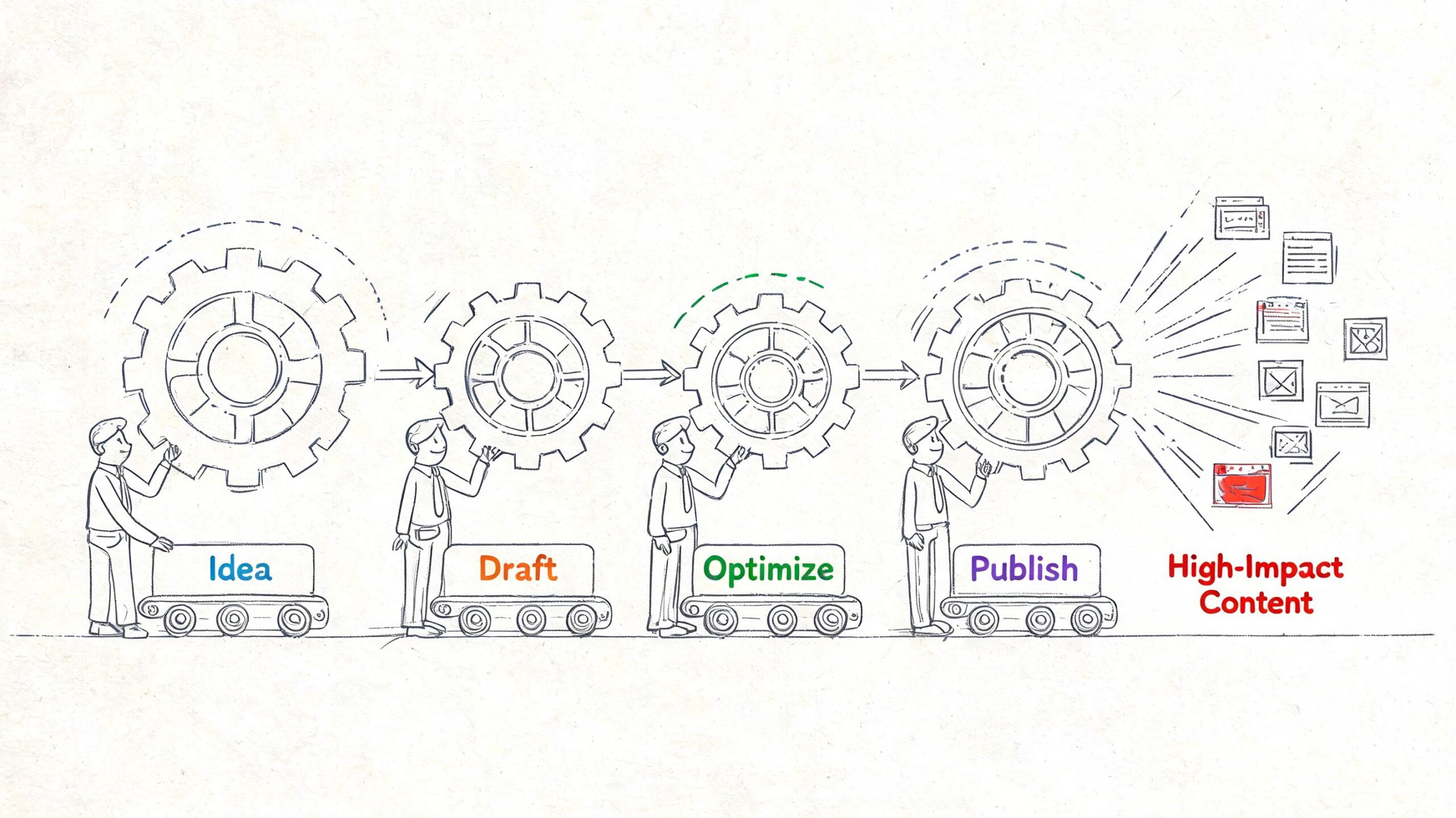
    An illustration showing a four-step content production process from idea generation to publishing high-impact content.

    The workflow that keeps you consistent

    A practical SMB workflow doesn't need a newsroom. It needs a sequence you can repeat without burning out.

    Here's the model I recommend:

    1. Choose one commercial theme

      Start with a service line, product category, or problem tied to revenue. Ignore vanity topics unless they support a money page.

    2. Build a content map

      Create one pillar topic and a list of supporting article angles. This removes guesswork before writing starts.

    3. Outline before drafting

      Your outline should include the primary question, major sub-questions, internal links to add, and the action you want the reader to take.

    4. Draft fast, edit hard

      Don't write and edit at the same time. Get the substance down, then tighten the structure, examples, and readability.

    5. Publish and interlink immediately

      New pages should connect to relevant existing pages on day one. A lonely post is wasted effort.

    Where automation actually helps

    Most founders don't fail because they lack ideas. They fail because the process is too heavy to sustain. Keyword research takes time. Outlining takes time. Drafting takes time. Publishing takes time. Link building takes time.

    Tools like OutRank become useful. Not because software replaces judgment, but because it removes repetitive work. If the platform can handle keyword discovery, draft generation, publishing support, competitor analysis, and backlink workflows, a small team can maintain output without turning content into a full-time internal job.

    Use automation for the repeatable parts:

    • Research support: Surface keyword opportunities and related subtopics.
    • Production speed: Generate structured drafts faster than starting from a blank page.
    • Publishing rhythm: Keep articles moving instead of leaving them stuck in a backlog.
    • Cluster expansion: Turn one strong topic into a planned series, not a one-off post.

    The real win isn't writing faster. It's publishing consistently enough that your site becomes difficult to ignore.

    If you're resource-strapped, that's the entire game. Not perfection. Not endless polishing. A reliable system that keeps producing strong long form content month after month.

    From Post to Powerhouse Repurposing Your Content

    Most businesses publish a long article, share it once, and abandon it. That's wasteful.

    A strong article should feed your email, social, sales enablement, and short-form content for weeks. Long form content is expensive in attention. Squeeze everything out of it.

    Turn one article into a content pack

    Take a finished guide and strip it for parts. Each subsection, objection, example, or checklist can become a distribution asset.

    Useful repurposing formats include:

    • Email sequence: Pull three to five sections into short educational emails that lead back to the full article.
    • LinkedIn post series: Turn one article into opinion posts, common-mistake posts, and buyer-question posts.
    • Sales follow-up asset: Send the article after discovery calls to handle objections at scale.
    • Carousel outline: Break the article into a step-by-step visual summary for social.
    • FAQ snippets: Rework subheadings into short answers for product pages or service pages.

    One article should create a small orbit of supporting content. That's how you increase reach without constantly inventing new ideas.

    Use a shorts-to-long-form funnel

    Short-form video gets attention quickly. It usually doesn't build the same value as a deep article. That's why the better play is to let short content attract interest and let long form content do the serious selling and ranking work.

    VirVid’s discussion of the Shorts-to-long-form funnel says YouTube Shorts have 5.91% engagement, but low monetization, and marketers use short clips to drive traffic into long-form assets. The same source describes this funnel as growing channels 41% faster. For a small business, the lesson is simple. Use short content for discovery. Use long form content for depth, trust, and conversion.

    A simple funnel looks like this:

    • Clip one strong insight: Pull a sharp claim, mistake, or myth from your article.
    • Create a short script: Keep it focused on one question only.
    • Use the article as the destination: Send viewers to the full guide, not your homepage.
    • Match the message: If the short talks about a specific problem, link to the article that solves that exact problem.

    This works especially well for local services and niche ecommerce because your short content can stay narrow and practical. You don't need to become a creator. You need to become useful.

    Measuring the True ROI of Your Content Engine

    If you measure long form content by likes, you'll miss the point and probably kill the strategy too early.

    Content should be judged by whether it brings the right visitors, improves search visibility, and helps produce leads or sales. These are the key metrics; everything else is secondary.

    Track business metrics, not vanity metrics

    The best content programs use a short list of hard metrics. Keep it simple enough that you'll review it.

    Focus on:

    • Keyword movement: Are your core buyer-intent pages climbing for the terms that matter?
    • Qualified organic traffic: Are the right pages attracting visitors from search?
    • Lead conversions: Are contact forms, calls, demo requests, or purchases tied to those visits?
    • Assisted conversions: Are people reading content before they convert later through another page?
    • Internal page flow: Are readers clicking deeper into service pages, category pages, or related guides?

    Traffic without commercial relevance is just activity. Track what helps revenue.

    Don't panic if a strong article takes time to mature. Long form content often compounds because one page can rank for many related searches and strengthen nearby pages through internal links.

    What to check in Search Console and GA4

    You don't need an expensive analytics stack to get useful answers. Google Search Console and GA4 are enough for most SMBs.

    In Search Console, check which queries trigger impressions for your long form pages. Look for signs that one article is starting to rank for a wider set of related searches than you originally targeted. That's usually a sign the topic is gaining traction.

    In GA4, create a habit of checking which landing pages bring organic sessions and what those users do next. Watch whether readers continue to service pages, product pages, contact pages, or checkout steps. If the article earns traffic but nobody moves deeper, the page may be attracting the wrong intent or failing to push the next action clearly enough.

    A practical review routine looks like this:

    • Monthly review: Check which articles gained visibility, clicks, and downstream actions.
    • Content refresh decisions: Improve pages that show promise but need better structure, stronger intros, or clearer internal links.
    • Pruning decisions: Merge or redirect weak overlap pages that dilute the cluster.
    • Expansion decisions: Double down on subtopics that start surfacing new relevant queries.

    This is how you prove ROI without guesswork. Not by asking whether content “feels valuable,” but by seeing whether your content engine is increasing search presence and moving prospects toward revenue.

    Your Final Playbook for Long Form Content Success

    Long form content is one of the few SEO plays that still gives small businesses a real structural advantage. It lets you compete on usefulness instead of budget. That matters because larger competitors usually win on brute force. You win on precision, depth, and consistency.

    The playbook is straightforward.

    Build around revenue-connected topics, not random blog ideas. Turn those topics into clusters, not isolated posts. Write articles that answer the main question early, cover the decision thoroughly, and guide readers toward the next step. Then stop treating publishing as the finish line. Repurpose the article, distribute it, and use short-form channels to bring more people back to the full asset.

    Most important, make the process repeatable. The businesses that get outsized SEO results aren't always the ones with the best writer in the room. They're the ones that keep publishing useful, structured, authoritative content without dropping the ball after three weeks.

    If you're a solo founder or lean in-house team, don't wait for ideal conditions. Start with one cluster. Publish one serious pillar. Add supporting content. Track outcomes. Tighten the workflow. Then scale with tools that remove bottlenecks and keep production moving.

    That's how long form content turns from “something we should do” into a durable acquisition channel.


    Agency Secrets gives small business owners a practical path to do exactly that. If you want an agency-free SEO system built around buyer-intent keyword research, authoritative article production, backlinks, and compounding evergreen growth, start with Agency Secrets. It’s the clearest next step if you want to build a long form content engine instead of publishing one-off posts.