Most small business content advice gets the core job wrong. It tells you to publish more, stay visible, and build awareness, as if attention automatically turns into revenue. It doesn't. A random stream of blog posts, social updates, and recycled tips usually creates a busy marketing calendar, not sales-ready leads.
A useful small business content marketing strategy starts somewhere else. Each piece of content needs a job. It should target a specific problem, bring in a specific kind of visitor, and push that visitor toward a specific next step. If the article can't do that, it may still be nice for the brand, but it's probably not helping the business enough to justify the time.
That matters even more for small teams. You don't have the margin for vanity traffic, sprawling campaigns, or a six-month content experiment with vague goals. You need a system that can work with limited time, limited budget, and limited patience. The upside is that a smaller business can often win by being sharper. Better topic selection, tighter calls to action, stronger local or niche expertise, and cleaner execution beat generic publishing every time.
Table of Contents
- Your Winning Content Marketing Mindset
- Define Your Content's Job Before You Write
- Find Sales-Ready Keywords Customers Are Using
- Build Your Simple Content Creation Engine
- Amplify Your Content Without a Big Budget
- Measure What Matters to Prove Your ROI
Your Winning Content Marketing Mindset
The first shift is simple. Content marketing is not blogging. It's a business system for creating trust, showing expertise, capturing demand, and moving buyers toward action.
That sounds obvious, but most small businesses still treat content like a side task. They publish when there's time, pick topics based on hunches, and hope consistency alone will rescue weak strategy. It won't. By 2025, 90% of organizations reported having a content marketing strategy, and 66% said that strategy was documented, according to ProperExpression's content marketing statistics roundup. That tells you where the market is. Content is no longer an experiment. It's an operating discipline.
A scrappy company doesn't need a giant editorial department. It needs a documented plan that answers a few hard questions:
- Who are we trying to reach
- What problems are they actively trying to solve
- What action do we want after each piece
- What topics deserve effort because they can produce revenue later
Practical rule: If a topic doesn't map to a customer problem and a next step, it belongs in the backlog, not the publishing queue.
Smaller businesses often have an edge because they know the objections buyers raise on calls. They know the questions people ask before purchasing. They know where deals stall. That knowledge is more useful than a generic “content calendar” filled with broad awareness posts.
The mindset to keep is blunt. Don't ask, “What should we post this week?” Ask, “What content would help the right buyer say yes faster?” That question leads to better keywords, better offers, better pages, and better follow-up.
Define Your Content's Job Before You Write
If you skip this step, the rest of your strategy collapses into activity. You'll publish, maybe even rank, and still feel unsure whether the effort is working.
The common mistake is using traffic as the goal. Traffic is useful, but only if the visitor is likely to take a profitable action. A thousand visits from people looking for free advice are less valuable than a small stream of visitors comparing vendors, pricing options, or solutions.
Stop chasing traffic with no buying intent
A lot of small businesses would be better off with fewer articles and clearer objectives. That lines up with the broader pattern in the market. 83% of marketers believe higher-quality content published less often is more effective, according to OneLocal's content marketing statistics summary.
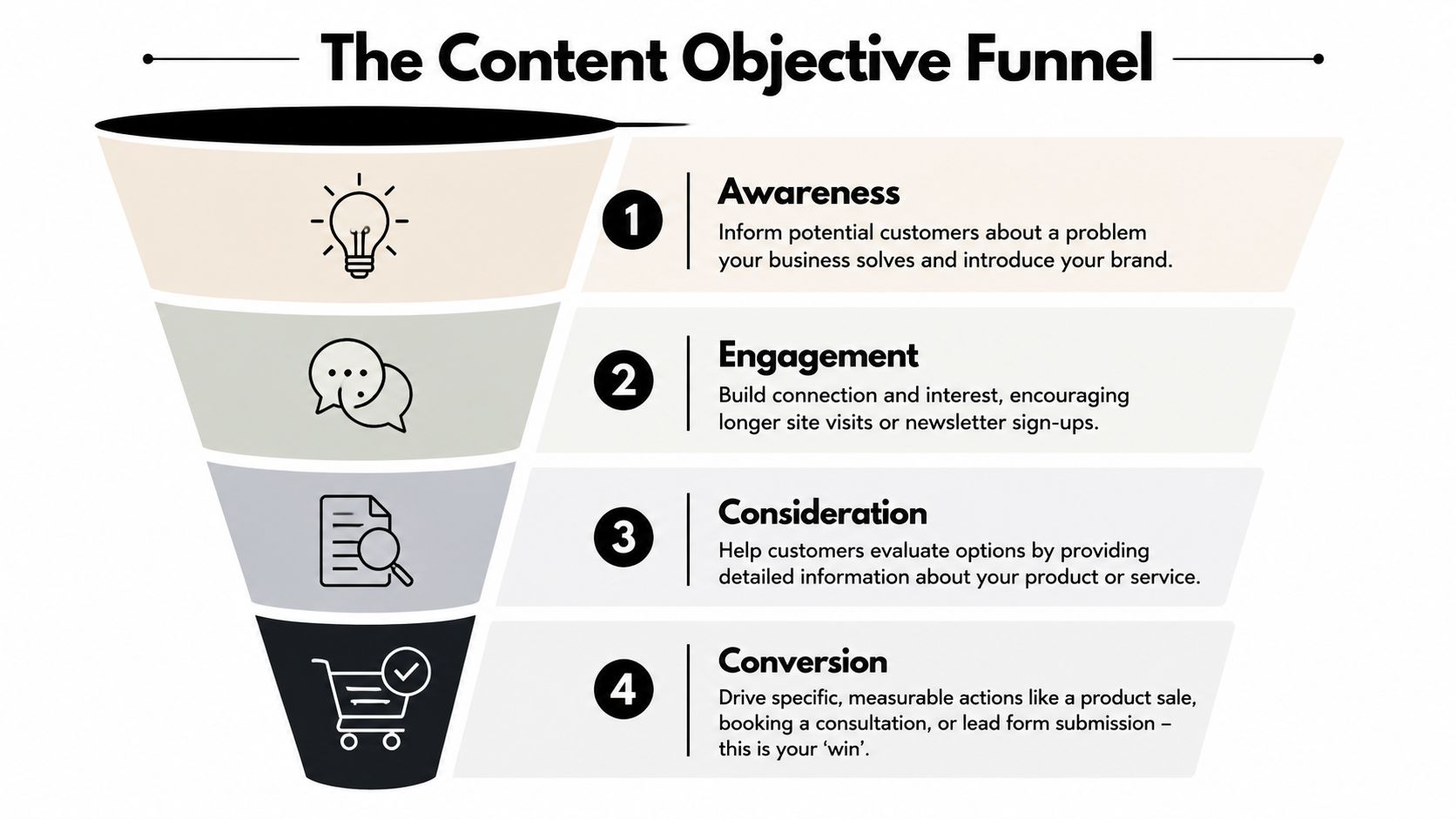
That's why every piece should have one primary job. Usually it falls into one of four buckets:
Awareness
The reader realizes they have a problem or sees your category for the first time.Engagement
The reader spends time with your brand, joins your email list, or clicks deeper into the site.Consideration
The reader compares options, evaluates your approach, or checks whether you fit their use case.Conversion
The reader books a call, requests a quote, starts a trial, or buys.
The mistake isn't publishing awareness content. The mistake is publishing only awareness content and then wondering why leads don't improve.
If your content never reaches consideration and conversion, you're building an audience for somebody else to close.
Match the goal to the business model
A local service company and an e-commerce store shouldn't measure the same content wins.
For a local service business, a strong content goal often looks like this:
- Primary win is a booked consultation or quote request
- Support action is a phone call, form submission, or service-page visit
- Useful topic types include pricing questions, service comparisons, location pages, and “is this right for me” content
For an e-commerce business, the content path usually changes:
- Primary win is a product sale
- Support action is an add-to-cart, email capture, or category-page click
- Useful topic types include product comparisons, use-case guides, setup advice, and buyer's guides
A simple way to pressure-test a topic is to ask three questions:
| Question | Good answer | Bad answer |
|---|---|---|
| What action should happen next? | Book, buy, request, subscribe | “Read more stuff” |
| Who is this for? | A clearly defined buyer or problem | Everyone in the market |
| Why this topic now? | It helps a buyer move forward | It sounds interesting |
Content gets much easier when the job is clear. The title is clearer. The CTA is clearer. The page you link to is clearer. Even the intro gets better because you're writing for a reader who needs something specific.
Find Sales-Ready Keywords Customers Are Using
Keyword research gets overcomplicated fast. Small businesses don't need jargon-heavy workflows. They need a way to identify phrases real customers use when they're close to acting.
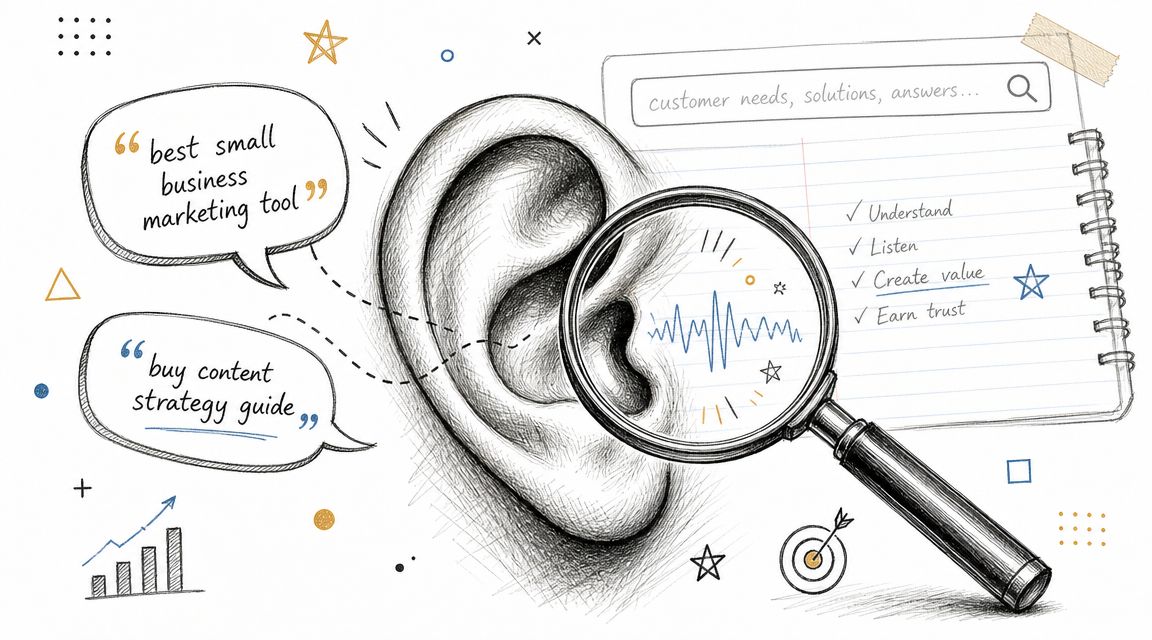
The best keywords usually don't come from brainstorming in isolation. They come from sales conversations, inbox questions, support tickets, live chat logs, review language, and the wording customers use when they're trying to solve a problem right now.
Listen before you research
Start with plain language. Ignore tools for a moment and write down the phrases buyers use naturally.
A few useful prompts:
Problem-driven searches
“Why is this happening?” “How do I fix this?” “What's causing this issue?”Solution-driven searches
“Best type of service for…” “Software for…” “Treatment for…” “Product for…”Decision-stage searches
“Cost,” “pricing,” “near me,” “vs,” “review,” “alternative,” “how long does it take”
Many businesses often falter. They chase broad terms because they look bigger. Broad terms often bring broad intent. If you sell accounting services, “small business finance tips” may bring readers. “Bookkeeping services for restaurants” is far more likely to bring a buyer.
Qualify the keyword before you commit
Before you write, test the phrase against buying intent.
Ask:
- Would a person searching this be likely to hire, buy, or inquire soon?
- Can our business help them directly?
- Do we have a clear CTA that fits the topic?
If the answer is yes to all three, the keyword is worth serious effort.
If the phrase attracts curiosity but not action, it might still be useful, but it should support a stronger bottom-of-funnel page. It shouldn't dominate the calendar.
A practical keyword mix for a small business usually includes:
| Keyword type | What it signals | Example intent |
|---|---|---|
| Problem-aware | The buyer knows the pain | They want diagnosis or clarity |
| Solution-aware | The buyer is exploring options | They want methods, vendors, or categories |
| Decision-ready | The buyer is close to acting | They want pricing, comparisons, proof, or contact |
Add an angle AI can't fake
Generic content is easier than ever to produce. That means generic content is less valuable than ever. Semrush's small business content marketing guidance highlights an important reality: original research, customer stories, and unique, experience-based content are difficult for competitors and AI tools to replicate.
That has direct strategic value.
Instead of publishing another interchangeable article on a broad topic, build pages around assets only you can create:
- Customer stories that show what changed and why buyers chose you
- Internal process content that explains how you work and what clients should expect
- Original observations from jobs completed, products sold, or recurring client questions
- Comparison pages based on real-world trade-offs you've seen firsthand
A small business rarely wins by sounding bigger. It wins by sounding more specific, more credible, and closer to the customer's actual decision.
Build Your Simple Content Creation Engine
Small businesses do not need a content machine with ten tools, three approval layers, and a full-time editor. They need a system that turns customer questions into pages that can rank, qualify leads, and push the right readers toward contact.
Consistency matters here, but consistency is usually an operations issue, not a creativity issue. Teams miss publish dates because the process is vague, ownership is unclear, and every article gets reinvented from scratch.
A simple engine fixes that.
The two documents that keep production sane
For most small businesses, the whole operation can run on two working documents:
An editorial calendar
A spreadsheet that tracks what you are publishing, when it goes live, and what business goal it supports.A content brief
A one-page writing spec that tells the writer exactly what the page needs to do.
Here's a calendar format that works without adding admin for the sake of admin:
| Publish Date | Topic / Title | Target Keyword | Content Type | Primary CTA | Status |
|---|---|---|---|---|---|
| Week 1 | Service pricing guide | service pricing keyword | Blog article | Request a quote | Draft |
| Week 2 | Comparison page | comparison keyword | Landing page | Book a consultation | In progress |
| Week 3 | Customer story | customer result keyword | Case study | Contact sales | Outline |
| Week 4 | Common mistakes article | problem keyword | Blog article | Visit service page | Scheduled |
This table does more than organize ideas. It filters out low-value content before anyone spends time writing it.
If a topic has no target keyword, no clear CTA, and no path to revenue, it does not belong on the calendar. That rule alone saves a lot of small businesses from publishing traffic bait that never turns into leads.
Build briefs for conversion, not just completion
Weak articles usually start with weak instructions. “Write something about this topic” produces exactly the kind of content that gets polite impressions and no sales conversations.
A useful brief should answer seven questions:
Primary keyword
Choose one main phrase.Search intent
Is the reader trying to understand a problem, compare options, or hire someone?Audience
Define the buyer. Local homeowner, operations manager, office admin, founder, procurement lead.Main promise
State what the page will help the reader figure out or decide.Primary CTA
Pick one next step.Supporting proof
Add the evidence that makes the page believable. Customer outcomes, pricing context, process steps, objections, FAQs.Conversion angle
Decide how the content qualifies the reader. Does it explain timelines, budget ranges, fit, trade-offs, or common buying mistakes?
That last point gets ignored all the time. It matters because a page can rank and still fail the business if it attracts readers who will never buy. Good content does not just answer the query. It helps the right prospect decide whether to contact you.
Keep the tool stack boring
Boring is good here. Google Sheets for the calendar and Google Docs for briefs are enough for many teams. Google Search Console or Semrush can handle keyword checks and performance reviews.
The trade-off is simple. More software gives you more workflow options, but it also creates more places for content to stall. Small businesses usually get better results from a plain system they use every week.
Agency Secrets also publishes a workflow for buyer-intent keyword research, article creation, publishing, backlinks, and evergreen SEO execution.
Working rule: Your content engine should reduce decisions, speed up production, and make it easier to publish pages that can produce leads.
Batch the work wherever possible. Outline multiple articles in one session. Collect examples, proof points, and FAQs at the same time. Review drafts in blocks instead of one by one.
That approach cuts context switching, keeps quality steadier, and makes it easier to publish even during busy weeks.
Amplify Your Content Without a Big Budget
Publishing is the midpoint, not the finish line. Small businesses waste a lot of effort by treating the publish button like the main event. The article goes live, gets one social post, then disappears into the archive.
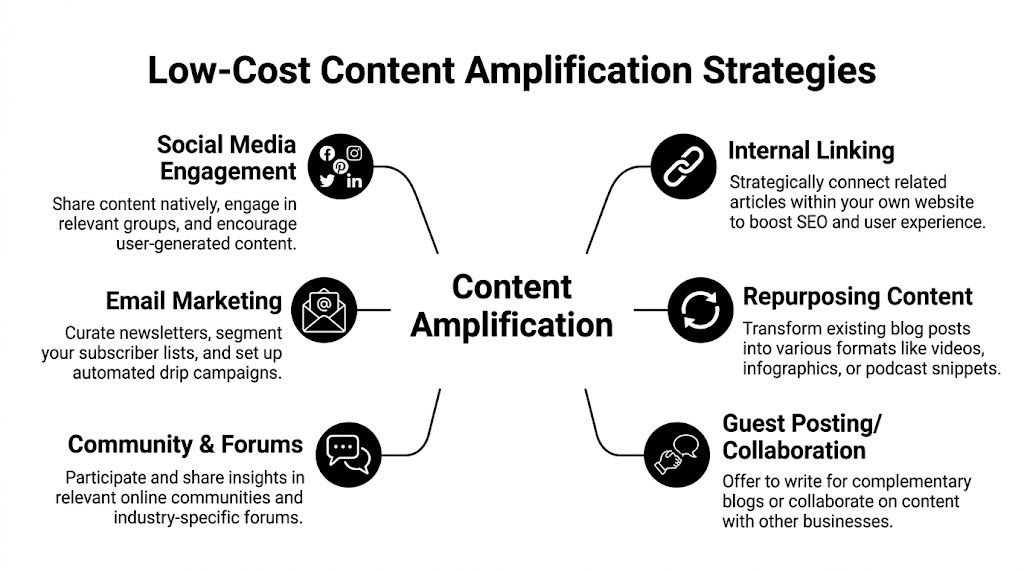
That's avoidable. Content marketing works better as a multi-format, multi-channel system. In Content Marketing Institute's benchmark statistics, 92% of B2B marketers used short articles or posts, 89% used organic social media platforms, 84% used blogs on corporate websites, and 71% used email newsletters. The takeaway for a small team is practical. One strong asset should travel.
Use internal linking like store signage
Internal linking is one of the cheapest ways to get more value from existing content. It's similar to signs in a store. Good signs help people move from browsing to buying.
A simple internal linking approach looks like this:
Link informational posts to service or product pages
If an article explains a problem, it should naturally point to the page that solves it.Link related articles together
This keeps visitors engaged and helps search engines understand topic relationships.Link newer posts to older relevant pages, and older pages back to newer ones
This stops strong pages from becoming dead ends.
The key is relevance. Don't force links because a plugin told you to. Add them where the next click helps the reader continue the decision process.
A good test is simple. If someone reads this paragraph, what page would help them next? Add that link.
To see another perspective on low-cost reach tactics, this video is worth a look.
Earn backlinks like referrals, not like spam
Backlinks still matter, but most small businesses approach them badly. They either ignore them completely or buy junk placements that don't help credibility.
A better approach is to think in terms of referrals. Which other sites already speak to your audience, but don't compete with you directly?
Start here:
Local partnerships
Suppliers, chambers, associations, neighborhood publications, and complementary businessesGuest contributions
Write useful articles for industry blogs where your expertise adds something specificOriginal assets worth citing
A customer story, local market insight, checklist, or comparison resource that saves others timePodcast and interview outreach
A founder with real operating experience can often earn mentions by sharing lessons, not by pitching links
Backlinks are easier to earn when the asset is genuinely useful and the outreach feels like collaboration, not extraction.
One strong article supported by relevant internal links, an email send, a few social cut-downs, and targeted outreach will outperform ten posts that nobody distributes.
Measure What Matters to Prove Your ROI
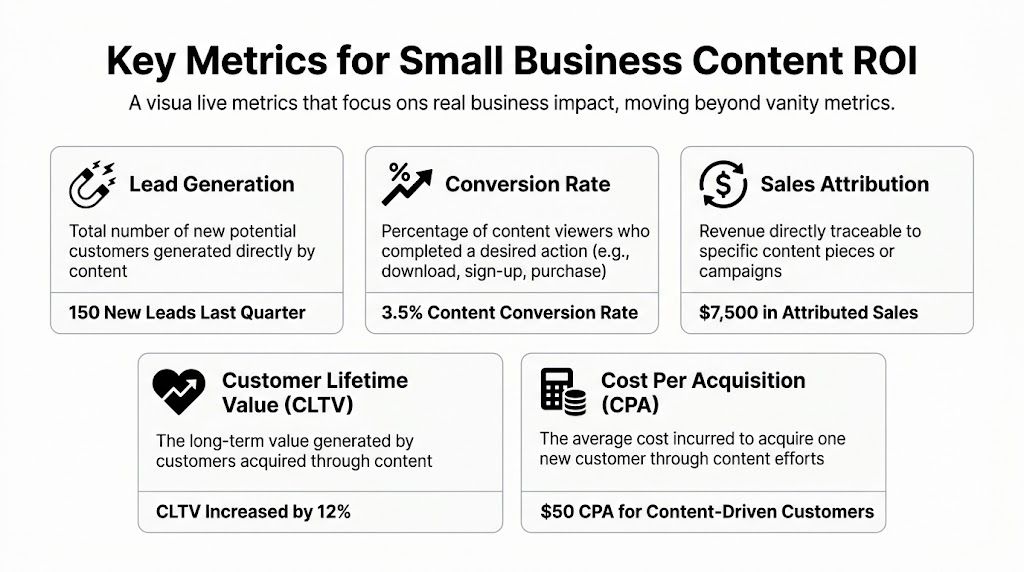
Most small businesses don't need more dashboards. They need clearer questions. The problem with content reporting isn't lack of data. It's that the data often has no direct connection to business decisions.
That gap shows up in a lot of content advice. Outbrain's guidance for small business content strategy points to the core issue: many guides discuss goals and formats but don't show small businesses how to prove which content contributes to leads or sales.
Are people finding you
This is the first question. If nobody is discovering the page, conversion analysis can wait.
Use Google Search Console for this. It will show:
- the queries bringing impressions
- which pages appear in search
- whether your target topics are gaining traction over time
What you're looking for isn't vanity growth. You're checking whether the right pages are appearing for the right searches. If your service comparison pages and bottom-of-funnel articles never show up, your strategy is probably too top-heavy.
Do they like what they see
Visibility alone doesn't mean much if searchers ignore your result. The next question is whether your listing earns the click.
Again, Search Console is enough for this. Review the pages that get impressions but weak click activity. Usually the issue is one of these:
- The title is vague
- The page doesn't match the searcher's intent
- The meta description doesn't signal a useful outcome
- The article targets a topic that sounds broader than it really is
Many businesses discover that “ranking” and “winning” are different. A page can appear in search and still underperform badly if the promise is fuzzy.
A search impression is not proof of success. It's proof you were invited to compete.
Are they taking the next step
This is the question that matters most. Once the visitor lands, do they move toward the business outcome you wanted?
Use Google Analytics or simple on-site conversion tracking to monitor actions like:
| Business type | Meaningful conversion |
|---|---|
| Local service | Quote request, consultation booking, phone click |
| E-commerce | Add-to-cart, checkout start, purchase |
| B2B lead gen | Demo request, form submission, contact page visit |
| Newsletter-led business | Email signup tied to a relevant offer |
You don't need a complicated attribution model to make this useful. Start by checking which content pieces assist or produce those actions most often. Then do more of what helps movement and less of what only inflates pageviews.
A lean reporting rhythm works well here:
Monthly
Review rankings, impressions, clicks, and conversions by page.Quarterly
Update underperforming pages, improve CTAs, refresh internal links, and expand the articles that already attract qualified visitors.Ongoing
Keep a short list of topics that produce real inquiries or sales conversations.
The smartest content teams don't obsess over perfect attribution. They build enough visibility into the funnel to answer a practical question: Which pages help us win more business? That's the metric set that keeps a small business content marketing strategy grounded in revenue, not noise.
If you want a simpler way to execute this kind of SEO-led content system without hiring an agency, Agency Secrets shares practical playbooks for buyer-intent keyword targeting, publishing evergreen articles, earning backlinks, and building compounding organic growth with a small team.
Leave a Reply