Tag: lead generation

  • Small Business Content Marketing Strategy: A Simple Plan

    Small Business Content Marketing Strategy: A Simple Plan

    Most small business content advice gets the core job wrong. It tells you to publish more, stay visible, and build awareness, as if attention automatically turns into revenue. It doesn't. A random stream of blog posts, social updates, and recycled tips usually creates a busy marketing calendar, not sales-ready leads.

    A useful small business content marketing strategy starts somewhere else. Each piece of content needs a job. It should target a specific problem, bring in a specific kind of visitor, and push that visitor toward a specific next step. If the article can't do that, it may still be nice for the brand, but it's probably not helping the business enough to justify the time.

    That matters even more for small teams. You don't have the margin for vanity traffic, sprawling campaigns, or a six-month content experiment with vague goals. You need a system that can work with limited time, limited budget, and limited patience. The upside is that a smaller business can often win by being sharper. Better topic selection, tighter calls to action, stronger local or niche expertise, and cleaner execution beat generic publishing every time.

    Table of Contents

    Your Winning Content Marketing Mindset

    The first shift is simple. Content marketing is not blogging. It's a business system for creating trust, showing expertise, capturing demand, and moving buyers toward action.

    That sounds obvious, but most small businesses still treat content like a side task. They publish when there's time, pick topics based on hunches, and hope consistency alone will rescue weak strategy. It won't. By 2025, 90% of organizations reported having a content marketing strategy, and 66% said that strategy was documented, according to ProperExpression's content marketing statistics roundup. That tells you where the market is. Content is no longer an experiment. It's an operating discipline.

    A scrappy company doesn't need a giant editorial department. It needs a documented plan that answers a few hard questions:

    • Who are we trying to reach
    • What problems are they actively trying to solve
    • What action do we want after each piece
    • What topics deserve effort because they can produce revenue later

    Practical rule: If a topic doesn't map to a customer problem and a next step, it belongs in the backlog, not the publishing queue.

    Smaller businesses often have an edge because they know the objections buyers raise on calls. They know the questions people ask before purchasing. They know where deals stall. That knowledge is more useful than a generic “content calendar” filled with broad awareness posts.

    The mindset to keep is blunt. Don't ask, “What should we post this week?” Ask, “What content would help the right buyer say yes faster?” That question leads to better keywords, better offers, better pages, and better follow-up.

    Define Your Content's Job Before You Write

    If you skip this step, the rest of your strategy collapses into activity. You'll publish, maybe even rank, and still feel unsure whether the effort is working.

    The common mistake is using traffic as the goal. Traffic is useful, but only if the visitor is likely to take a profitable action. A thousand visits from people looking for free advice are less valuable than a small stream of visitors comparing vendors, pricing options, or solutions.

    Stop chasing traffic with no buying intent

    A lot of small businesses would be better off with fewer articles and clearer objectives. That lines up with the broader pattern in the market. 83% of marketers believe higher-quality content published less often is more effective, according to OneLocal's content marketing statistics summary.
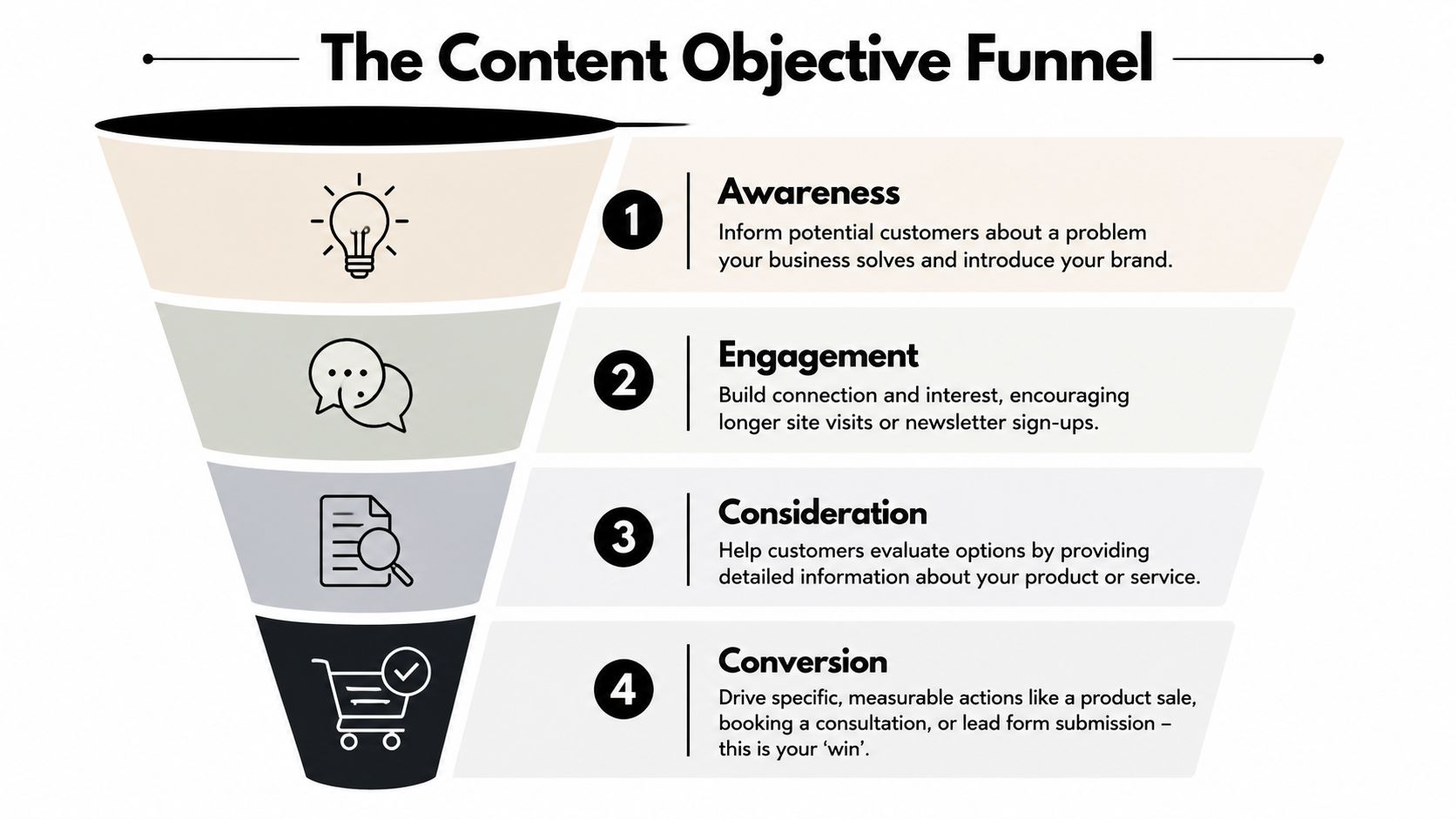
    A four-stage funnel diagram illustrating content marketing objectives from initial brand awareness to final customer conversion.

    That's why every piece should have one primary job. Usually it falls into one of four buckets:

    1. Awareness
      The reader realizes they have a problem or sees your category for the first time.

    2. Engagement
      The reader spends time with your brand, joins your email list, or clicks deeper into the site.

    3. Consideration
      The reader compares options, evaluates your approach, or checks whether you fit their use case.

    4. Conversion
      The reader books a call, requests a quote, starts a trial, or buys.

    The mistake isn't publishing awareness content. The mistake is publishing only awareness content and then wondering why leads don't improve.

    If your content never reaches consideration and conversion, you're building an audience for somebody else to close.

    Match the goal to the business model

    A local service company and an e-commerce store shouldn't measure the same content wins.

    For a local service business, a strong content goal often looks like this:

    • Primary win is a booked consultation or quote request
    • Support action is a phone call, form submission, or service-page visit
    • Useful topic types include pricing questions, service comparisons, location pages, and “is this right for me” content

    For an e-commerce business, the content path usually changes:

    • Primary win is a product sale
    • Support action is an add-to-cart, email capture, or category-page click
    • Useful topic types include product comparisons, use-case guides, setup advice, and buyer's guides

    A simple way to pressure-test a topic is to ask three questions:

    Question Good answer Bad answer
    What action should happen next? Book, buy, request, subscribe “Read more stuff”
    Who is this for? A clearly defined buyer or problem Everyone in the market
    Why this topic now? It helps a buyer move forward It sounds interesting

    Content gets much easier when the job is clear. The title is clearer. The CTA is clearer. The page you link to is clearer. Even the intro gets better because you're writing for a reader who needs something specific.

    Find Sales-Ready Keywords Customers Are Using

    Keyword research gets overcomplicated fast. Small businesses don't need jargon-heavy workflows. They need a way to identify phrases real customers use when they're close to acting.

    The best keywords usually don't come from brainstorming in isolation. They come from sales conversations, inbox questions, support tickets, live chat logs, review language, and the wording customers use when they're trying to solve a problem right now.

    A pencil-sketch style illustration of an ear, a magnifying glass, and a notepad representing content strategy.

    Listen before you research

    Start with plain language. Ignore tools for a moment and write down the phrases buyers use naturally.

    A few useful prompts:

    • Problem-driven searches
      “Why is this happening?” “How do I fix this?” “What's causing this issue?”

    • Solution-driven searches
      “Best type of service for…” “Software for…” “Treatment for…” “Product for…”

    • Decision-stage searches
      “Cost,” “pricing,” “near me,” “vs,” “review,” “alternative,” “how long does it take”

    Many businesses often falter. They chase broad terms because they look bigger. Broad terms often bring broad intent. If you sell accounting services, “small business finance tips” may bring readers. “Bookkeeping services for restaurants” is far more likely to bring a buyer.

    Qualify the keyword before you commit

    Before you write, test the phrase against buying intent.

    Ask:

    • Would a person searching this be likely to hire, buy, or inquire soon?
    • Can our business help them directly?
    • Do we have a clear CTA that fits the topic?

    If the answer is yes to all three, the keyword is worth serious effort.

    If the phrase attracts curiosity but not action, it might still be useful, but it should support a stronger bottom-of-funnel page. It shouldn't dominate the calendar.

    A practical keyword mix for a small business usually includes:

    Keyword type What it signals Example intent
    Problem-aware The buyer knows the pain They want diagnosis or clarity
    Solution-aware The buyer is exploring options They want methods, vendors, or categories
    Decision-ready The buyer is close to acting They want pricing, comparisons, proof, or contact

    Add an angle AI can't fake

    Generic content is easier than ever to produce. That means generic content is less valuable than ever. Semrush's small business content marketing guidance highlights an important reality: original research, customer stories, and unique, experience-based content are difficult for competitors and AI tools to replicate.

    That has direct strategic value.

    Instead of publishing another interchangeable article on a broad topic, build pages around assets only you can create:

    • Customer stories that show what changed and why buyers chose you
    • Internal process content that explains how you work and what clients should expect
    • Original observations from jobs completed, products sold, or recurring client questions
    • Comparison pages based on real-world trade-offs you've seen firsthand

    A small business rarely wins by sounding bigger. It wins by sounding more specific, more credible, and closer to the customer's actual decision.

    Build Your Simple Content Creation Engine

    Small businesses do not need a content machine with ten tools, three approval layers, and a full-time editor. They need a system that turns customer questions into pages that can rank, qualify leads, and push the right readers toward contact.

    Consistency matters here, but consistency is usually an operations issue, not a creativity issue. Teams miss publish dates because the process is vague, ownership is unclear, and every article gets reinvented from scratch.

    A simple engine fixes that.

    The two documents that keep production sane

    For most small businesses, the whole operation can run on two working documents:

    • An editorial calendar
      A spreadsheet that tracks what you are publishing, when it goes live, and what business goal it supports.

    • A content brief
      A one-page writing spec that tells the writer exactly what the page needs to do.

    Here's a calendar format that works without adding admin for the sake of admin:

    Publish Date Topic / Title Target Keyword Content Type Primary CTA Status
    Week 1 Service pricing guide service pricing keyword Blog article Request a quote Draft
    Week 2 Comparison page comparison keyword Landing page Book a consultation In progress
    Week 3 Customer story customer result keyword Case study Contact sales Outline
    Week 4 Common mistakes article problem keyword Blog article Visit service page Scheduled

    This table does more than organize ideas. It filters out low-value content before anyone spends time writing it.

    If a topic has no target keyword, no clear CTA, and no path to revenue, it does not belong on the calendar. That rule alone saves a lot of small businesses from publishing traffic bait that never turns into leads.

    Build briefs for conversion, not just completion

    Weak articles usually start with weak instructions. “Write something about this topic” produces exactly the kind of content that gets polite impressions and no sales conversations.

    A useful brief should answer seven questions:

    • Primary keyword
      Choose one main phrase.

    • Search intent
      Is the reader trying to understand a problem, compare options, or hire someone?

    • Audience
      Define the buyer. Local homeowner, operations manager, office admin, founder, procurement lead.

    • Main promise
      State what the page will help the reader figure out or decide.

    • Primary CTA
      Pick one next step.

    • Supporting proof
      Add the evidence that makes the page believable. Customer outcomes, pricing context, process steps, objections, FAQs.

    • Conversion angle
      Decide how the content qualifies the reader. Does it explain timelines, budget ranges, fit, trade-offs, or common buying mistakes?

    That last point gets ignored all the time. It matters because a page can rank and still fail the business if it attracts readers who will never buy. Good content does not just answer the query. It helps the right prospect decide whether to contact you.

    Keep the tool stack boring

    Boring is good here. Google Sheets for the calendar and Google Docs for briefs are enough for many teams. Google Search Console or Semrush can handle keyword checks and performance reviews.

    The trade-off is simple. More software gives you more workflow options, but it also creates more places for content to stall. Small businesses usually get better results from a plain system they use every week.

    Agency Secrets also publishes a workflow for buyer-intent keyword research, article creation, publishing, backlinks, and evergreen SEO execution.

    Working rule: Your content engine should reduce decisions, speed up production, and make it easier to publish pages that can produce leads.

    Batch the work wherever possible. Outline multiple articles in one session. Collect examples, proof points, and FAQs at the same time. Review drafts in blocks instead of one by one.

    That approach cuts context switching, keeps quality steadier, and makes it easier to publish even during busy weeks.

    Amplify Your Content Without a Big Budget

    Publishing is the midpoint, not the finish line. Small businesses waste a lot of effort by treating the publish button like the main event. The article goes live, gets one social post, then disappears into the archive.

    That's avoidable. Content marketing works better as a multi-format, multi-channel system. In Content Marketing Institute's benchmark statistics, 92% of B2B marketers used short articles or posts, 89% used organic social media platforms, 84% used blogs on corporate websites, and 71% used email newsletters. The takeaway for a small team is practical. One strong asset should travel.
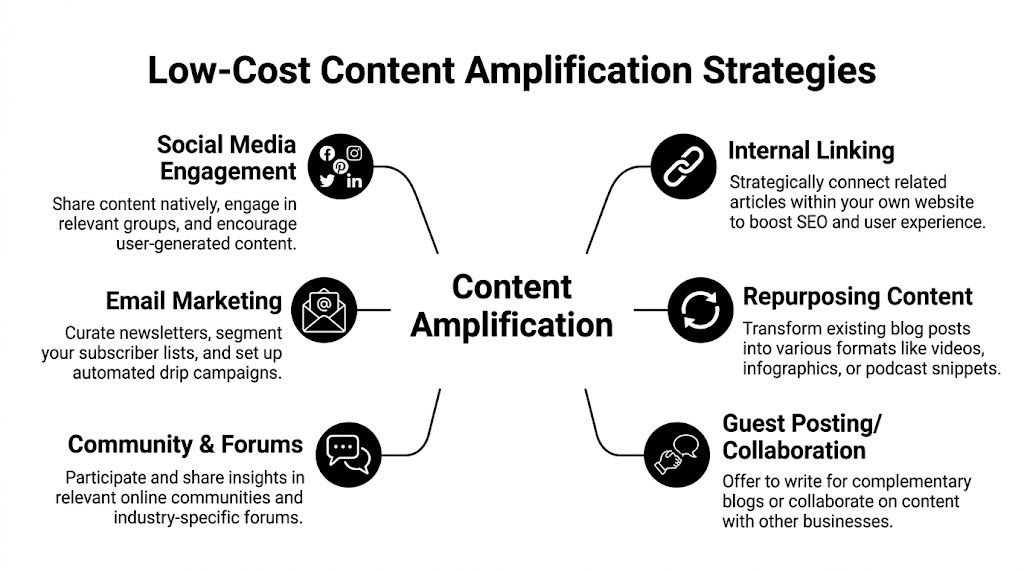
    A diagram outlining six effective, low-cost strategies for businesses to amplify their online content and reach.

    Use internal linking like store signage

    Internal linking is one of the cheapest ways to get more value from existing content. It's similar to signs in a store. Good signs help people move from browsing to buying.

    A simple internal linking approach looks like this:

    • Link informational posts to service or product pages
      If an article explains a problem, it should naturally point to the page that solves it.

    • Link related articles together
      This keeps visitors engaged and helps search engines understand topic relationships.

    • Link newer posts to older relevant pages, and older pages back to newer ones
      This stops strong pages from becoming dead ends.

    The key is relevance. Don't force links because a plugin told you to. Add them where the next click helps the reader continue the decision process.

    A good test is simple. If someone reads this paragraph, what page would help them next? Add that link.

    To see another perspective on low-cost reach tactics, this video is worth a look.

    Earn backlinks like referrals, not like spam

    Backlinks still matter, but most small businesses approach them badly. They either ignore them completely or buy junk placements that don't help credibility.

    A better approach is to think in terms of referrals. Which other sites already speak to your audience, but don't compete with you directly?

    Start here:

    • Local partnerships
      Suppliers, chambers, associations, neighborhood publications, and complementary businesses

    • Guest contributions
      Write useful articles for industry blogs where your expertise adds something specific

    • Original assets worth citing
      A customer story, local market insight, checklist, or comparison resource that saves others time

    • Podcast and interview outreach
      A founder with real operating experience can often earn mentions by sharing lessons, not by pitching links

    Backlinks are easier to earn when the asset is genuinely useful and the outreach feels like collaboration, not extraction.

    One strong article supported by relevant internal links, an email send, a few social cut-downs, and targeted outreach will outperform ten posts that nobody distributes.

    Measure What Matters to Prove Your ROI

    Most small businesses don't need more dashboards. They need clearer questions. The problem with content reporting isn't lack of data. It's that the data often has no direct connection to business decisions.

    That gap shows up in a lot of content advice. Outbrain's guidance for small business content strategy points to the core issue: many guides discuss goals and formats but don't show small businesses how to prove which content contributes to leads or sales.
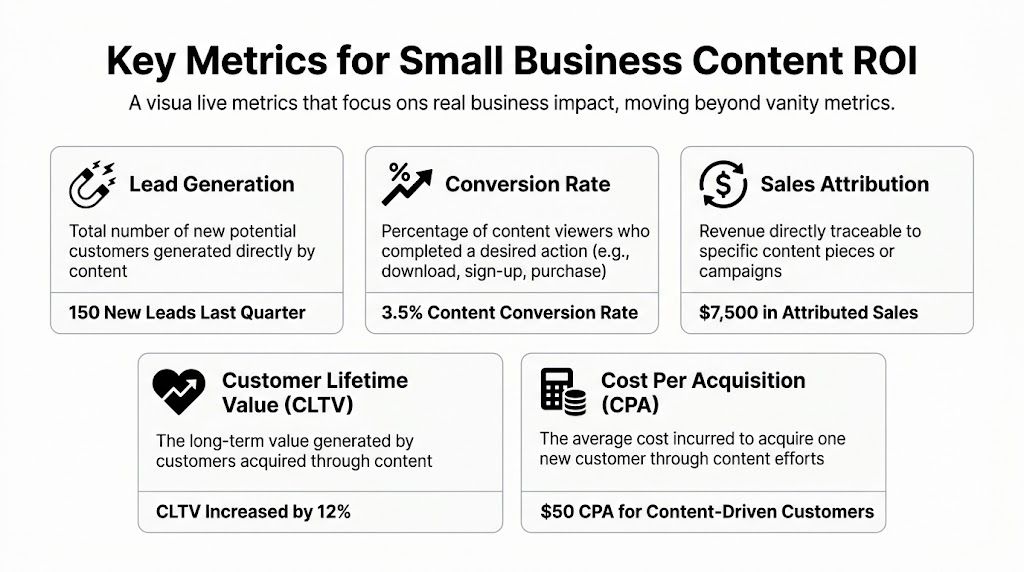
    An infographic showing five key metrics for measuring small business content marketing return on investment.

    Are people finding you

    This is the first question. If nobody is discovering the page, conversion analysis can wait.

    Use Google Search Console for this. It will show:

    • the queries bringing impressions
    • which pages appear in search
    • whether your target topics are gaining traction over time

    What you're looking for isn't vanity growth. You're checking whether the right pages are appearing for the right searches. If your service comparison pages and bottom-of-funnel articles never show up, your strategy is probably too top-heavy.

    Do they like what they see

    Visibility alone doesn't mean much if searchers ignore your result. The next question is whether your listing earns the click.

    Again, Search Console is enough for this. Review the pages that get impressions but weak click activity. Usually the issue is one of these:

    • The title is vague
    • The page doesn't match the searcher's intent
    • The meta description doesn't signal a useful outcome
    • The article targets a topic that sounds broader than it really is

    Many businesses discover that “ranking” and “winning” are different. A page can appear in search and still underperform badly if the promise is fuzzy.

    A search impression is not proof of success. It's proof you were invited to compete.

    Are they taking the next step

    This is the question that matters most. Once the visitor lands, do they move toward the business outcome you wanted?

    Use Google Analytics or simple on-site conversion tracking to monitor actions like:

    Business type Meaningful conversion
    Local service Quote request, consultation booking, phone click
    E-commerce Add-to-cart, checkout start, purchase
    B2B lead gen Demo request, form submission, contact page visit
    Newsletter-led business Email signup tied to a relevant offer

    You don't need a complicated attribution model to make this useful. Start by checking which content pieces assist or produce those actions most often. Then do more of what helps movement and less of what only inflates pageviews.

    A lean reporting rhythm works well here:

    1. Monthly
      Review rankings, impressions, clicks, and conversions by page.

    2. Quarterly
      Update underperforming pages, improve CTAs, refresh internal links, and expand the articles that already attract qualified visitors.

    3. Ongoing
      Keep a short list of topics that produce real inquiries or sales conversations.

    The smartest content teams don't obsess over perfect attribution. They build enough visibility into the funnel to answer a practical question: Which pages help us win more business? That's the metric set that keeps a small business content marketing strategy grounded in revenue, not noise.


    If you want a simpler way to execute this kind of SEO-led content system without hiring an agency, Agency Secrets shares practical playbooks for buyer-intent keyword targeting, publishing evergreen articles, earning backlinks, and building compounding organic growth with a small team.

  • SEO for Real Estate Agents: Generate Leads in 2026

    SEO for Real Estate Agents: Generate Leads in 2026

    You’re probably in one of two spots right now. You’re either paying for leads and wondering why every month starts at zero again, or you’ve got a website that looks decent but barely produces calls, valuation requests, or serious buyer inquiries.

    That’s where most agents get stuck. They don’t need another giant SEO checklist. They need the few actions that move rankings, show up in Google Maps, and turn local searches into conversations. That’s what seo for real estate agents should be about. Not vanity traffic. Not blogging for the sake of blogging. Leads.

    The playbook below is the one that matters when time is tight and consistency is the primary bottleneck. It focuses on the handful of moves that create local visibility, build authority, and keep generating inquiries long after the work is published. It also addresses directly the trade-off every busy agent faces: do it manually and risk inconsistency, or automate the repetitive parts so the strategy is executed.

    Table of Contents

    Why SEO Is Your Best Investment for Leads in 2026

    Agents feel the pain of paid lead channels fast. You fund ads, buy portal exposure, or pay for promoted placements, and the moment you stop paying, the pipeline slows down. That model can work for short bursts, but it doesn’t build an asset you own.

    SEO does. A strong local site keeps attracting buyers and sellers while you’re on appointments, handling inspections, or negotiating offers. That’s the part many agents miss. Good seo for real estate agents isn’t just marketing activity. It’s business infrastructure.

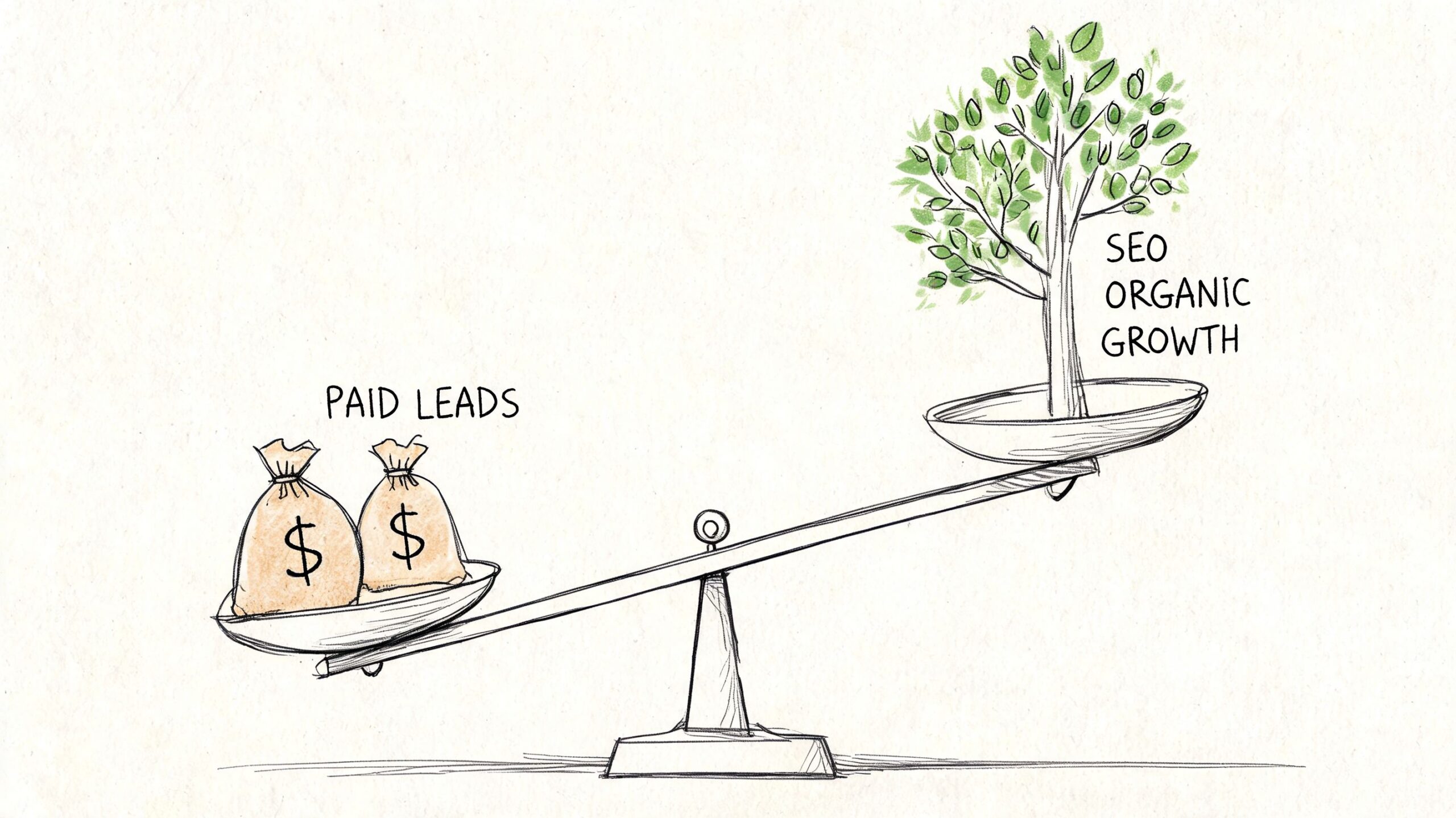
    A scale weighing paid leads against organic growth tree to show value of SEO for real estate.

    The economics are hard to ignore. Organic search drives 300% more traffic to websites than social media, 97% of homebuyers start their search online, and real estate SEO delivers an average ROI of 1,389% over three years, according to Siteimprove’s real estate SEO overview. That’s why SEO keeps outperforming channels that rely on constant spend.

    SEO brings in better intent

    Traffic alone doesn’t pay the bills. Intent does.

    Someone searching for your name after a referral is useful. Someone typing “realtor near me,” “homes for sale in [neighborhood],” or “how to price my home in [city]” is often even better because they’re actively trying to solve a property problem right now. SEO captures that demand at the moment it exists.

    Practical rule: If a page doesn’t target a search with clear local or transaction intent, it’s usually not a priority page.

    That’s why broad lifestyle content rarely carries a solo agent’s growth plan on its own. It can support authority, but the pages that generate leads usually sit closer to action: area pages, seller pages, service pages, and detailed local guides.

    SEO compounds while paid media resets

    Paid campaigns can still have a place. They’re useful when you need immediate visibility. But they reset every month. SEO compounds. A neighborhood guide you publish today can keep ranking, attracting clicks, and feeding inquiries long after the page goes live.

    There’s also a control issue. Portals own their platform. Ad networks control pricing. Your website is the one marketing asset you fully control. If you want predictable inbound leads over time, that asset deserves the first serious investment.

    A lot of agents delay SEO because it feels technical. In practice, the winning version is much simpler. Get found locally. Publish pages around buyer and seller intent. Keep the site fast and usable. Earn local trust signals. Repeat consistently.

    The Foundation Winning Local Search and Google Maps

    If an agent asks where to start, the answer is almost never “write more blogs” first. It’s local search. Specifically, Google Business Profile, reviews, citations, and location relevance. If those signals are weak, you’ll struggle to appear where high-intent local searches happen.

    For local visibility, a fully optimized Google Business Profile is paramount, and success metrics include mobile site speed scores above 80 and accurate IDX data feeds, according to FatJoe’s real estate SEO guide.

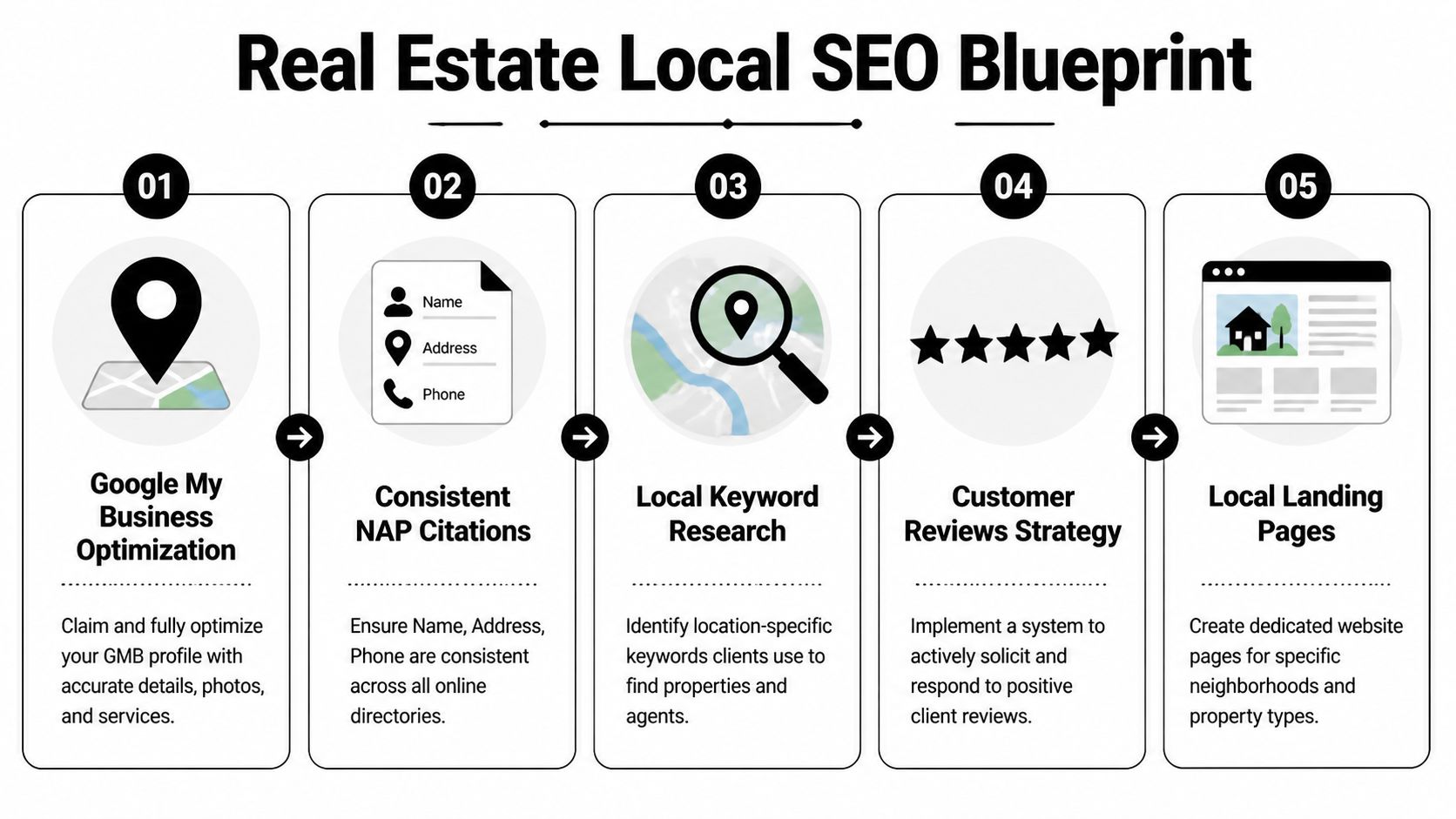
    This visual breaks the local blueprint into the core actions worth doing first.

    A five-step blueprint infographic outlining essential strategies for improving local SEO for real estate agents.

    Treat your Google Business Profile like a sales page

    Most agent profiles are half-complete. That leaves money on the table.

    A fully built profile should include:

    • Correct business details: Your name, address, phone number, website, and service areas must match everywhere else online.
    • Service clarity: Add services that match what you want to rank for, such as buyer representation, listing agent services, relocation help, or property valuations.
    • Real photos: Office photos, team photos, local area shots, and property-related images help the profile feel active and credible.
    • Ongoing updates: Use Google Posts for listings, market updates, and local news. It keeps the profile fresh and gives searchers more reasons to click.
    • Q&A coverage: Seed common questions and answer them clearly. Think valuation timelines, neighborhoods served, or whether you handle first-time buyers or luxury sellers.

    A neglected profile sends the wrong signal. Google wants complete local businesses it can trust. So do prospects.

    After your profile, make sure your website supports it. That means your city and neighborhood pages should exist, load cleanly on mobile, and reflect the same core business information.

    A practical walkthrough helps here:

    Reviews and citations decide whether Google trusts you locally

    Reviews do more than build persuasion. They strengthen local relevance.

    The mistake is asking randomly. The better system is to request reviews at moments when clients already feel relief or excitement, right after a successful closing milestone, after handing over keys, or after solving a difficult issue well. Keep the request short, direct, and easy to complete.

    What matters most:

    • Consistency: A steady flow of reviews looks healthier than occasional bursts.
    • Specificity: Reviews that mention neighborhoods, buying or selling experience, and service quality help both users and local relevance.
    • Responses: Reply to every review. A thoughtful response shows activity and professionalism.

    The Map Pack usually goes to the agent who looks the most complete, trusted, and locally relevant, not the one with the fanciest website.

    Citations matter for the same reason. Your NAP data, meaning name, address, and phone, should be identical across directories like Yelp and BBB, plus any local chambers, broker pages, or industry profiles you control. Inconsistent details create avoidable confusion.

    One more local search trap deserves attention. Many agent sites have messy IDX feeds. If listing pages are thin, outdated, or duplicative, they often clutter the site without adding ranking strength. Accurate IDX data is useful. A bloated IDX setup isn’t. Keep indexable pages focused on the ones that provide unique value.

    Keyword Research That Finds Ready-to-Act Clients

    Keyword research for agents goes wrong when it starts and ends with volume. High search volume looks exciting, but it often pulls you toward broad phrases that are hard to rank for and weaker at converting.

    The better approach is intent layering. You’re not just collecting keywords. You’re mapping what people search when they’re learning, comparing, and getting ready to act. Follow Up Boss describes this well: effective SEO involves semantic search, where you identify a primary keyword like “homes for sale in [Neighborhood]” and layer related questions from Google into the page so it satisfies user intent more completely. Their guide also warns against keyword stuffing and recommends a hub-and-spoke structure for connected pages, as shown in Follow Up Boss’s realtor SEO tactics.

    Think in intent layers, not just keywords

    A useful keyword set for seo for real estate agents usually spans three buckets:

    Client Type Search Intent Example Keyword
    Buyer Early research cost to buy a house in Austin
    Buyer Comparison homes for sale in Hyde Park Austin
    Buyer Transactional realtor near me
    Seller Early research best time to sell home in Dallas
    Seller Comparison how to price my home in Bishop Arts
    Seller Transactional listing agent in Dallas

    Each search warrants a distinct page type. Early research queries fit guides and explainers. Comparison terms fit neighborhood pages and market pages. Transactional terms belong on service pages that make contacting you easy.

    A few practical patterns work well:

    • Buyer research terms: target moving guides, cost guides, school-area guides, and neighborhood comparisons.
    • Mid-funnel location terms: target pages about specific suburbs, ZIP codes, building types, or lifestyle pockets.
    • Bottom-funnel service terms: target agent, valuation, and sell-with-me pages.

    If you lump all of that onto one generic homepage, you dilute the relevance.

    Seller keywords are the opening most agents ignore

    Most agents overbuild buyer content because listings feel more tangible. That’s a mistake. Seller intent is often less crowded and closer to revenue.

    Good seller topics include:

    • Pricing questions: “how to price my home in [area]”
    • Timing questions: “best time to sell in [neighborhood]”
    • Condition questions: “should I renovate before selling”
    • Process questions: “what to expect when selling a home in [city]”

    These searches usually come from owners making decisions, not casual browsers. They also let you compete where big portals are weaker. Portals dominate listing inventory. They don’t dominate nuanced local seller advice.

    Use tools like Google Ads Keyword Planner, Keywords Everywhere, and Google’s related questions to build the list manually. If consistency is the issue, this is one of the best areas to automate with OutRank. It can surface buyer and seller topics continuously, which is useful when you don’t have time to sit in spreadsheets every week.

    A strong content calendar for an agent should include seller topics every month, not just listing pages and buyer articles.

    One caution. Don’t force exact-match phrases into every line. Semantic SEO works because the page answers the topic broadly and naturally. Stuffing “seo for real estate agents” or “homes for sale in [area]” into awkward sentences does the opposite of what you want.

    Creating Content That Builds Authority and Trust

    The easiest way to tell whether an agent understands content is to look at their neighborhood pages. Weak ones read like brochure copy. Strong ones help someone make a decision.

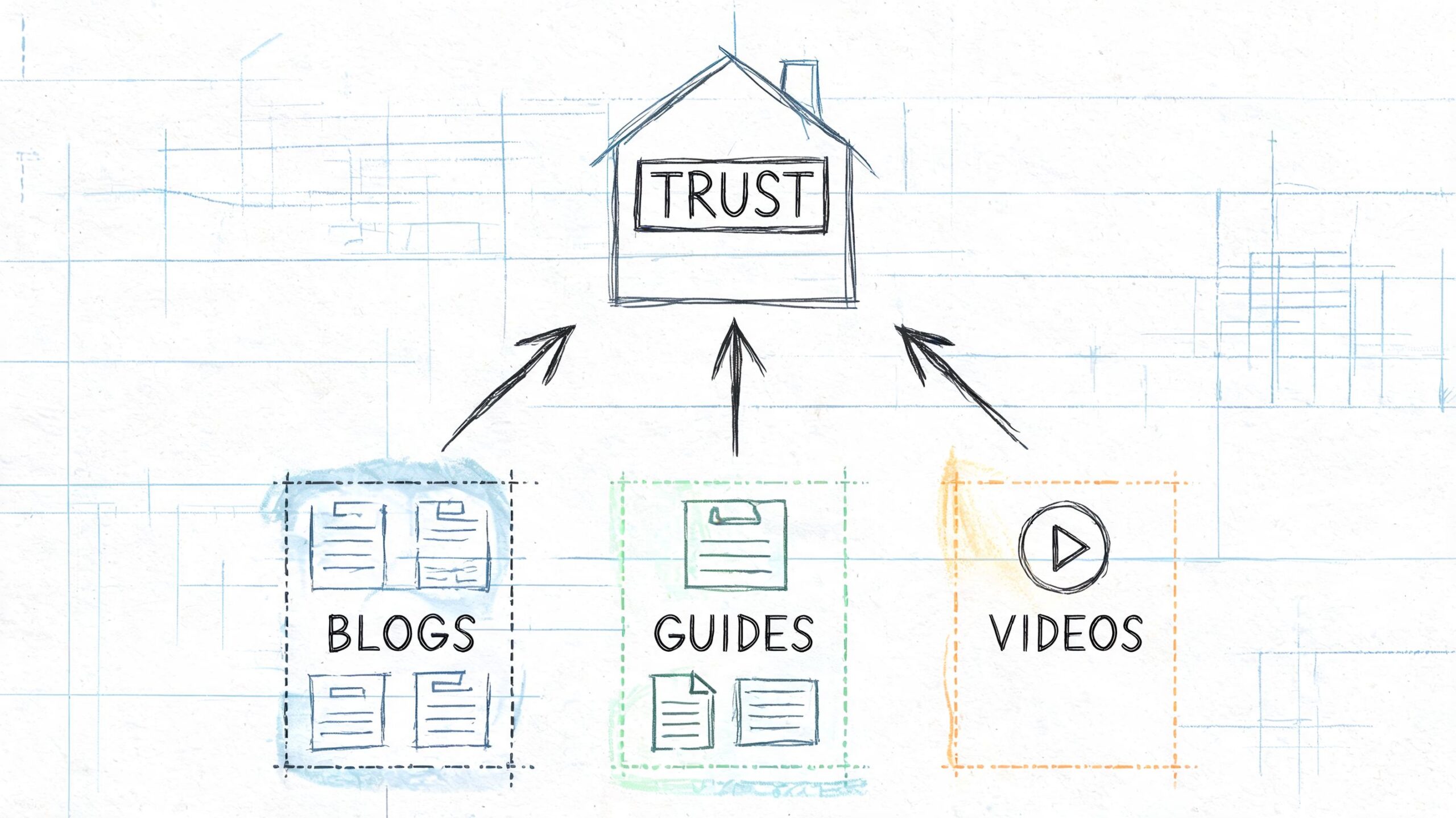
    That difference matters because Google rewards pages that answer the search. Prospects do too. If a buyer lands on your page and learns something useful about the area, schools, commute patterns, housing style, or local buying considerations, you’ve done more than attract a click. You’ve started building trust.

    A hand-drawn illustration showing blogs, guides, and videos building up to a house labeled trust.

    What a strong neighborhood guide actually looks like

    A useful neighborhood guide has a clear main topic and a structure that helps both readers and search engines. The page might target a phrase like “living in [neighborhood]” or “homes for sale in [neighborhood],” but it shouldn’t stop at a thin paragraph and a listings widget.

    A solid page usually includes:

    • A direct opening answer: Explain who the area suits and why people move there.
    • Lifestyle detail: Cover parks, walkability, housing stock, transport, and local amenities.
    • Buyer context: Mention who tends to buy there, such as families, commuters, or downsizers, without making unsupported claims.
    • Relevant FAQs: Add natural subheadings based on real search questions.
    • Strong internal links: Connect to related suburb pages, buyer guides, valuation pages, and contact pages.

    One practical example. If you’re building a page on a family-oriented suburb, don’t just say it’s “popular.” Explain what a buyer would want to know: property types, school-related decision factors, commuting trade-offs, and nearby amenities that shape day-to-day living.

    Write pages that rank and still sound human

    On-page SEO is mostly about clarity.

    Use a title that leads with the core topic. Write an H1 that matches the page intent. Break the page into H2s and H3s that answer real questions. Add a meta description that makes the click worthwhile. If you’re writing a property page, practical keyword-led titles like those recommended in the earlier Follow Up Boss guidance work well because they align with how people search.

    The same principle applies to seller content. Creating content for seller-intent searches like “how to price my home in [city]” can yield 2-3x higher conversion rates, according to Visuable’s guide to SEO for real estate agents. That’s why seller pages deserve the same attention as buyer guides.

    A simple content stack for agents looks like this:

    • Core money pages: city pages, neighborhood pages, buyer service pages, seller service pages
    • Trust builders: neighborhood guides, market explainers, moving guides, school-area content
    • Conversion helpers: FAQs, valuation pages, contact pages, listing appointment pages

    Good real estate content shouldn’t read like it was written for an algorithm. It should feel like the most helpful agent in town sat down and answered the search properly.

    This is also where automation can make sense. Writing one strong page is manageable. Publishing and interlinking useful pages month after month is where agents fall off. OutRank can help keep the publication rhythm going, but the strategy still has to be right. Automation amplifies a good plan. It doesn’t rescue a weak one.

    Technical SEO and Backlinks Made Simple

    Technical SEO sounds intimidating until you strip it down to what affects lead generation. For most agent sites, the big issues are speed, mobile usability, crawl clarity, and structured data. If those are in reasonable shape, your content and local relevance can do their job.

    Backlinks are similar. People overcomplicate them or turn them into spam. In practice, the best links for agents usually come from local relationships, partnerships, and useful content that deserves a mention.

    Fix the three technical issues that hurt agents most

    Start with the basics:

    1. Speed
      Slow pages lose leads. Heavy images, bloated themes, and scripts from too many plugins are common causes. Compress images, keep templates lean, and test key pages on mobile.

    2. Mobile usability
      Most property searches happen on phones. If your contact buttons are awkward, text is cramped, or forms are painful to complete, rankings aren’t your only problem. Conversion drops too.

    3. Schema and structure
      Clear headings, logical site architecture, and basic schema markup help search engines understand your pages. For agent sites, schema such as RealEstateAgent can add useful context.

    The important part is restraint. You don’t need to chase every technical tweak on a checklist. You need a site that loads well, works on mobile, and makes your key pages easy to crawl and understand.

    A few common problems are worth removing fast:

    • Thin duplicate area pages: These often happen when agents create dozens of near-identical location pages.
    • Broken internal links: They weaken crawl paths and create a poor user experience.
    • Index bloat from poor IDX setups: Too many low-value pages can distract from the pages you want ranking.

    Backlinks work best when they come from real local relationships

    Think of link building as digital PR.

    The strongest link opportunities for agents often come from the work they already do offline. Mortgage brokers, stagers, conveyancers, local charities, builders, neighborhood businesses, and community publications all create realistic paths to relevant mentions.

    Useful approaches include:

    • Local partnerships: Exchange useful resource mentions with trusted local businesses.
    • Community involvement: Sponsor an event or support a local organization that lists partners on its website.
    • Expert contributions: Offer market commentary to local publications or contribute a housing article.
    • Directory quality control: Keep profiles on credible directories complete and accurate.

    What doesn’t work well is the cheap shortcut approach. Random paid links, irrelevant blog networks, and spammy outreach usually create more risk than value. Agents don’t need hundreds of questionable links. They need a credible local footprint.

    Field note: If you’d be embarrassed to show the website linking to you to a client, it’s probably not a backlink worth chasing.

    This is another area where automation helps if done carefully. Outreach, prospecting, and placement take time. OutRank can reduce that workload, which is useful for solo operators, but it should still support a quality-first approach. Relevance beats volume.

    Tracking What Matters and Automating for Growth

    SEO only feels vague when you measure the wrong things. Agents who obsess over every keyword fluctuation usually burn out. Agents who track visibility and lead signals stay focused.

    The main numbers worth watching are straightforward: organic traffic, rankings for your main city and neighborhood terms, Google Business Profile visibility, and conversions like calls or form submissions. The question isn’t “Did traffic go up?” It’s “Did the right pages bring the right inquiries?”

    Watch lead signals, not just ranking reports

    A clean monthly review should include:

    • Organic traffic by landing page: Which pages are bringing search visitors in?
    • Local keyword rankings: Are your city, suburb, and service pages moving up?
    • Click-through rate from search: Low CTR often means your titles and meta descriptions need work.
    • Conversions: Calls, valuation requests, contact forms, and booked consultations matter most.

    If a page ranks but never converts, look at intent mismatch. You may be attracting the wrong visitor, or the page may fail to move them toward contact. If a page gets impressions but poor clicks, rewrite the title and meta description. If a page gets traffic and no inquiries, the CTA may be weak or buried.

    A realistic timeline helps keep expectations grounded. Agents typically see initial ranking improvements within 3–6 months, while significant organic traffic from content like neighborhood guides often takes 6–12 months to build, according to SEO Team Toronto’s guidance on real estate SEO timelines.

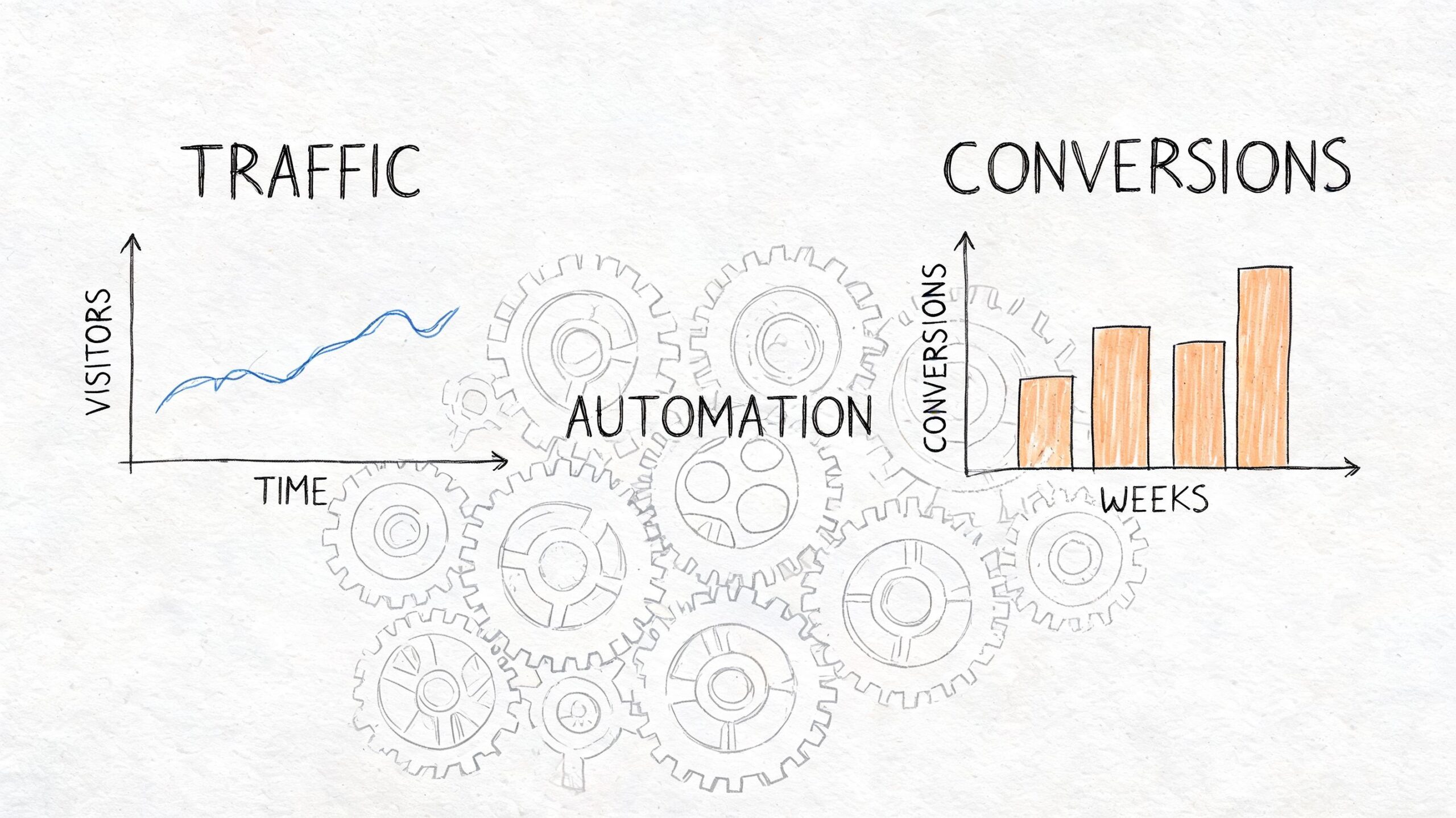
    A hand-drawn sketch illustrating how automation drives website traffic and business conversions over time.

    Automation is how busy agents stay consistent

    That timeline is exactly why execution discipline matters. Most agents don’t fail at SEO because they chose the wrong tactic. They fail because they stop. They publish a few pages, update a profile once, ask for a handful of reviews, then disappear back into reactive marketing.

    Automation solves a practical problem. It keeps the machine running.

    Used properly, OutRank can help with:

    • Keyword discovery: so you keep finding buyer and seller topics worth publishing
    • Content production: so the site grows even when your week gets consumed by deals
    • Backlink support: so authority building doesn’t become another abandoned task
    • Competitor monitoring: so you can see where rivals are gaining ground

    That doesn’t remove the need for judgment. You still need to know which pages matter, which neighborhoods deserve dedicated coverage, and which seller topics match your market. But once the playbook is clear, automation is often the difference between a strategy that sounds good and one that compounds.

    The agents who win with seo for real estate agents usually do boring things well for a long time. They own their Google Business Profile. They build pages around buyer and seller intent. They publish useful local content. They keep the site technically healthy. They measure leads. Then they repeat.


    If you want that process without hiring an agency or turning SEO into a second job, Agency Secrets is a practical place to start. It lays out the playbook clearly and shows how to use OutRank to automate the heavy lifting, from keyword research and article publishing to backlinks and competitor analysis, so your site keeps growing while you stay focused on clients and closings.