
If you're a small business owner doing your own marketing, keyword research for local SEO usually starts the same way. You open a tool, type in a broad service term, see a pile of keyword ideas, and then get stuck deciding what matters.
The issue isn't finding more keywords. It's choosing the right local keywords, matching them to the right pages, and focusing on terms that can lead to calls, bookings, and walk-ins without turning this into a full-time job. That's where most small teams lose momentum.
A practical local SEO workflow is simpler than people make it sound. Start with the services you sell, layer in the places you serve, validate demand with localized tools, study the search results, and then put your best terms on the pages that can win. That's the difference between random optimization and a system that compounds.
Table of Contents
- The Foundation of Local SEO Keyword Strategy
- Discovering Your Core and Long-Tail Local Keywords
- Analyzing Keywords with Tools and Competitor Insights
- Prioritizing High-Intent Keywords for Quick Wins
- Mapping Keywords to Pages and On-Page Optimization
- Tracking Your Local SEO Performance and Iterating
The Foundation of Local SEO Keyword Strategy
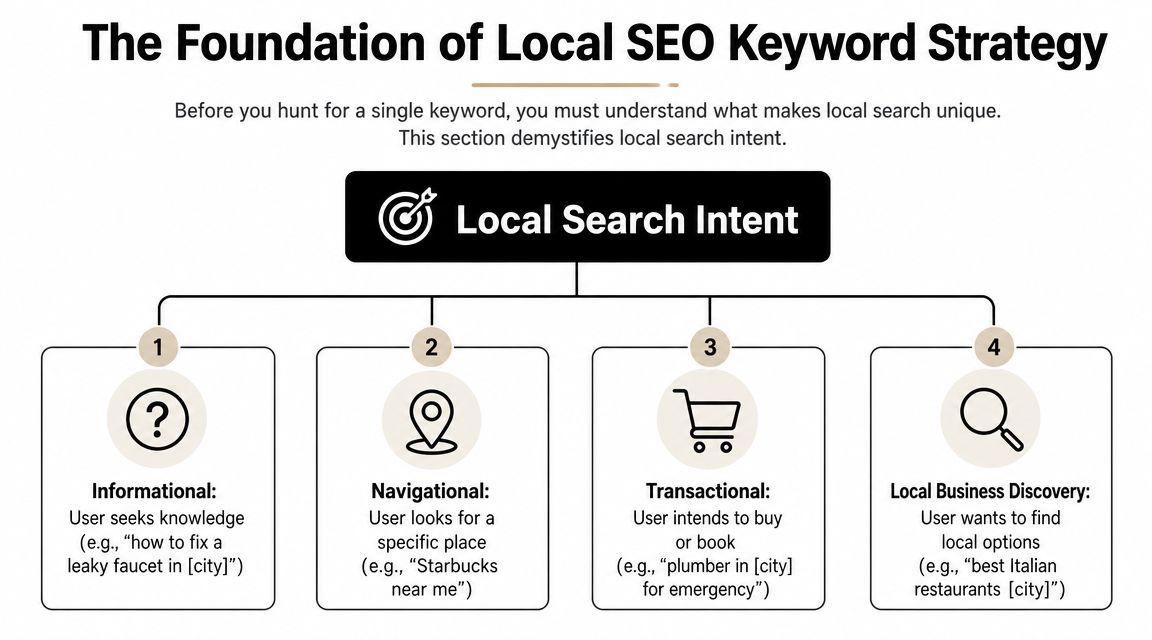
Keyword research for local SEO starts with one question. Is the searcher trying to learn, compare, or act nearby right now?
That sounds obvious, but it's where local businesses go wrong. They treat local search like general SEO and end up writing pages for broad topics that attract curiosity instead of customers. Someone searching for "how to fix a leaky faucet" wants advice. Someone searching for "plumber near me" usually wants a provider, a phone number, hours, reviews, or directions. Those are completely different jobs.
Why local intent changes everything
Local search intent is tied to place. The searcher may include a city name, a neighborhood, a ZIP code, or a phrase like "near me." They may also leave the location out and still expect local results. Google often understands that intent from the query itself and responds with maps, listings, reviews, and business profiles.
The commercial value of that intent is hard to ignore. SOCi reported that in the U.S., there are over 5.9 million keywords related to "near me" and 800 million searches per month, while LocaliQ found that 28% of local searches lead to a purchase within 24 hours according to SOCi's local SEO statistics roundup. That is why local keyword research belongs at the front of your SEO work, not at the end.
Practical rule: If a keyword doesn't connect clearly to a service you offer in a place you serve, it's usually not a priority yet.
Four local intent patterns show up again and again:
- Informational intent: Searches like "how to choose an HVAC system in Dallas." Useful for trust-building content.
- Navigational intent: Searches for a specific brand or business, such as "Joe's Auto Repair near me."
- Transactional intent: Searches with immediate buying or booking intent, such as "emergency dentist in Austin."
- Local business discovery: Searches like "best coffee shop downtown" where the searcher wants options nearby.
What success looks like for a local business
For a local company, traffic alone isn't a useful finish line. A page can get visits and still fail if it doesn't lead to action.
A better KPI set is grounded in outcomes that matter to a business owner:
| KPI | Why it matters |
|---|---|
| Phone calls | High-intent local searchers often call before they click around |
| Direction requests | A strong sign that map visibility is doing its job |
| Contact form submissions | Useful for service businesses with longer sales cycles |
| Bookings or appointments | Direct proof that the keyword matched buyer intent |
| Google Business Profile interactions | Important when the search results page is the conversion point |
If you remember one thing, remember this. Local SEO is not a traffic game first. It's an intent-matching game. The business that wins usually isn't the one with the biggest keyword list. It's the one that understands which searches are closest to revenue.
Discovering Your Core and Long-Tail Local Keywords
Most small businesses overcomplicate discovery. They start with software when they should start with the business itself.
The cleanest workflow begins with a short list of seed terms. These are the plain-English names of your services or products. A plumber might start with drain cleaning, water heater repair, leak detection, sewer line repair, and emergency plumbing. A med spa might start with Botox, facials, laser hair removal, and lip filler.
Start with services, not tools
An effective local workflow follows a structured path. Semrush and Neil Patel recommend listing solution terms and locations, finding variations with tools, evaluating metrics, analyzing competitors, and then mapping keywords to pages, as outlined in Semrush's local keyword research guide. That's a better approach than opening a tool and chasing whatever looks popular.
Build your seed list from sources you already have:
- Service menu: Your main categories, sub-services, and specialty jobs.
- Sales conversations: The phrases customers use on the phone or in forms.
- Customer emails and texts: Often more revealing than polished marketing copy.
- Reviews: They show how people describe your work in natural language.
- Google Search Console: If your site already has visibility, this often reveals surprise queries worth expanding.
Once you have your seed list, start combining it with local qualifiers.
Build your modifier bank
These are the origins of long-tail local keywords. You don't need to invent clever phrasing. You need to reflect how real customers search.
Use a bank of modifiers like these:
- Geographic modifiers: City, neighborhood, district, county, ZIP or postcode, nearby landmarks
- Service qualifiers: Emergency, same-day, affordable, commercial, residential, 24-hour
- Problem-based modifiers: Repair, replacement, installation, cost, near me, open now
- Audience modifiers: Pediatric, family, luxury, small business, apartment, senior
A few examples make this easier to see:
| Seed term | Local modifier | Expanded keyword idea |
|---|---|---|
| water heater repair | Phoenix | water heater repair Phoenix |
| dentist | near me | dentist near me |
| dog grooming | downtown | dog grooming downtown |
| HVAC installation | 24-hour | 24-hour HVAC installation in Tampa |
| electrician | commercial | commercial electrician in Brooklyn |
Broad terms often look attractive in a keyword tool, but small teams usually get faster traction from specific service-plus-location combinations.
A simple keyword capture template
You don't need a fancy dashboard. A spreadsheet works.
Use columns like this:
| Keyword idea | Service | Location | Intent | Notes |
|---|---|---|---|---|
| emergency plumber Chicago | Emergency plumbing | Chicago | Transactional | Strong fit for core service page |
| plumber near me | General plumbing | Service area | Discovery | Likely Local Pack heavy |
| drain cleaning Lincoln Park | Drain cleaning | Lincoln Park | Transactional | Candidate for neighborhood section |
| how to prevent frozen pipes Chicago | Plumbing advice | Chicago | Informational | Blog or FAQ support content |
Keep going until you have a raw list that feels messy. That's normal. Discovery is supposed to create options. The next step is where you cut the list down.
Analyzing Keywords with Tools and Competitor Insights
Raw keyword ideas need a reality check before they deserve a page, a GBP update, or a month of effort. For a small team, that check should answer three questions fast. Is anyone nearby searching for this? Does the search show buying intent? Is Google sending people to websites, the map, or both?
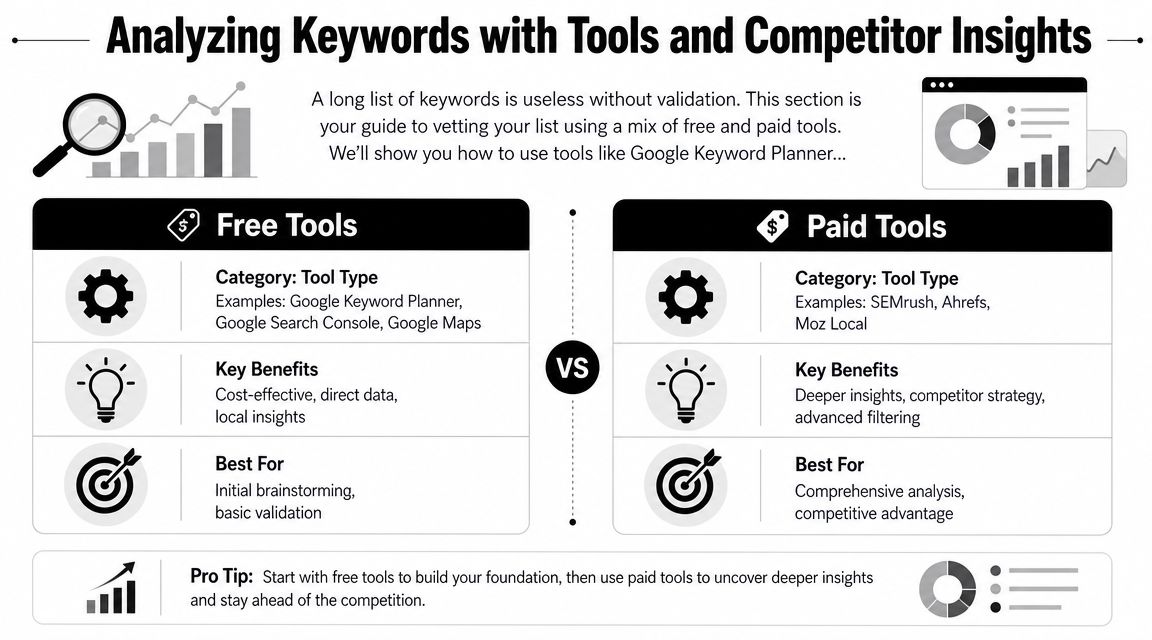
I usually tell owners to stop shopping for tools and start building a workflow. Good local keyword analysis comes from combining one source for demand, one for competitor clues, and one manual review of the live search results.
Good Better Best tool stacks
Use the stack that matches your time and budget, not the one an agency with six subscriptions uses.
| Level | Best for | Tool stack | Trade-off |
|---|---|---|---|
| Good | Solopreneurs | Google Keyword Planner, Google Search Console, Google Trends, Google Maps | Low cost, slower research, more manual checking |
| Better | Small teams | Good stack plus Semrush or Ahrefs | Faster filtering, better competitor discovery, higher monthly cost |
| Best | Competitive local markets | Better stack plus a dedicated local rank tracker or GBP-focused workflow | Better visibility into map performance, more setup and spend |
The trade-off is straightforward. Free tools can get you to good decisions, but they take more judgment. Paid tools save time, surface more variations, and make competitor research easier. They also tempt small teams to chase too many keywords at once.
A simple rule helps. If you manage one location, start with the Good stack and add one paid tool only after you have clear service pages and a working Google Business Profile. If you compete in a dense market like legal, dental, HVAC, or home services across multiple suburbs, the Better stack usually pays for itself in saved time.
A practical review workflow
Run each keyword through the same filter so you do not make decisions based on volume alone.
- Check local demand in Google Keyword Planner, Google Trends, and Search Console if you already have some visibility.
- Check the live SERP from the target area. Search on mobile and desktop if possible.
- Check the map results to see whether the Local Pack is the main conversion point.
- Check competitor pages and profiles for the query. Look at page type, GBP categories, reviews, and service wording.
- Score the keyword based on relevance, intent, and difficulty to win.
That fifth step matters because small teams need a way to choose, not just collect.
A prioritization matrix you can use in a spreadsheet
This is the version I use with businesses that need to make decisions in one working session.
| Keyword | Local demand | Intent | Local Pack presence | Difficulty | Business value | Priority |
|---|---|---|---|---|---|---|
| emergency plumber Austin | High | High | High | Medium | High | Do now |
| water heater installation Round Rock | Medium | High | Medium | Medium | High | Next |
| plumbing tips Austin | Medium | Low | Low | Low | Low | Later |
| plumber near me | High | High | Very high | High | High | GBP + service page support |
Keep the scoring simple. High, medium, and low is enough. A messy but usable sheet beats a detailed scoring model you never finish.
How to read the live search results
Keyword tools estimate demand. Google's results show the format you have to win.
Search the phrase as a customer would. For example, search “plumber near me” or “water heater repair Phoenix” and study the first screen. If you mostly see a map with three businesses, reviews, call buttons, and directions, that keyword is not just an SEO content play. It is a Local Pack play. Your page still matters, but your Google Business Profile, category choice, reviews, and landing page alignment matter just as much.
Check these questions:
- What shows first? Local Pack, ads, organic pages, directories, AI Overview, or a mix
- Who is winning? Independent local businesses, large directories, franchises, or national brands
- What page type ranks? Homepage, service page, location page, review page, or article
- What intent is Google assuming? Emergency help, general research, price comparison, or brand lookup
- Is a click to the website even likely? Some searches lead to calls or direction requests straight from the map
The last point is easy to miss. If the map is doing most of the work, a keyword can still be valuable even when website traffic stays modest. For a locksmith, roofer, dentist, or towing company, phone calls from the Local Pack often matter more than pageviews.
Analysts cited in Koom's local SEO research article note that local searches often end on the results page itself through map interactions and business profile actions. That matches what small businesses see in practice. The win is often the call, not the click.
To get a visual walk-through of keyword validation and search result analysis, this overview is useful:
What to check in the Local Pack
Local pack analysis sounds technical, but it just means studying the businesses shown in the map for your target search. Open Google, search a service in your area, and inspect the three map listings that appear first.
Look for patterns you can act on:
- Primary category fit: Does the listed category closely match the search term?
- Review language: Do recent reviews mention the exact service in the search query?
- GBP completeness: Are hours, services, photos, and attributes filled out and current?
- Landing page match: Does the profile link to a page that clearly answers the query?
- Location strength: Is the business physically close to the search area or strongly associated with it?
- Reputation signals: Are ratings, review volume, and recency noticeably stronger than yours?
Competitor research is useful here, but keep it practical. Do not copy every category, service label, or page title a competitor uses. Find the few signals that repeat across winners, then fix gaps on your own profile and pages.
I often see businesses lose local rankings because their signals are split. The page targets “drain cleaning,” the GBP leans toward “emergency plumber,” and reviews mostly mention “water heater repair.” Google has to guess what the business is best known for. Competitors with tighter alignment make that decision easy.
For small teams, that is the goal of this stage. Find the terms where demand exists, the SERP matches your offer, and the Local Pack gives you a realistic path to calls and leads.
Prioritizing High-Intent Keywords for Quick Wins
This is the point where discipline matters. Most small teams don't fail because they chose zero good keywords. They fail because they tried to target too many at once.
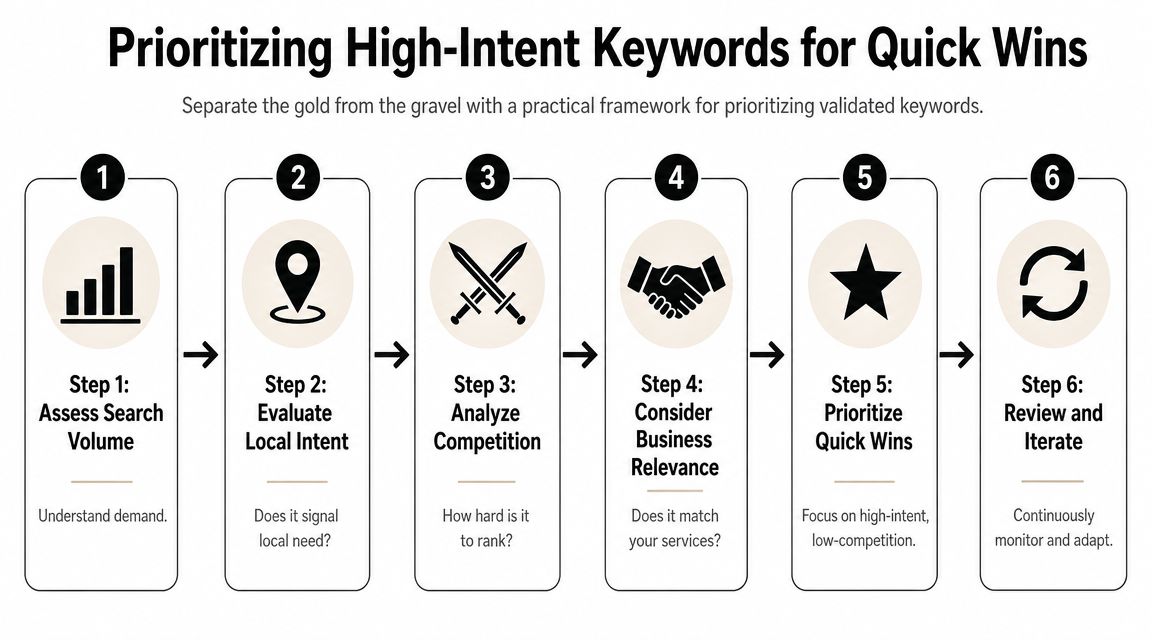
A practical keyword plan favors keywords that are highly relevant, locally validated, commercially useful, and realistically winnable. That's not always the highest-volume term.
The four-factor filter that keeps you honest
Experts at LocalDominator and SEObility agree that local keyword prioritization turns on relevance, local search volume, competition, and intent, with relevance as the most important factor, based on LocalDominator's local keyword research framework.
Here's how to apply those four factors in practice:
Relevance
If you don't want the lead, don't target the keyword. A family law firm shouldn't chase "criminal defense lawyer near me" just because it appears nearby on the SERP.Local volume
You need evidence that people in your service area search for it. Local demand beats national volume every time in local SEO.Competition
Some terms are crowded by directories, mature brands, and aggressive local players. Others have weaker pages, thin profiles, or poor page matching. Those are often better entry points.Intent
"How to unclog a sink" and "emergency plumber open now" are not equal. One is educational. One is urgent. If your time is limited, urgency wins.
A good local keyword often looks boring on paper. That's usually a good sign. Specific service terms convert better than flashy broad phrases.
A prioritization matrix you can use today
Use a simple 1 to 3 scoring model. Keep it lightweight so you'll maintain it.
| Keyword | Relevance | Local volume | Competition | Intent | Total | Action |
|---|---|---|---|---|---|---|
| emergency plumber Chicago | 3 | 3 | 2 | 3 | 11 | Target now |
| drain cleaning Lincoln Park | 3 | 2 | 2 | 3 | 10 | Target now |
| plumbing tips Chicago | 2 | 2 | 2 | 1 | 7 | Support content |
| plumber | 2 | 3 | 1 | 2 | 8 | Defer |
A few quick rules make this matrix more useful:
- Target now: High relevance, strong intent, manageable competition
- Support content: Useful for blog posts, FAQs, and trust-building pages
- Defer: Broad terms that need more authority or a stronger local footprint
- Drop: Keywords that don't fit your business model or service area
Small teams achieve quick wins. They stop chasing the biggest phrase and start publishing the page most likely to rank and convert first.
Mapping Keywords to Pages and On-Page Optimization
Keyword research only starts the job. The ranking asset is the page, and in local SEO, the wrong page match costs calls.
A common example is a plumber with one general Services page trying to rank for emergency plumbing, drain cleaning, water heater repair, and every neighborhood in the city. Google has to guess which query that page deserves to rank for. Customers have the same problem. A person searching "emergency plumber Chicago" wants a fast, obvious answer, not a page that also talks about remodels and sump pumps.
Map existing pages first
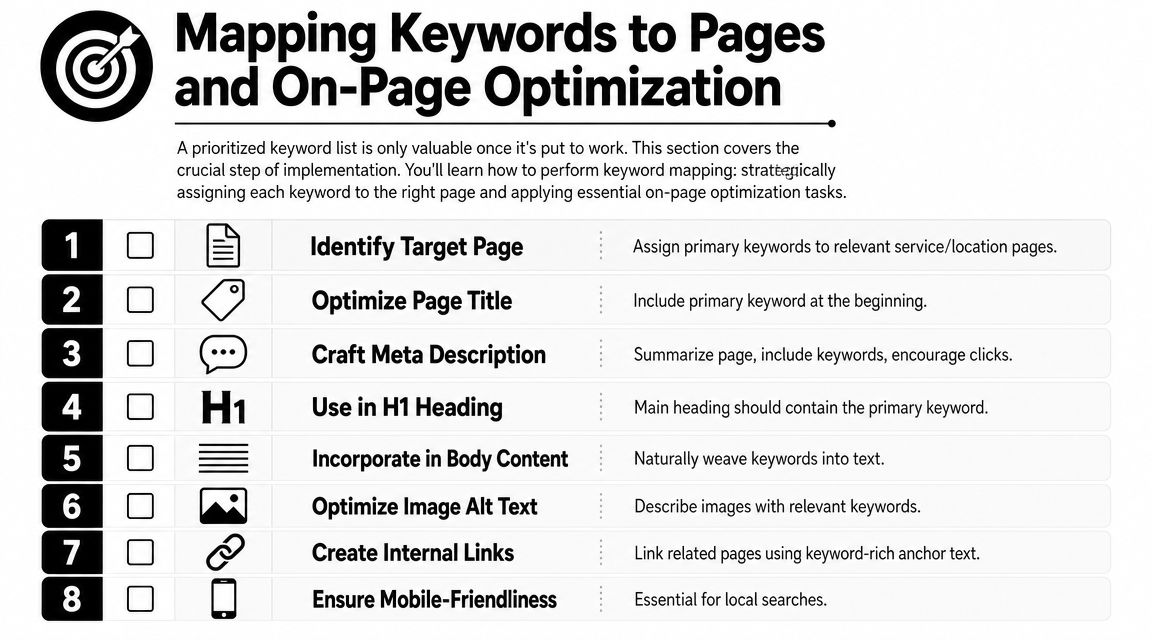
For a small team, the fastest workflow is simple. Start with the pages you already have. Assign one primary keyword to each page. Then look for gaps.
Use a page map like this:
| Page | Primary keyword | Secondary terms | Keep or create |
|---|---|---|---|
| Emergency plumbing page | emergency plumber Chicago | 24-hour plumber Chicago, urgent plumbing repair | Keep |
| Drain cleaning page | drain cleaning Chicago | clogged drain repair Chicago | Keep |
| Water heater page | water heater repair Chicago | hot water heater repair near me | Keep |
| Lincoln Park service area page | plumber Lincoln Park | local plumbing service Lincoln Park | Create only if truly distinct |
This step prevents keyword cannibalization, which is just a technical way of saying two pages from the same site compete for the same search.
A few rules keep the map usable:
- One primary keyword per page: Variants and close synonyms can support the main term
- Match intent to page type: Service terms belong on service pages. Informational terms belong on blog posts or FAQs
- Create location pages only when they can be unique: If the page has no distinct proof, service details, or local relevance, skip it
- Support the money page instead of competing with it: A blog post on "signs you need drain cleaning" should link to the drain cleaning service page, not target the same main phrase
If time is tight, use a Good, Better, Best approach.
- Good: Spreadsheet with page URL, target keyword, title tag, and status
- Better: Spreadsheet plus a quick SERP check for each keyword to confirm the right page type is ranking
- Best: Spreadsheet, SERP check, and local pack review to see whether the keyword is won mainly through the website, the Google Business Profile, or both
That last point matters more than many business owners realize. If the search result is dominated by the map pack, your page still needs to rank, but it also needs to reinforce the profile that may get the click or call first.
How to optimize the page without stuffing it
After the keyword is mapped, make the page obvious to both searchers and Google.
Place the primary keyword in the spots that carry the most meaning:
- Title tag: Lead with the service and city when it fits naturally
- H1 heading: Keep it clear and close to the title tag
- Opening paragraph: Confirm the service and area early
- Subheadings: Use related service terms and real customer questions
- Body copy: Add useful local details such as service areas, response times, common job types, and trust signals
- Image alt text: Describe the image first. Add local context only when it is relevant
Read the page out loud.
If it sounds repetitive, salesy, or strange, fix the copy. Local pages usually improve when they are more specific, not when they repeat the exact keyword five extra times.
Schema can support this work by clarifying business details, services, and location. It helps search engines interpret the page, but it does not fix weak page targeting or thin content.
Don't ignore your Google Business Profile
For many local keywords, the Local Pack is the first real conversion point. That is the map and three business listings people see when they search for something like "plumber near me." If your profile shows up there, the customer may call without ever opening your website.
That changes how page mapping should work.
Your service pages and your Google Business Profile should use the same service language so Google sees a consistent pattern across your site and profile. Keep that alignment across:
- Primary and secondary categories
- Business description
- Services and products
- Posts and updates
- Photos and captions
- Questions and answers
Here is the practical trade-off. A page targeting "water heater repair Chicago" may help organic rankings, but if the map pack gets most of the clicks and calls for that query, the win comes from both assets working together. The page supplies relevance and detail. The profile supplies visibility, reviews, hours, and a fast path to contact.
For a solopreneur, that means prioritizing pages that support high-intent map pack searches first. Build the emergency service page before the broad company overview. Tight alignment beats more content.
Tracking Your Local SEO Performance and Iterating
Local SEO work compounds only if you review it. Otherwise you're publishing pages, tweaking profiles, and guessing.
Tracking doesn't need to be complicated. For a small team, the best system is the one you'll check consistently. That usually means a short keyword set, a simple notes field, and a monthly review of business outcomes.
Track business signals, not just ranks
Rank tracking matters, especially by city or service area, but don't treat it as the only scorecard.
Watch these signals together:
- Keyword positions in your target area: Especially for service-plus-location terms
- Google Business Profile actions: Calls, direction requests, and other profile interactions
- Lead form submissions: Look for pages that start generating qualified inquiries
- Call quality: Ask staff which services people mention when they call
- Page engagement: Are visitors landing on the intended page and taking the next step?
One useful pattern shows up often. A keyword may never drive huge website traffic because the search results page answers the query with map listings and profile details. It can still be a winner if it leads to more calls or direction requests. That's why local SEO performance needs business context.
A lightweight review rhythm for small teams
A monthly review works well for most small businesses.
Use a short checklist:
- Check your top target keywords: Did any move up, down, or trigger different SERP features?
- Review your best pages: Are the mapped service pages still the right fit?
- Inspect one competitor: Did they launch a better page, add reviews, or improve their profile?
- Look for near-miss keywords: Terms where you're visible but not yet strong enough to win consistently
- Refine the next batch: Update one page, improve one profile area, and build one supporting asset
What works is steady iteration. Update pages with better local details. Tighten service language. Improve internal links. Add FAQs that reflect real customer questions. Expand into adjacent neighborhoods only when the current service pages are doing their job.
The businesses that get the most from keyword research for local SEO don't treat it like a one-time spreadsheet exercise. They use it as a feedback loop. That's where the edge comes from.
If you want a simpler way to turn keyword research into content and rankings without hiring an agency, Agency Secrets is worth a look. It gives small business owners a practical SEO playbook built around buyer-intent keyword targeting, strong content structure, backlinks, and evergreen growth, with OutRank helping automate research, article creation, publishing, and competitor analysis.
Leave a Reply