You're probably doing what most local owners do. You run a few ads, get a short spike in calls, then watch the leads dry up the moment you pause spend. Meanwhile, your website sits there like an online brochure instead of a sales asset.
That's the gap content marketing for local business closes. It turns your site into something that keeps working when you're on jobs, seeing patients, serving tables, or handling payroll. A strong service page can bring in calls. A useful FAQ can remove hesitation. A well-written article can attract someone who didn't know your business name yesterday but knows they need help now.
The part most businesses miss is that this only works as a system. Keyword research feeds content. Content feeds internal links. Better structure supports local SEO. Local SEO makes link building easier. Links strengthen the pages you already published. Over time, the whole thing compounds.
Table of Contents
- The Local Advantage Why Content Outperforms Ads
- Find What Your Local Customers Are Asking
- Create Content That Answers Local Questions
- Master On-Page and Local SEO Fundamentals
- Build Local Trust with Links and Citations
- Your System for Compounding Growth
The Local Advantage Why Content Outperforms Ads
Paid ads are rented attention. Once your budget stops, the traffic stops with it. That's fine for a promotion or a short-term push, but it's a weak foundation for a plumber, dentist, HVAC company, roofer, or café that needs steady demand.
Content works differently. You publish a page once, improve it over time, and it can keep bringing in visits, calls, and quote requests long after you hit publish. A page about “emergency plumber in South Austin,” a guide to “Invisalign cost in Scottsdale,” or an article on “best coffee beans for French press at home” can keep showing up whenever local buyers search.

This isn't a fringe tactic anymore. 90% of organizations now have a content marketing strategy, and 71% of marketers say its significance has grown in the past year, according to compiled industry benchmarks on content marketing adoption. For a local business, that means your market is training customers to expect useful content before they call.
Practical rule: Ads can buy attention. Content can earn trust and keep earning it.
The best part is the asset value. A good article doesn't disappear like a boosted post. It can support your service pages, rank for long-tail local searches, answer objections, and give other sites a reason to link to you. That's where the compounding starts.
Here's the trade-off most owners need to hear clearly:
| Approach | What it does well | What it does poorly |
|---|---|---|
| Paid ads | Fast testing, immediate visibility, seasonal promos | Stops working when spend stops |
| Local content | Builds search visibility, trust, and reusable sales assets | Takes discipline and consistency |
| Both together | Captures short-term demand while building long-term reach | Requires focus so you don't spread thin |
If your budget is tight, content usually gives you a better long-term position. If your budget is healthy, content still matters because it lowers your dependence on paid acquisition.
That's why content marketing for local business isn't just blogging. It's a growth engine built from pages, articles, FAQs, internal links, citations, and local trust signals that stack on each other.
Find What Your Local Customers Are Asking
Most local content fails before writing starts. The business guesses what people want, writes broad posts nobody asked for, and wonders why nothing ranks or converts.
The better approach is simpler. Build content from the questions customers already ask, then match those questions to the phrases they use in search. Salesforce recommends identifying your audience by analyzing customer challenges, and Keap emphasizes keyword research so content reflects the exact phrases people search for, as explained in Salesforce's small business content marketing guidance.
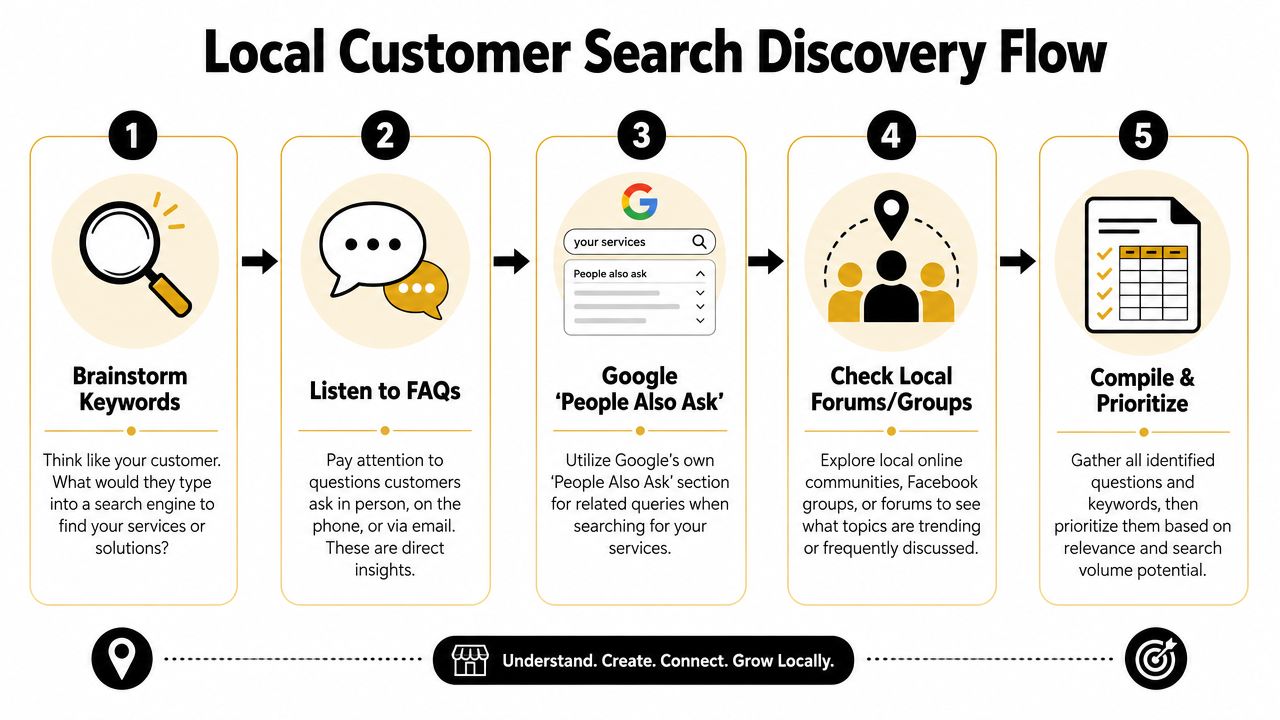
Start with the questions you already hear
You don't need fancy software to begin. Open a document and list what people ask on calls, in DMs, at the front desk, and during estimates.
For a plumber, the list might look like this:
- Urgent service questions: “Do you handle burst pipes at night?” “How fast can someone get here?”
- Cost questions: “How much does water heater replacement cost?” “Do you charge a callout fee?”
- Trust questions: “Are you licensed?” “Do you guarantee the work?”
- Problem questions: “Why does my drain keep backing up?” “Why is my water pressure low?”
Those aren't just sales questions. They're content topics.
Customers usually search for the problem first and the provider second.
Turn one service into many search terms
Take one core service and expand it with modifiers. A local electrician in Phoenix could start with “electrical repair” and branch into:
- Service plus city: electrical repair Phoenix
- Service plus suburb: electrical repair Tempe
- Service plus urgency: emergency electrician Phoenix
- Service plus problem: flickering lights electrician Phoenix
- Service plus cost: electrical panel upgrade cost Phoenix
- Service plus audience: electrician for older homes Phoenix
Many owners go wrong. They only target broad service phrases and skip the high-intent searches around symptoms, urgency, and pricing. Those are often the searches that lead to calls because the person already feels the problem.
A quick way to prioritize is to sort topics into three buckets:
| Bucket | What it usually means | Example |
|---|---|---|
| Ready to buy | The person wants a provider now | emergency plumber in South Austin |
| Comparing options | The person is evaluating service types or pricing | tank vs tankless water heater Austin |
| Learning first | The person wants to understand the issue | why does my bathroom sink smell |
Use Google like a customer would
Type your service into Google and look closely at the results page. Autocomplete, related searches, and “People Also Ask” will show the language buyers use. That's free research.
If you own a dental clinic, search terms might uncover angles like:
- Treatment concerns: “Does Invisalign hurt”
- Price intent: “Invisalign cost Scottsdale”
- Comparison intent: “Invisalign vs braces adults”
- Location intent: “cosmetic dentist near Old Town Scottsdale”
Then check your own Google Business Profile reviews, email inbox, and contact form submissions. If several people phrase the same concern similarly, that wording belongs in your page headings, FAQs, and article titles.
A practical workflow for content marketing for local business looks like this:
- List services you want more of
- Write down customer questions tied to those services
- Add city, neighborhood, and urgency modifiers
- Check Google autocomplete and People Also Ask
- Group similar queries into one strong page instead of many weak ones
Don't create a separate page for every tiny variation. A plumber doesn't need one page for “clogged kitchen sink Austin” and another for “kitchen sink drain clogged Austin” if one solid page can cover the intent well.
What works is consolidation with clarity. What doesn't work is publishing thin, repetitive pages that say the same thing with slightly different keywords.
Create Content That Answers Local Questions
Once you know what people search, your next job is answering better than anyone local. That doesn't mean writing more. It means publishing the right mix of pages so each piece supports the others.
HubSpot's 2026 data reports that website, blog, and SEO content is the highest ROI-generating channel for marketers, and blog posts were named among the top five highest-ROI formats by 22.26% of marketers in 2025, with blogs used by 38% of marketers in that year, according to HubSpot marketing statistics. For local businesses, that matters because service pages and evergreen articles can keep attracting buyers long after publication.
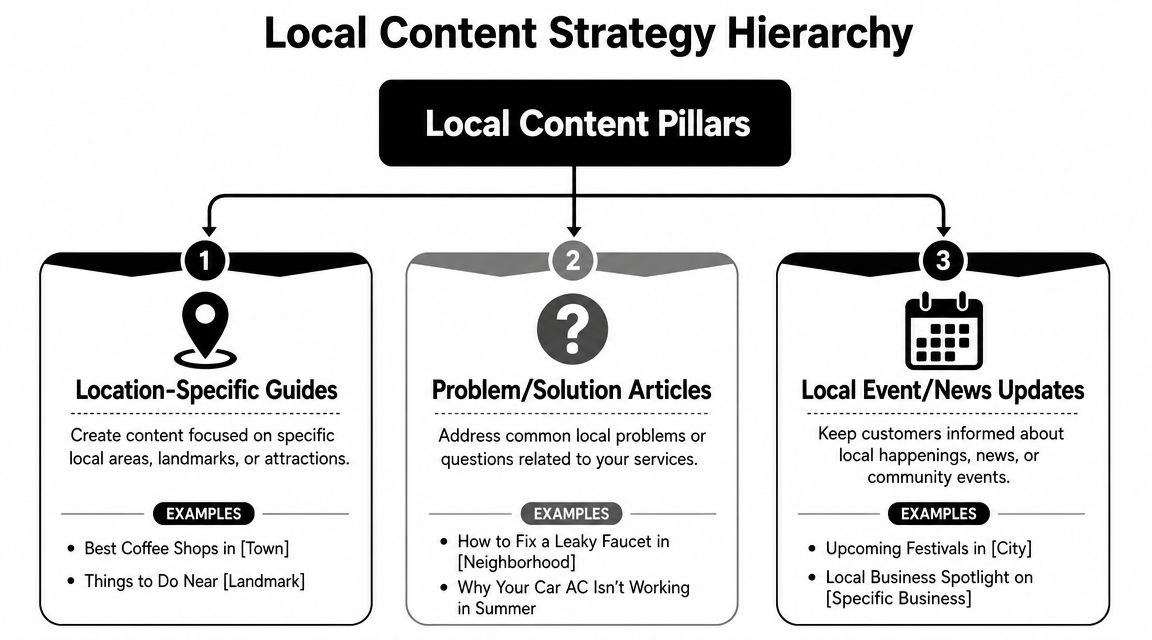
Service pages that convert
Start with your money pages. These are the pages for services you want booked now.
A strong local service page usually includes:
- A clear headline: Say the service and area plainly. “Emergency Plumbing in South Austin” is stronger than “Trusted Solutions for Your Home.”
- Specific problems you solve: Burst pipes, blocked drains, leaking water heaters, no hot water.
- Proof and reassurance: Licensing, service area details, process, warranty, financing if relevant.
- A visible next step: Call button, booking form, request-a-quote form.
For a dentist, that may be a page on “Dental Implants in Naperville.” For a café, it may be “Coffee Catering for Office Events in Brooklyn.” For a roofer, it may be “Roof Repair in Plano.”
These pages should be direct. Don't bury the service under brand storytelling.
Location pages that prove local relevance
A location page is not the same as a service page. It exists to show that your business understands a specific area and serves it well.
A useful location page might include:
| Element | Example for a plumber | Why it matters |
|---|---|---|
| Area-specific intro | Common plumbing issues in older homes in Hyde Park | Shows local relevance |
| Nearby landmarks or neighborhoods | Serving Hyde Park, North Loop, and Hancock | Helps match local intent |
| Local service context | Familiar with older pipe systems and slab leak issues | Builds trust |
| Contact path | Call for service in this area today | Keeps the page action-oriented |
What doesn't work is copying one template across ten suburbs and swapping the town name. That's easy to spot and rarely persuasive.
If a local page wouldn't help a real customer in that area, it probably won't help your rankings either.
A realtor can do this especially well. A page about a neighborhood can include parks, commute patterns, school-adjacent lifestyle points, pet-friendly spots, and housing style notes. That kind of specificity makes the page useful, not just optimized.
Blog posts that pull in early-stage demand
Blog content catches people before they're ready to call. Done well, it feeds your service pages with internal links and trust.
Good local blog topics usually fall into a few patterns:
- Cost and pricing: “How much does a new roof cost in Denver?”
- Problem diagnosis: “Why does my AC smell musty in summer?”
- Comparisons: “Porcelain veneers vs bonding”
- Local guidance: “What café owners should know about seasonal outdoor seating permits”
- Preparation content: “What to do before the exterminator arrives”
A café owner could publish “Best pastries for office breakfast catering” and link that post to a catering service page. A dental clinic could write “How long does Invisalign treatment take” and link to its Invisalign consultation page. A plumber could publish “What to do when a pipe bursts before help arrives” and direct readers to emergency service.
Here's the important connection. Your blog is not separate from sales. It supports sales when each article points readers toward the next logical page.
A simple three-part content stack looks like this:
- Service page for direct commercial intent
- Location page for geographic relevance
- Supporting blog post for questions, objections, and early-stage search intent
That stack turns isolated pages into a content system. Each new article strengthens existing assets instead of sitting alone in your blog archive.
Master On-Page and Local SEO Fundamentals
Publishing useful content isn't enough. Google still needs clear signals about what the page is about, where you work, and how the page connects to the rest of your site.
A lot of owners overcomplicate this part. You don't need advanced technical knowledge to get the basics right. You need a repeatable checklist and the discipline to apply it to every important page.
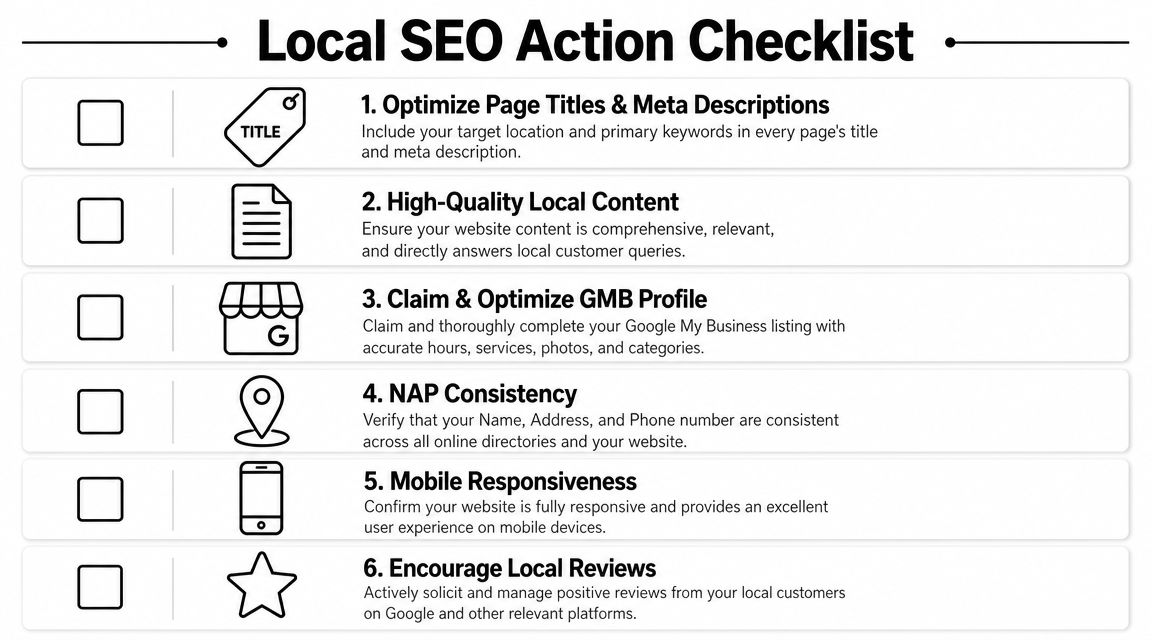
What to fix on every important page
Start with the page elements users and search engines both read first.
- Title tag: Include the core service and location naturally. “Emergency Plumber in South Austin | 24 Hour Service”
- Meta description: Summarize the page clearly and give a reason to click.
- H1 heading: Match the page topic without being clever.
- H2 and H3 structure: Break up the page by questions, services, process, and FAQs.
- Internal links: Link from blog posts to service pages, from service pages to related service pages, and from location pages to contact pages.
- Image alt text: Describe the image accurately and keep it relevant.
Here's a simple model:
| Page type | Main keyword focus | Best internal links |
|---|---|---|
| Service page | service + city | related services, contact page, FAQs |
| Location page | service area or neighborhood | service page, testimonials, contact page |
| Blog post | question or problem query | service page, location page, relevant FAQ |
Internal links matter more than most local businesses think. They help users move through your site, and they show search engines which pages carry the most weight.
Before the next checklist, this walkthrough is worth watching if you want a visual explanation of local SEO basics.
What local businesses need beyond the page
Local SEO also depends on signals outside the article itself.
Your baseline checklist should include:
- Google Business Profile: Claim it, complete it, choose the right categories, and keep hours current.
- NAP consistency: Your business name, address, and phone number should match across your website and directory listings.
- Contact page signals: Include your full contact details and service area information.
- Map embed: Add a Google Map on your contact or location page if you serve from a physical location.
- Schema markup: LocalBusiness schema helps search engines understand business details in a structured way.
- Mobile usability: Most local searches happen on phones, so your pages need to load cleanly and make calls easy.
A local page fails when the user has to hunt for basics like service area, phone number, hours, or next step.
What works is clarity. What doesn't work is stuffing city names into awkward sentences, hiding contact details, or publishing long pages with no structure.
If you do the fundamentals well, your content has a better chance to rank, earn clicks, and turn visits into calls. If you skip them, even strong writing can underperform.
Build Local Trust with Links and Citations
Local rankings don't come from content alone. Google also looks for trust signals that show your business is real, established, and connected to the community it serves.
That's where citations and local links come in. Citations confirm your business details across the web. Links from relevant local sites strengthen authority and can send direct referral traffic too.
Citations first, then relationships
Start with the boring work because it matters. Make sure your business appears consistently in the places customers and search engines expect to find it.
That usually means checking:
- Major business listings: Your core profiles and local directories
- Industry directories: Dental associations, legal directories, contractor listings, restaurant platforms
- Community listings: Chamber of commerce pages, neighborhood business directories, local event sites
- Review platforms: The sites your customers already use to evaluate businesses in your category
For a dentist, that might mean dental association listings and local directories. For a café, it may include local food guides and city business pages. For a plumber, it often includes contractor and home service directories.
If your name, address, or phone number varies across those profiles, clean that up before chasing advanced tactics. Messy citations dilute trust.
How local links happen in real life
The best local links rarely come from outreach templates. They come from doing real things in your market that other organizations naturally mention online.
A few examples:
A plumbing company sponsors a youth baseball team. The league posts sponsor logos and links from its website.
A dentist hosts a school toothbrush drive. A local nonprofit lists community partners and links to the practice.
A café collaborates with a nearby bookstore for an evening event. The bookstore publishes the event page and links to the café's site.
A roofer creates a storm prep checklist for homeowners in a specific county. A neighborhood association shares it in its online resources section.
Those links are hard for competitors to copy because they're rooted in actual relationships.
Spammy link tactics usually leave local businesses with junk placements nobody reads. Community-based links do the opposite. They build search trust and local recognition at the same time.
A strong content asset also makes link building easier. If you publish a useful neighborhood guide, local event roundup, or homeowner checklist, you give other sites a reason to reference your business. That's why the earlier steps matter. Better content creates more link opportunities later.
Your System for Compounding Growth
Most local businesses don't need more marketing ideas. They need a system they can keep running while the business stays busy.
That system is simple. Publish on a schedule you can maintain. Promote each piece in the channels your audience uses. Check performance. Improve what works. Metric Marketing recommends maintaining an editorial calendar, while multi-channel distribution and analytics review are emphasized in the source material summarized at Metric Marketing's small business content guidance.
A calendar you can actually keep
You do not need an elaborate publishing machine. You need consistency.
For most local businesses, a workable rhythm looks like this:
| Week | Main task | Example |
|---|---|---|
| Week 1 | Publish one service or location page update | add FAQs to “Emergency Plumbing in Round Rock” |
| Week 2 | Publish one supporting article | “Why your water heater runs out faster in winter” |
| Week 3 | Distribute and repurpose | email newsletter, Facebook post, Instagram story |
| Week 4 | Review and improve | update title, add internal links, expand FAQ |
That's manageable for a small team. It's also enough to create momentum if you stick with it.
If you own a dental clinic, your month might include one implant page refresh, one blog post about recovery expectations, and one email to past consultation leads. If you run a café, it might be one catering page update, one event-related blog post, and a newsletter promoting both.
What to measure without drowning in reports
A lot of owners quit because analytics feels like homework. It doesn't need to.
Look at a short list:
- Which pages get search impressions and clicks
- Which pages drive calls, form submissions, or bookings
- Which topics hold attention and lead users to another page
- Which channels help distribute content effectively
You can get most of this from Google Search Console, Google Analytics, your call tracking setup, and your form submissions.
The key is pattern recognition. If a plumber's article about slab leaks keeps attracting search traffic, that topic deserves follow-up content and stronger links to the slab leak service page. If a dentist's financing FAQ gets visits but no consultations, the page may need a clearer next step. If a café's catering page gets traffic from email but not search, that points to an SEO gap, not a content gap.
What doesn't work is publishing, sharing once, and forgetting it. What does work is a loop:
- Publish
- Promote
- Measure
- Improve
- Link it into the rest of your site
That's how content marketing for local business becomes a compounding engine instead of a pile of disconnected posts. Each useful page makes the next one easier to rank. Each internal link strengthens existing assets. Each citation and local mention supports trust. Over time, your site stops acting like a brochure and starts acting like a lead source.
If you want a simpler way to execute this without hiring a full agency, Agency Secrets is worth a look. It focuses on the exact system local businesses need: buyer-intent keyword research, consistent publication of authoritative content, relevant backlinks, and the compounding effect of evergreen SEO. If you want the playbook and the tools to help you run it with less manual work, that's a practical place to start.
Leave a Reply