Blog

  • Get High Authority Backlinks: 2026 Guide

    Get High Authority Backlinks: 2026 Guide

    Most backlink advice is backward. It tells small businesses to chase volume, buy placements, or obsess over DA screenshots. That approach burns money and usually builds a backlink profile full of links nobody reads, nobody trusts, and Google can safely ignore.

    A better approach is smaller, sharper, and much more realistic if you're running the business yourself. You don't need hundreds of links. You need the right links from relevant sites, useful pages, and real editorial contexts. That's how a solo operator can compete with bigger brands that waste budget on bloated SEO campaigns.

    The practical way to get high authority backlinks is to treat link building like business development. Find the right targets. Create one or two assets worth citing. Reach out with a useful reason. Vet every opportunity. Then track whether those links improve rankings, traffic, and leads. That workflow is slower than buying junk links, but it holds up.

    Table of Contents

    What Actually Counts as a High Authority Backlink

    High authority is not a vanity score. It is a link from a site that people in your market trust, placed on a page that makes editorial sense, and strong enough to pass real visibility and credibility to your business.
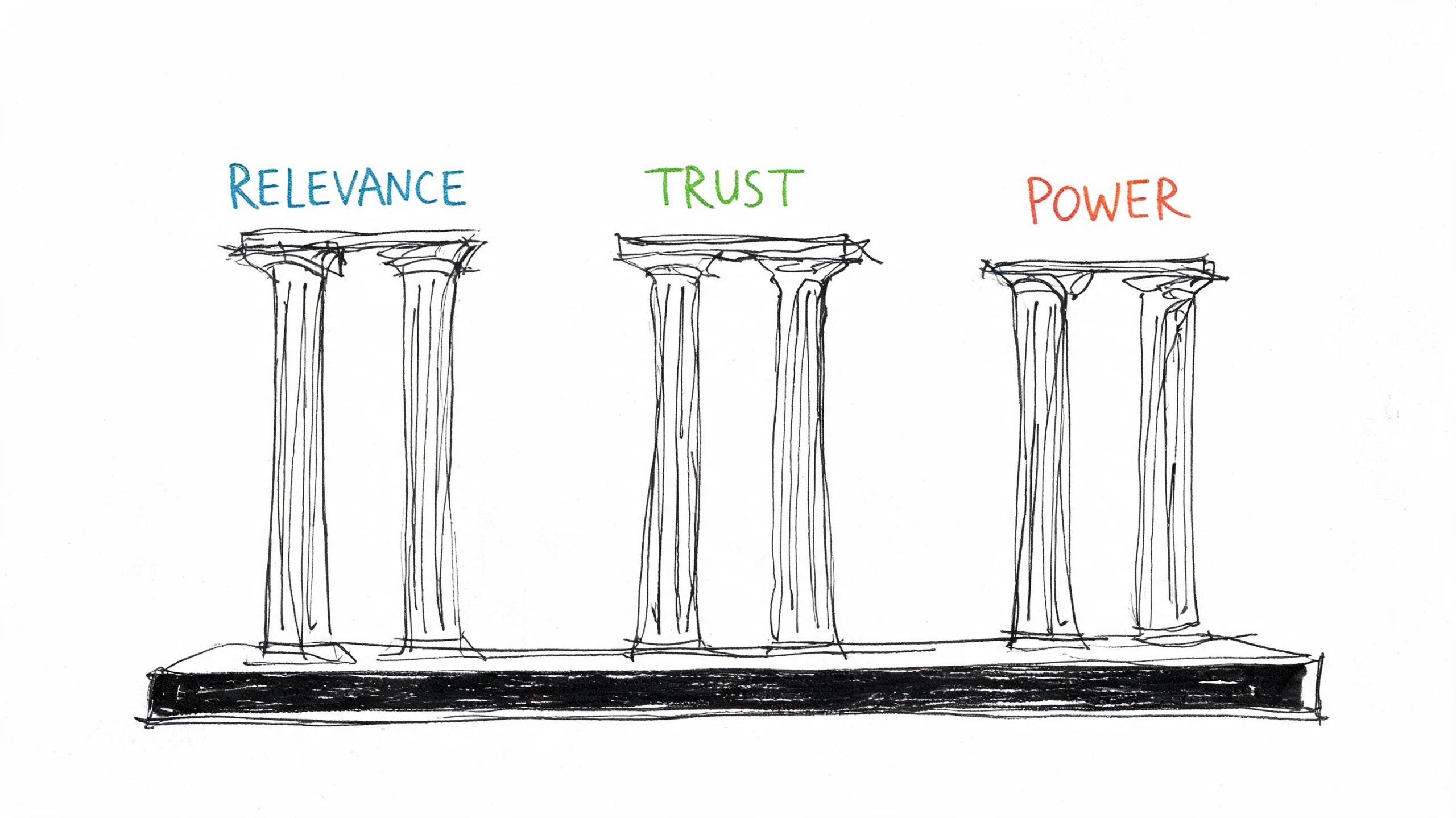
    A hand-drawn sketch of three architectural pillars labeled Relevance, Trust, and Power on a dark base.

    Authority starts with relevance

    A local clinic will usually get more SEO value from a respected healthcare publication than from a high-DR marketing blog. An industrial supplier will usually benefit more from a trade journal than from a broad business site with no subject overlap. Search engines do not treat every strong domain as equally meaningful. Context changes the value of the link.

    Metrics still help with screening. They just should not make the decision for you. A useful benchmark is this: high-authority backlinks from sites with DA above 60 to 70 are foundational for SEO, and a single DA 75+ link can equal the value of 5 to 10 links from DA 30 sites, according to Rock The Rankings on high-authority backlinks.

    For a solo business owner, the practical definition is simpler than the SEO industry makes it sound:

    • Relevant: The site covers your niche, your customer problem, or a close adjacent topic.
    • Trusted: The site has real authors, real readers, and content that exists for more than selling links.
    • Powerful: The link sits inside the main content of a page that already earns attention and trust.

    That is the filter.

    If a link would send you qualified referral traffic, strengthen your reputation, or help a prospect trust you faster, it is probably worth pursuing. If it only looks good inside a spreadsheet, skip it.

    Trust and placement matter more than raw domain metrics

    A DA 70 link in a weak article can be mediocre. A DA 45 link from the right industry site can be excellent. I see small businesses waste money when they buy based on domain score alone and ignore the page, the topic, the anchor text, and the company the link keeps.

    Ask basic questions. Is the article indexed? Does the site publish on one topic or dozens of unrelated ones? Do the outbound links look editorial, or do they look rented? Would you be comfortable showing that placement to a customer who is doing due diligence on your business?

    That standard keeps you out of trouble and saves budget.

    For small businesses, the goal is not to build the biggest backlink profile in the category. The goal is to earn a compact set of links that make your business look like a credible choice in a narrow market. One mention from a trade association, local news site, software partner, or respected niche publisher can do more than twenty low-trust links that never should have been built.

    Finding Link Opportunities Worth Your Time

    The bottleneck in link building is rarely outreach. It is picking targets that were never realistic in the first place. A solo business owner does not need a list of 500 sites. You need 20 to 30 prospects with a clear reason to care about your business, your expertise, or an asset you can produce without hiring an agency.

    A house connected by a dotted line to a magnifying glass revealing a glowing yellow chain link.

    Start with competitor patterns, not raw backlink exports

    Ahrefs and Semrush are useful here, but the goal is not to download every referring domain and copy it. The goal is to identify repeatable link types you can earn with limited time.

    Pull two or three direct competitors. Then sort their links into buckets:

    1. Resource page links from curated tools, guides, and recommended vendor pages.
    2. Contributed content links from industry blogs, podcasts, and expert roundup posts.
    3. Partner links from software vendors, distributors, associations, or complementary service providers.
    4. Editorial citations where a journalist, publisher, or blogger quoted them or referenced a useful asset.

    Then ask one practical question for each link. What caused it?

    Sometimes the answer is a decent template. Sometimes it is a founder quote, a local data point, a case study, or a niche page that solved a specific problem better than the generic results already ranking. That cause matters more than the backlink itself, because it tells you what to build and who to pitch.

    Small operators can beat bigger brands in this area. Large companies often win on volume. You can win on fit.

    Build a short list you can qualify by hand

    A prospect is worth your time if you can answer three questions quickly:

    • Is the site relevant to your market?
    • Is there an obvious page or format where your business belongs?
    • Can you explain the value of your inclusion in one or two sentences?

    If any answer is fuzzy, skip it.

    I would rather see a local accountant work a list of 15 association pages, local business publications, software partner directories, and niche finance blogs than spend a week emailing national publications that will never reply. Relevance and accessibility usually beat prestige when time is tight.

    Resource pages and niche lists still produce wins

    Resource pages get dismissed because so many bad ones exist. The good ones still work. They are maintained, selective, and built to help a specific audience find credible options.

    Search like a customer or editor would search. Use queries tied to your niche plus phrases such as "recommended tools," "helpful resources," "best vendors," "member directory," or "industry association." Then review the page manually.

    A strong resource-page opportunity usually checks these boxes:

    • The page serves readers first.
    • Your page or business fills a real gap in the list.
    • The site is active enough that someone may still review suggestions.

    Keep the outreach tight. Mention the exact page. Explain what your resource adds. Make it easy for the editor to say yes or ignore you without reading a long pitch.

    Weak fit kills response rates faster than weak copy.

    Use journalist requests as an ongoing channel

    HARO-style outreach is one of the few channels where a solo business owner can get strong editorial links without paying for placement, but it only works if you treat it like a routine. Analysts at Digital Applied's link building strategies found that using HARO can deliver DR 50+ editorial links with a 15 to 25% selection rate for optimized responses. The same analysis found that replying in under 2 hours improved selection odds, and that a brief daily habit can produce links from sites with strong authority signals.

    The trade-off is consistency. You may send many useful replies before one lands. That is still a good exchange if the process only takes 20 to 30 focused minutes a day.

    Use a simple workflow:

    • Choose narrow categories. Only respond where you have direct experience.
    • Reply fast. Journalists often use the first credible answers they receive.
    • Lead with the quote. Put the usable insight in the first lines.
    • Write like an operator. Specific examples beat polished marketing language.
    • Keep your byline clean. Name, role, company, website.

    If you run a local service business, a small ecommerce brand, or a specialized consultancy, you already have material worth quoting. Client patterns, pricing shifts, operational mistakes, buyer objections, and regional trends are all usable if you explain them plainly.

    That is the agency-free advantage. You are closer to the work, so your answers can be more specific, faster, and more useful than generic PR copy.

    Creating Content That Naturally Earns Links

    A lot of business owners spend too much time chasing links and too little time building pages that deserve them. If the asset is weak, outreach turns into begging. If the asset is useful, outreach becomes simple distribution.
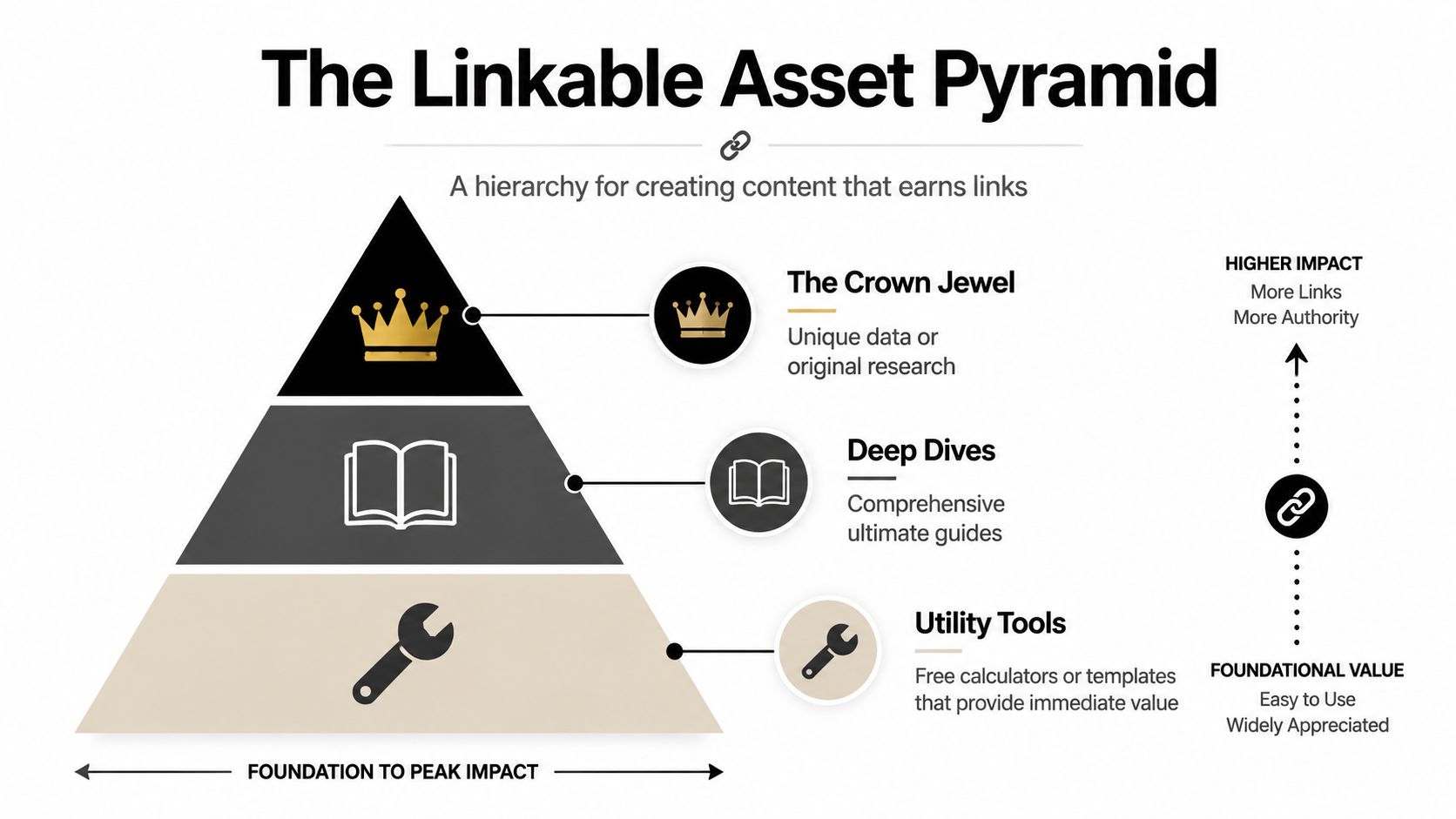
    A hierarchical pyramid diagram illustrating the different types of content assets that earn high authority backlinks.

    For a solo operator, the goal is not to publish more. The goal is to publish a small set of pages that other sites can cite without hesitation. Good linkable assets usually do one of three jobs. They explain something clearly, help someone complete a task, or add evidence from real-world experience.

    The three asset types worth building first

    I would start with one asset in each of these categories, then improve them over time instead of constantly creating new posts.

    Utility tools are the fastest win. Calculators, checklists, templates, intake forms, scripts, and worksheets earn links because they save people time. A local accountant can publish a quarterly tax checklist. A wedding photographer can publish a shot-list template. A B2B consultant can publish a vendor evaluation worksheet. None of these require a design team.

    In-depth guides work when the topic has search demand and weak existing resources. The page needs clear structure, plain-English explanations, examples, and a point of view shaped by actual client work. Publishing a longer article alone is not enough. It has to be the page another writer trusts as a reference.

    Original insight pages have the highest ceiling. That does not require a formal study. You can publish a pricing breakdown, a benchmark page, a summary of patterns from sales calls, or a list of recurring mistakes you see in projects. If the insight comes from doing the work, it can earn citations.

    Why some pages get cited and others get ignored

    Writers, editors, and site owners link for a practical reason. They are usually looking for one of four things:

    • Definition support: a page that explains a term without fluff
    • Evidence support: a source that strengthens a claim
    • Utility support: a tool, template, or checklist readers can use
    • Comparison support: a page that helps readers evaluate options

    That is why format matters.

    A 600-word opinion post rarely earns links unless the author already has a strong audience. A useful calculator can earn links with almost no promotion. A comparison page can attract citations from buyers, bloggers, and service pages if it stays current. A well-structured guide can become the source other writers reference when they need to explain a concept quickly.

    That is the agency-free advantage here. You do not need a content calendar packed with twenty article ideas. You need a few assets that are easier to cite than the alternatives.

    A practical content mix for small businesses looks like this:

    Asset type Best use Why it earns links
    Concept guide Explain a core topic in your niche Writers need a clear reference
    Template or checklist Help people take action fast Useful resources get cited
    Comparison page Clarify differences between options Supports buyer research
    Original observations Add perspective from real work Builds credibility and quotable material

    One warning. Do not start with an infographic, a glossy trend piece, or a broad “ultimate guide” unless you already know people in your field want that format. In small-budget link building, practical beats impressive.

    The best linkable assets reduce friction for another writer. They explain, prove, or simplify something that writer needs.

    A simple workflow works better than chasing content trends:

    1. List repeated questions. Pull them from sales calls, emails, and customer objections.
    2. Match each question to an asset type. Explanation, tool, comparison, or insight.
    3. Build the easiest high-value version first. A checklist often beats a large article.
    4. Add proof from real work. Screenshots, examples, numbers from your process, or common scenarios.
    5. Update the page quarterly. Freshness matters more on comparison and data-driven assets.

    If time is tight, start with the page another site can cite in one sentence and their reader can use in five minutes.

    The Art of Effective Outreach Without Being Spammy

    Cold outreach is overrated. Page-specific outreach is what gets links.

    A hand holding an envelope with a network node diagram rising from it, symbolizing digital communication and connectivity.

    A solo business owner does not need to send 500 emails a month. You need 20 to 30 well-chosen prospects, a real reason to contact each one, and a page worth linking to. That is how you compete with bigger teams without burning time on inbox churn.

    Editors and site owners ignore outreach for one simple reason. The email creates work instead of removing it. If your message asks them to review a random article, trust your claims, and decide where it fits, you are giving them another task. Good outreach does the opposite. It points to a specific page, a specific gap, and a specific fix.

    Start with a reason tied to the page

    The strongest outreach angle usually falls into one of four buckets:

    • A broken outgoing link on their page
    • An outdated recommendation or stat
    • A missing resource their readers would use
    • A section where your example, quote, or tool improves the article

    That is why the Skyscraper Technique can still work. Executed with precision, it can yield a 20 to 40% response rate. But 70% of campaigns fail because the pitches are generic. Showing a side-by-side comparison of value can boost replies by 35% or more, according to Search Logistics on link building statistics.

    The useful lesson is not "copy this tactic." It is simpler than that. Show why your page helps their reader more than what is there now.

    Before you email anyone, write down your reason in one sentence. If you cannot explain the fit that clearly, skip the prospect.

    Write like a person who noticed something useful

    Short emails work because they respect attention, not because they are clever. Keep the note specific, easy to scan, and low pressure. I tell clients to remove anything that sounds like a compliment written for ten other websites.

    Use these as starting points, then customize them.

    Broken link replacement

    Subject: Broken link on your [topic] page

    Hi [Name],

    I was reading your page on [topic] and noticed one resource in the [section name] appears to be broken.

    If you're updating it, I have a current guide on [topic] addressing the same angle here: [Your Page]

    If it's useful, feel free to swap it in. Either way, I thought you'd want to know about the broken link.

    Best,
    [Your Name]

    Resource page suggestion

    Subject: Possible addition to your [page title]

    Hi [Name],

    I found your resource page for [audience/topic] and saw you list tools and guides for [specific use case].

    We published a [guide/template/tool] on [topic] that could fit the [relevant section] because it helps readers [specific value].

    If helpful, I can send the direct link and a one-line summary for quick review.

    Thanks,
    [Your Name]

    Two small details improve reply rates. Use the recipient's page title or section name so they know you looked. Then make the ask easy to evaluate in under 30 seconds.

    One more thing helps. Study examples before you start sending emails.

    Follow up without becoming a nuisance

    A lot of good pitches get missed the first time. Inbox timing is messy. People save things and forget them. That is normal.

    The fix is a short follow-up sequence, not a bigger sales routine.

    • First email: State the page, the issue or opportunity, and your suggested resource.
    • Second email: Send a brief follow-up a few days later. Mention the same page and keep it to one or two sentences.
    • Third email: Close the loop. Give them an easy out and stop there.

    A clean follow-up looks like this:

    Just checking in on this resource suggestion for your [page/topic] page. If it's not a fit, no problem at all.

    That works because it sounds like a professional note, not a campaign trying to squeeze one more reply out of a list.

    The agency-free way to handle outreach is boring on purpose. Build a short prospect list. Match each site to one useful asset. Send personalized emails. Track replies in a simple spreadsheet. Keep the angles that get traction, and drop the ones that waste your week.

    Your Link Vetting Checklist To Avoid Penalties

    A decent outreach campaign can still create problems if you say yes to the wrong sites. Many business owners are harmed at this stage. They finally get traction, then accept links from sites that exist mainly to sell links.

    A good link prospect passes a common-sense test

    Don't overcomplicate vetting. Open the site and ask basic questions. Does it look like a publication someone reads? Are there named authors? Are the articles coherent? Do outbound links feel selective, or does every post push to unrelated businesses?

    Then use your tools. Ahrefs, Semrush, and even a manual Google search can tell you a lot. You're looking for topical consistency, signs of organic visibility, and pages that appear to serve users first.

    The strongest prospects usually share these traits:

    • Editorial clarity: Articles have a purpose, not just filler paragraphs around a link.
    • Relevant topic coverage: The site regularly publishes in your niche or a close adjacent one.
    • Reasonable outbound linking: It doesn't spray links to casinos, crypto schemes, payday loans, or unrelated software in every post.
    • Healthy publishing pattern: New content appears, old content still exists, and the site doesn't look abandoned.

    If a site looks like it was built for link sellers, treat it that way.

    Link Vetting Checklist

    Check What to Look For (Green Flag) What to Avoid (Red Flag)
    Relevance The site covers your industry or a tightly related topic The site publishes on every topic under the sun
    Editorial quality Named authors, readable articles, clear standards Thin content, anonymous posts, obvious AI slop
    Link placement Link appears naturally in the article body Footer, sidebar, author bio, or forced paragraph insertion
    Outbound profile Selective links to credible businesses and sources Frequent links to spammy or unrelated industries
    Site health Consistent publishing and signs of real readership Abandoned blog, broken pages, erratic updates
    Intent The placement makes sense for readers The page exists mainly to host outbound links

    Red flags that should end the conversation

    Some prospects don't deserve a second thought. Walk away if you see patterns like these:

    • Topic mismatch: A site about fashion wants to link to your B2B accounting page.
    • Paid-placement language: The editor immediately offers "dofollow packages" across multiple sites.
    • Recycled guest posts: Every article follows the same template with different anchor text.
    • Sketchy neighbors: The site links to industries you wouldn't want your brand near.
    • No real standards: The publisher accepts anything as long as someone pays.

    The safest mindset is simple. If you'd be embarrassed to show the site to a customer, don't want the link.

    Measuring ROI and Scaling Your Link Building

    A link is only valuable if it improves a page that matters to the business.

    Small business owners get into trouble when they measure link building by volume. Ten new links can look productive in a report and still do nothing for rankings, leads, or sales. The better approach is simpler. Tie every link effort to a page with a job to do, then check whether that page gained more visibility, better traffic, or more conversions over time.

    Track the signals that connect to revenue

    Start with four numbers:

    • Referring domains to your money pages
    • Ranking movement for the linked page
    • Referral traffic from the linking site
    • Leads or sales assisted by organic visits to that page

    That gives you a practical scorecard without turning this into a data project.

    Google Search Console shows whether impressions and clicks are rising. Google Analytics shows whether the page attracts useful visits and assists conversions. Your SEO tool helps you confirm whether the page is gaining stronger referring domains over time. For a solo operator, that is enough to spot whether the work is paying off.

    Patience still matters. Link building usually pays back over months, not days. A strong placement on the right site can support rankings long after the outreach work is done, especially if it points to a commercial page or a linkable asset that feeds internal authority to revenue pages.

    Review links at the page level, not just the domain level

    This is the part many small businesses skip.

    Do not ask, "Did link building work?" Ask, "Did links to page A improve page A's performance enough to justify the time spent getting them?" That question is much easier to answer, and it helps you stop wasting effort on pages that were never likely to produce business value.

    A simple monthly review works well:

    • Pick the 5 to 10 pages you actively built links to
    • Compare current rankings against the previous month
    • Check organic clicks and assisted conversions
    • Note any new referring domains to each page
    • Flag pages that improved, stalled, or declined

    After two or three cycles, patterns show up. Some pages respond quickly to a few strong links. Others need better on-page work, stronger search intent alignment, or a better offer before more links will help.

    Scale the parts that do not require your judgment

    A solo business owner should keep control of the work that affects quality. That means choosing targets, deciding the angle, writing or editing the outreach that needs a human touch, and building real publisher relationships.

    The repeatable tasks can be systemized:

    • prospect collection
    • contact research
    • content briefs
    • asset updates
    • reporting
    • internal linking support

    I usually advise owners to build one repeatable link workflow before trying to expand. For example, if resource page outreach is producing decent links at a reasonable time cost, keep that engine running before adding digital PR, guest posts, and broken link campaigns on top of it. One process executed consistently beats four half-finished tactics.

    Scaling link building without an agency usually means getting more selective, not doing more. Cut low-response prospect lists. Reuse winning outreach angles. Update the assets that already attracted links instead of constantly publishing from scratch. Protect your time for the small set of actions that earn placements.

    Frequently Asked Questions About High Authority Links

    Are high authority backlinks always expensive

    No. The expensive route is usually the shortcut route, paid placements on sites that exist to sell links. A solo business owner does better by earning links through useful assets, partner mentions, resource pages, journalist requests, and broken link outreach. The cash cost can stay low. The actual cost is time, follow-up, and choosing opportunities carefully.

    Should you care about DA and DR

    Use DA and DR to filter prospects fast, then move on.

    They are screening metrics, not decision-makers. A relevant link from a well-run niche site often does more for rankings and qualified traffic than a higher-metric link from an off-topic site with weak editorial standards. Check the site, the page, and the context of the link before you spend an hour on outreach.

    How long does link building take

    Longer than most owners expect.

    High-quality links usually come from repeated outreach, better assets, and steady relationship-building, not one clever email. That is why solo operators need a process, not a pile of tactics. Pick a page worth promoting, build a short list of strong prospects, send useful outreach, track what earns replies, and keep improving the asset. Done right, link building compounds, but it rarely pays off in a week.

    Should you buy backlinks

    I would not build a small business SEO strategy around bought links. The risk is not just Google penalties. It is wasting money on links that never move rankings, never send traffic, and sit on sites with no real audience.

    If you have budget, put it into assets people want to reference, cleaner outreach, and better prospect research. That gives you something you can keep using next month instead of starting over.

    What's the best first step if you're doing this alone

    Start with one page.

    Choose the page that already has business value, a service page, a strong guide, or a useful local resource. Improve it until another site has a real reason to cite it. Then build a short target list using competitor backlinks, relevant resource pages, and media request platforms. One page with a clear angle and focused outreach beats ten pages with weak positioning.

    If you want a practical, agency-free SEO system instead of random tactics, Agency Secrets is a smart place to start. It shows small business owners how to combine keyword research, content production, high authority backlinks, and evergreen SEO into one workflow, with OutRank handling much of the heavy lifting so you can stay focused on the parts that need your judgment.
  • How to Rank for Low Competition Keywords in 2026

    How to Rank for Low Competition Keywords in 2026

    Most SEO advice still pushes small businesses toward the biggest keywords in the room. That's backwards.

    If you're a local service business, solo founder, ecommerce operator, or lean in-house marketer, you probably don't lose in search because your product is worse. You lose because you're trying to compete on terms built for companies with bigger sites, larger teams, and stronger backlink profiles. Going after broad keywords too early burns time, drains budget, and usually ends with a page stranded far from page one.

    The underdog play is different. You win by being more precise. You target the phrases larger competitors ignore, the ones tied to specific problems, narrow use cases, and clear buyer intent. That's how smaller sites start ranking, earn trust, and build momentum without hiring an agency.

    Table of Contents

    Why Chasing High-Volume Keywords Is a Losing Game

    Small businesses get trapped by search volume.

    A founder opens a keyword tool, sees a giant term in the niche, and assumes that's the prize. So they publish a page for something broad like "marketing software," "plumber," or "project management app." Then they wait. And wait. Meanwhile, the search results are crowded with massive brands, old domains, layered content hubs, and backlink-heavy pages that have been accumulating authority for years.

    That isn't a content problem. It's a strategy problem.

    Broad keywords look attractive because they suggest scale. But for a smaller site, they often create the worst mix possible: vague intent, strong competition, and a long path to any meaningful return. Even if you do rank someday, the traffic can be messy because broad terms pull in people who are early in research mode, casually browsing, or looking for something adjacent to what you sell.

    Go where the giants aren't paying attention. That's usually where the practical revenue lives.

    A better path is to stop treating SEO like a popularity contest and start treating it like market positioning. Precision beats brute force. A narrow keyword with the right intent can bring in fewer visitors and still produce more leads, calls, demos, or sales than a flashy head term.

    Here are the trade-offs most smaller businesses learn the hard way:

    • Big volume usually means bigger incumbents. You aren't just competing with pages. You're competing with domain strength, content depth, and brand familiarity.
    • Broad intent creates weak conversion paths. A visitor searching a general term may not be close to action.
    • Longer timelines create fragile commitment. When a page takes too long to move, teams stop publishing or start chasing the next shiny keyword.
    • Low competition keywords stack. One page rarely changes a business. A focused set of pages does.

    This is why underdogs should build from the edges inward. Rank for the specific query first. Earn clicks, links, and internal topical relevance. Then move one layer broader.

    That approach isn't glamorous. It works.

    What Makes a Keyword Low Competition

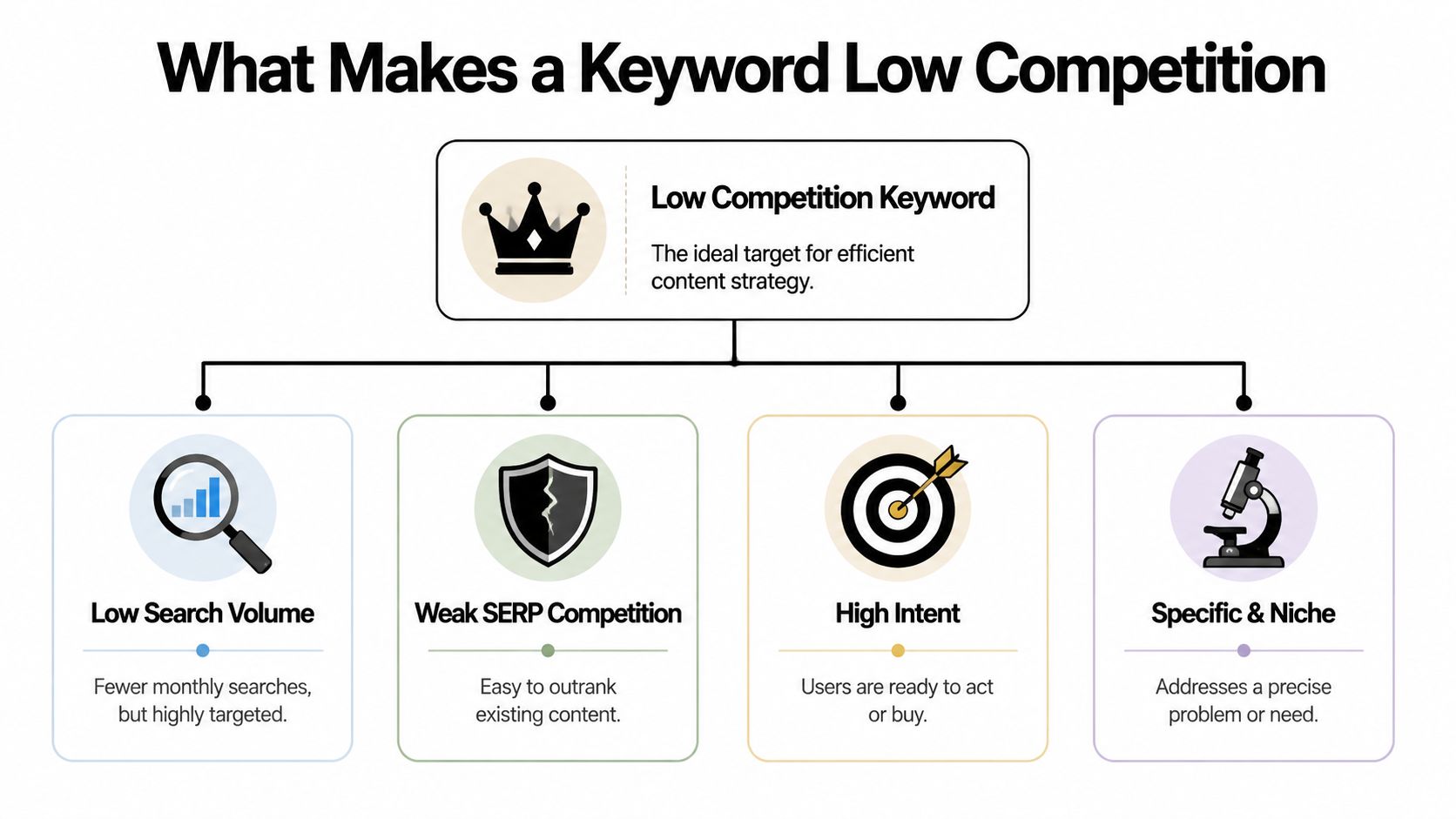
    A low competition keyword isn't just a phrase with lower search volume. It's a keyword where the current search results give you a realistic opening.

    Think of SEO like choosing a route. A high-competition keyword is the packed highway at rush hour. Everyone wants it, everyone is fighting for position, and the biggest vehicles dominate the lane. A low competition keyword is the backroad. Fewer cars. Less pressure. You still reach the destination, but you don't waste resources forcing your way through traffic.

    According to Semrush's low-competition keyword methodology, low-competition keywords are often identified by Keyword Difficulty scores below 30 to 40, and scores under 30% are labeled "Easy", which makes them feasible for new or low-authority domains. The same source notes that SMBs focusing on KD below 30% clusters saw 150% to 300% organic traffic uplifts in case studies from 2020 to 2025.

    A diagram illustrating the four key factors that define low competition keywords for content strategy.

    The highway versus backroad test

    When I assess whether a keyword is low competition, I don't stop at a tool score. I look for four conditions working together.

    • Lower difficulty. This is the obvious one. If the keyword sits in the easier range, it deserves attention.
    • Specific wording. Narrow phrases usually mean a narrower SERP. That's good for smaller sites.
    • Intent clarity. A keyword with obvious purpose is easier to satisfy with a focused page.
    • Weaker existing results. If the top pages are thin, outdated, off-intent, or from forums and mixed directories, you have a shot.

    A keyword can have modest volume and still be far more useful than a broad term because the visitor knows what they want. That's why long-tail and use-case-driven phrases often outperform the obvious targets for underdog sites.

    Practical rule: If the current top results look generic, loosely matched, or half-finished, the keyword may be easier than the number suggests.

    Keyword Difficulty thresholds that matter

    KD isn't perfect, but it's useful when you treat it as a filter rather than a verdict.

    KD Score Range Competition Level What It Means for Your Business
    0-29 Easy Best hunting ground for newer sites, local businesses, and smaller brands
    30-39 Low to moderate Possible if intent is clear and the current SERP is weak
    40+ Competitive Usually not the first place an underdog should spend energy

    Many businesses struggle with this specific step. They use one number in isolation. But KD only tells part of the story. Search results can still be beatable if the ranking pages don't solve the query well.

    Look for signs like these:

    • Forum-heavy SERPs. Google may be struggling to find a strong page.
    • Mismatched content types. Product pages ranking for informational searches, or blog posts ranking for commercial queries.
    • Thin local pages. Common in service niches where competitors haven't invested in content.
    • Weak topical depth. The top page answers the core question but leaves obvious follow-up questions untouched.

    Low competition keywords aren't magic. They're just winnable. That's enough.

    A Practical Workflow for Discovering Hidden Gem Keywords

    Most businesses don't need more keyword ideas. They need a better way to separate useful ideas from junk.

    Start manually. Tools help later. If you skip the manual step, you'll end up with a list that looks clean in a spreadsheet but has no connection to how customers search.

    A hand holding a magnifying glass over a hand-drawn map to identify a hidden gem niche concept.

    Start where customers already complain and compare

    The best low competition keywords often show up in places where people describe their problem in plain language.

    Search these sources with a notebook open:

    1. Reddit threads
      Product comparisons, frustration posts, niche subreddits, and "what should I use for…" questions are full of raw keyword phrasing.

    2. Quora and industry forums
      Not because the answers are always good, but because the questions reveal recurring demand.

    3. Google autocomplete
      Type a seed phrase and run the alphabet soup method. Add letters after the phrase and note what keeps appearing.

    4. People Also Ask
      This is one of the fastest ways to map adjacent questions and supporting subtopics.

    5. Competitor navigation and page titles
      If a competitor has a page for a narrow use case, that's often a sign the query has value.

    Build a list from these sources first. Don't judge it too early. You're trying to capture language, not declare winners.

    Then sort the list by theme. A local roofer might end up with clusters like emergency repair, insurance claims, leak diagnosis, and neighborhood-specific searches. A software company might see clusters around alternatives, integrations, pricing, and use-case pages.

    Use tools to narrow the list, not to replace judgment

    Once you have themes, move into a keyword tool and filter aggressively.

    According to SEOptimer's overview of high-volume low-competition keywords, high-volume low-competition keywords are defined as terms with 1,000 or more monthly searches and low KD scores below 30, and sites targeting long-tails with 100 to 1,000 volume achieved 40% to 60% first-page ranking rates within 90 days, compared with 5% to 10% for high-KD terms in Ahrefs and Semrush data from 2020 to 2025.

    That doesn't mean you should only chase the highest numbers inside the easy range. It means you should prioritize combinations that are still realistic.

    Use filters like these:

    • Minimum relevance first. If the term doesn't connect to what you sell, cut it.
    • Low KD second. Keep the list focused on terms your site can plausibly win.
    • Volume as a tiebreaker. Use it to prioritize among good options, not to override intent.
    • SERP sanity check last. Open the results and look at what's ranking.

    A practical shortlist usually includes three buckets:

    Bucket What it looks like Why it matters
    Quick wins Narrow problem-focused phrases Easier to rank and useful for early traction
    Commercial terms Alternatives, reviews, best-for pages Stronger buying intent
    Authority builders Closely related informational topics Support internal links and topical coverage

    After you've built that shortlist, watch this walkthrough for another angle on researching easier terms:

    One more thing matters here. Don't confuse weird with valuable. Some low competition keywords are easy because nobody searching them is likely to buy, call, or care. The point isn't to find obscure phrases. The point is to find overlooked phrases that map to real demand.

    Validating Keywords for Profit Not Just Traffic

    A keyword isn't good because it can bring visits. It's good if those visits can turn into business.

    Many small sites waste months at this stage. They publish informational content that attracts curious readers, students, and people with no intention to buy. The analytics dashboard looks alive, but the pipeline doesn't move.

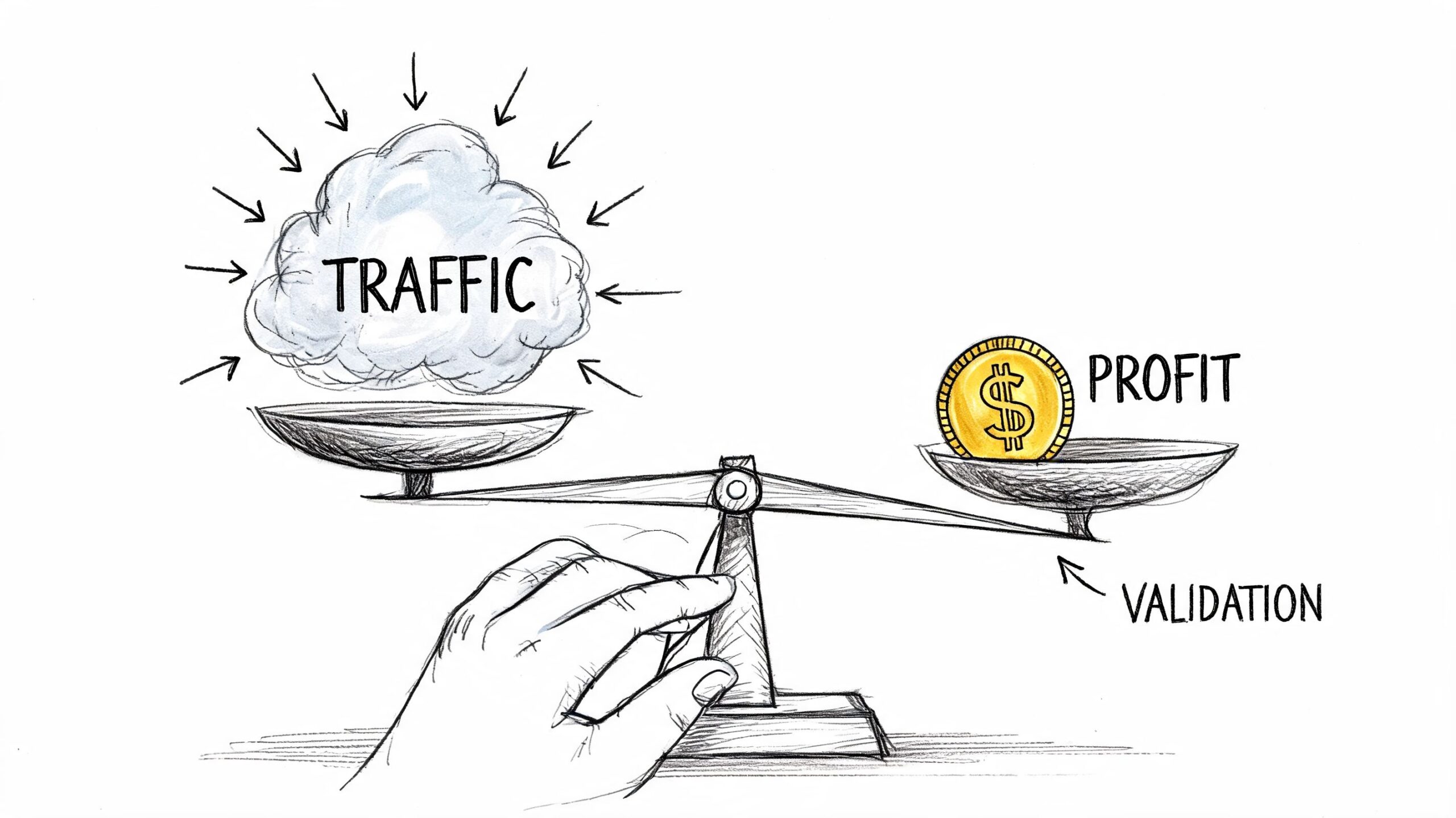
    A hand balancing a scale with traffic represented by a cloud and profit represented by a gold coin.

    Traffic can distract you from revenue

    Bottom-of-funnel keywords deserve more attention than they usually get, especially for lean businesses. According to this YouTube discussion on BOFU keyword opportunities, specific buyer-intent phrases such as "best zero-based budgeting app for freelancers" are often undertargeted and can rank in weeks rather than months compared with broader terms.

    That's the kind of asymmetry underdogs should exploit.

    Someone searching a broad educational query may only want a definition. Someone searching an alternative, review, best-for, or near-me phrase is much closer to taking action. Those keywords often have less competition precisely because they're narrow. Large publishers prefer scale. Small businesses need qualified demand.

    If a keyword sounds like something a real buyer would type five minutes before making a decision, pay attention.

    A simple intent checklist

    Before adding any keyword to your calendar, run it through this screen:

    • Does the searcher want information, comparison, or action?
      Action and comparison terms usually deserve priority if leads or sales matter now.

    • Can your business satisfy the intent directly?
      If the searcher wants a tool comparison and you sell one, great. If they want free templates and you only sell consulting, think harder.

    • Would the ideal customer search it?
      Not every relevant keyword is commercially useful. Relevance alone isn't enough.

    • Can one page answer the query cleanly?
      If the topic is too broad or mixes multiple intents, it may need a different angle.

    • Is there a natural next step?
      Strong pages make the conversion path obvious. Book a call. Request a quote. Start a trial. View pricing.

    Here's a quick lens for judging intent:

    Intent type Example pattern Priority for a small business
    Informational how to, what is, why does Useful when tightly connected to your offer
    Commercial best, review, alternative, comparison Usually high priority
    Transactional buy, near me, pricing, quote Highest priority when relevant
    Navigational brand names, login, support Usually low priority unless it's your brand

    The hard truth is simple. A smaller business doesn't need the most traffic. It needs the right traffic first.

    Content and Link Building for Low Competition Terms

    Once you've chosen the keyword, don't overcomplicate the page.

    Low competition keywords usually don't require a giant content production machine or an expensive backlink campaign. What they do require is a page that matches intent better than what's already ranking. That means relevance, clarity, structure, and a strong internal link network.

    Build the page that should rank

    For easier terms, content quality often wins before raw authority does. But quality in SEO doesn't mean "long." It means the page earns the click and then satisfies the search.

    A page targeting a specific low competition keyword should usually do these things:

    • Answer the main question early. Don't hide the value in paragraph eight.
    • Match the content type already favored by the SERP. If searchers want a comparison page, don't force a generic blog post.
    • Cover obvious follow-up questions. Use subheadings that reflect how buyers think.
    • Show real specificity. Mention use cases, constraints, trade-offs, and who the option is best for.
    • Link to supporting pages. Build clusters so the page isn't isolated.

    A focused page with sharp intent usually beats a bloated page that tries to rank for everything.

    Internal linking matters more than most small businesses realize. If you publish a page about "best accounting software for freelance designers," link to it from broader pages about freelancer accounting, tax workflows, invoicing, and software comparisons. That helps search engines understand the page belongs inside a real topical system, not as a random one-off article.

    A simple cluster often includes:

    1. A commercial page targeting the main buyer-intent term
    2. Supporting informational pages that answer adjacent questions
    3. A broader category or hub page that links the topic together

    Earn links you can actually get

    You don't need a heroic outreach campaign for every low competition keyword. Many smaller sites stall because they think link building means sending hundreds of cold emails. Usually, they would be better off earning a handful of highly relevant mentions.

    Realistic tactics include:

    • Podcast guesting. Niche shows often link to your homepage or resource page.
    • Expert commentary. Journalists, newsletters, and industry writers need usable quotes.
    • Partnership pages. Suppliers, software integrations, and associations often maintain member or partner listings.
    • Local relevance links. Chambers, sponsorships, neighborhood guides, and event pages can help local service sites.
    • Original utility assets. A calculator, checklist, template, or comparison table gives people something to cite.

    What doesn't work well for most underdogs is building links to pages that don't deserve them. If the content is vague, over-optimized, or written without first-hand usefulness, even a decent link won't save it.

    The best sequence is simple. Pick a narrow keyword. Publish the page that answers it cleanly. Support it with nearby content. Then earn a few relevant links that make contextual sense.

    How to Automate and Scale Your Keyword Strategy

    The manual playbook is enough to get traction. It isn't enough to maintain consistency once the business gets busy.

    That's where automation helps. Not as a shortcut for weak strategy, but as a way to apply a strong process repeatedly without rebuilding it from scratch every week.

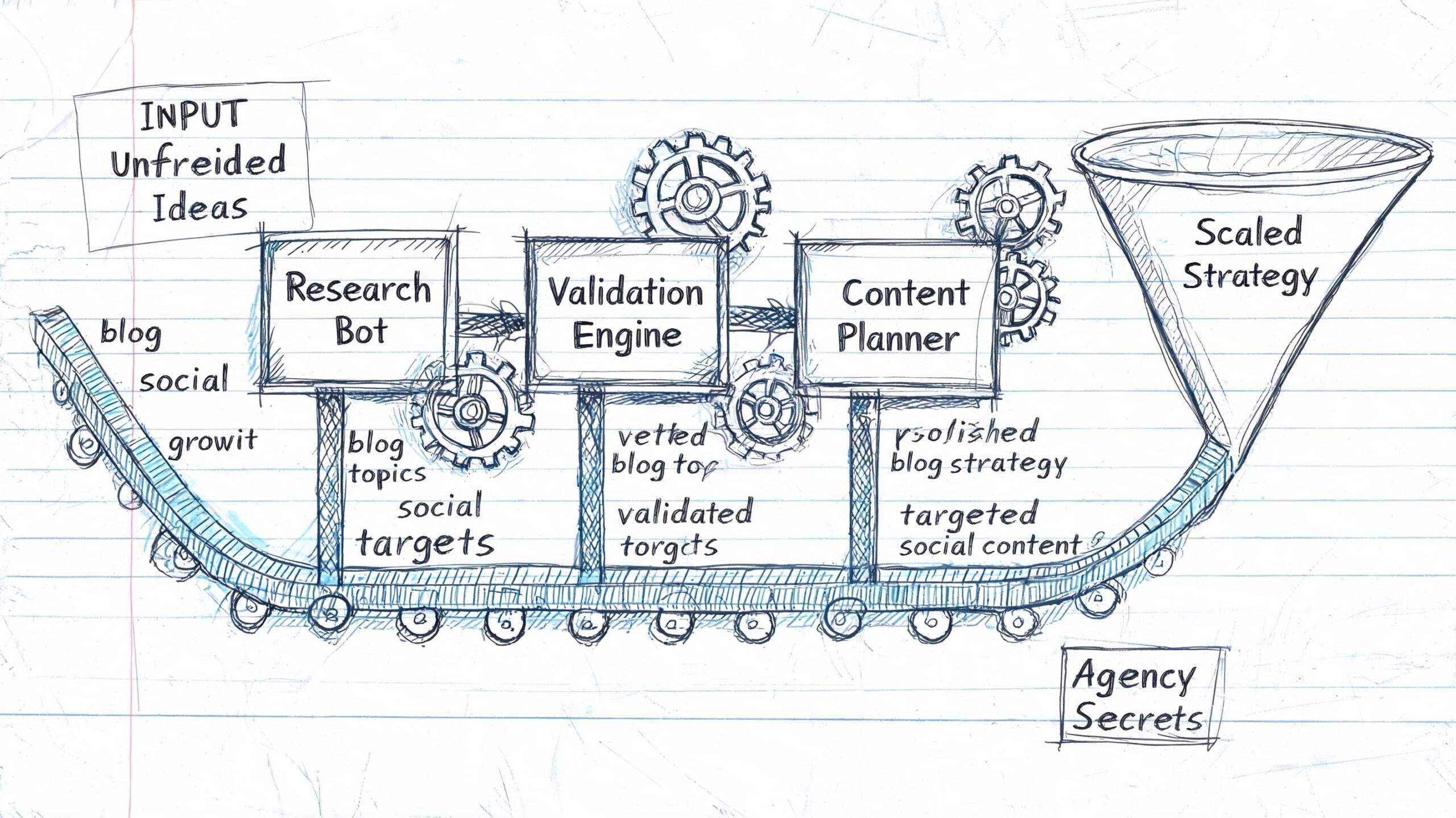
    A hand-drawn sketch of a business process automation workflow labeled as Agency Secrets on notebook paper.

    Good automation follows a clear process

    If your workflow is fuzzy, automation just helps you make mistakes faster. But if your workflow is already sound, automation can remove the repetitive parts that slow teams down.

    That usually means systematizing work like this:

    • Keyword discovery based on low competition and clear intent
    • Clustering related phrases into pages instead of creating cannibalized content
    • Content briefs that reflect the actual SERP and intent
    • Publishing cadence that doesn't collapse when the founder gets busy
    • Internal linking across related pages and categories

    Where AI actually helps

    According to Seoprofy's discussion of low-competition keyword workflows, an emerging trend is using AI tools with precise prompts to find low-competition keyword clusters for low-DA sites, and tools that integrate People Also Ask and social data can automate discovery and publication of up to 30 articles per month while helping build authority 2x faster.

    That matters because the biggest challenge for smaller teams usually isn't knowing one good keyword. It's turning one good keyword into a durable publishing system.

    Used well, AI can help with:

    • Expanding seed topics into clusters
    • Finding long-tail variations that reflect real customer language
    • Drafting faster around a validated outline
    • Maintaining consistency across many supporting pages

    Used badly, AI floods your site with generic content around weak keywords. That's worse than publishing slowly.

    The winning setup is simple: humans decide the market, intent, offer, and trade-offs. Automation handles the repetition.


    Agency Secrets gives small business owners a practical way to run this playbook without hiring an agency. It focuses on buyer-intent keyword research, consistent publication, relevant backlinks, and evergreen compounding, then pairs that strategy with OutRank to automate the heavy lifting. If you want an agency-free system for finding low competition keywords, publishing at scale, and growing organic traffic while you run the business, explore Agency Secrets.

  • 8 Powerful Example of Backlinks You Can Earn in 2026

    8 Powerful Example of Backlinks You Can Earn in 2026

    What does a strong backlink example look like when you are the one who has to earn it?

    Business owners usually do not need another generic list of link types. They need to know which links can improve rankings, which ones can send qualified referral traffic, and which ones are a waste of outreach time. A guest post on the wrong site, a bloated directory profile, or a paid placement dressed up as editorial coverage can all look fine in a report while doing very little for the business.

    The useful question is not whether a backlink exists. The useful question is whether the link is relevant, credible, and realistic for your site to earn again.

    This guide approaches backlinks like a working playbook, not a glossary. Each example shows what the link looks like, how to judge its quality signals before you pitch, and how to repeat the process without hiring an agency. That includes the trade-offs. Some link types take longer but hold value well over time. Others are faster to pursue, but only if you filter hard and avoid low-trust sites.

    The goal is to build a backlink profile that supports rankings, trust, and real business visibility. Random links rarely do that. Relevant, defensible links often do.

    Table of Contents

    1. Editorial Backlinks from Industry Publications

    Why do some backlinks move rankings and referral traffic, while others sit in your report and do nothing?

    Editorial backlinks usually sit in the first group. A trade publication, industry blog, or established news site links to your business because your insight makes their article better. That editorial judgment is what gives the link weight.

    What this backlink looks like

    A retail software company gets quoted in a piece about point-of-sale trends. A roofing contractor is cited in an article about storm-season maintenance. The link appears inside the body of the article, next to a claim, example, or expert quote the reader can use.

    A conceptual illustration showing a blue highlight box with text connected to a trusted globe icon.

    That context matters. A link from a respected publication is hard to manufacture because an editor has to decide your contribution deserves space. In practice, these links tend to send stronger quality signals than links you place yourself.

    How to earn it without a PR agency

    Business owners usually miss editorial links for one reason. They pitch the company instead of pitching something publishable.

    Editors care about material they can drop into a story quickly. That usually falls into three buckets:

    • Original observations: a short data roundup, trend summary, pricing analysis, or pattern you've seen across customers
    • Expert input: a clear quote on a narrow topic where you have direct experience
    • Citable assets: a glossary, benchmark page, checklist, or explainer that supports a claim

    Practical rule: If a writer cannot quote it, cite it, or use it to support a point, it probably will not earn an editorial backlink.

    I have seen small companies get these links with simple assets, not flashy campaigns. A dentist can publish a plain-English guide to insurance terms patients keep misunderstanding. A local accountant can maintain a page with filing deadlines and common penalties. A SaaS company can publish a benchmark page with definitions and examples that other writers can reference without rewriting from scratch.

    The trade-off is speed. Editorial backlinks take more effort per win than directory links or easier outreach plays. But one strong mention from a publication your buyers already trust can outperform a pile of weaker links.

    Quality signals to check before you spend time pitching

    Do not chase logos alone. Check the site like an operator.

    • Topical relevance: The publication covers your market, your buyers, or a closely related problem.
    • Real editorial standards: Articles have named authors, clear point of view, and original writing.
    • Contextual placement: Links appear inside articles, not on random partner pages or thin roundups.
    • Indexation and visibility: The site shows up in search for its own topics and publishes pages that get read.
    • Audience fit: A mention there would still be valuable if Google ignored the link.

    A quick test helps. Open three recent articles and ask: would a prospect trust this site, and would an editor naturally cite a business like mine here? If the answer is no, skip it.

    A simple editorial outreach angle that gets replies

    Cold outreach works better when it gives the editor a usable angle, not a generic introduction.

    Use this structure:

    Subject: Data point for your piece on [topic]
    Email:
    Hi [Name],
    I noticed you cover [specific beat]. We recently saw [specific observation] across [customers, projects, region, dataset].

    One example: [brief insight with a number, pattern, or concrete takeaway]. If helpful, I can send a short quote or a cleaner summary you can use in your article.

    [Name]
    [Role]
    [Company]

    Keep it short. Give them something they can publish. Leave out the company history, the mission statement, and the request for a "collaboration."

    For business owners without an agency, that is the playbook. Create one asset worth citing, identify publications that already cover your topic, and pitch a specific angle tied to their audience. That is how editorial backlinks become repeatable instead of random.

    2. Guest Posting and Contributor Articles

    What makes a guest post worth the effort?

    The answer is simple. It should put your business in front of the right readers and leave you with a link you would still want if Google ignored it tomorrow. That is the standard business owners should use, because guest posting gets expensive fast. The cost is not always money. It is time spent researching sites, pitching editors, writing drafts, and waiting through slow review cycles.

    A strong example of backlinks in this category is a contributor article on a publication your buyers already trust. The link usually sits in the body where it supports a point, or in the author bio when that is the site's policy. A weak version lives on a blog that accepts any topic from any industry and treats articles like ad inventory.

    The difference shows up before you ever pitch. Good sites have a point of view, recognizable contributors, and articles that match one clear audience. Weak sites publish scattered topics, thin posts, and obvious paid placements. I skip any site where my article would look out of place or where five minutes on the blog tells me nobody edits for quality.

    Use this quick qualification check:

    • Reader fit: Would a real prospect read this site and get value from it?
    • Topic discipline: Does the publication stay close to a clear niche?
    • Content quality: Are recent posts specific, useful, and written by people with experience?
    • Link behavior: Do contributor posts cite sources naturally, or are they stuffed with exact-match anchors?
    • Business value: Would being featured there help credibility in sales conversations?

    That last filter matters more than many SEO teams admit.

    If a guest post only exists to place a link, it usually reads that way. Editors feel it. Readers feel it. Search engines often do too. The safer play is to pitch an article that teaches something your company has learned firsthand, then link only where it helps the reader go deeper.

    Here is a practical angle by business type:

    • E-commerce brand: write about inventory planning, return patterns, merchandising tests, or fulfillment mistakes
    • SaaS company: contribute lessons from onboarding, churn reduction, implementation, or reporting
    • Local service business: share process breakdowns, customer education, or compliance tips people in your area need
    • Agency or consultant: publish frameworks, case observations, or decision criteria buyers can use

    A simple guest post pitch that gets accepted

    Editors do not need a brand story. They need a clear idea that fits their audience.

    Use this structure:

    • Subject: 1 article idea for [site name] readers
    • First line: Reference one recent piece or category they publish
    • Pitch: Offer one narrow topic with a practical payoff
    • Credibility: Explain why your company has something useful to say
    • Close: Include two headline options and note that the draft will be non-promotional

    Example:

    Hi [Name], I enjoyed your recent posts on retail operations. I noticed you have not covered stockout prevention from the perspective of smaller catalog brands. I run [Business], and we have seen a few repeat mistakes hurt reorder rates and customer retention. I can write a practical piece for your readers with examples, plain language, and no sales pitch. Two title options: [Title A] and [Title B].

    Keep the promise tight. Narrow beats broad. “How small brands reduce stockouts before peak season” is a stronger pitch than “Everything you need to know about inventory management.”

    One more trade-off is worth calling out. Guest posting gives you more control than PR-style link building because you can choose the target sites and shape the article. You give up speed. Good publications may take weeks to reply, ask for revisions, or schedule your post a month out. That is normal. I would rather place three useful contributor articles on respected sites than churn out ten posts on blogs nobody reads.

    That is the playbook for business owners doing this without an agency. Build a short target list, qualify each site like a customer would, pitch one sharp idea, and write the kind of article an editor would gladly publish again.

    3. Resource Page and Directory Backlinks

    Which directory links still deserve your time?

    The answer is narrower than many business owners hope. Good directory and resource page links come from places customers already use to compare vendors, verify legitimacy, or find a local provider. That includes a chamber of commerce listing, a trade association member page, a software marketplace like G2 or Capterra, or a niche resource page built for a specific audience.

    These links rarely carry a campaign on their own. They do give your site a clean, believable foundation. For a small business handling SEO in-house, that matters. A sparse backlink profile with a few trusted citations and resource listings is far better than a bloated profile full of low-grade directories nobody visits.

    What separates a useful listing from junk

    Start with one question. Would this page still exist if Google disappeared tomorrow?

    If the answer is yes, it is worth a closer look. Real resource pages help visitors make a decision. Real directories sort businesses into sensible categories, show contact details, and keep outdated listings in check. Bad directories exist to sell placements, publish anything, and rank for random keywords.

    A strong fit usually has four quality signals:

    • Clear editorial judgment: Someone reviews submissions or curates who gets included.
    • Relevant audience: The page serves your buyers, your geography, or your niche.
    • Clean page structure: Categories make sense, descriptions are readable, and listings are not stuffed with keywords.
    • Signs of maintenance: Recent businesses are listed, dead companies are removed, and the page does not look abandoned.

    For local businesses, strong options often include Google Business Profile, Yelp, Apple Maps, Healthgrades, and industry associations. For software companies, Product Hunt, G2, Capterra, and respected comparison hubs can make sense. For service businesses, curated vendor pages and local organization directories often beat general business directories by a mile.

    How I qualify a resource page in five minutes

    Do not overcomplicate this. Open the page and review it like a buyer.

    Check the other listings first. If you see real businesses you recognize, useful descriptions, and categories that match the page title, keep going. If you see casinos, crypto tools, law firms, essay services, and payday lenders mixed together, leave.

    Then check intent. Ask what the visitor is trying to do on that page. Compare providers? Find contact details? Choose a tool? Those are good signs. If every path leads to a paid submission form, that tells you what the site is built for.

    One quick example. A bookkeeping firm listed on a resource page for small business accounting tools is a sensible fit, even if the link itself is not especially powerful. The same firm listed on a generic directory with 500 unrelated categories gets little beyond risk and clutter.

    A simple submission playbook

    This tactic works best as a repeatable process, not a one-off hunt.

    Build a short list of target pages in three buckets: local, niche, and industry-specific. Keep a spreadsheet with the site name, submission URL, category, whether the listing is free or paid, and any notes on approval requirements. Then prepare a standard asset pack so each submission takes minutes instead of half an hour.

    Your asset pack should include:

    • One short company description: 40 to 60 words, plain language, no hype
    • One longer description: For directories that allow more detail
    • NAP details: Name, address, phone, exactly formatted the same way each time
    • Primary website URL: Use the correct landing page, not whatever is easiest
    • Logo and business categories: Ready to upload
    • Proof points: Founding year, certifications, service area, pricing model, or supported platforms if relevant

    That consistency does two jobs. It saves time, and it reduces the small mismatches that create confusion across listings.

    Outreach template for curated resource pages

    Some resource pages do not have a submission form. They have an editor, a site owner, or an association manager. In that case, keep the pitch short and useful.

    Hi [Name], I was reviewing your [resource page name] and noticed you include [type of businesses or tools]. We work with [audience] and offer [clear one-line description]. If you are updating the page, I believe [Business Name] would be a relevant addition because [specific reason tied to the page]. Happy to send a short description in the format you prefer.

    That works better than a long email about domain authority, SEO value, or how great your company is. The editor cares about fit.

    The trade-off business owners should understand

    Resource pages and directories are base-layer links. They support trust, discovery, and profile completeness. They usually do not produce the same lift as a good editorial mention or a well-placed contributor article.

    That is fine. Use them for coverage, accuracy, and credibility. Then spend the rest of your link-building time on tactics that can earn stronger editorial links.

    4. Broken Link Building

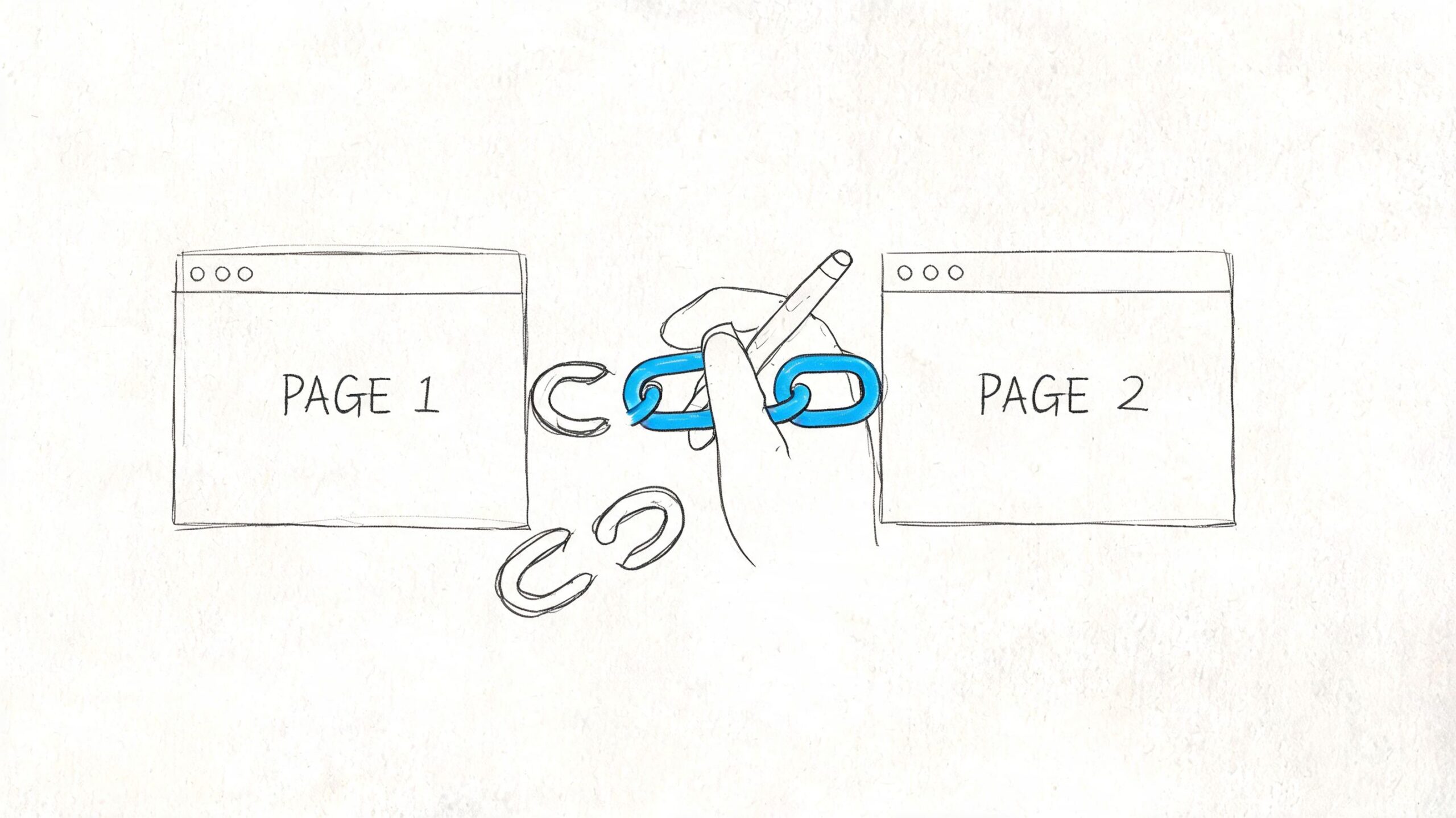
    Want a backlink tactic that still works for business owners without a big brand or a PR team? Start with pages that already have a problem. Broken link building works because you are helping the publisher fix a dead resource while giving them a relevant replacement.

    A strong opportunity usually looks like this. An article in your niche links to a guide, tool, or study that no longer loads. The dead page covered a topic readers still need. You already have, or can publish, a page that solves the same job well enough to deserve the swap.

    A hand connecting two web pages with a blue chain link to represent backlink building.

    The match matters more than volume. A broken link on a relevant page can be worth pursuing. Fifty dead links on weak, off-topic pages usually waste time.

    Here's the filter I use before sending outreach:

    • Topic match: The original dead page covered the same question your replacement answers.
    • Page quality: The linking page is maintained, readable, and sends trust signals.
    • Reader intent: Someone clicking that old link would be satisfied by your page.
    • Editorial fit: Your replacement feels like a resource, not a disguised service page.

    That last point is where many business owners lose the link. If the broken URL used to point to a practical guide and you pitch a product page, the editor has to choose between helping readers and helping you. They will protect the reader.

    Use a crawler, browser extension, or your SEO platform to find dead outbound links on pages that already rank or attract links in your field. Then review the old URL before you pitch. Check what the page used to be about in archive snapshots or by reading the context around the broken link. That small step prevents bad outreach and helps you build a replacement that fits.

    A replacement pitch that gets replies

    Keep the email short and specific. Site owners respond better when the note feels like a quick heads-up, not a campaign sequence.

    Hi [Name], I was reading your page on [topic] and noticed the link in the [section name] goes to a page that no longer loads. The original resource looked like it covered [topic]. We recently published an updated version here: [your page]. If you're revising the page, it could be a useful replacement for readers.

    That format works because it does three things fast. It shows you checked the page. It proves the replacement is relevant. It leaves the decision with the editor.

    If you want to watch the process in action, this walkthrough is a useful starting point.

    One practical trade-off. Broken link building can produce excellent editorial links, but it is slower than directory submissions and less predictable than reclaiming an unlinked mention. The upside is quality. The downside is that you often need to create a better replacement asset before outreach starts.

    Publish first. Pitch second. That order saves time, protects your close rate, and gives you a repeatable process instead of a one-off backlink hunt.

    5. Skyscraper Content and Link Reclamation

    Want backlinks from pages that already prove they link out? Build something better than the asset they reference, or reclaim mentions you already earned.

    Skyscraper content works best when the target topic already has link demand. The job is not to make a page longer. The job is to publish the page editors wish they had cited the first time.

    A practical example: an outdated beginner guide in your niche still picks up links because it ranks, gets shared, and answers a common question. You can compete for those same links with a version that is easier to scan, updated for the current year, and stronger on proof. In my experience, upgrades that win links usually improve the page in three places at once.

    • Usability: Clear section jumps, faster answers, cleaner formatting, and examples a first-time reader can apply.
    • Evidence: Current references, original screenshots, tighter definitions, and fewer vague claims.
    • Utility: Templates, checklists, comparison tables, calculators, or files readers can use right away.

    That is the standard.

    If your page is only “more detailed,” outreach gets ignored because the editor gains nothing by changing the citation. If your page saves their readers time or reduces the chance that the article sends traffic to stale advice, the pitch becomes easier to accept.

    How to find a skyscraper target worth pursuing

    Start with a keyword or topic that matters to your business, then look at the pages already attracting links around that topic. The best targets usually have one of three weaknesses: they are old, they are thin, or they are hard to use. A clunky article with strong backlinks is often a better opportunity than a polished one with the same link count.

    Before creating anything, check the linking pages themselves. Are they industry blogs, software companies, associations, or personal sites no one updates? That tells you how high the bar is. Business owners doing this without an agency should pick targets where a clear upgrade is realistic within a week or two of work, not a three-month research project.

    Link reclamation is the faster play

    Reclaiming unlinked mentions often produces quicker wins because the writer already chose to reference your brand, founder, tool, or research. You are not asking them to change their argument. You are asking them to add the missing path for readers.

    Use a short email:

    Hi [Name], thanks for mentioning [brand/page] in your article on [topic]. I noticed the mention isn't linked. If you want to make it easier for readers to find the resource, the correct page is [URL].

    That message works because it is specific, low-friction, and easy to verify.

    I like to treat reclamation as a weekly maintenance task. Set alerts for your brand name, product names, founder names, and any original studies or frameworks you publish. Then review new mentions in batches. A small list handled consistently beats a giant spreadsheet you never revisit.

    If you need inspiration for the kind of asset that attracts citations, SEOptimer's piece on backlink examples highlights a useful gap. Many pages explain backlink types but do not show them visually. That creates an opening for a screenshot-heavy, annotated resource that editors can cite because it teaches faster than a generic text post.

    One trade-off matters here. Skyscraper outreach can win strong editorial links, but it usually requires more production time than reclamation. Reclamation is faster and simpler to run. Skyscraper campaigns have a higher ceiling when you build an asset that deserves to become the page people cite by default.

    6. Local Citations and NAP Consistency

    For local businesses, some of the most important backlink work looks boring. That doesn't make it optional.

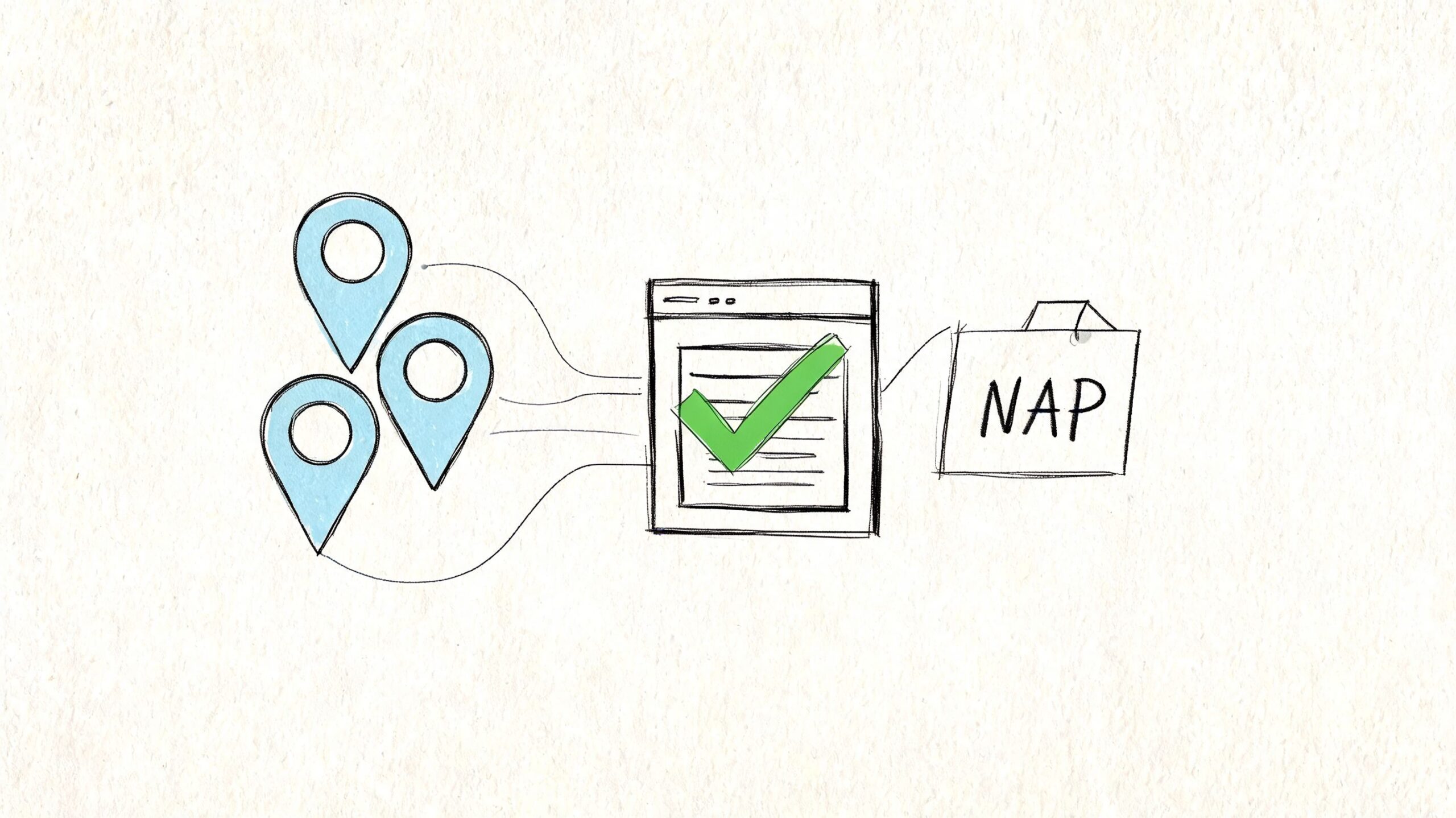
    A local citation is a listing or mention of your business name, address, and phone number across platforms like Google Business Profile, Yelp, Apple Maps, industry directories, and local associations. Some citations include a backlink. Some only include the mention. Both help validate that your business is real and located where you claim.

    What a citation backlink actually does

    If you run a clinic, law office, plumbing company, salon, or restaurant, citations are part of the trust layer beneath your rankings. They support your local presence, reinforce brand consistency, and make it easier for customers to contact you.

    A hand-drawn illustration showing location pins connecting to a webpage with a checkmark and the acronym NAP.

    This category isn't about chasing flashy wins. It's about removing doubt. Search engines and users both notice when your business is called one thing on Yelp, another on Apple Maps, and a third on your own website.

    How local businesses usually mess this up

    The common failures are simple:

    • Inconsistent NAP: Different phone numbers, suite numbers, abbreviations, or business names across listings.
    • Duplicate profiles: Old addresses or old practitioners still attached to legacy pages.
    • Wrong landing page: Every citation points to the homepage even when a location page would fit better.

    Field note: A weak local SEO setup often isn't missing advanced tactics. It's carrying years of messy business data across the web.

    If you're trying to rank in a city or service area, claim the core profiles first, clean up duplicates, and make sure every important listing points to the right page on your site. For a multi-location business, that usually means separate location pages with matching details.

    Citations won't replace editorial links or content assets. They do make every other backlink work harder because they reduce uncertainty around your business identity.

    7. Ego Bait and Influencer Mentions

    Why do some roundup posts attract links while others die after a few social shares? The difference is usually simple. Strong ego bait gives the featured person a real reason to reference the page because the inclusion helps their reputation, supports a claim they already make, or fits a page they already maintain.

    A practical example of backlinks in this category is a tight, niche-focused list such as “Best DTC Packaging Designers” or “Independent CPAs Sharing Tax Advice for Creators.” Broad vanity lists rarely travel. A curated page with clear selection criteria can.

    This works especially well for business owners without an agency because the process is repeatable. Pick a narrow angle, feature people or brands with an obvious audience overlap, add a short reason each one made the list, and publish something polished enough that a team would feel comfortable citing it on a press page, partner page, or founder bio.

    What makes this type of page link-worthy

    The page has to stand on its own. If it reads like a random collection of names, outreach will not save it.

    Quality signals to include:

    • Specific selection logic: Explain why each person or company was chosen.
    • A narrow scope: “Best Shopify email designers for beauty brands” beats “Top marketing experts.”
    • Original commentary: Add your take on what each featured entry does well.
    • Clean presentation: Use headshots, logos, pull quotes, or examples of work where appropriate.
    • Clear fit: Feature people who already have pages where this mention could reasonably appear.

    The trade-off is reach versus credibility. A list of 100 names gives you more people to contact, but weaker editorial standards. A list of 12 to 20 strong picks usually earns fewer replies and more useful mentions.

    Outreach that gets responses

    The first email should not ask for a link. It should make the feature easy to verify and easy to share.

    A simple structure works well:

    • State the inclusion: Tell them they were featured.
    • Show the reason: Mention the specific work, result, or perspective that earned the mention.
    • Give them a use case: Offer a badge, image, or short excerpt for their team.
    • Leave the decision with them: If they want to reference it, the link is there.

    Example:

    Hi [Name], we featured [person/company] in our roundup on [topic] because your work on [specific reason] stood out. We included a short note on [result, project, or differentiator]. If your team wants a square graphic or short excerpt for your press or resources page, I can send one over.

    That last line matters. It gives the recipient a practical next step without turning the message into a request.

    One more field note. This tactic works best when the page is selective enough that inclusion feels earned. If every company in the category makes the list, the mention loses value and the backlink opportunity usually disappears with it.

    8. HARO Help A Reporter Out and Expert Commentary Backlinks

    What if the fastest way to earn a strong backlink is to stop pitching for links and start answering journalists better than everyone else?

    HARO-style opportunities reward usable expertise. A reporter needs a clean quote, a specific example, and a credible source before deadline. Business owners who know their craft can compete here without a big brand, a PR team, or an agency retainer.

    The win is not volume. It is placement quality.

    A published quote on a relevant news site or trade publication often does more for trust and referral visibility than a batch of easy directory links. As noted earlier, strong rankings tend to follow stronger link profiles. Expert commentary will not build that profile on its own, but it can add the kind of editorial mentions that are hard to copy.

    There is also a practical targeting lesson in the DoFollow Nectar case study. They built links to pages worth citing, then passed value to commercial pages through internal linking. Use the same playbook here. If a reporter can cite a useful guide, original data point, checklist, or how-to resource on your site, your odds improve and the link usually carries more value than a homepage mention.

    How to pitch a quote that gets used

    Journalists do not need your brand story. They need clean copy they can drop into an article with minimal editing.

    Use this structure:

    • Credential in one line: State why your experience fits the question.
    • Answer first: Lead with the quote, not the setup.
    • Add one specific detail: Include a result, pattern, or field observation.
    • Finish with attribution: Name, title, company, and website.

    Write the sentence you want to see in print.

    A weak reply says, “I'd love to contribute to this piece. I'm the founder of…” then spends four paragraphs building credibility. A usable reply gets to the point in the first sentence and gives the reporter a clean, quotable angle.

    For example, a local roofer answering a storm-prep query might explain the one inspection mistake that turns minor shingle loss into interior water damage. A fitness founder might describe the habit change clients do maintain after week three. A B2B SaaS operator might point to one implementation bottleneck buyers underestimate and how teams reduce it.

    Quality signals that separate good opportunities from wasted time

    Not every journalist request deserves an answer. Some lead to no attribution, no publication, or topics so broad that your input becomes generic.

    Prioritize requests with these signals:

    • Clear publication or writer identity
    • A topic close to your real operating experience
    • A realistic path to citation, such as your guide, study, process, or firsthand example
    • A publication audience you would want even without the link

    That last point matters. Some commentary links send almost no referral traffic, but they still strengthen credibility. Others drive qualified visitors because the story matches buyer intent. The trade-off is speed versus fit. Broad requests are easier to answer quickly. Narrow requests usually convert better because your expertise stands out.

    A simple outreach template you can reuse

    Subject lines are often fixed inside these platforms, so the body has to do the work. Keep it tight.

    Hi [Name],
    [Name], [Title] at [Company]. We work with [relevant audience/problem].

    Quote: “[2 to 4 sentence answer with one specific insight.]”

    One detail from our work: [brief example, observation, or result without hype].

    Attribution: [Full name, title, company, website]

    A few field notes from campaigns that successfully produce placements. Reply early when you can. Cut adjectives. Give one strong point instead of three average ones. If your answer sounds like website copy, rewrite it until it sounds like a person who has solved the problem before.

    Expect misses. Plenty of good responses never get picked. That is normal. The businesses that get results from expert commentary treat it like a repeatable pipeline: monitor requests, answer the tight-fit ones, send publication-ready quotes, and build a small library of cite-worthy assets on the site.

    8 Backlink Strategies Compared

    Strategy Implementation Complexity 🔄 Resource Requirements ⚡ Expected Outcomes ⭐📊 Ideal Use Cases 💡 Key Advantages ⭐
    Editorial Backlinks from Industry Publications 🔄 Very high, editorial vetting, long lead times ⚡ Moderate–high, PR/outreach, top-tier content & relationships ⭐📊 Very high SEO authority and qualified referral traffic 💡 Brand credibility, product launches, expert commentary for small businesses ⭐ Highest ranking impact; durable, highly trusted links
    Guest Posting and Contributor Articles 🔄 Medium–high, pitching, editorial review, revisions ⚡ High, long-form writing, outreach volume, possible outsourcing ⭐📊 High when on quality hosts; drives referral traffic and topical authority 💡 Thought leadership, audience growth, niche authority building ⭐ Contextual backlinks + direct audience exposure; scalable with process
    Resource Page and Directory Backlinks 🔄 Low, listing submissions and approvals ⚡ Low, simple submissions; can be automated at scale ⭐📊 Medium SEO value per link; cumulative referral/local impact 💡 Local businesses, SaaS on review platforms, broad directory coverage ⭐ Easy wins; scalable; improves local discovery and citations
    Broken Link Building 🔄 Medium, research + outreach workflow ⚡ Moderate, tools for discovery + targeted outreach/content ⭐📊 Very high, contextual links from established domains with good conversion 💡 Sites with many resource pages or outdated roundups; competitive niches ⭐ High success rate when targeted; mutually helpful for webmasters
    Skyscraper Content & Link Reclamation 🔄 High, large content projects + targeted outreach ⚡ High, significant content creation and SEO tooling ⭐📊 Very high, combines organic rankings with quality backlinks 💡 Competitive keywords, data-heavy topics, brands replacing inferior resources ⭐ Builds topical authority; sustainable and compounding results
    Local Citations & NAP Consistency 🔄 Low, claim and standardize listings ⚡ Low–moderate, time to create/verify many listings (tools available) ⭐📊 Very high for local search; medium for broader SEO 💡 Local service businesses (plumbers, clinics, restaurants) ⭐ Essential for local rankings and map visibility; high ROI for local SMBs
    Ego Bait & Influencer Mentions 🔄 Medium, content creation + influencer outreach ⚡ Moderate, creative assets, research, personalized outreach ⭐📊 High but variable, potential viral reach and high-authority mentions 💡 Niches with active influencers (marketing, tech, lifestyle) ⭐ Fast amplification and relationship-building; strong referral spikes
    HARO & Expert Commentary Backlinks 🔄 Low–medium, quick, time-sensitive responses ⚡ Low, time to craft concise, quotable replies; repetitive participation ⭐📊 Very high, premium publication links and brand mentions 💡 Experts, founders, PR-focused owners seeking earned media ⭐ Free access to high-authority backlinks and media validation

    Your Backlink Blueprint From Example to Execution

    What should you do first if you want backlinks that improve rankings instead of wasting a month of effort?

    Start by matching the tactic to the business. That decision matters more than the outreach template. A local service company usually gets faster returns from citation cleanup, local press, and unlinked mention reclamation. A founder with real expertise can often get better links from journalist requests and expert commentary than from cold guest post pitches. A site with useful content already published should usually strengthen what it has before creating more.

    The pattern is simple. Relevant links on pages people read keep paying off. Placements bought for the sake of having "more backlinks" tend to fade in value, send weak referral traffic, or create cleanup work later.

    I'd keep the first 30 days tight.

    • Fix the pages and profiles you already control: clean up citations, standardize business details, and reclaim mentions that should already link to you.
    • Choose one page worth promoting: a guide, original resource, tool, calculator, checklist, or data page.
    • Run one outreach motion at a time: broken links, journalist responses, contributor pitches, or resource page outreach.
    • Route authority with internal links: send link equity from informational pages to the service, product, and category pages that need to rank.

    This is the part business owners often skip. They collect examples, then chase all of them at once. The better approach is narrower and less exciting. Pick one lane, set a weekly quota, and review results after a month. Ten well-researched pitches to relevant sites will usually teach more than a hundred generic emails sent from a template you barely customized.

    Quality still decides the outcome. As noted earlier, the web already contains an overwhelming number of backlinks. You do not need scale for its own sake. You need a small set of links that fit the page, fit the topic, and come from sites your customers or peers would recognize as credible. In practice, a few strong placements can do more for a money page than dozens of low-trust directory listings or recycled guest posts.

    Use this checklist before you spend time on any prospect:

    • Is the linking site topically related to your business?
    • Does the page get updated and appear maintained?
    • Would a human reader click the link and find it useful?
    • Is the page already stuffed with outbound links?
    • Can you point the link to a page that deserves to rank, not just your homepage?
    • Will this placement still look natural six months from now?

    If two or three answers are weak, skip it.

    Backlink building works best as a system, not a scavenger hunt. Build one asset. Promote it through one channel. Track replies, placements, and assisted ranking gains. Then keep the winners and cut the busywork. That is how small teams get results without handing the whole process to an agency.

    Agency Secrets helps business owners turn SEO theory into a working system. If you want a practical way to research keywords, publish authoritative content, and earn relevant backlinks without hiring an agency, Agency Secrets is worth a look. It lays out the playbook clearly, and its recommended platform, OutRank, is built to automate the heavy lifting so small teams can compete consistently.

  • Content Marketing for Startups: A Lean Playbook (2026)

    Content Marketing for Startups: A Lean Playbook (2026)

    You shipped the product. A few early users love it. Then growth stalls.

    Your homepage gets some direct traffic, branded search is tiny, and every “we should do content” conversation dies the same way: no one knows what to write, who should write it, or how long it will take before it matters. So the blog becomes a dumping ground for feature updates, generic thought pieces, and posts targeting keywords your biggest competitors already own.

    That approach burns time and teaches founders the wrong lesson. Content marketing for startups doesn't fail because content is slow. It fails because startups treat it like a side project instead of a system.

    The version that works is narrower, sharper, and far less glamorous. You pick a specific buyer. You target a small pocket of demand that bigger companies ignore. You publish content that solves one expensive problem at a time. Then you turn every winning topic into an evergreen asset that keeps pulling in qualified visitors long after publication.

    Table of Contents

    Your Content Marketing Engine Starts Here

    Most founders don't need more marketing ideas. They need fewer moving parts.

    The trap is familiar. You publish when you have time. You choose topics that sound important in meetings. You hope SEO will sort itself out. A few months later, nothing compounds because nothing connects. The audience is vague, the topics are broad, distribution is improvised, and measurement starts and ends with pageviews.

    That's why content feels expensive even when you're doing it in-house.

    A startup needs a repeatable engine, not a content calendar full of disconnected posts. The engine is simple:

    1. Define a narrow audience with a real buying problem.
    2. Find high-intent topics inside underserved micro-segments.
    3. Create useful, authoritative content that earns trust.
    4. Distribute it deliberately instead of waiting for traffic.
    5. Measure business impact so you keep what works and kill what doesn't.
    6. Systemize the winners into an evergreen library.

    Practical rule: If a topic can't be tied to a specific buyer problem and a likely next action, it probably doesn't belong on an early-stage startup blog.

    This approach also matches where the market is going. Content investment is growing, with 54% of businesses planning to increase spending in 2024, and businesses investing $4,000 or more per content piece are 2.6 times more likely to report their strategy as “very successful” than lower-spend brands, according to Reboot's content marketing statistics summary. The lesson for startups isn't “spend recklessly.” It's that thoughtful, high-quality content beats cheap volume.

    If you're resource-constrained, that's good news. You don't need a giant team. You need discipline. One article that targets a real buying question can outperform ten posts written for “awareness” that never influence a decision.

    Pinpoint Your Audience Before Writing a Word

    The fastest way to waste a quarter is writing for “small businesses,” “marketers,” or “founders” as if those are usable audiences.

    They aren't. Those labels are too broad to guide headlines, examples, calls to action, or SEO decisions. Startups that skip audience work usually produce content that sounds polished but misses the buyer's actual problem.

    A high angle ink drawing showing a winding yellow path through dense dark forest foliage.

    Research backs this up. 60% of corporate marketers lack understanding of best practices for buyer persona development, and buyers review an average of 13 pieces of content before making a purchase decision, according to Proven SaaS on startup content marketing. If your content doesn't line up with the buyer's context, those interactions don't build momentum. They just add noise.

    Build a minimum viable persona

    You don't need a bloated persona deck. You need a working profile you can use in editorial decisions this week.

    Focus on these inputs:

    • Role and context who the buyer is inside the company or household
    • Trigger problem what happened that made them look for a solution
    • Buying stage whether they're problem-aware, comparing options, or ready to choose
    • Language the exact phrases they use to describe friction
    • Constraints what makes switching, buying, or implementing hard

    A useful persona sounds like this:

    Element Weak version Useful version
    Audience Small business owner Multi-location clinic owner struggling to manage inbound leads
    Goal Get more customers Increase qualified bookings without hiring another admin
    Pain point Marketing is hard Existing website gets traffic but doesn't convert local service intent
    Search behavior Searches for SEO help Searches for terms tied to compliance, local visibility, and service-specific demand

    That level of specificity changes everything. It tells you what examples to use, which objections to address, and what kinds of keywords deserve attention.

    Run interviews that produce usable insights

    Good audience research doesn't require a research department. It requires curiosity and a repeatable script.

    The proven-saas methodology recommends using surveys, phone interviews, in-person conversations, web analytics, and exit surveys. It also suggests conducting at least 10 to 15 customer interviews per persona, which is realistic if you treat it as part of sales and customer success, not a separate research project.

    Ask questions that reveal decision logic:

    • What was happening right before you started looking for a solution?
    • What did you try first that didn't work?
    • What nearly stopped you from buying?
    • What wording would you type into Google if you had to solve this again?
    • What alternatives were you comparing us against?

    Avoid asking what content people want. Most buyers won't tell you directly. They will tell you their frustrations, hesitations, and decision criteria. That's more valuable.

    A strong walkthrough helps if your team hasn't done this before.

    Turn audience research into editorial decisions

    Many teams stall at this stage. They gather notes, then return immediately to writing generic posts.

    Don't summarize interviews into fluffy persona paragraphs. Convert them into a simple editorial filter.

    Buyers don't care that you published. They care that you understood the job they're trying to get done.

    Use these decisions:

    1. Choose one persona per article. Mixed audiences produce muddled writing.
    2. Map one pain point to one content format. Comparisons for evaluation. How-to content for active problem solving. Checklists for implementation friction.
    3. Write in the buyer's vocabulary. If customers say “missed appointments,” don't rewrite it as “operational inefficiency.”
    4. Attach every article to a stage. Awareness, consideration, or decision.

    Startups don't have the budget for unfocused content. Persona work isn't a branding exercise. It's the difference between publishing into the void and publishing something a buyer can recognize as relevant.

    Find Topics That Win Customers Not Just Clicks

    Broad keywords look impressive in a spreadsheet and terrible in practice.

    If you're a startup, trying to rank for a huge generic term is usually a vanity project. The traffic is broad, the competition is entrenched, and the search intent is messy. You can spend months chasing visibility that never turns into trials, demos, or sales conversations.

    The better move is to hunt where larger companies rarely bother: micro-underserved segments.

    A hand-drawn illustration showing a dashboard with business growth metrics connected to a small green plant.

    According to Invoke Media on underserved market segments, long-tail, intent-driven keywords can drive 3–5× more conversions than broad generic terms. That's exactly why content marketing for startups should focus less on reach and more on precision.

    Start with purchase intent not search volume

    A high-intent keyword usually contains one or more of these signals:

    • Specific audience qualifiers such as industry, company size, or use case
    • Problem qualifiers that imply pain, urgency, or friction
    • Solution qualifiers like software type, compliance need, or workflow requirement
    • Comparison language that signals active evaluation

    Examples:

    • inventory management for Etsy jewelry sellers
    • CRM for small therapy practices
    • local SEO for emergency plumbers
    • appointment reminder software for dental clinics
    • HIPAA-compliant client intake forms for solo practices

    None of these are glamorous trophy terms. That's the point. They attract people with context, not idle curiosity.

    How to spot a micro-niche worth serving

    Good startup topics sit at the overlap of three conditions.

    First, the audience is narrow enough that the problem is described clearly. Second, the pain is expensive enough that people will act. Third, the competition is too broad or too lazy to build dedicated content around it.

    Use this quick decision framework:

    Question Good sign Bad sign
    Is the audience named clearly? “Texas HVAC contractors” “Businesses”
    Is the pain specific? “Low visibility in map results” “Needs more growth”
    Is there buyer intent? “Best scheduling app for mobile detailing” “What is scheduling”
    Can your product plausibly help? Yes, directly Only through a vague brand story

    If a topic fails any of those tests, it probably belongs later, not now.

    Build a topic map your competitors won't bother with

    Large competitors tend to publish horizontally. They want the biggest category terms. Startups win vertically.

    That means taking one niche and building a stack of related evergreen articles around it. For example, if you serve small clinics, your cluster might include:

    • Decision content comparing tools for patient intake or reminders
    • Operational content solving booking, follow-up, or no-show issues
    • Compliance content addressing regulated workflows
    • Local visibility content tied to geography or service lines

    Pick a niche where you can sound like an insider. Outsiders can rank briefly. Insiders build trust.

    Use low-cost tools like Google Search Console, Google autocomplete, competitor title tags, and support ticket language to find these phrases. Then group topics by buyer stage instead of publishing random one-offs.

    That's the moat. Not more content. Better fit.

    Create High-Impact Content on a Startup Budget

    Lean content is often misunderstood. Founders hear “lean” and think cheap, fast, and disposable.

    That's backward. For startups, lean content means protecting limited resources by creating fewer pieces with a better chance of ranking, being shared, and influencing a buying decision. The worst use of a small budget is high-output mediocrity.

    A seven-step process infographic illustrating how lean teams can create high-impact content on a startup budget.

    The market is already moving toward a hybrid workflow. 72% of people used generative AI tools for content tasks in 2024, while 47% of organizations use AI for content creation and 51% use it for real-time optimization, according to BYYD's overview of content marketing trends citing Statista data. For startups, that matters because it cuts production friction without removing human judgment.

    Why one strong article beats a pile of weak ones

    A startup article needs to do more than exist. It should answer the search intent cleanly, show practical expertise, and move the reader toward a next step.

    That usually means:

    • a direct answer near the top
    • examples grounded in a real use case
    • structure that makes scanning easy
    • internal links to related resources
    • a call to action matched to buyer stage

    Short, generic posts often fail on all five.

    There's also a quality threshold issue. From the startup content pitfalls covered by Technical.ly, articles over 1,000 words generate significantly more leads than very short content, but composition still matters more than raw length. The takeaway isn't “make everything longer.” It's “earn the reader's attention with substance.”

    Use AI like a production assistant not a replacement

    AI is useful at the parts of content creation that drain time but don't require your sharpest strategic thinking.

    Use it for:

    • Outline generation based on a target query and buyer stage
    • Angle expansion when you need supporting subtopics
    • First-draft assembly from your notes, transcript, or brief
    • Optimization passes for clarity, heading structure, and coverage gaps
    • Repurposing a pillar article into email, FAQ, or social snippets

    Don't hand it the entire job.

    What still needs a human:

    • deciding whether the topic deserves to exist
    • injecting product and customer insight
    • cutting generic filler
    • checking claims and examples
    • aligning the article with brand voice and sales reality

    AI speeds up production. It doesn't create authority. Your experience, customer context, and editorial judgment still do that.

    Teams often go wrong here. They publish AI drafts that sound competent but say nothing distinctive. Search engines and buyers both recognize that quickly.

    A lean editorial workflow that actually ships

    The easiest way to keep quality high is to standardize the process. Not every article needs a full editorial board. It does need checkpoints.

    A practical startup workflow looks like this:

    1. Brief the article clearly
      Define the target query, persona, stage, and desired next action. If you can't explain why the article should exist in two sentences, kill it early.

    2. Collect proprietary input
      Pull in sales call notes, support questions, onboarding friction, and implementation examples. This is the material competitors can't easily copy.

    3. Draft fast
      Use Google Docs, Notion, or an AI-assisted writing workflow to build the first version. Speed matters at this stage because perfectionism kills consistency.

    4. Edit for utility
      Remove repeated points, simplify jargon, and make sure the opening answers the query immediately.

    5. Optimize structure
      Clean H2s and H3s, useful internal links, concise title, and a CTA that matches buyer intent.

    6. Publish and refresh
      Evergreen articles shouldn't be treated as finished. Update examples, tighten weak sections, and add links as your library grows.

    Here is the trade-off many organizations face: content quality typically increases when the founder or operator provides insight, but publishing frequency typically increases when the task is delegated. The solution is not to pick one. The solution is to separate insight from production. Founders provide raw material. Editors and tools shape it.

    That division is what makes content marketing for startups sustainable instead of exhausting.

    A Smart Distribution Strategy for Zero-Audience Startups

    Publishing is not distribution. It's inventory creation.

    A new startup blog has no authority, no audience habit, and no built-in amplification. If you hit publish and wait for search traffic, you'll probably wait a long time. Early distribution has to be active, targeted, and tied to places where your buyers already pay attention.

    Borrow trust before you try to build it

    The fastest route to early visibility is borrowed authority.

    That means showing up in niche environments where your audience already asks questions and evaluates vendors. Depending on your market, that could be Reddit communities, Slack groups, LinkedIn comment threads, industry newsletters, association sites, or partner audiences.

    A simple priority order works well:

    • Communities first because they already contain buyer conversations
    • Partnership distribution second through co-marketing, guest contributions, or vendor ecosystems
    • Founder-led distribution third through personal LinkedIn posts, email replies, and direct outreach
    • Organic social last unless you already have audience traction

    Don't drop links and vanish. Quote the key point from the article, answer a specific question, then link only when it helps.

    Turn every article into an email asset

    Email matters more than most startup teams admit because it's the one distribution channel you own.

    Every strong article should create at least one email use case:

    Content type Email angle Goal
    How-to guide Teach one tactic and link to full article Re-engage subscribers
    Comparison post Summarize decision criteria Support evaluation
    Checklist Offer a practical takeaway Drive clicks and saves
    Evergreen FAQ Answer a common objection Move hesitant leads forward

    Buyers rarely convert after one touch. A strong article gives you something useful to send in onboarding, nurture, reactivation, and sales follow-up.

    The distribution mistakes that waste the most time

    Most startup teams don't fail because they ignore distribution completely. They fail because they engage in distribution with low impact that feels productive.

    Common mistakes:

    • Posting everywhere at once instead of going deep in the few channels where buyers spend time
    • Rewriting the same generic social caption for every article
    • Treating backlinks like a separate SEO project instead of a byproduct of useful, promotable assets
    • Ignoring sales and customer success even though those teams already know what content prospects ask for

    Technical.ly's framework on startup content pitfalls emphasizes that channel-specific distribution playbooks matter, and that the “build-it-and-they-will-come” assumption hurts even strong content. That's exactly right. A post without a distribution routine is just a document on your website.

    The early goal isn't mass reach. It's getting the right article in front of the right small group often enough that it starts generating feedback, links, and pipeline influence.

    Measure What Matters and Prove Content ROI

    A lot of startup content reporting is theater.

    Traffic is up. Impressions increased. Time on page looks decent. None of that answers the only question leadership cares about: did this content help create qualified demand?

    A diagram illustrating the funnel process from content and engagement to measuring ROI and performance.

    Disciplined startups can outperform larger teams by avoiding common pitfalls. 85% of B2B marketing leaders fail to connect content activities to measurable business outcomes, and 56% cite data quality and completeness as the primary obstacle, according to Technical.ly's breakdown of startup content marketing pitfalls. If you measure cleanly from the start, you don't just make better decisions. You create internal credibility.

    Traffic is useful but it is not the scoreboard

    Traffic matters because it shows whether distribution and SEO are working. It does not tell you whether the topic attracts the right people.

    A startup should treat traffic as an input metric, not the final result.

    If an article brings visitors who never subscribe, start a trial, request a demo, or assist a sales conversation, it may be winning in analytics and losing in the business.

    That's why vanity metrics are dangerous. They reward broad topics, catchy headlines, and weak-fit visitors. Early-stage companies can't afford that distortion.

    A simple startup measurement model

    You don't need a giant attribution stack. You need a clean chain from content to commercial signal.

    Track content using four levels:

    1. Visibility
      Search impressions, clicks, rankings, and referral visits. This tells you whether people can find the piece.

    2. Engagement quality
      Scroll depth, time on page, CTA clicks, and return visits. This shows whether the content is doing its job once someone lands.

    3. Lead capture
      Email signups, demo requests, free trial starts, or contact form submissions tied to the article.

    4. Pipeline influence
      Whether the article appears in journeys that lead to opportunity creation or closed business.

    A basic review table helps:

    Metric type Ask this question Keep or kill signal
    Visibility Is the article getting discovered? If no, improve title, linking, and distribution
    Engagement Are readers consuming the core message? If no, tighten intro and structure
    Conversion Does it create a next action? If no, fix CTA and intent match
    Influence Does it show up in buyer journeys? If no, topic may be attracting the wrong audience

    How to review content without fooling yourself

    Set a review cadence and use the same questions every time.

    Look for patterns such as:

    • articles that rank but don't convert
    • articles that convert but need stronger distribution
    • topics that attract the wrong ICP
    • clusters where one page performs and related pages lag behind

    When you find a winner, don't celebrate and move on. Update it, link to it from newer articles, add FAQs from sales calls, and turn it into related assets. When you find a loser, be honest. Some topics are bad fits, even if they sound smart in strategy meetings.

    Good measurement makes content less political. It shifts the conversation from opinions about what feels valuable to evidence about what moves buyers.

    Scale Your Success with an Evergreen Content System

    One-off campaigns create activity. Evergreen systems create compounding returns.

    That's the shift most startups need to make after the first few wins. Stop thinking article by article. Start thinking in terms of assets that can be improved, linked together, repurposed, and redistributed without starting from zero every time.

    According to Averi's guide to content marketing for startups, content marketing generates 3x more leads at 62% lower cost than traditional marketing, yet few teams build low-maintenance systems designed to keep paying off over time. The startups that do usually organize around pillars, clusters, refresh cycles, and reuse.

    Build once improve repeatedly

    An evergreen engine has a few characteristics:

    • Pillar pages that cover a core topic in depth
    • Cluster articles that address narrow variations, objections, and use cases
    • Internal linking that moves readers and authority through the library
    • Refresh routines so strong pages stay current
    • Repurposing workflows that turn one article into email, sales enablement, and community posts

    Automation earns its place. Not as a shortcut for replacing expertise, but as a system for reducing repetitive production work.

    What the engine looks like in practice

    A practical engine looks like this in operation:

    A buyer question appears in sales calls. That question becomes a tightly scoped article. If the article performs, you build related pieces around adjacent pain points, comparisons, and implementation issues. Those pieces link together. The strongest page gets refreshed and redistributed. Over time, that cluster becomes the default resource center for a narrow problem your larger competitors still treat generically.

    That's how content marketing for startups stops being a blog and starts becoming infrastructure.


    If you want a practical way to run this playbook without hiring an agency or building a large in-house team, Agency Secrets is worth a look. It's built for operators who want better keyword targeting, stronger evergreen content, and a simpler path to sustainable organic growth.

  • Keyword Research for Small Business: A Profit-First Guide

    Keyword Research for Small Business: A Profit-First Guide

    You've probably done some version of this already. You wrote a few blog posts, added service pages, maybe paid for a keyword tool, and watched impressions or visits creep up. Then you checked the numbers that matter: calls, quote requests, booked jobs, product sales, and the lift wasn't there.

    That's the trap.

    Most small businesses don't fail at SEO because they ignore keyword research for small business. They fail because they pick keywords like a publisher chasing pageviews instead of an owner chasing profit. They go after broad phrases, celebrate traffic, and end up attracting people who were never going to buy.

    A small business doesn't need more random visitors. It needs the right searches from the right people at the right moment. That changes how you build your keyword list, how you judge opportunities, and what you publish first.

    Table of Contents

    Stop Chasing Traffic and Start Winning Customers

    Much SEO advice pushes small businesses toward the wrong scoreboard. It tells you to find high-volume terms, publish more content, and grow traffic. That sounds sensible until you realize traffic can rise while revenue stays flat.

    A man in a suit holding a small bucket while standing before a large, cascading waterfall.

    Traffic can hide a bad strategy

    A local service business can rank for broad, educational terms and still struggle to get leads. An online store can publish top-of-funnel guides that bring readers who are curious, not ready. A clinic can attract people researching symptoms while missing the searches from people looking to book.

    That's why raw traffic is a vanity metric unless it connects to a business outcome.

    The better question is simple: does this keyword bring someone who is likely to call, book, request a quote, start a cart, or compare providers seriously?

    Practical rule: If a keyword doesn't align with a service, product, or profitable next step, it belongs lower on the list, no matter how attractive the volume looks.

    Small businesses usually waste time here. They target broad words because the numbers feel bigger. But bigger isn't better if the searcher's intent is vague.

    Profit-first keywords change the game

    The strongest keyword research for small business starts with buying signals, not ego. Long-tail keywords are where this becomes obvious. According to AIOSEO's analysis of keyword research for small businesses, long-tail keywords typically have 3 to 5 or more words, can convert up to 2.5 times better than short-tail terms, and account for approximately 70% of all search traffic.

    That matters because long-tail searches usually reveal what the person wants. “Plumber” is broad. “Emergency hot water heater repair Denver” is specific, urgent, and commercial. One keyword inflates your impression count. The other can bring a customer.

    A profit-first approach changes your filter:

    • Choose buyer language: Use phrases that signal need, urgency, comparison, or action.
    • Ignore vanity volume: A keyword with lower volume can still be the better business asset if the searcher is ready.
    • Tie SEO to money pages: Prioritize terms that map to services, product collections, category pages, or quote pages.
    • Accept smaller audiences: A smaller search pool with clear intent often beats a large pool with mixed motives.

    The right ten keywords can outperform a giant list of weak ones because they attract people who want help now, not someday.

    Uncovering Keywords by Thinking Like a Customer

    A homeowner wakes up to a leaking water heater, grabs a phone, and searches the way stressed people search. Fast. They do not care what you call the service internally. They care about the problem, the cost, how soon you can help, and whether you serve their area.

    That is the starting point for useful keyword discovery.

    Small business owners often begin with a service list. That creates tidy spreadsheets, but it misses the language customers use when they are ready to act. Profit-first keyword research starts closer to the sale. Pull terms from the moments when real buyers ask for help.

    Mine the words customers already use

    Your best keyword source is usually sitting in plain sight. Check contact form submissions, call transcripts, live chat logs, estimate requests, emails, reviews, and sales notes. Those phrases come from people with a real need, which makes them far more useful than a generic brainstorm.

    Look for patterns like these:

    • Problem language: “water heater leaking,” “toilet won't stop running,” “drain backing up”
    • Urgency language: “same day,” “emergency,” “open now,” “after hours”
    • Cost language: “how much,” “quote,” “price,” “cost to replace”
    • Location language: neighborhood names, city names, “near me”

    Write them down exactly as customers say them.

    Do not rewrite “hot water tank busted” into a cleaner industry term just because it sounds better on a service menu. Searchers rarely use your polished internal wording. They use the words they would say on the phone when they need a fix today.

    A simple process works well. Review the last 20 to 30 customer conversations, highlight repeated phrases, and group them by theme. You are not trying to build a master keyword file yet. You are trying to catch buying language before it gets buried under SEO jargon.

    Study direct competitors without copying them

    Competitor research is useful when you treat it as pattern spotting, not imitation. Pick 2 or 3 businesses that target the same customers, then search your core services and open the pages that appear again and again.

    Check for specifics:

    • Which services have their own pages
    • Which words show up in title tags and headings
    • Which city or neighborhood modifiers they use
    • Which customer questions they answer on service pages
    • Which profitable services are missing or poorly covered

    This part matters because competitors often reveal what the market already responds to. If every strong local player has dedicated pages for emergency repair, same-day service, and water heater replacement, that is a signal. If none of them have a focused page for a higher-margin service you offer, that gap may deserve attention before you chase broader terms.

    Use their coverage to sharpen your list. Do not copy their wording line by line. You want market clues, not duplicate pages.

    Customers search for the outcome they want, the problem they have, or the urgency they feel.

    Use Google's results pages as free keyword research

    Good early-stage keyword research does not require expensive software. Google gives small businesses enough raw material to build a solid starting list if you know where to look.

    Type a service into search and pay attention before you even hit enter. Autocomplete shows common phrasing. After that, scan the results page for useful variations and intent clues:

    • People Also Ask: question-based searches and objections
    • Related searches: modifiers, alternatives, and adjacent needs
    • Titles of ranking pages: common wording that matches demand
    • Local pack listings: city and service combinations Google keeps surfacing

    For a local service business, searches like these usually expose strong variations:

    1. Core service plus city
      “water heater repair denver”

    2. Problem plus urgency
      “emergency plumber for burst pipe”

    3. Service plus qualifier
      “best drain cleaning near me”

    4. Cost question
      “cost to replace water heater”

    The goal here is not to collect hundreds of phrases. A bloated list makes prioritization harder, especially for a small business with limited time and budget. Build a short list of terms tied to real customer language, clear problems, and services you want to sell more of.

    That gives you a keyword pool with a much better chance of producing revenue, not just traffic.

    Qualifying Keywords A Simple Vetting Process

    A raw keyword list is noisy. Some phrases fit your business perfectly. Others look promising but attract the wrong audience. The fastest way to clean the list is to run every keyword through three filters: relevance, intent, and competition.

    A hand holds a sieve filtering gold nuggets labeled relevance, intent, and competition from small stones.

    Relevance comes first

    This is the filter that is frequently skipped.

    A keyword can have decent search volume and still be a bad target if it doesn't connect to a core service, profitable product line, or meaningful next step. Relevance asks one blunt question: if someone lands on your site from this term, can you serve them well and profitably?

    For a plumber, “how does a water heater work” may be loosely related. “water heater replacement near me” is directly relevant. One searcher wants education. The other may want a job booked.

    Use this quick relevance check:

    • High relevance: directly tied to a service or product you want more of
    • Medium relevance: adjacent topic that supports a buying journey
    • Low relevance: loosely related, broad, or unlikely to create business value

    If relevance is low, discard it. Don't rescue weak keywords with hope.

    Intent tells you who is close to buying

    Intent is where keyword research for small business stops being academic and starts getting useful. The same topic can produce very different searchers.

    The four intent types are simple in practice:

    Intent type What the searcher wants Common modifiers
    Informational Learn or understand how, why, guide, tips
    Navigational Find a brand or website brand names, login, company names
    Commercial Compare options before acting best, top, vs, review
    Transactional Take action now buy, quote, near me, book, repair

    Commercial and transactional terms usually deserve first attention because they're closer to revenue. Informational terms still matter, but they work best when they support a core service or product path.

    Working test: Search the keyword in Google. If the results are mostly service pages, product pages, or comparison pages, the intent is probably valuable. If the results are mostly general blog posts, the keyword is likely earlier-stage.

    Competition decides whether the keyword is worth your effort

    Plenty of small businesses choose the right intent and still lose because they chase terms that are too competitive for their current site.

    Search volume and difficulty become useful at this stage. According to Macmillan Design's guide to keyword research for small businesses, keywords balancing 100 to 1,000 monthly searches and difficulty scores under 40 offer the highest ranking success rates for small businesses, up to 60% higher than high-competition terms.

    That's a practical benchmark, not a law. But it's a strong default if you don't have a large site, a powerful backlink profile, or a big content budget.

    Use free or entry-level tools like Google Keyword Planner or Ubersuggest to sense-check demand and competition. Then ask:

    • Can I publish a better page than what's ranking?
    • Does this keyword fit a page that could generate revenue?
    • Is the competition realistic for my site today, not in theory?

    A keyword with modest volume and manageable difficulty often beats a glamorous term dominated by strong sites. Small businesses win by being precise, not by picking fights they can't finish.

    The Profit Priority Matrix Which Keywords to Target First

    Once you've qualified your list, the next problem appears fast. You still can't do everything.

    A small business needs a ranking system that answers one practical question: what gets worked on first? The cleanest way to do that is a simple matrix using two axes, commercial intent and competition.

    How to place a keyword in the matrix

    Take each qualified keyword and ask two questions.

    First, how likely is this searcher to become a lead or sale if they land on the right page?

    Second, how realistic is it for your site to compete for that term in the near term?

    That creates four buckets.

    Quadrant Keyword Profile Strategic Action
    Quick Wins High intent, low competition Build or optimize these first. They have the fastest path to leads.
    Core Targets High intent, high competition Keep these in your plan, but support them with stronger pages, internal links, and related content over time.
    Content Plays Low intent, low competition Use selectively for trust-building and supporting the buyer journey.
    Avoid Low intent, high competition Skip these unless they serve a very specific strategic purpose.

    This matrix keeps you from treating every keyword as equally valuable. They aren't.

    What to do in each quadrant

    Quick Wins are your best first moves. Think local service terms, product-specific modifiers, or urgent problem phrases with clear buying intent. If you only have a few hours each week, spend them here first.

    Core Targets matter, but they need patience. These are often broader service phrases or stronger commercial terms that bigger sites also want. They deserve a page, but not at the expense of easier revenue opportunities.

    Content Plays can still be useful when they support a sale. A cost question, comparison query, or common objection can help someone move toward action if you connect it to your service or product naturally.

    Avoid is the quadrant where time disappears. Broad educational phrases with heavy competition often look attractive because they seem important. For many small businesses, they create work without creating pipeline.

    Here's a fast example for a local plumbing company:

    • Quick Win: “emergency water heater repair denver”
    • Core Target: “plumber denver”
    • Content Play: “cost to replace a water heater”
    • Avoid: broad DIY queries unrelated to booked work

    Pick the keywords that can pay you back soonest. Authority grows faster when early pages bring real business results.

    The matrix also keeps your content mix honest. You can still publish informational pieces, but they stop taking over the strategy. Revenue-led pages stay at the center.

    Turning Keywords into Content and Conversions

    Keywords don't make money by sitting in a spreadsheet. They need a destination, a page built for the right searcher, with the right message, and a clear next step.

    A four-step infographic illustrating the process from keyword research to achieving website conversions.

    Match page type to search intent

    Many small businesses leak value during this stage of the process. They find a strong transactional keyword, then target it with a blog post. Or they chase an informational query with a thin service page. The mismatch weakens rankings and conversions.

    Use this mapping instead:

    • Transactional keywords belong on service pages, product pages, collection pages, or booking pages.
    • Commercial keywords often fit comparison pages, buyer guides, or tightly written landing pages.
    • Informational keywords belong on blog posts, FAQs, and resource pages that support the sales path.
    • Navigational keywords usually belong to brand and core site architecture, not campaign content.

    For example, “emergency plumbing repair near me” should point to a conversion-focused service page. “Water heater repair cost” can support that page as an informational article that answers a common buying question and links naturally into the service page.

    Use clusters to build authority around buying topics

    A single isolated page rarely does enough. Small businesses get better traction when they group related keywords under a parent topic and build a small content silo.

    According to Leadpages' keyword research guidance for small businesses, small businesses applying keyword clustering see 3.2x faster ranking, often under 90 days, and 25% to 40% traffic growth in 6 months. The same source notes that clustering related terms such as “emergency plumber” and “24/7 hot water repair” helps build topical authority.

    That matters because Google doesn't just evaluate a single page in isolation. It looks at whether your site shows depth around a topic. A cluster helps you send that signal without producing random content.

    A practical cluster for a local plumber could look like this:

    • Primary service page: emergency plumber in your city
    • Supporting service page: water heater repair
    • Support article: signs your water heater needs repair
    • Support article: repair vs replacement questions
    • FAQ page: after-hours plumbing questions

    The key is focus. Don't build clusters around anything vaguely related to your industry. Build them around topics that connect back to booked work or sales.

    A simple content map for a small business website

    If you want keyword research for small business to stay manageable, map each target phrase to one page and one goal.

    Here's a practical model:

    1. Homepage
      Use a broad brand and category signal. Keep the messaging clear about who you help and where.

    2. Core service or product pages
      Target your highest-intent priority keywords. These pages should answer the main need quickly and make the next action obvious.

    3. Supporting pages
      Build out related commercial terms, niche services, and local variations where relevant.

    4. Blog and FAQ content
      Cover objections, cost questions, comparisons, and educational queries that help the buyer move forward.

    A useful internal rule is simple. If a keyword signals action, send it to a money page. If it signals research, support the money page with content that earns trust and links inward.

    Done well, this turns SEO into a system. Keywords feed pages. Pages feed leads. New customer questions feed the next round of content.

    Your First 90 Days of Keyword-Driven Growth

    A small business owner blocks off a Saturday to “work on SEO,” opens a keyword tool, and ends the day with a spreadsheet full of terms that will never produce a sale. Ninety days later, nothing has changed because the work was aimed at traffic instead of revenue.

    The first 90 days should do one job. Prove that keyword research can turn into leads, booked calls, and sales without draining your time or budget.

    A practical 90-day plan

    Start with five keywords, not fifty.

    Use the research and vetting process above to choose your top five Quick Win opportunities. Keep the filter tight. Each one should match a real service or product, show clear buying intent or strong pre-buying intent, and be realistic for your site to compete on. If a keyword looks attractive in a tool but has weak commercial value, leave it alone.

    Next, build or improve one page for each keyword. Put your best effort into a small set of pages instead of publishing a pile of thin content. Transactional terms belong on service or product pages. Research-driven terms belong on support content that helps the buyer make a decision and pushes them toward the right money page.

    Then measure outcomes that matter to the business. Rankings are useful feedback, but they are not the scorecard. Watch calls, form submissions, quote requests, booked appointments, demo requests, and sales tied to those pages.

    A simple operating loop keeps this manageable:

    • Research gives you the language buyers use
    • Focused pages capture high-intent searches
    • Sales calls, emails, and customer questions reveal new keyword opportunities
    • Those opportunities shape the next batch of pages

    That cycle is how a small company builds search growth on a limited budget. It stays practical because every step connects back to profit.

    What success should look like

    In the first 90 days, success looks like traction, not volume.

    A few pages that attract the right visitors and produce action are worth far more than a large blog archive that brings in the wrong audience. I would rather see a local service business publish three pages that generate quote requests than thirty articles that never influence a sale.

    A small site grows faster when every page has a job.

    Once the first pages start producing qualified leads, the next decisions get easier. Expand into the next tier of Core Targets. Build a tighter cluster around the service that is already converting. Fix pages that attract visits but fail to produce calls or inquiries. In practice, that usually means the keyword was weak, the page intent was mismatched, or the offer was not clear enough.

    That is the profit-first version of SEO. You stop asking what might bring more traffic and start asking which keyword has the best chance of producing business value next.

    Building a keyword-driven growth engine works because it compounds over time. If you want a faster, agency-free way to put this process into practice, Agency Secrets is built for that job. It shows small business owners how to find buyer-intent keywords, publish useful content, build authority, and turn SEO into a repeatable growth channel without hiring an expensive consultant or assembling a large team.

  • How Long to Rank on Google? A 2026 Timeline & Roadmap

    How Long to Rank on Google? A 2026 Timeline & Roadmap

    Most new pages take 6 to 12 months to reach Google's top 10, and the average page in the number one spot is about 5 years old. That's the honest baseline, but it isn't a sentence. If you control the right variables, you can move faster than the average and use the waiting period to build authority instead of hoping rankings appear on their own.

    A lot of articles about how long to rank on google stop at “it depends.” That's technically true and practically useless. Small business owners don't need a shrug. They need a roadmap that shows what slows rankings down, what speeds them up, and which actions effectively change the timeline.

    The good news is that SEO isn't random. Google is cautious, not mysterious. New sites and new pages pay a trust tax first. Businesses that target the wrong keywords, publish inconsistently, and ignore backlinks usually wait a long time and get very little. Businesses that publish focused content, build topical depth, and earn authority signals give Google reasons to move them up sooner.

    That's the difference between passively waiting and actively ranking.

    Table of Contents

    The Honest Answer to How Long It Takes to Rank

    The answer is slower than many expect, but faster than many businesses plan for.

    According to Ahrefs' 2025 analysis summarized here, most new web pages take 6 to 12 months to reach Google's top 10, only 1.74% of newly published pages achieve top 10 rankings within their first year, and the average page ranking in position one is approximately 5 years old. That tells you two things at once. First, fast rankings are the exception. Second, older pages dominate because they've had time to accumulate trust, links, and relevance.

    That's the honest baseline for a small business site. If you publish a page today and expect first-page rankings next week, you're setting yourself up to misread the process.

    Why the average is not your destiny

    Averages hide the variables that matter.

    A local service page targeting a narrow buyer-intent search can move much sooner than a brand-new ecommerce category page trying to outrank major retailers. A detailed article on a low-competition problem can gain traction while a broad “best software” page sits buried for months. The timeline changes when you change the inputs.

    Practical rule: Don't ask only “how long does SEO take?” Ask “what am I doing that makes Google trust this page faster?”

    The businesses that beat the average usually do a few things well:

    • They choose winnable topics instead of chasing the biggest keywords first.
    • They publish around a topic, not as one-off blog posts with no structure.
    • They build authority signals through internal linking, site quality, and backlinks.
    • They keep improving pages instead of treating publishing as the finish line.

    What works and what doesn't

    What works is a system. What doesn't is dabbling.

    Publishing a handful of articles, waiting, and checking rankings every few weeks is the slowest way to do SEO. Google needs repeated evidence that your site deserves more visibility. Small businesses win when they compound that evidence. That means consistent content, clear search intent, and a deliberate authority-building process.

    If you understand that ranking is earned in layers, the timeline starts to make sense. You're not waiting for luck. You're stacking proof.

    The Ranking Reality Why Google Makes New Sites Wait

    Google treats new pages like unknown vendors in a bidding process. It doesn't hand them the contract because they showed up. It asks for proof.

    That's why many small business owners feel like they're stuck in a sandbox. They publish solid content, but established competitors still hold the top spots. The delay isn't arbitrary. Google is managing risk.

    A line drawing illustration showing a person climbing a slope labeled Google Trust, representing new site ranking.

    The trust tax on new content

    Google increasingly leans on E-E-A-T and historical performance signals when it decides which pages deserve visibility. As Ahrefs explains in this analysis, that's a key reason behind the so-called sandbox effect. New pages lack the link velocity and behavioral signals that established domains have, so Google prioritizes crawling and ranking pages with a stronger history of trustworthiness.

    For a business owner, that means your new page isn't just competing on wording. It's competing on reputation.

    Google wants to know:

    • Does this site regularly publish useful information
    • Do other sites reference it
    • Do searchers seem satisfied when they click
    • Has this domain shown consistency over time

    A new site usually can't answer those questions strongly yet.

    Why “good content” often isn't enough

    A lot of owners hear “create great content” and assume the page will rank if the writing is strong. That advice is incomplete.

    A well-written page on a weak site still has to overcome uncertainty. If Google has two pages that both answer the query, it usually leans toward the one backed by a stronger reputation profile. That reputation comes from age, backlinks, topic depth, and past performance.

    Google isn't punishing your new page. It's asking for more evidence than your competitors have to provide.

    That's also why random publishing rarely works. Ten unrelated posts don't signal authority the way a focused cluster does. One page with no links looks thin compared with a site that has supporting articles, internal links, and relevant mentions elsewhere on the web.

    The business-friendly way to think about it

    Think of ranking as a reputation interview.

    Your content is the answer you give in the interview. Your site history, internal structure, and backlinks are the references checking your story. If those references are weak or missing, the interview takes longer.

    That's frustrating, but it's also useful. Once you stop expecting instant trust, the SEO playbook becomes much clearer. You don't need tricks. You need to reduce uncertainty.

    The 7 Levers That Dictate Your Ranking Speed

    The ranking timeline isn't fixed. It bends around a handful of variables you can influence. I think of them as levers, because each one can shorten or extend how long it takes to get meaningful visibility.

    Lever 1 and 2 choose the right keyword and match intent

    The first lever is keyword competition. If you go after broad, high-stakes searches too early, you'll wait longer and burn budget. A newer site has a better shot with specific, lower-competition phrases tied to clear intent.

    The second lever is search intent alignment. Google doesn't rank pages just because they contain the right phrase. It ranks pages that match what the searcher expects to find. If someone searches for a comparison, a service page often won't win. If they want a local provider, a generic informational post won't satisfy them.

    A simple mistake here can add months.

    Business Scenario Keyword Competition Estimated Time to Top 10
    New local service site targeting specific long-tail service queries Low Faster end of the normal range
    New ecommerce store targeting broad product category terms High Slower end of the normal range
    Established niche site publishing detailed buyer-intent guides Medium Moderate if authority already exists
    New business blog publishing unfocused general topics Mixed Unpredictable and often slow
    Site with topic clusters and relevant backlinks targeting long-tail terms Low to Medium Faster than a site publishing isolated pages

    Lever 3 and 4 build authority with content depth

    The third lever is domain authority, or more plainly, how much trust your site has earned. A newer domain has less room for error. An established one can rank pages faster because Google already knows the site and crawls it more confidently.

    The fourth lever is content quality and volume, but these two have to work together. One excellent article helps. A body of related, well-structured content helps more because it gives Google context.

    Often, small businesses make a bad trade-off. They either publish thin content frequently, or they write one polished article every few months and stop. Neither approach creates momentum. The better path is consistent, useful publishing around a topic, with strong structure, clear answers, and supporting pages that reinforce each other.

    Working rule: Publish for topical depth, not for the illusion of activity.

    Lever 5 6 and 7 earn trust and remove friction

    The fifth lever is your backlink profile. Relevant links from reputable sites still matter because they act like independent validation. They don't replace good content, but they make Google more comfortable promoting it.

    The sixth is technical SEO health. If your site is slow, messy, hard to crawl, or poorly structured, you make Google work harder to understand it. That delays movement. Clean architecture, logical internal linking, mobile-friendly pages, and proper indexing remove unnecessary friction.

    The seventh lever is crawl and indexing signals. If Google isn't discovering pages efficiently, the clock starts late. You want pages crawled, indexed, and revisited as your site grows. Internal links, updated sitemaps, and consistent publication patterns all help reinforce that.

    Here's how these levers affect the timeline in practice:

    • Keyword choice sets difficulty
    • Intent match determines relevance
    • Authority sets your starting position
    • Content depth builds topical confidence
    • Backlinks accelerate trust
    • Technical health removes drag
    • Indexing signals help pages enter the race sooner

    A business owner can't control Google's clock directly. But you can control whether you're fighting uphill on every lever at once.

    The Agency Secrets Roadmap to Rank in Months Not Years

    The fastest SEO campaigns don't rely on one magic page. They rely on a workflow that compounds. That workflow is simple on paper and hard to execute manually at a consistent pace: choose the right keywords, publish enough focused content to build topical authority, and earn enough authority signals to move the site out of the “unknown” category.

    That's where systems outperform one-off effort.

    A five-step roadmap for achieving Google page one rankings over a six-month SEO strategy period.

    One useful benchmark comes from this review of AI-assisted SEO workflows, which notes that while traditional SEO often takes 6 to 12 months, platforms generating 30+ optimized articles per month with integrated keyword research and backlink acquisition can cut timelines to 2 to 4 months for low-competition keywords. That doesn't mean every page will rank that fast. It means the process can be accelerated when content production and authority building happen together instead of in scattered bursts.

    Month 1 start with precision not volume

    The first month isn't about publishing everything you can. It's about narrowing the field.

    Start with buyer-intent and problem-aware keywords. A small business usually gets better results from specific searches than broad vanity terms. “Emergency dentist open Saturday” is more useful than trying to own “dentist.” “Best inventory software for small boutique” is more realistic than “inventory software.”

    Your workflow should include:

    • Keyword clustering so related searches support one another
    • Competitor review to see what currently ranks and what format wins
    • Site structure planning so every new page fits into a topic map
    • Technical cleanup to make sure the site is crawlable and organized

    The mistake here is publishing before you know where each page belongs. That creates content sprawl. Sprawl slows rankings because Google sees fragments instead of a coherent area of expertise.

    A visual overview helps keep the process grounded:

    Month 2 and 3 publish clusters not isolated posts

    Most momentum is built here.

    Instead of writing one article and hoping it carries the topic, publish a set of related pages that answer adjacent questions, comparisons, objections, and use cases. If you run a local clinic, that might mean service pages, symptom guides, aftercare content, and cost or eligibility explainers. If you run an ecommerce store, that could mean category support pages, buying guides, and comparison content.

    This is also where a platform like OutRank changes the economics of SEO for a small team. The manual version of this workflow is slow. Research takes time. Drafting takes time. Internal linking gets skipped. Publishing cadence breaks. An automated workflow keeps the engine running by handling keyword research, article generation, and publication at a pace most small businesses can't sustain manually.

    The advantage isn't just speed. It's consistency across the exact activities Google uses to build trust over time.

    When done right, each new page strengthens the rest of the cluster. That's how waiting time becomes asset-building time.

    Month 4 and beyond add authority signals

    Content without authority often stalls. Once your base is in place, start reinforcing it with backlinks and steady optimization.

    That means:

    1. Earning relevant links from reputable sites in or near your niche.
    2. Improving internal links so important pages receive support from across the site.
    3. Refreshing pages that show movement but haven't broken through yet.
    4. Expanding winning clusters once Google starts rewarding a topic.

    What doesn't work is treating backlinks as a separate campaign disconnected from content. The strongest SEO motion happens when authority points to pages inside a real topical system.

    For small businesses, this is the practical playbook. Don't try to rank overnight. Build enough content depth and trust signals that ranking becomes the natural next step.

    How to Track Progress Before Hitting Page One

    Most businesses get discouraged too early because they measure the wrong thing. They look only for page-one rankings and miss the signals that show the campaign is working before it gets there.

    That's risky. A Semrush study on ranking persistence found that over 92% of domains with content in the top 100 eventually fall out entirely. Visibility is fragile. If you want to stay out of that group, you need to track early signals and keep improving instead of assuming a single ranking jump means the job is done.

    A hand holding a magnifying glass following a path representing the SEO journey to page one.

    What to watch inside Google Search Console

    Google Search Console is the simplest place to monitor movement.

    You want to see whether Google is discovering, indexing, and testing your pages more often. A page can be far from page one and still show strong forward motion.

    Watch for these signs:

    • Impressions rising for target queries, even if clicks are still low
    • More pages being indexed as your content footprint expands
    • Average positions improving from deep rankings into more competitive territory
    • New query variations appearing because Google is understanding the page more broadly

    These are leading indicators. They tell you the page is entering the conversation.

    Useful benchmark: A page that moves from obscurity to visible impressions is often closer to a breakthrough than its current ranking suggests.

    What progress usually looks like

    Ranking growth rarely happens in a straight line. One week a page appears for several long-tail queries. Then it disappears. Then it returns higher. That pattern is normal while Google tests relevance.

    For a small business, the practical interpretation is simple:

    Signal What it usually means What to do
    Impressions increase but clicks stay low Google is testing the page Improve title and meta positioning
    Indexed pages are growing Crawl and discovery are healthy Keep publishing related content
    Positions improve slowly Relevance is building Add internal links and strengthen supporting content
    Rankings stall after initial movement The page needs more trust or better alignment Refresh the page and build authority around it

    A page doesn't go from nowhere to number three in one smooth move. It tends to climb in stages, and those stages matter.

    If you only check rankings every month and ignore the rest, you'll miss the evidence that your campaign is gaining traction. Search Console gives you those mile markers. Use them.

    Stop Waiting and Start Ranking

    The wrong mindset is “SEO takes a long time, so I'll publish something and see what happens.” That mindset creates slow, fragile results.

    The stronger mindset is “SEO takes time, so I need a system that compounds every month.” That's how small businesses beat competitors with bigger teams and bigger budgets. They don't try to brute-force the biggest terms first. They target buyer intent, build topic coverage, strengthen internal links, and earn authority signals steadily.

    If you remember one thing, remember this: the timeline is real, but it's also negotiable.

    You probably won't outrank entrenched domains in a week. You can, however, shorten the path by removing the mistakes that make Google hesitate. Pick better keywords. Build clusters instead of isolated posts. Support promising pages with backlinks and updates. Track impressions and indexing so you know when to push harder.

    SEO rewards businesses that keep stacking proof.

    A site that publishes with precision and consistency becomes easier for Google to trust. A site that treats each page as part of a larger authority system gets stronger with every month of effort. That's why the goal isn't to “get one page ranking.” The goal is to build an engine that keeps producing rankings.

    Frequently Asked Questions About Google Ranking Times

    Can a new website rank quickly

    Yes, but “quickly” usually means on the easier end of the search environment, not across the board.

    A new site can gain traction faster on narrow, lower-competition terms with clear intent. It usually won't move as fast on broad, commercially aggressive queries where older domains have deeper authority. If you're asking how long to rank on google for a new site, the best answer is that some pages can move early, but the strongest results come from focused execution over time.

    Do backlinks still matter

    Yes. They still matter because they help validate your site beyond your own publishing.

    According to Neil Patel's data-driven study, pages with approximately 25 referring domains can reach top positions in as little as 100 days, even on lower-authority sites. That doesn't mean every page needs the same number or will follow the same path, but it does show why quality backlinks can meaningfully shorten the ranking timeline.

    Should you update content if it is not ranking

    Usually, yes.

    If a page gets indexed but stalls, that's a signal to review keyword targeting, intent match, page structure, supporting internal links, and authority around the topic. Some pages don't need to be replaced. They need to be sharpened. Updating is often more effective than abandoning a page too early.

    Is publishing more content enough on its own

    No. More content helps only when it is connected, targeted, and useful.

    Publishing random articles adds noise. Publishing a focused cluster builds relevance. The difference is whether the pages support one another and reinforce a clear area of expertise. Volume without structure is busywork. Volume with intent and internal linking is an asset.

    What is a realistic expectation for a small business

    A realistic expectation is steady movement before major wins.

    Expect indexing first, then impressions, then ranking improvements, then stronger visibility on the right terms. Competitive keywords often take longer. Narrower buyer-intent topics can move sooner. The best campaigns don't rely on one breakthrough page. They create multiple opportunities for traffic by building a topic footprint that grows stronger over time.

    If you want the practical path, start with pages that are close to revenue, publish enough supporting content to make those pages credible, and build authority around the topics that matter most.


    If you want a practical way to apply this playbook without hiring an agency, Agency Secrets shows business owners how to do it. Their approach centers on precise keyword research, consistent publication, authority-building backlinks, and evergreen content that compounds. If you want to turn SEO from a waiting game into a repeatable system, it's a smart place to start.

  • SEO for Auto Repair Shops: A 2026 Local Playbook

    SEO for Auto Repair Shops: A 2026 Local Playbook

    You know the pattern. Your techs do solid work, your repeat customers trust you, and your schedule should be fuller than it is. Then you search your own shop name, or worse, “brake repair near me,” and a weaker competitor is sitting above you in Google Maps with more reviews, a cleaner website, and a better online footprint.

    That gap usually isn’t about who fixes cars better. It’s about who built the better local search system.

    SEO for auto repair shops works when it’s tied to how drivers buy. They search on their phones, compare a few options fast, scan reviews, tap to call, and book with the shop that looks trustworthy and easy to reach. In 2026 local search benchmarks for auto repair shops, mobile devices account for 65-80% of organic search sessions, according to Authority Specialist’s auto repair SEO statistics. If your site is clunky on mobile or your profile is incomplete, you’re losing people before they ever ask for a quote.

    Most shop owners don’t need another generic marketing checklist. They need a playbook that gets them more calls, more appointments, and more cars in the bays without turning them into full-time marketers. That’s what this is.

    Table of Contents

    Your Blueprint for Local SEO Success in 2026

    Most shops don’t have an SEO problem. They have a focus problem. They spread effort across random blog posts, half-finished profile updates, and broad homepage copy that tries to rank for everything from oil changes to engine rebuilds on one page.

    The better approach is simpler. Build your local presence in layers. First, lock down your Google Business Profile. Second, give every core service its own page. Third, publish useful supporting content. Fourth, strengthen trust with reviews, citations, and technical cleanup. Then track calls, direction requests, and bookings so you know what’s effective.

    That order matters because local SEO for a repair shop isn’t won by traffic alone. It’s won by being visible at the exact moment someone needs brakes, diagnostics, tires, AC work, or routine maintenance nearby.

    Practical rule: If a tactic doesn’t help a local driver find you, trust you, or contact you faster, it’s probably not a priority for your shop.

    There’s also a real trade-off between doing everything manually and doing what will get done. Shop owners are busy. Service managers are busy. If your SEO plan depends on somebody remembering to publish articles, update links, request reviews, and audit pages every week, it usually stalls.

    A working system for seo for auto repair shops needs three traits:

    • Clear service targeting: Each money-making repair category needs its own destination page.
    • Local proof: Reviews, profile completeness, and citation consistency need to support what your website claims.
    • Operational consistency: Content, updates, and authority building need a cadence you can maintain.

    The shops that win don’t always have the biggest brand. They usually have the cleanest execution.

    Dominate Google Maps with Your Business Profile

    Monday morning, a driver hears grinding brakes on the way to work and searches “brake repair near me.” Your shop shows up in the map pack beside two competitors. At that point, ranking helps, but the profile that looks complete, current, and trustworthy usually gets the call.

    A hand pointing to a location pin on a drawn map, illustrating local SEO for shop visibility.

    I treat Google Business Profile like a second homepage for auto shops. In many cases, it gets checked before the website. Drivers want fast answers. Can this shop handle my problem, is it open, and does it look credible enough to trust with my car?

    A claimed profile with a phone number is not enough. The shops that pull more calls usually have tighter category targeting, fuller service lists, better photos, and recent activity that shows the business is open and paying attention. That matters even more for busy owners who do not have time to babysit marketing every week. This is one of the best places to use AI and automation well. Use it to draft Google Posts, turn common front-desk questions into Q&A entries, and build a monthly checklist your team can follow.

    Treat your profile like a front counter that sells

    Start with the fields that shape relevance and trust.

    • Choose the right primary category: For most shops, that means selecting the category that matches the core business, not the broadest label available. Secondary categories should reflect real revenue lines such as brake service, oil change service, transmission shop, tire shop, or auto air conditioning service if those fit the business.
    • Write a useful business description: Say what the shop does, which vehicles it works on, and what makes the operation credible. Mention diagnostics, scheduled maintenance, fleet work, diesel repair, or European vehicles only if those are real strengths.
    • Build out the services list: Add each major service a customer might search for. Brake repair, check engine light diagnostics, suspension repair, wheel alignment, AC service, battery replacement, tire replacement, and transmission service should not be missing if you sell them every week.
    • Upload current photos: Show the storefront, service bays, waiting area, scan tools, alignment rack, technicians, and finished work. Fresh photos do two jobs. They improve trust with searchers and give Google more signals that the business is active.
    • Seed your own Q&A: Put common pre-appointment questions in place before random users do it for you. Cover warranty terms, towing, shuttle service, after-hours key drop, financing, same-day appointments, and whether you service specific makes.

    Shops ask about Google Posts all the time. They help most when they support buying intent, not when they read like filler. Post about seasonal AC inspections before summer, battery testing before winter, holiday hours, or a short explanation of what a brake inspection includes. Skip generic “Happy Monday” updates. They do nothing for calls.

    A quick walkthrough helps if you haven’t touched your profile much lately.

    What to update every month

    A Google Business Profile does not need constant tinkering. It needs clean maintenance and quick response times.

    Area What good looks like Common mistake
    Photos Fresh shop, team, and service photos Same old storefront image for months
    Hours Standard and holiday hours are accurate Wrong holiday hours
    Services Service list matches what you actually sell Missing profitable services
    Q&A Common buyer questions answered Leaving public questions unanswered
    Posts Timely updates tied to real offers or service needs Posting generic motivational content

    For busy shops, I recommend assigning this to a simple monthly workflow. Have AI draft the post, suggest new Q&A ideas from recent phone calls, and flag missing photos or outdated hours for approval. The owner or service manager still reviews the final updates, but the prep work gets done faster. That trade-off matters. Manual SEO plans often die in the service lane.

    A strong Google Business Profile helps a rushed driver decide to call you in under a minute.

    Keep the priority straight. A polished profile gets you shortlisted in Google Maps. Reviews, accurate service details, and a credible website are what turn that visibility into booked work.

    Build a Website That Converts Searchers into Customers

    A driver searches "brake repair near me" from a phone in your parking lot, lands on your site, and still does not call. That usually comes down to one problem. The page does not match the service they need, or it makes the next step harder than it should be.

    For auto shops, website SEO is not about publishing more pages for the sake of volume. It is about building the few pages that line up with high-intent searches and turn that visit into an appointment request or phone call. Shops that are short on time can use AI to speed up page drafts, pull common customer questions from call logs, and keep service copy current. The owner still approves the final version. The time savings are what keep the plan running.

    Use one service per page

    A single "Services" page forces Google and the customer to do too much work. If you want to show up for brake repair, oil changes, engine diagnostics, AC recharge, transmission service, and suspension work, each service needs its own page.

    That structure works because it matches how people search.

    A brake page should focus on brake problems, warning signs, inspection steps, repair options, and how to book. An oil change page should speak to maintenance intervals, oil types, filter replacement, and wait time. Those are different searches with different buying intent, even if both happen in the same shop.

    A diagram illustrating a tiered website structure designed for auto repair shop search engine optimization and conversions.

    Thin location pages with swapped city names are still common in this industry, and they still underperform. A useful service page answers the questions a real customer asks before calling. What does the noise mean? Is the car safe to drive? What does your inspection include? Do you work on my make?

    Here is a page hierarchy that fits most independent shops:

    • Homepage: Brand, primary location, trust signals, and immediate contact options
    • Main service category pages: Broad areas like maintenance, diagnostics, brake service, and engine repair
    • Dedicated service pages: Specific jobs such as oil change, check engine light diagnostics, brake pad replacement, and AC recharge
    • Contact and appointment pages: Clear paths for customers who are ready to book

    What a high-converting service page needs

    The best service pages rank because they are specific. They convert because they reduce doubt.

    Every core service page should include:

    1. A precise title and H1
      "Brake Repair in Austin" tells both Google and the customer what the page covers.

    2. A first paragraph that matches the search
      Someone who searched for engine diagnostics wants a repair answer fast, not a long intro about your company's history.

    3. Service details in plain language
      Explain what the service includes, what symptoms usually lead to it, and what the customer should do next.

    4. Proof that your shop is trustworthy
      Warranties, certifications, technician experience, review snippets, brands serviced, and years in business all help.

    5. A visible CTA above the fold and again near the bottom
      "Call now," "Request an appointment," and "Schedule an inspection" work because they are direct.

    6. Mobile-first contact options
      Tap-to-call buttons, short forms, map access, and hours should be easy to find on a phone.

    One trade-off matters here. Long pages can rank well if they answer real questions, but they still need to get to the point fast. I usually front-load the page with the problem, the service, trust signals, and the CTA, then use the rest of the page to handle objections and support the ranking.

    AI can help here too. It can turn service advisor notes, review themes, and recorded FAQs into draft copy for each service page, which cuts production time without forcing your team to write from scratch. That matters for busy shops with ten profitable services and no marketing department.

    If your phone number is buried, your forms ask for too much information, or your key service pages sit three clicks deep in a menu, fix that first. Rankings help. Easy booking gets the job.

    Automate Content and Links to Build Authority

    Content and link building are where most shop SEO plans die. Not because they’re unimportant, but because they take time your team doesn’t have. The owner isn’t going to become a part-time publisher. The service writer isn’t going to research keywords between customer calls.

    That’s why automation matters now. It isn’t a shortcut around strategy. It’s a way to execute strategy consistently.

    Manual content breaks down fast

    Most shops know they should publish useful content. They just never get around to it. The result is a website with a few service pages, an outdated blog, and no support around the questions drivers search.

    That leaves easy authority on the table. Content topics for auto shops are practical and repetitive in a good way. Drivers ask the same things every week:

    • Maintenance timing: When should I get an oil change?
    • Warning signs: What does a grinding brake noise mean?
    • Urgency questions: Can I drive with the check engine light on?
    • Cost framing: What affects the price of AC repair?
    • Seasonal concerns: Why does my battery keep dying in cold weather?

    Recent data reports that AI SEO tools have generated over 750k articles with 4.7 ratings, enabling small businesses to publish 30 optimized posts per month and secure high-authority backlinks, driving up to 3x traffic growth for local services in 2025-2026 benchmarks, according to Auto Repair SEO’s report on common shop SEO mistakes and AI-driven execution.

    A hand-drawn illustration depicting content automation and link building gears working together to increase website authority.

    What to automate and what to keep human

    Many often stumble at this point. They either reject AI entirely or let it publish generic junk. Neither approach is smart.

    Use automation for repeatable production work:

    • Keyword clustering: Group related questions around brakes, maintenance, diagnostics, tires, and AC service.
    • Draft generation: Create first drafts for FAQ posts, maintenance explainers, and local support content.
    • Publishing workflows: Keep content going out on a schedule instead of in random bursts.
    • Backlink outreach support: Surface relevant opportunities and standardize outreach steps.

    Keep human review on the parts that shape trust:

    • Local accuracy: Make sure your city, service area, and actual offerings are correct.
    • Shop voice: The content should sound like your shop, not a generic automotive encyclopedia.
    • Offer positioning: Mention what makes your process better, faster, more transparent, or more convenient.
    • Compliance and quality control: Remove vague claims and make sure advice is technically sound.

    If your competitors still rely on occasional manual blog posts, consistent automation becomes an unfair advantage.

    The trade-off is simple. Manual work can be better when a subject is highly specialized, but it usually happens less often. Automated workflows can scale fast, but only if someone sets standards and reviews output. For most independent shops, the right answer is a hybrid system. Let automation handle volume and consistency, then have a human tighten the details that affect trust and conversions.

    Lock Down Your Local Reputation and Citations

    You can have a strong profile and solid pages and still lose the click if your reputation signals are weak. In local search, drivers make snap decisions. They compare ratings, scan recent feedback, and look for signs that your shop is active and reliable.

    Reviews and citations do different jobs, but both build trust. Reviews help convince people. Citations help confirm that your business information is consistent across the web.

    Build a review request system your front desk will actually use

    The mistake most shops make is treating review requests as optional. They ask when they remember, usually after a great interaction, then go quiet for a week. That creates uneven momentum.

    A better system is simple and repeatable.

    • Ask at the right moment: Right after a successful pickup or follow-up call, when the customer is relieved and satisfied.
    • Use one link everywhere: Put the same review request link in texts, emails, invoices, and follow-up messages.
    • Train the counter staff: Give them one natural sentence they can use every time.
    • Reply to every review: Thank happy customers and respond calmly to complaints with specifics and professionalism.

    Here’s a response style that works well:

    Thanks for trusting us with your vehicle. We appreciate the feedback and are glad we could help.

    And for a negative review:

    We’re sorry the visit didn’t meet expectations. We take that seriously and would like to review what happened and make it right.

    Keep the tone human. Don’t argue in public. Don’t copy and paste robotic responses.

    Keep your citations boring and consistent

    Citations are mentions of your name, address, and phone number on business listings, directories, maps, and industry sites. This is not a creative task. It’s a consistency task.

    Your shop details should match exactly across your website, Google Business Profile, Apple Business Connect, Bing Places, Yelp, and relevant automotive directories. If one listing says “Suite B,” another drops it, and a third has an old phone number, you create trust friction for both search engines and customers.

    Use this cleanup checklist:

    Citation item What to check
    Business name Same spelling everywhere
    Address Same formatting everywhere
    Phone number One primary local number
    Website URL Correct canonical homepage or location page
    Hours Match current operating hours
    Categories Relevant to your actual services

    A few shop-specific directories can also help if the listings are accurate and complete. What matters most is not how many you build in a rush. It’s whether your core listings are clean, duplicate-free, and maintained.

    If you’ve changed locations, phone numbers, or branding, citation cleanup becomes urgent. Old data lingers for a long time and confuses both ranking systems and customers trying to contact you.

    Essential Technical SEO Checks for Your Shop Website

    A shop owner usually notices technical SEO when the phone goes quiet after a site redesign. Rankings slip, mobile visitors hit the page, the tap-to-call button loads late or the form breaks, and those searchers move to the next shop. That is the version of technical SEO that matters for auto repair. It affects calls, appointments, and direction requests.

    For most local shops, the work is straightforward. Get the site fast enough on mobile, remove friction from key actions, and make your business details easy for Google to read. AI tools can speed up the audit process by flagging broken schema, large images, slow templates, and indexing issues in minutes, which is useful if you do not have time to hunt through reports yourself. The fix still needs human judgment. A busy brake repair page matters more than a blog post nobody visits.

    Fix the issues that block calls first

    Start with page speed on your money pages. If your oil change, brake repair, check engine light, or transmission service pages drag on mobile, you lose high-intent traffic before the page has a chance to convert. Focus on Core Web Vitals, but do not treat them like a trophy. The practical goal is simple. Your main service pages should load quickly enough that someone on a phone can read, tap, and call without waiting.

    Mobile usability comes next, and many shop sites fall short here. I regularly see websites that look fine on desktop but force mobile visitors to pinch the screen, fight a sticky popup, or scroll past a giant hero image before they can contact the shop. That is not a design issue. It is lost revenue.

    Check these items on an actual phone, not just in a browser preview:

    • Tap-to-call buttons appear above the fold
    • Forms are short and submit cleanly
    • Menus open without covering the whole screen
    • Text is readable without zooming
    • Maps, hours, and location details are easy to find

    Then add LocalBusiness schema and keep it accurate. Schema gives search engines a cleaner read on your shop name, location, hours, phone number, and services. It will not fix weak local SEO by itself, but it supports the rest of the signals you are already building.

    Your website needs to help a stressed driver call you fast. Fancy effects do not help if the page is slow or the contact path is clumsy.

    Give your developer a short, specific ticket list

    Vague requests produce vague results. Send a punch list tied to lead generation.

    • Speed: compress oversized images, delay nonessential scripts, and improve load times on service and location pages
    • Mobile UX: test tap targets, menu behavior, form fields, and click-to-call buttons on real devices
    • Schema: add valid LocalBusiness markup to the homepage and location pages
    • Indexing: make sure important service pages are crawlable, indexable, and included in the sitemap
    • Security: keep the site on HTTPS and fix mixed-content warnings
    • Internal linking: connect related services naturally so Google and users can move between them

    If you manage the site in-house, use PageSpeed Insights, Google Search Console, and Google’s Rich Results Test to catch the obvious problems. AI site audit tools can help prioritize the list so you are not wasting hours on minor warnings. Fix the pages that drive calls first. For most shops, that means service pages, location pages, and the contact page.

    Measure What Matters and Refine Your Strategy

    Monday starts the same way at a lot of shops. The bays are full, the phone rang all weekend, and the owner still has no clear read on whether SEO is producing brake jobs, diagnostics, or transmission work. A traffic chart does not answer that. Booked work does.

    The shops that improve fastest track lead signals tied to revenue, then use that data to decide what to fix next. If a location page gets more impressions but calls stay flat, the issue is probably conversion. If GBP calls rise after new reviews and fresh photos, keep pushing there. Good reporting should tell you where the next appointment is coming from and where the bottleneck is.

    Track revenue signals, not vanity metrics

    For an auto repair shop, the core question is simple. Did search visibility turn into calls, direction requests, and appointments?

    Use three tools as your baseline:

    • Google Business Profile insights for calls, views, and direction requests
    • Google Analytics 4 for form submissions, call clicks, and the pages that drive leads
    • Google Search Console for keyword impressions, clicks, and page-level visibility

    Here’s the KPI set I watch for local shop campaigns:

    KPI Why it matters
    Calls from GBP Strong signal that map visibility is producing high-intent leads
    Direction requests Good proxy for local buying intent and walk-in demand
    Appointment form submissions Direct website lead volume
    Rankings for core service keywords Visibility for pages tied to revenue
    Top landing pages Shows which services and locations attract real demand

    A hand-drawn illustration showing bar charts for bookings and revenue being analyzed under a KPI magnifying glass.

    A shop owner does not need a custom dashboard with 40 widgets. They need a short scorecard they can review in 10 minutes. That is where AI helps. Instead of pulling reports by hand, use automation to summarize month-over-month movement, flag drops on money pages, and surface patterns like "oil change page up, AC repair page down, GBP calls flat." Busy owners usually do not skip SEO because they disagree with it. They skip it because reporting takes too much time.

    Run a monthly review loop

    Monthly is enough for most independent shops. Weekly checks make sense if you run aggressive promotions or manage multiple locations, but for a single shop, a disciplined monthly review catches the important shifts without turning SEO into a second job.

    253 Media’s local SEO results for auto repair shops show what happens when a shop sticks with a consistent process over time. Rankings improve, calls increase, and paid ads become less necessary for every lead.

    Use this review loop:

    1. Check lead volume first
      Review GBP calls, direction requests, appointment forms, and call clicks from the site.

    2. Review the pages tied to real jobs
      Look at brake repair, check engine light diagnostics, AC repair, transmission service, and your top location pages. Those pages should carry the campaign.

    3. Compare visibility against outcomes
      If rankings improved but leads did not, strengthen the page. Add clearer service details, trust signals, financing info, stronger calls to action, or better mobile contact options.

    4. Update one underperforming asset
      Refresh a weak service page, add new before-and-after photos to GBP, tighten title tags, or expand a thin page that gets impressions but few clicks.

    5. Queue the next month’s work with automation
      Use AI to draft page updates, pull review themes into on-page copy, generate FAQ ideas from Search Console queries, and prepare content briefs without spending half a day in spreadsheets.

    That last step matters more than many owners realize.

    A lot of SEO campaigns stall because the review happens, but nothing ships after it. The best system is the one your shop can keep running while managing technicians, parts delays, and front desk traffic. AI does not replace strategy. It handles the repetitive execution so the strategy gets carried out.

    If one page starts producing calls, build around it. Add related FAQs. Strengthen internal relevance on the page itself. Create supporting content that answers adjacent search intent, like "why does my car shake when braking" or "how long does AC repair take." If a page gets impressions but no leads, fix the offer and contact path before chasing more traffic.

    If you want a practical way to execute this without hiring an agency or building a content team, Agency Secrets is worth a look. It lays out a clear SEO playbook for small business owners and pairs it with OutRank, which helps automate keyword research, article production, publishing, and backlink workflows so your shop can keep building organic visibility while you stay focused on running the business.

  • Content Marketing for E-commerce: A Practical Guide (2026)

    Content Marketing for E-commerce: A Practical Guide (2026)

    You’re probably in one of two situations right now. Your store gets traffic, but too much of it comes from ads that stop working the second you stop paying. Or you’ve built a decent product line, but organic sales still feel random, and every month starts with the same question: how do I get more people to buy without burning margin?

    That’s where content marketing for e-commerce stops being a “brand play” and starts being an operating system. Not the fluffy kind built around posting more on social because someone said you should. The kind built around answering buying questions, ranking for searches with intent, tightening product pages, and tracking which content leads to revenue.

    Small stores usually don’t win by outspending larger brands. They win by being more useful, more specific, and easier to trust. That’s why SEO-driven, text-based content is still one of the most underused advantages in e-commerce. A helpful buying guide, a product comparison, or a sharp product page often does more for sales than another forgettable batch of generic social posts.

    Table of Contents

    Why Your Store Needs More Than Just Products

    A shopper lands on your store from Google, opens three product tabs, then leaves without buying. The products may be fine. The missing piece is the information that helps them trust what they’re seeing, compare options, and decide with less risk.

    A catalog by itself rarely does that job.

    Product pages close demand that already exists. Content creates and captures demand earlier, especially for small stores that cannot outspend larger brands on ads, creators, or constant promotions. That is why text-based, search-driven content matters so much in e-commerce. It keeps working after publication, it lives on your site, and it meets buyers while they are still figuring out what to buy.

    Paid traffic still has a place. I use it. But ads stop the moment spend stops, while a useful buying guide or comparison page can keep bringing in qualified traffic for months. According to BrightEdge research on channel performance, organic search drives a large share of overall website traffic, which is exactly why SEO content punches above its weight for smaller merchants.

    The advantage is not volume for its own sake. The advantage is intent.

    If someone searches “best pillow for side sleepers with neck pain,” a solid article or collection page can do work that a standard product grid cannot. It can explain the trade-offs, narrow the options, answer objections, and move the shopper to the right SKU. That is sales support, not publishing for appearance.

    Small stores win by answering buyer questions better

    Large retailers often win on assortment, price pressure, and brand recognition. Small stores can still win the click and the sale by being more useful.

    In practice, that usually means publishing pages like these:

    • Pre-purchase education: “How to choose the right espresso grinder for a small kitchen”
    • Decision support: “Ceramic vs stainless steel lunch containers”
    • Purchase confidence: “What size weighted blanket should you buy”

    These pages do not exist to collect empty traffic. They reduce hesitation that blocks conversion.

    That discipline is where many stores fall short. The Content Marketing Institute’s research with MarketingProfs found broad adoption of content marketing among B2B organizations, while a smaller share report having a documented strategy. E-commerce has the same problem in plain English. Stores publish blog posts, but many never connect those posts to a category, a product, or a measurable revenue goal.

    I have seen this play out over and over. A store posts broad lifestyle articles that bring in readers who were never going to buy. Traffic goes up. Revenue does not.

    The fix is usually straightforward:

    • Cut broad topics that have no clear link to what you sell
    • Prioritize search-led articles over expensive formats that are hard to produce consistently
    • Treat product and collection copy as conversion assets, not admin tasks
    • Measure content by assisted revenue, product page visits, and conversion paths, not likes or pageviews alone

    Useful text content looks plain compared with polished video campaigns. It often wins anyway, especially for lean teams. A well-ranked guide, comparison page, FAQ, or use-case article can bring in buyers every week without another production cycle or media budget.

    A good content asset should do one job well. Bring in the right shopper, help them choose, or remove a reason not to buy.

    Mapping Content to Your Sales Funnel

    Think about your online store the same way you’d think about a physical shop.

    Some people are walking past the window. Some are inside, comparing options. Some are standing at the counter with their card in hand, deciding whether to go through with it. Your content should match that moment.

    A diagram illustrating how content marketing strategies map to the different stages of an e-commerce sales funnel.

    Top of funnel is your storefront window

    Top-of-funnel content brings in people who know the problem or interest, but haven’t chosen a product yet. They’re browsing the window. They’re not asking for a discount code. They’re asking basic questions.

    Educational blog posts, beginner guides, and simple social content do the heavy lifting.

    Typical examples:

    • Problem-first articles: how to store coffee beans properly
    • Beginner content: starter guide to home Pilates equipment
    • Lifestyle education: what to pack for a winter hiking trip

    The mistake here is trying to sell too hard, too early. If someone searches for advice and lands on a page that feels like a thin sales pitch, they bounce.

    Middle of funnel is the sales floor

    Middle-of-funnel content helps a shopper evaluate options. This is the in-store moment where a good associate asks the right questions, narrows the choices, and explains trade-offs.

    Useful formats here include:

    • Product comparisons
    • Buying guides
    • Expert reviews
    • Category pages with educational copy
    • Video demos that answer practical questions

    A comparison page works because it helps the customer make a decision without leaving your ecosystem. Instead of forcing them back to search results to compare products elsewhere, you guide the comparison on your site.

    One of the smartest ways to structure this content is through topic clusters. Research cited by JoinBrands on content marketing best practices found that organizing content around a pillar page linked to 10 to 15 supporting cluster articles can improve rankings for the topic set by 23% to 40% within 6 to 12 months compared to disconnected content.

    That matters because e-commerce stores often publish isolated pieces. A buying guide here, a product page there, maybe a blog post from six months ago. Search engines respond better when those pieces clearly connect.

    Bottom of funnel is the checkout counter

    Bottom-of-funnel content closes the sale. This is the checkout counter. The customer is close, but close isn’t the same as sold.

    This stage depends on:

    • Product pages that answer objections
    • Product descriptions that explain value clearly
    • Customer testimonials and reviews
    • FAQ sections
    • Offer pages and launch pages

    The strongest bottom-funnel content removes friction. It covers sizing, use case, compatibility, materials, shipping expectations, return concerns, and who the product is best for.

    For many stores, the fix with the greatest impact isn’t more traffic. It’s better conversion content on the pages that already get visits.

    Don’t create content by format first. Create it by sales job first. Then choose the format that matches the moment.

    A simple way to judge any asset is to ask: is this attracting, guiding, or converting? If you can’t answer that in one line, the content probably doesn’t have a real role.

    Finding Keywords That Drive Sales

    Keyword research for e-commerce doesn’t start with volume. It starts with intent.

    You’re not looking for random topics that happen to get searched. You’re looking for questions and phrases that lead naturally to a product category, a product page, or a high-intent next step.

    A hand-drawn marketing funnel showing the stages of awareness, interest, desire, and action for e-commerce.

    Start with buyer questions, not topic ideas

    Most store owners brainstorm content from the brand’s point of view. That usually produces weak ideas. “Our spring collection.” “Behind the scenes.” “Why we started the company.”

    There’s a place for brand content, but it usually isn’t what drives search-led sales. The better starting point is this: what does a customer type into Google before they buy?

    The overlooked opportunity is old-fashioned SEO content. As Semrush notes in its e-commerce content strategy guide, most e-commerce content marketing advice leans toward visual formats, while educational blog posts and text-based SEO content are often overlooked, even though they can help smaller stores capture high-intent organic traffic.

    A quick research process works well:

    1. Open Google and start with product-led phrases
      Type your category, then note autocomplete suggestions.

    2. Look at People Also Ask
      These are buying objections and pre-purchase questions handed to you.

    3. Use your own site search and support inbox
      Customer questions are keyword seeds.

    4. Check category modifiers
      Words like best, for beginners, for small spaces, vs, worth it, how to choose.

    Separate informational and transactional searches

    This is the divide most stores miss.

    Informational keywords attract people earlier in the journey. They often start with phrases like how to, what is, why does, or best way to. These belong in blog posts, guides, and FAQ content.

    Examples:

    • how to clean suede sneakers
    • how much protein powder should a beginner use
    • what bedding is best for hot sleepers

    Transactional keywords show stronger buying intent. They often include product types, comparisons, or qualifiers that suggest the shopper is narrowing choices.

    Examples:

    • best protein powder for beginners
    • cooling sheets queen
    • suede sneaker protector spray

    The video below gives a practical look at search intent and content structure.

    The trick isn’t choosing one or the other. It’s pairing them. A strong informational article should lead naturally to a category, buying guide, or product. A strong transactional page should still educate enough to remove hesitation.

    Build clusters around product categories

    Treat each major category like a content hub.

    If you sell skincare, one category cluster might center on cleansers. If you sell outdoor gear, one cluster might center on daypacks. From there, build supporting pages around needs, comparisons, care, fit, use cases, and common questions.

    A practical cluster could include:

    • Pillar page: beginner’s guide to choosing a daypack
    • Support article: daypack vs hiking backpack
    • Support article: what size daypack do you need
    • Support article: best daypack features for commuters
    • Commercial page: best daypacks for travel and daily use

    This structure does two things well. It helps the shopper move logically through a decision, and it makes internal linking much easier. Every article can point readers toward the most relevant category or product collection.

    If a keyword doesn’t connect to a product path, be careful. It may still be worth publishing, but it shouldn’t dominate your calendar.

    Search traffic only matters if the visitor is close enough to your product to matter commercially.

    For a small e-commerce store, that filter saves a lot of wasted effort.

    Your E-commerce Content Type Playbook

    A small store usually does not lose on content because it picked the wrong channel. It loses because it publishes the same kind of asset over and over. Three blog posts. Then a burst of Instagram. Then a product launch email. None of it is bad, but none of it covers the full buying journey.

    The fix is a tighter mix of formats tied to revenue. For small e-commerce brands, text usually carries more of that load than people admit. Search-friendly articles, buying guides, comparison pages, FAQs, and stronger product copy keep working after publish day. They also cost less to produce than a steady stream of video or creator campaigns.

    Match the format to the buying decision

    Use content types based on the question the shopper is trying to answer.

    Content Type Primary Funnel Stage Main Goal Example Title
    Blog post Top of funnel Attract search traffic from problem-aware shoppers How to Choose the Right Running Belt for Long Runs
    Buying guide Middle of funnel Help shoppers compare options and narrow choices The Best Coffee Grinder Type for Small Apartments
    Product comparison page Middle of funnel Capture high-intent evaluation searches Ceramic vs Stainless Steel Travel Mug
    Product page copy Bottom of funnel Convert visitors who are close to purchase Compact Cold Brew Maker With Stainless Filter
    FAQ page Bottom of funnel Remove objections and reduce hesitation Questions About Our Organic Cotton Sheet Set
    Customer review roundup Bottom of funnel Reinforce trust with social proof Why Customers Keep Reordering Our Everyday Tote
    Demo video Middle to bottom Show use, fit, or setup clearly How Our Adjustable Desk Lamp Works in Small Spaces
    Email content Middle to bottom Re-engage visitors and move them back to product pages Which Backpack Fits Your Weekend Travel Style

    That table keeps teams honest.

    If traffic is the problem, publish search-driven articles and comparison pages. If conversion is the problem, improve product pages, FAQs, review roundups, and post-visit email. A lot of stores skip straight to social content because it feels faster. In practice, text-based assets often produce a better return for smaller catalogs because they rank, answer buying questions, and support internal linking at the same time.

    What each format is best at

    SEO blog posts work when the topic is specific and close to a purchase. Broad lifestyle content rarely pays back for a smaller store unless it supports a brand play with a long time horizon. The better move is to answer a narrow question a shopper asks right before comparing products.

    A practical post usually does four things in order:

    • Answer the question fast
    • Explain the decision criteria
    • Show which features or product types fit each need
    • Send the reader to the right product or collection

    Buying guides sit one step closer to revenue. They help shoppers choose between types, sizes, materials, or use cases. They also tend to convert better than general blog content because the visitor is already evaluating options.

    Product comparison pages deserve more attention than they get. Searches like “X vs Y,” “best for small apartment,” or “ceramic vs stainless” often come from shoppers who are close to buying and trying to reduce risk. For many small stores, these pages are some of the highest-value text assets on the site.

    Product page copy carries more sales weight than a lot of brands realize. The Salsify 2024 Consumer Research report found that product descriptions and product images rank among the top information shoppers use when deciding what to buy online. That matches what shows up in store data. Weak copy forces the shopper to guess. Strong copy answers the last few questions before checkout.

    A product page that sells usually includes:

    • A clear use case
    • Specific benefits tied to real outcomes
    • Material, feature, or ingredient detail
    • Size, fit, care, or compatibility information
    • Answers to common objections
    • Proof close to the buy button

    FAQ pages pull more weight than their name suggests. They help on-page conversion, capture long-tail searches, and reduce support tickets if the questions are real. “How does this fit?” “Will this work with X?” “How long does it last?” Those are sales questions, not housekeeping.

    Customer review roundups and user-generated content work best near the point of decision. A polished testimonial page buried in the footer does very little. A review snippet, customer photo, or short quote placed next to sizing, materials, or delivery details can remove hesitation fast.

    Video still has a place, but the trade-off matters. Video takes more time, costs more to produce, and is harder to update at scale. Use it where motion or setup changes the buying decision: apparel fit, furniture assembly, texture, before-and-after use, or side-by-side demonstration. Skip it for products that can be explained clearly in photos and copy.

    Build a stack, not isolated assets

    The strongest content programs are built in layers.

    A search article brings in a shopper who is defining the problem. A buying guide helps narrow the field. A comparison page resolves the final debate. The product page closes. Email and reviews help recover visitors who needed more time.

    That sequence is why SEO-driven text content is still so useful for small e-commerce stores. One good article can bring traffic for months. One good comparison page can assist dozens of product visits. One better product page can lift conversion without any extra traffic.

    The playbook is simple. Publish fewer content types, but make each one do a clear sales job.

    Creating a Simple Content Workflow

    Monday starts with good intentions. By Thursday, you are answering support tickets, fixing a product feed issue, chasing inventory, and the draft you meant to publish is still sitting in Google Docs. That is how content dies in small e-commerce stores. Not because the ideas were bad, but because nothing in the week was built to get the work out the door.

    A simple workflow fixes that.

    A hand-drawn illustration showing the circular five-step content marketing process from planning to analyzing.

    Build one source of truth

    A spreadsheet is enough for a small store. The point is not to create an editorial machine. The point is to stop losing good topics, publishing disconnected pieces, and forgetting which pages were supposed to support which products.

    Track these fields:

    • Keyword or topic
    • Search intent
    • Funnel stage
    • Target page type
    • Primary product or category linked
    • Status
    • Publish date
    • Results notes

    Documented processes tend to beat ad hoc ones. Content Marketing Institute has repeatedly found that marketers with a documented content strategy are more likely to describe their efforts as successful. The reason is practical. A written plan forces topic selection, publishing cadence, and business goals into the same place.

    For e-commerce, that matters even more because text content only pays off when it connects to a product path. A keyword without a destination page is traffic. A keyword tied to a collection, product, or comparison page is potential revenue.

    Keep the workflow small enough to survive a busy week

    I have seen stores kill momentum by building a workflow meant for a six-person team. Solo founders and lean teams need a process that still works during a messy week.

    A workable rhythm looks like this:

    • Research block: pull search terms from Search Console, customer emails, reviews, and competitor gaps
    • Outline block: map 3 to 5 pieces at once so the angle is clear before writing starts
    • Draft block: write fast, leave editing for later
    • Optimization block: add product references, on-page SEO, images, and conversion points
    • Publish block: upload, schedule, and log the page in your tracker

    Batching cuts switching costs. It also makes SEO-driven content easier to sustain, which is one of the few channels where a small store can still compound results without paying for every click.

    One useful rule. Keep one content format in production at a time. If you are already writing a buyer's guide, do not also try to script three videos, launch a quiz, and redesign a category page in the same week.

    Assign clear ownership

    Content stalls when every step depends on someone remembering what comes next.

    Even a two-person team should decide who owns research, who drafts, who reviews product accuracy, and who publishes. If one person handles all of it, write the steps down anyway. That removes guesswork and makes it easier to outsource pieces later without breaking quality.

    Use simple status labels such as:

    • Backlog
    • Researching
    • Drafting
    • Review
    • Ready to publish
    • Published
    • Updating

    That last status matters. Text content for e-commerce is not a one-and-done asset. Sizes change, product lines shift, and comparison pages get stale fast. A lightweight update cycle often produces better ROI than publishing more net-new posts.

    Use a pre-publish checklist that protects revenue

    Before anything goes live, check the page against the job it is supposed to do.

    For blog posts

    • Intent match: Does the article answer the exact question behind the search?
    • Commercial path: Is there a clear next click to a product, collection, or comparison page?
    • Specificity: Does the copy include details a shopper can use to decide?

    For product pages

    • Speed to clarity: Can someone understand the product in a few seconds?
    • Objection handling: Are fit, compatibility, materials, shipping, or care questions answered?
    • Scannability: Can a shopper skim benefits, specs, and proof without reading every line?

    For all content

    • Headline quality: Is the promise clear and specific?
    • Support media: Does an image, chart, or short demo improve understanding?
    • Measurement setup: Can you track organic visits, clicks to product pages, assisted conversions, and sales?

    The goal is consistency, not perfection. Small stores do not need a heavy content operation. They need a repeatable system that publishes useful pages, ties them to products, and makes ROI easier to measure later.

    Promoting Your Content to Drive Traffic

    A small store publishes a solid buying guide, posts it once on Instagram, gets a handful of clicks, and writes content off as a bad channel. I’ve seen that mistake over and over. The page was often fine. Distribution was the weak point.

    For e-commerce, promotion works best when it starts with channels that keep paying back. Search is first on that list, especially for small stores that cannot afford to chase reach every week. A useful, text-based page that ranks for a purchase-adjacent query can bring in qualified traffic for months, sometimes longer, with only light updates. That is a much better bet than pouring hours into social posts that disappear in a day.

    Email comes next because it turns content into action. A comparison article can go to shoppers who viewed a collection and stalled. A care guide can support post-purchase customers and reduce confusion that leads to returns. A fit explainer can help hesitant buyers get comfortable enough to click through to a product page.

    Use promotion paths that match how people buy:

    • New guide to email subscribers: give a specific reason to read, such as choosing the right size, material, or model
    • Browse abandonment emails: send comparison or decision-support content, not just a discount
    • Post-purchase flows: send setup, care, or usage content that improves the customer experience
    • Category merchandising: place educational content near collection promotions so shoppers can move from research to product pages

    Social still has a place, but it is usually a support channel for small e-commerce teams, not the engine. A raw blog link dropped into a feed rarely drives meaningful sales. A tighter approach is to pull one sharp point from the article, pair it with a product angle, and send people back to the full piece on your site.

    The strongest content also gets reused. One well-built article can feed several revenue-focused assets without creating from zero again.

    A buying guide can become:

    • A short email series
    • Several social posts built around objections or questions
    • Product page FAQ copy
    • Retargeting ad angles
    • Support copy for category pages

    That matters because competition keeps rising. As noted earlier, more brands are investing in content. Small stores do not win by publishing everywhere. They win by publishing text content that captures search intent, then pushing that same asset through owned channels that move shoppers closer to a purchase.

    My rule is simple. Put the full version on your site first. Build it to rank. Send it to your list. Then adapt it for other channels only after it proves it can pull clicks to products, assist conversions, or generate sales.

    For a small store, one useful article promoted well usually beats five articles that get posted once and forgotten.

    That approach is less flashy than influencer campaigns or constant video production. It is also easier to measure, cheaper to sustain, and often more profitable for stores that need content to earn its keep.

    Measuring the ROI of Your Content

    A small store publishes a buying guide, gets a few hundred visits, and calls it a win. Two months later, that same guide has sent 47 readers to product pages, assisted 9 orders, and brought in more revenue than three weeks of social posts. That is the level to measure at.

    Content earns its keep when it helps sell products. For a lean e-commerce team, that usually means text-based pages that rank for buyer intent, pull shoppers into product paths, and keep doing that without ongoing media spend.

    Track revenue, not just reach

    Many e-commerce content guides spend plenty of time on formats and promotion, then get vague on measurement. CXL points out the need for a clear framework for tying content work to revenue, especially in e-commerce where the goal is sales, not attention alone (CXL).

    Start with a short list of metrics you can act on:

    • Revenue from sessions that start on content pages
    • Assisted conversions from content
    • Clicks from content pages to product or category pages
    • Conversion rate for readers who continue to a commercial page
    • Email signups from content, if email helps close the sale
    • Repeat purchases from customers first acquired through content

    This keeps the focus where it belongs. A post with modest traffic can outperform a high-traffic article if it consistently sends qualified visitors into the catalog.

    Use a simple attribution model

    You do not need expensive attribution software to answer the core question: which pages help produce orders?

    Use a setup like this:

    1. Tag internal calls to action
      Track clicks from articles to category pages, collection pages, and products so you can see which content pushes readers deeper into the store.

    2. Group content by job
      Separate educational posts, buying guides, comparisons, product education, and on-page product content. Each type plays a different role and should not be judged the same way.

    3. Check assisted conversions
      Review orders where a shopper visited content before buying, even if the final session came through email, direct, or branded search.

    4. Review common paths
      Look for content pages that appear often before product views, add-to-carts, or purchases.

    5. Score commercial usefulness
      Give more weight to content that leads to product engagement than content that only pulls top-of-funnel traffic.

    I like piece-level math because it forces honesty. If an article costs $400 to research, write, and publish, and it drives $625 in attributable sales, the ROI is clear. That is not perfect attribution, but it is good enough to decide whether the page deserves an update, more internal links, or a companion article.

    Judge content over a realistic window

    Timing matters.

    A comparison page can influence revenue within days if it targets bottom-funnel searches. A search-first educational article usually needs more time to rank, collect impressions, and start assisting purchases. Treating both on the same timeline leads to bad decisions, usually cutting pages that would have become profitable with another month or two.

    A simple review model works well:

    Content bucket What to measure first What matters later
    Educational blog posts Qualified traffic and clicks to commercial pages Assisted conversions and first-order revenue
    Buying guides and comparisons Product page click-through and add-to-cart behavior Direct and assisted revenue
    Product page content improvements Conversion rate and average behavior on page Repeat purchase quality and support load reduction

    The trade-off is straightforward. Educational content often has a slower payoff but can compound through search. Buyer-intent content usually drives fewer visits, but the visits are worth more. Small stores tend to do better when they know which lane each piece belongs in before publishing it.

    The practical standard is simple. Keep content that brings in qualified search traffic and moves shoppers closer to a sale. Update content that shows promise but weak product engagement. Cut or merge content that attracts visits and does nothing else.

    If content marketing for e-commerce is going to deserve budget, it has to prove it can produce orders, assist revenue, or lower acquisition costs over time. That is why SEO-driven text content is so useful for smaller stores. It is cheaper to produce than constant video, easier to test than influencer campaigns, and far easier to measure against sales.

  • SEO for Real Estate Agents: Generate Leads in 2026

    SEO for Real Estate Agents: Generate Leads in 2026

    You’re probably in one of two spots right now. You’re either paying for leads and wondering why every month starts at zero again, or you’ve got a website that looks decent but barely produces calls, valuation requests, or serious buyer inquiries.

    That’s where most agents get stuck. They don’t need another giant SEO checklist. They need the few actions that move rankings, show up in Google Maps, and turn local searches into conversations. That’s what seo for real estate agents should be about. Not vanity traffic. Not blogging for the sake of blogging. Leads.

    The playbook below is the one that matters when time is tight and consistency is the primary bottleneck. It focuses on the handful of moves that create local visibility, build authority, and keep generating inquiries long after the work is published. It also addresses directly the trade-off every busy agent faces: do it manually and risk inconsistency, or automate the repetitive parts so the strategy is executed.

    Table of Contents

    Why SEO Is Your Best Investment for Leads in 2026

    Agents feel the pain of paid lead channels fast. You fund ads, buy portal exposure, or pay for promoted placements, and the moment you stop paying, the pipeline slows down. That model can work for short bursts, but it doesn’t build an asset you own.

    SEO does. A strong local site keeps attracting buyers and sellers while you’re on appointments, handling inspections, or negotiating offers. That’s the part many agents miss. Good seo for real estate agents isn’t just marketing activity. It’s business infrastructure.

    A scale weighing paid leads against organic growth tree to show value of SEO for real estate.

    The economics are hard to ignore. Organic search drives 300% more traffic to websites than social media, 97% of homebuyers start their search online, and real estate SEO delivers an average ROI of 1,389% over three years, according to Siteimprove’s real estate SEO overview. That’s why SEO keeps outperforming channels that rely on constant spend.

    SEO brings in better intent

    Traffic alone doesn’t pay the bills. Intent does.

    Someone searching for your name after a referral is useful. Someone typing “realtor near me,” “homes for sale in [neighborhood],” or “how to price my home in [city]” is often even better because they’re actively trying to solve a property problem right now. SEO captures that demand at the moment it exists.

    Practical rule: If a page doesn’t target a search with clear local or transaction intent, it’s usually not a priority page.

    That’s why broad lifestyle content rarely carries a solo agent’s growth plan on its own. It can support authority, but the pages that generate leads usually sit closer to action: area pages, seller pages, service pages, and detailed local guides.

    SEO compounds while paid media resets

    Paid campaigns can still have a place. They’re useful when you need immediate visibility. But they reset every month. SEO compounds. A neighborhood guide you publish today can keep ranking, attracting clicks, and feeding inquiries long after the page goes live.

    There’s also a control issue. Portals own their platform. Ad networks control pricing. Your website is the one marketing asset you fully control. If you want predictable inbound leads over time, that asset deserves the first serious investment.

    A lot of agents delay SEO because it feels technical. In practice, the winning version is much simpler. Get found locally. Publish pages around buyer and seller intent. Keep the site fast and usable. Earn local trust signals. Repeat consistently.

    The Foundation Winning Local Search and Google Maps

    If an agent asks where to start, the answer is almost never “write more blogs” first. It’s local search. Specifically, Google Business Profile, reviews, citations, and location relevance. If those signals are weak, you’ll struggle to appear where high-intent local searches happen.

    For local visibility, a fully optimized Google Business Profile is paramount, and success metrics include mobile site speed scores above 80 and accurate IDX data feeds, according to FatJoe’s real estate SEO guide.

    This visual breaks the local blueprint into the core actions worth doing first.

    A five-step blueprint infographic outlining essential strategies for improving local SEO for real estate agents.

    Treat your Google Business Profile like a sales page

    Most agent profiles are half-complete. That leaves money on the table.

    A fully built profile should include:

    • Correct business details: Your name, address, phone number, website, and service areas must match everywhere else online.
    • Service clarity: Add services that match what you want to rank for, such as buyer representation, listing agent services, relocation help, or property valuations.
    • Real photos: Office photos, team photos, local area shots, and property-related images help the profile feel active and credible.
    • Ongoing updates: Use Google Posts for listings, market updates, and local news. It keeps the profile fresh and gives searchers more reasons to click.
    • Q&A coverage: Seed common questions and answer them clearly. Think valuation timelines, neighborhoods served, or whether you handle first-time buyers or luxury sellers.

    A neglected profile sends the wrong signal. Google wants complete local businesses it can trust. So do prospects.

    After your profile, make sure your website supports it. That means your city and neighborhood pages should exist, load cleanly on mobile, and reflect the same core business information.

    A practical walkthrough helps here:

    Reviews and citations decide whether Google trusts you locally

    Reviews do more than build persuasion. They strengthen local relevance.

    The mistake is asking randomly. The better system is to request reviews at moments when clients already feel relief or excitement, right after a successful closing milestone, after handing over keys, or after solving a difficult issue well. Keep the request short, direct, and easy to complete.

    What matters most:

    • Consistency: A steady flow of reviews looks healthier than occasional bursts.
    • Specificity: Reviews that mention neighborhoods, buying or selling experience, and service quality help both users and local relevance.
    • Responses: Reply to every review. A thoughtful response shows activity and professionalism.

    The Map Pack usually goes to the agent who looks the most complete, trusted, and locally relevant, not the one with the fanciest website.

    Citations matter for the same reason. Your NAP data, meaning name, address, and phone, should be identical across directories like Yelp and BBB, plus any local chambers, broker pages, or industry profiles you control. Inconsistent details create avoidable confusion.

    One more local search trap deserves attention. Many agent sites have messy IDX feeds. If listing pages are thin, outdated, or duplicative, they often clutter the site without adding ranking strength. Accurate IDX data is useful. A bloated IDX setup isn’t. Keep indexable pages focused on the ones that provide unique value.

    Keyword Research That Finds Ready-to-Act Clients

    Keyword research for agents goes wrong when it starts and ends with volume. High search volume looks exciting, but it often pulls you toward broad phrases that are hard to rank for and weaker at converting.

    The better approach is intent layering. You’re not just collecting keywords. You’re mapping what people search when they’re learning, comparing, and getting ready to act. Follow Up Boss describes this well: effective SEO involves semantic search, where you identify a primary keyword like “homes for sale in [Neighborhood]” and layer related questions from Google into the page so it satisfies user intent more completely. Their guide also warns against keyword stuffing and recommends a hub-and-spoke structure for connected pages, as shown in Follow Up Boss’s realtor SEO tactics.

    Think in intent layers, not just keywords

    A useful keyword set for seo for real estate agents usually spans three buckets:

    Client Type Search Intent Example Keyword
    Buyer Early research cost to buy a house in Austin
    Buyer Comparison homes for sale in Hyde Park Austin
    Buyer Transactional realtor near me
    Seller Early research best time to sell home in Dallas
    Seller Comparison how to price my home in Bishop Arts
    Seller Transactional listing agent in Dallas

    Each search warrants a distinct page type. Early research queries fit guides and explainers. Comparison terms fit neighborhood pages and market pages. Transactional terms belong on service pages that make contacting you easy.

    A few practical patterns work well:

    • Buyer research terms: target moving guides, cost guides, school-area guides, and neighborhood comparisons.
    • Mid-funnel location terms: target pages about specific suburbs, ZIP codes, building types, or lifestyle pockets.
    • Bottom-funnel service terms: target agent, valuation, and sell-with-me pages.

    If you lump all of that onto one generic homepage, you dilute the relevance.

    Seller keywords are the opening most agents ignore

    Most agents overbuild buyer content because listings feel more tangible. That’s a mistake. Seller intent is often less crowded and closer to revenue.

    Good seller topics include:

    • Pricing questions: “how to price my home in [area]”
    • Timing questions: “best time to sell in [neighborhood]”
    • Condition questions: “should I renovate before selling”
    • Process questions: “what to expect when selling a home in [city]”

    These searches usually come from owners making decisions, not casual browsers. They also let you compete where big portals are weaker. Portals dominate listing inventory. They don’t dominate nuanced local seller advice.

    Use tools like Google Ads Keyword Planner, Keywords Everywhere, and Google’s related questions to build the list manually. If consistency is the issue, this is one of the best areas to automate with OutRank. It can surface buyer and seller topics continuously, which is useful when you don’t have time to sit in spreadsheets every week.

    A strong content calendar for an agent should include seller topics every month, not just listing pages and buyer articles.

    One caution. Don’t force exact-match phrases into every line. Semantic SEO works because the page answers the topic broadly and naturally. Stuffing “seo for real estate agents” or “homes for sale in [area]” into awkward sentences does the opposite of what you want.

    Creating Content That Builds Authority and Trust

    The easiest way to tell whether an agent understands content is to look at their neighborhood pages. Weak ones read like brochure copy. Strong ones help someone make a decision.

    That difference matters because Google rewards pages that answer the search. Prospects do too. If a buyer lands on your page and learns something useful about the area, schools, commute patterns, housing style, or local buying considerations, you’ve done more than attract a click. You’ve started building trust.

    A hand-drawn illustration showing blogs, guides, and videos building up to a house labeled trust.

    What a strong neighborhood guide actually looks like

    A useful neighborhood guide has a clear main topic and a structure that helps both readers and search engines. The page might target a phrase like “living in [neighborhood]” or “homes for sale in [neighborhood],” but it shouldn’t stop at a thin paragraph and a listings widget.

    A solid page usually includes:

    • A direct opening answer: Explain who the area suits and why people move there.
    • Lifestyle detail: Cover parks, walkability, housing stock, transport, and local amenities.
    • Buyer context: Mention who tends to buy there, such as families, commuters, or downsizers, without making unsupported claims.
    • Relevant FAQs: Add natural subheadings based on real search questions.
    • Strong internal links: Connect to related suburb pages, buyer guides, valuation pages, and contact pages.

    One practical example. If you’re building a page on a family-oriented suburb, don’t just say it’s “popular.” Explain what a buyer would want to know: property types, school-related decision factors, commuting trade-offs, and nearby amenities that shape day-to-day living.

    Write pages that rank and still sound human

    On-page SEO is mostly about clarity.

    Use a title that leads with the core topic. Write an H1 that matches the page intent. Break the page into H2s and H3s that answer real questions. Add a meta description that makes the click worthwhile. If you’re writing a property page, practical keyword-led titles like those recommended in the earlier Follow Up Boss guidance work well because they align with how people search.

    The same principle applies to seller content. Creating content for seller-intent searches like “how to price my home in [city]” can yield 2-3x higher conversion rates, according to Visuable’s guide to SEO for real estate agents. That’s why seller pages deserve the same attention as buyer guides.

    A simple content stack for agents looks like this:

    • Core money pages: city pages, neighborhood pages, buyer service pages, seller service pages
    • Trust builders: neighborhood guides, market explainers, moving guides, school-area content
    • Conversion helpers: FAQs, valuation pages, contact pages, listing appointment pages

    Good real estate content shouldn’t read like it was written for an algorithm. It should feel like the most helpful agent in town sat down and answered the search properly.

    This is also where automation can make sense. Writing one strong page is manageable. Publishing and interlinking useful pages month after month is where agents fall off. OutRank can help keep the publication rhythm going, but the strategy still has to be right. Automation amplifies a good plan. It doesn’t rescue a weak one.

    Technical SEO and Backlinks Made Simple

    Technical SEO sounds intimidating until you strip it down to what affects lead generation. For most agent sites, the big issues are speed, mobile usability, crawl clarity, and structured data. If those are in reasonable shape, your content and local relevance can do their job.

    Backlinks are similar. People overcomplicate them or turn them into spam. In practice, the best links for agents usually come from local relationships, partnerships, and useful content that deserves a mention.

    Fix the three technical issues that hurt agents most

    Start with the basics:

    1. Speed
      Slow pages lose leads. Heavy images, bloated themes, and scripts from too many plugins are common causes. Compress images, keep templates lean, and test key pages on mobile.

    2. Mobile usability
      Most property searches happen on phones. If your contact buttons are awkward, text is cramped, or forms are painful to complete, rankings aren’t your only problem. Conversion drops too.

    3. Schema and structure
      Clear headings, logical site architecture, and basic schema markup help search engines understand your pages. For agent sites, schema such as RealEstateAgent can add useful context.

    The important part is restraint. You don’t need to chase every technical tweak on a checklist. You need a site that loads well, works on mobile, and makes your key pages easy to crawl and understand.

    A few common problems are worth removing fast:

    • Thin duplicate area pages: These often happen when agents create dozens of near-identical location pages.
    • Broken internal links: They weaken crawl paths and create a poor user experience.
    • Index bloat from poor IDX setups: Too many low-value pages can distract from the pages you want ranking.

    Backlinks work best when they come from real local relationships

    Think of link building as digital PR.

    The strongest link opportunities for agents often come from the work they already do offline. Mortgage brokers, stagers, conveyancers, local charities, builders, neighborhood businesses, and community publications all create realistic paths to relevant mentions.

    Useful approaches include:

    • Local partnerships: Exchange useful resource mentions with trusted local businesses.
    • Community involvement: Sponsor an event or support a local organization that lists partners on its website.
    • Expert contributions: Offer market commentary to local publications or contribute a housing article.
    • Directory quality control: Keep profiles on credible directories complete and accurate.

    What doesn’t work well is the cheap shortcut approach. Random paid links, irrelevant blog networks, and spammy outreach usually create more risk than value. Agents don’t need hundreds of questionable links. They need a credible local footprint.

    Field note: If you’d be embarrassed to show the website linking to you to a client, it’s probably not a backlink worth chasing.

    This is another area where automation helps if done carefully. Outreach, prospecting, and placement take time. OutRank can reduce that workload, which is useful for solo operators, but it should still support a quality-first approach. Relevance beats volume.

    Tracking What Matters and Automating for Growth

    SEO only feels vague when you measure the wrong things. Agents who obsess over every keyword fluctuation usually burn out. Agents who track visibility and lead signals stay focused.

    The main numbers worth watching are straightforward: organic traffic, rankings for your main city and neighborhood terms, Google Business Profile visibility, and conversions like calls or form submissions. The question isn’t “Did traffic go up?” It’s “Did the right pages bring the right inquiries?”

    Watch lead signals, not just ranking reports

    A clean monthly review should include:

    • Organic traffic by landing page: Which pages are bringing search visitors in?
    • Local keyword rankings: Are your city, suburb, and service pages moving up?
    • Click-through rate from search: Low CTR often means your titles and meta descriptions need work.
    • Conversions: Calls, valuation requests, contact forms, and booked consultations matter most.

    If a page ranks but never converts, look at intent mismatch. You may be attracting the wrong visitor, or the page may fail to move them toward contact. If a page gets impressions but poor clicks, rewrite the title and meta description. If a page gets traffic and no inquiries, the CTA may be weak or buried.

    A realistic timeline helps keep expectations grounded. Agents typically see initial ranking improvements within 3–6 months, while significant organic traffic from content like neighborhood guides often takes 6–12 months to build, according to SEO Team Toronto’s guidance on real estate SEO timelines.

    A hand-drawn sketch illustrating how automation drives website traffic and business conversions over time.

    Automation is how busy agents stay consistent

    That timeline is exactly why execution discipline matters. Most agents don’t fail at SEO because they chose the wrong tactic. They fail because they stop. They publish a few pages, update a profile once, ask for a handful of reviews, then disappear back into reactive marketing.

    Automation solves a practical problem. It keeps the machine running.

    Used properly, OutRank can help with:

    • Keyword discovery: so you keep finding buyer and seller topics worth publishing
    • Content production: so the site grows even when your week gets consumed by deals
    • Backlink support: so authority building doesn’t become another abandoned task
    • Competitor monitoring: so you can see where rivals are gaining ground

    That doesn’t remove the need for judgment. You still need to know which pages matter, which neighborhoods deserve dedicated coverage, and which seller topics match your market. But once the playbook is clear, automation is often the difference between a strategy that sounds good and one that compounds.
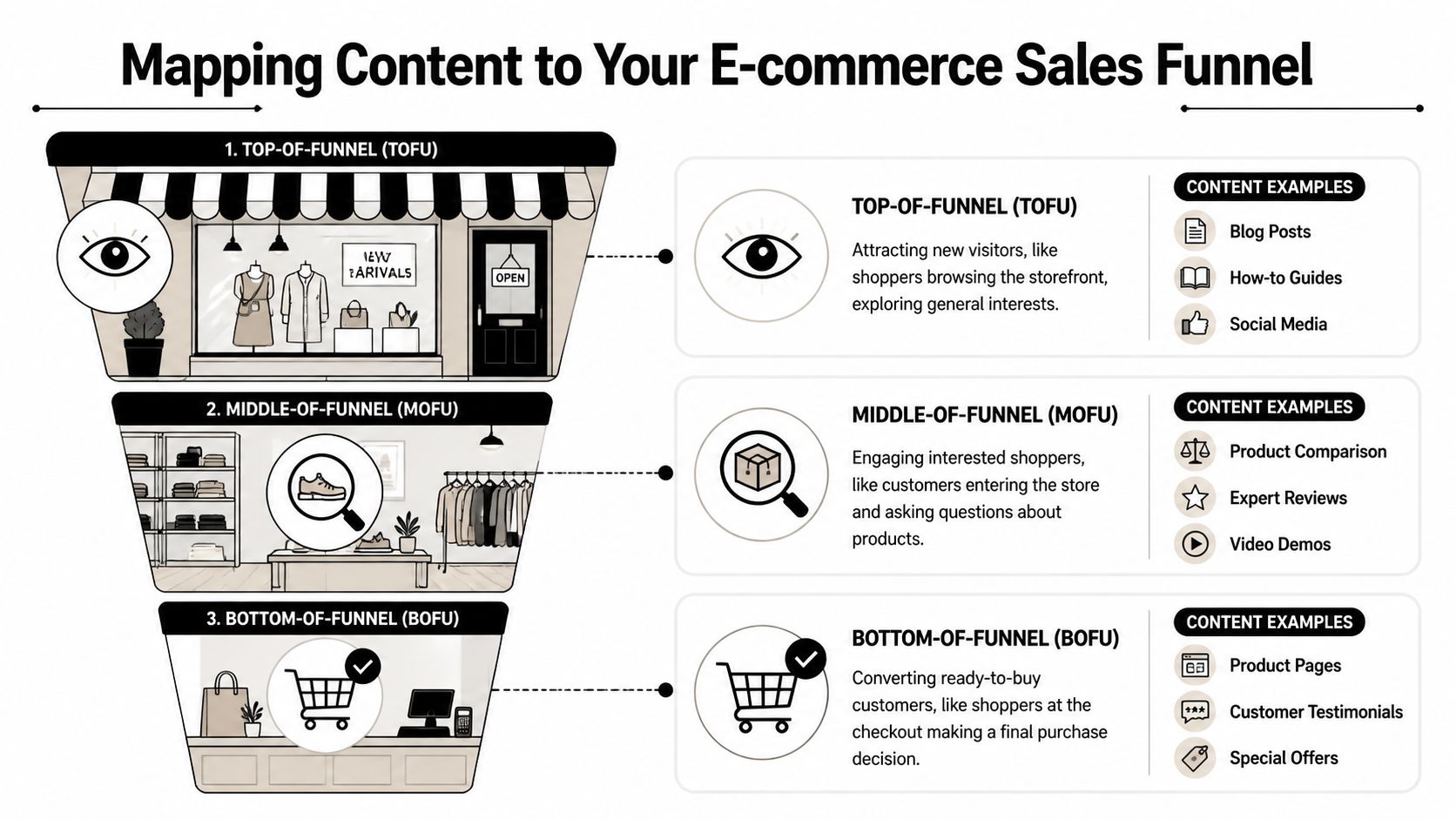
    The agents who win with seo for real estate agents usually do boring things well for a long time. They own their Google Business Profile. They build pages around buyer and seller intent. They publish useful local content. They keep the site technically healthy. They measure leads. Then they repeat.


    If you want that process without hiring an agency or turning SEO into a second job, Agency Secrets is a practical place to start. It lays out the playbook clearly and shows how to use OutRank to automate the heavy lifting, from keyword research and article publishing to backlinks and competitor analysis, so your site keeps growing while you stay focused on clients and closings.

  • Long Form Content: The SMB Guide to SEO Dominance

    Long Form Content: The SMB Guide to SEO Dominance

    Long form content gets an average of 77.2% more links than short articles. That single number should change how most small businesses think about SEO.

    If you're still publishing thin blog posts because they feel easier to produce, you're choosing the hardest path to growth. Bigger competitors already have stronger domains, larger teams, and more brand recognition. You won't beat them by publishing more noise. You beat them by publishing assets that deserve rankings, links, and leads.

    Long form content works because it gives Google and real buyers what short posts usually don't: complete answers, clear structure, strong internal links, and enough depth to signal authority. For a small business, that's not a branding exercise. It's a distribution strategy. One strong long form system can compound for months without paying an agency, funding nonstop ads, or hiring a full editorial team.

    Table of Contents

    What Is Long Form Content and Why It’s Your SEO Secret Weapon

    Articles in the top results are often long for a reason. Backlinko’s analysis of Google search results found that the average first-page result contains 1,447 words. That does not mean you should chase a word count target. It means search winners usually cover the topic with enough depth to satisfy the search.

    Long form content is a page built to finish the job. It answers the core question, handles the obvious follow-up questions, addresses objections, and gives the reader a clear next step. For an SMB, that could be a service page, buyer’s guide, comparison post, or pillar article. The format matters less than the outcome. The page should reduce uncertainty and move a prospect closer to action.

    A hand-drawn illustration showing a rocket labeled SEO Secret Weapon launching from long-form content.

    That is why long form content works so well for SEO. Google rewards pages that solve the search, not pages that hit a cute word count. Readers reward pages that save them another 10 tabs.

    Short posts usually miss on both fronts.

    Why short posts keep losing

    A 600-word post can work for a narrow query. It fails for anything tied to evaluation, comparison, pricing, implementation, or trust. Those searches need substance. If your page only scratches the surface, readers bounce and keep looking.

    Short posts also create an efficiency problem for small teams. You publish more often, but each post has less ranking range, fewer internal link opportunities, and less chance of becoming the page people reference, bookmark, or share. You stay busy without building an asset base.

    Here’s the practical filter:

    • Use short content for updates, announcements, single-answer FAQs, and support docs.
    • Use long form content for topics that influence revenue, require trust, or involve multiple decision points.
    • Prioritize depth anywhere a prospect is comparing options, costs, timelines, risks, or providers.

    If a topic can help someone choose whether to buy, hire, book, or request a quote, give it a serious page.

    Why this matters more for SMBs than big brands

    Big companies can afford wasted content. Small businesses cannot. You need every article to do more than fill a calendar slot. It should rank, support sales, answer repeated customer questions, and create material you can reuse in email, social, and sales conversations.

    That is the genuine advantage of long form content for SMBs. One strong article can become a working asset. Ten strong articles built from the same system can become a lead engine.

    Smaller teams can beat bigger competitors through this approach. You are closer to customer pain points. You hear the same objections on calls. You know what buyers ask before they commit. Put that knowledge into structured long form pages and you can publish content that is sharper than the bland, committee-written pieces larger brands push out.

    The win does not come from writing one heroic 3,000-word article. It comes from building a repeatable system to produce useful long form content every month. That is exactly why tools like OutRank matter for resource-strapped teams. They help you research faster, organize content around real search demand, and keep publishing without hiring an agency or stalling out after three posts.

    Long form content is not a writing style. It is a production model for turning what your business already knows into search traffic, trust, and qualified leads.

    Building Your Strategic Foundation with Topic Clusters

    If you publish random long articles, you'll get random results. You need a structure that tells Google what your site is about and helps readers move from one question to the next.

    That structure is the topic cluster.

    A diagram illustrating the SEO topic cluster strategy featuring a central pillar page and supporting content pieces.

    Think like a library, not a blog

    A good cluster works like a small reference library. The pillar page is the main book on the shelf. It covers the broad subject in an all-encompassing way. The supporting articles are the specialist volumes. Each one expands a subtopic and links back to the pillar and to related pages.

    That internal structure matters. Search Engine Land’s guide to longform content notes that pillar pages of 2,000 to 5,000 words linking to 10 to 20 supporting articles can yield 40 to 50% higher domain authority scores. That's the kind of advantage small businesses need because it lets one focused content system do more work than disconnected posts ever can.

    Later in the section, watch this breakdown if you want a visual explanation of how clusters support SEO performance.

    What a usable cluster looks like

    Let's say you run a local dental clinic. Don't publish one article on “teeth whitening tips” and call it content strategy. Build a pillar around a broader commercial theme such as cosmetic dentistry or teeth whitening treatments. Then support it with articles that answer the decision-level questions buyers ask.

    A practical cluster might include:

    • Core pillar page: Your complete guide to teeth whitening options, candidates, risks, maintenance, and booking considerations.
    • Comparison article: In-office whitening versus take-home kits.
    • Concern-driven article: How long whitening results last.
    • Local intent article: What to ask a clinic before booking treatment in your city.
    • Eligibility article: Whether whitening works for stains, crowns, or sensitive teeth.

    A cluster gives Google context and gives buyers a path. Both matter.

    Many SMBs overcomplicate things. You don't need fifty topics. You need a few revenue-connected themes and the discipline to build depth around each one.

    Start with buyer intent. Pick topics tied to services, categories, or repeated sales questions. Then map the cluster before writing anything. When every article has a job, content stops feeling like a guessing game and starts behaving like infrastructure.

    The Anatomy of a Perfect Long Form Article

    Google’s first-page results average 1,447 words, according to Backlinko research cited in Network Solutions’ overview of long-form content. That number matters for one reason. Winning pages usually cover the topic with enough depth to satisfy the searcher and move them toward a decision.

    For an SMB, that changes how you should write. Stop treating long form content like a school assignment. Build each article like a sales asset you can repeat, templatize, and publish at scale with a tool like OutRank.
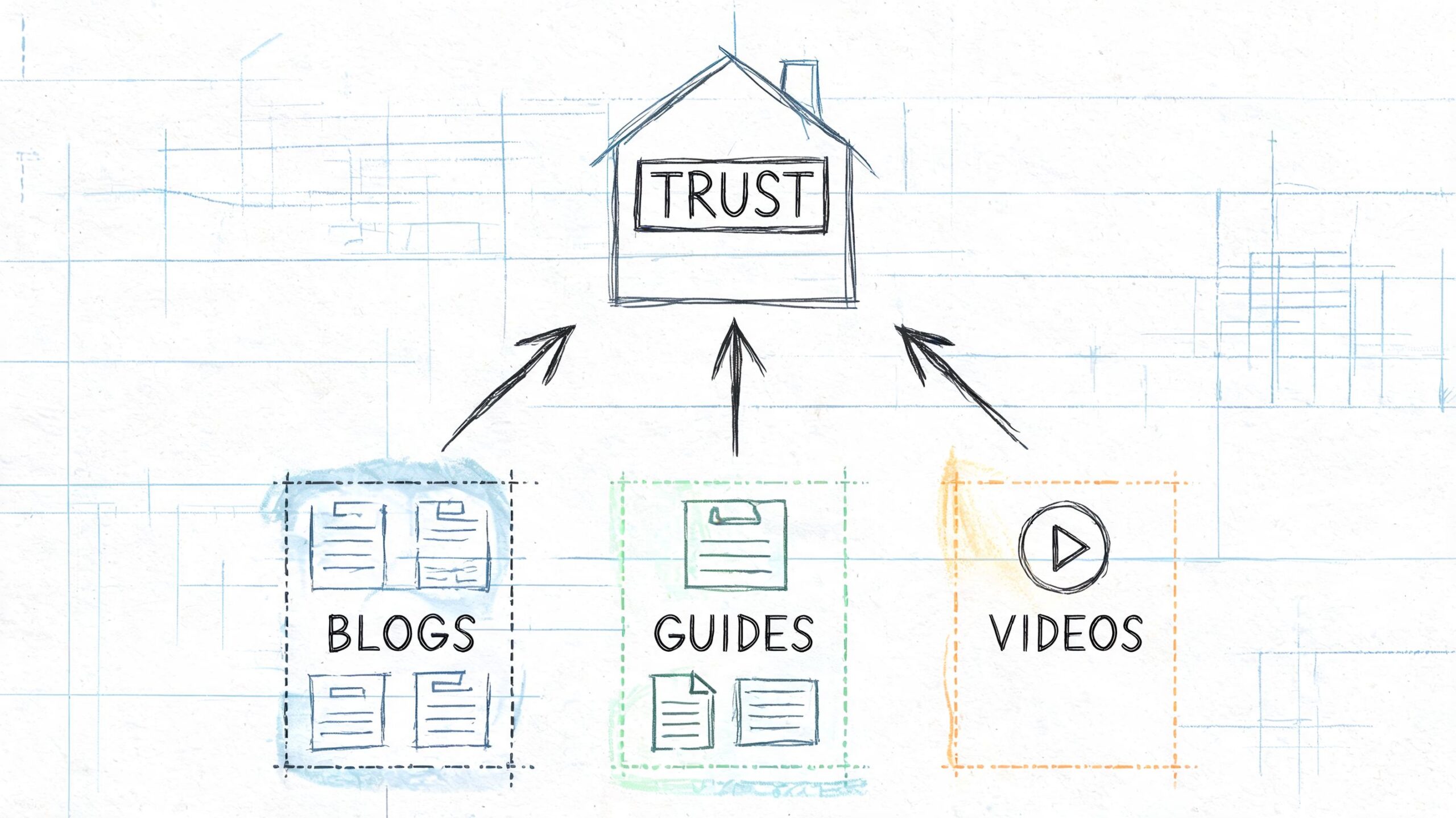
    A strong long form article does four jobs. It answers the core question fast, organizes the topic into clear decision points, proves credibility, and gives the reader a next step.

    Start with the answer

    Business owners often waste the first 200 words on scene-setting. That hurts rankings and conversions.

    Lead with the direct answer. If the search is “how long does commercial epoxy flooring last,” open with the actual range, then explain what changes the outcome. After that, break down traffic level, installation quality, maintenance, cost tradeoffs, and replacement timing.

    Your introduction should handle three things immediately:

    1. Confirm the reader is in the right place
    2. Give the short answer in plain language
    3. Show what the article will help them decide

    That structure improves engagement because the visitor gets value before they commit to reading the full page.

    Build the article around decision points

    Good long form content is structured around the questions a buyer asks before taking action. That is what keeps the article useful instead of bloated.

    Use sections that match real intent:

    • Definition or quick answer: What it is, who it is for, or the short verdict
    • Key variables: What affects the result, price, timeline, or outcome
    • Comparisons: Option A versus Option B
    • Common mistakes: What buyers get wrong
    • Proof and evidence: Experience, examples, specifications, cited sources
    • Next step: What to do now

    This is the difference between a page that ranks and a page that helps sell. For SMBs producing content consistently, this structure also gives you a repeatable template. You do not need to reinvent the article format every time. OutRank or a similar workflow can speed up drafting, but the underlying structure still needs to be sound.

    Format for skimming

    Readers scan first. If your page looks heavy, they leave before your best point shows up.

    Use formatting that makes the article easy to move through:

    • Clear H2 and H3 headings built from real sub-questions
    • Short paragraphs that keep one idea per block
    • Bullets and numbered lists for steps, comparisons, and checklists
    • Tables when the reader needs to compare options quickly
    • Trust signals such as firsthand experience, product details, expert input, and cited sources

    Put the strongest information high on the page and make it easy to spot. Summaries, subheads, and clean visual flow improve usability. They also make your content easier to scale because every article follows the same reading pattern.

    Long Form Content Best Practices Checklist

    Element Best Practice Why It Matters
    Headline Promise a clear outcome or answer Improves relevance and qualifies the click
    Introduction Answer the main query in the opening lines Reduces bounce and sets expectations fast
    Structure Use H2s and H3s based on sub-questions Makes the page easier to scan and understand
    Paragraphs Keep them short and focused Improves readability on desktop and mobile
    Evidence Use cited studies, product details, and real expertise Builds credibility and supports E-E-A-T
    Internal linking Link to related supporting pages naturally Strengthens topical relevance and supports deeper journeys
    Visual flow Break up text with bullets, tables, and callouts Helps scanners find useful information quickly
    Conclusion End with a decision, summary, or next step Turns attention into action

    One more rule. Every section must earn its place.

    Do not pad the article to hit an arbitrary word count. Do not repeat the same point in three different headings. Do not add generic FAQ fluff if it does not help the buyer decide. The best long form content feels complete because it is tightly organized, easy to scan, and built from a system your business can repeat every month.

    Your Scalable Workflow for Publishing High-Impact Content

    One excellent article won't change your business. A repeatable publishing system might.

    That's the difference between content as a project and content as a growth engine.

    Amra & Elma’s roundup of long-form marketing statistics says that by 2026, 61% of marketing strategies incorporate long-form content, up from 42% in 2023, and 74% of marketers rank long-form blogging as the top-performing format for lead generation. Treat that as a projection and a warning. If you wait until everyone around you has built a content engine, you'll be catching up from behind.

    An illustration showing a four-step content production process from idea generation to publishing high-impact content.
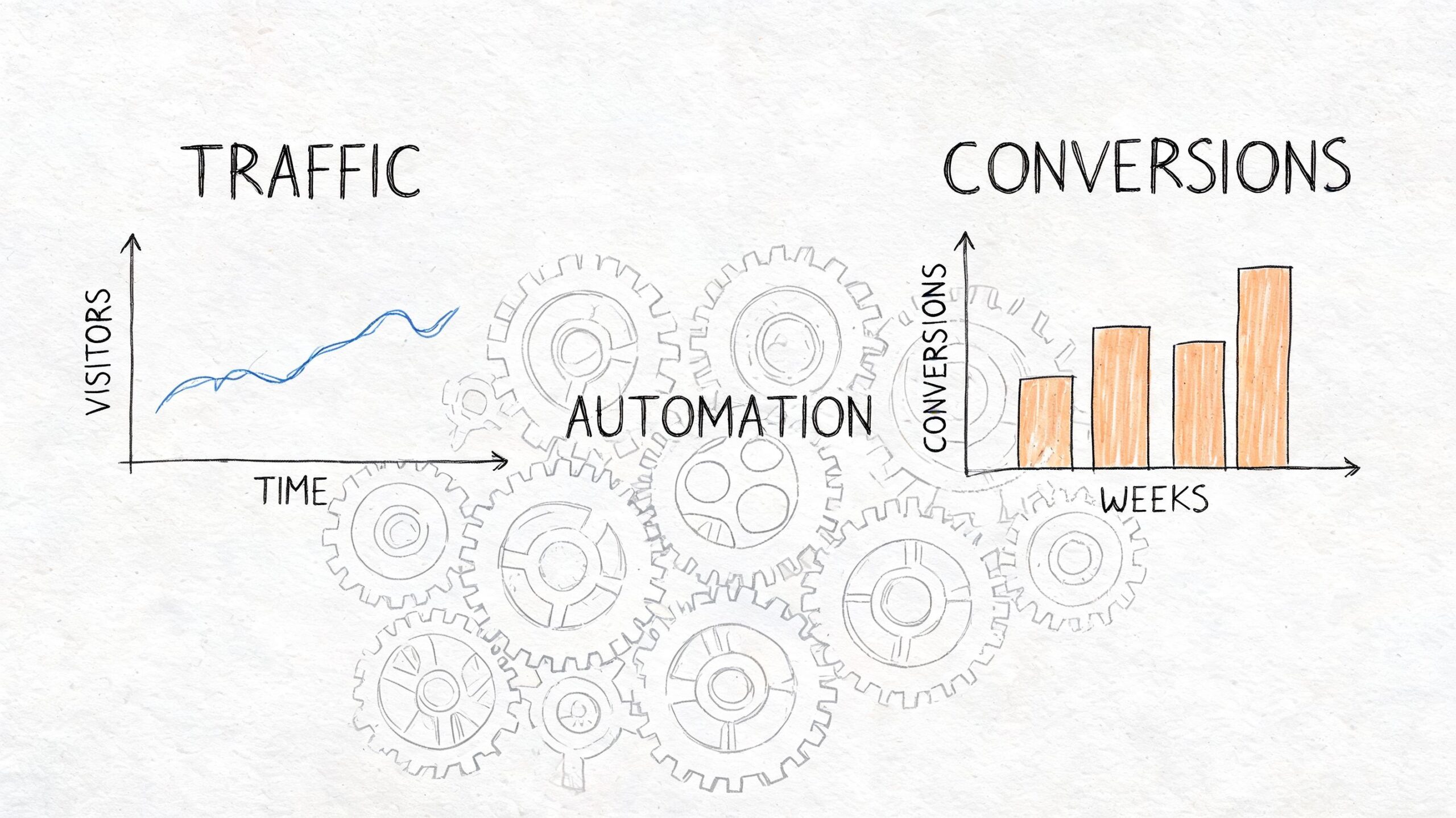
    The workflow that keeps you consistent

    A practical SMB workflow doesn't need a newsroom. It needs a sequence you can repeat without burning out.

    Here's the model I recommend:

    1. Choose one commercial theme

      Start with a service line, product category, or problem tied to revenue. Ignore vanity topics unless they support a money page.

    2. Build a content map

      Create one pillar topic and a list of supporting article angles. This removes guesswork before writing starts.

    3. Outline before drafting

      Your outline should include the primary question, major sub-questions, internal links to add, and the action you want the reader to take.

    4. Draft fast, edit hard

      Don't write and edit at the same time. Get the substance down, then tighten the structure, examples, and readability.

    5. Publish and interlink immediately

      New pages should connect to relevant existing pages on day one. A lonely post is wasted effort.

    Where automation actually helps

    Most founders don't fail because they lack ideas. They fail because the process is too heavy to sustain. Keyword research takes time. Outlining takes time. Drafting takes time. Publishing takes time. Link building takes time.

    Tools like OutRank become useful. Not because software replaces judgment, but because it removes repetitive work. If the platform can handle keyword discovery, draft generation, publishing support, competitor analysis, and backlink workflows, a small team can maintain output without turning content into a full-time internal job.

    Use automation for the repeatable parts:

    • Research support: Surface keyword opportunities and related subtopics.
    • Production speed: Generate structured drafts faster than starting from a blank page.
    • Publishing rhythm: Keep articles moving instead of leaving them stuck in a backlog.
    • Cluster expansion: Turn one strong topic into a planned series, not a one-off post.

    The real win isn't writing faster. It's publishing consistently enough that your site becomes difficult to ignore.

    If you're resource-strapped, that's the entire game. Not perfection. Not endless polishing. A reliable system that keeps producing strong long form content month after month.

    From Post to Powerhouse Repurposing Your Content

    Most businesses publish a long article, share it once, and abandon it. That's wasteful.

    A strong article should feed your email, social, sales enablement, and short-form content for weeks. Long form content is expensive in attention. Squeeze everything out of it.

    Turn one article into a content pack

    Take a finished guide and strip it for parts. Each subsection, objection, example, or checklist can become a distribution asset.

    Useful repurposing formats include:

    • Email sequence: Pull three to five sections into short educational emails that lead back to the full article.
    • LinkedIn post series: Turn one article into opinion posts, common-mistake posts, and buyer-question posts.
    • Sales follow-up asset: Send the article after discovery calls to handle objections at scale.
    • Carousel outline: Break the article into a step-by-step visual summary for social.
    • FAQ snippets: Rework subheadings into short answers for product pages or service pages.

    One article should create a small orbit of supporting content. That's how you increase reach without constantly inventing new ideas.
    Use a shorts-to-long-form funnel

    Short-form video gets attention quickly. It usually doesn't build the same value as a deep article. That's why the better play is to let short content attract interest and let long form content do the serious selling and ranking work.

    VirVid’s discussion of the Shorts-to-long-form funnel says YouTube Shorts have 5.91% engagement, but low monetization, and marketers use short clips to drive traffic into long-form assets. The same source describes this funnel as growing channels 41% faster. For a small business, the lesson is simple. Use short content for discovery. Use long form content for depth, trust, and conversion.

    A simple funnel looks like this:

    • Clip one strong insight: Pull a sharp claim, mistake, or myth from your article.
    • Create a short script: Keep it focused on one question only.
    • Use the article as the destination: Send viewers to the full guide, not your homepage.
    • Match the message: If the short talks about a specific problem, link to the article that solves that exact problem.

    This works especially well for local services and niche ecommerce because your short content can stay narrow and practical. You don't need to become a creator. You need to become useful.

    Measuring the True ROI of Your Content Engine

    If you measure long form content by likes, you'll miss the point and probably kill the strategy too early.

    Content should be judged by whether it brings the right visitors, improves search visibility, and helps produce leads or sales. These are the key metrics; everything else is secondary.

    Track business metrics, not vanity metrics

    The best content programs use a short list of hard metrics. Keep it simple enough that you'll review it.
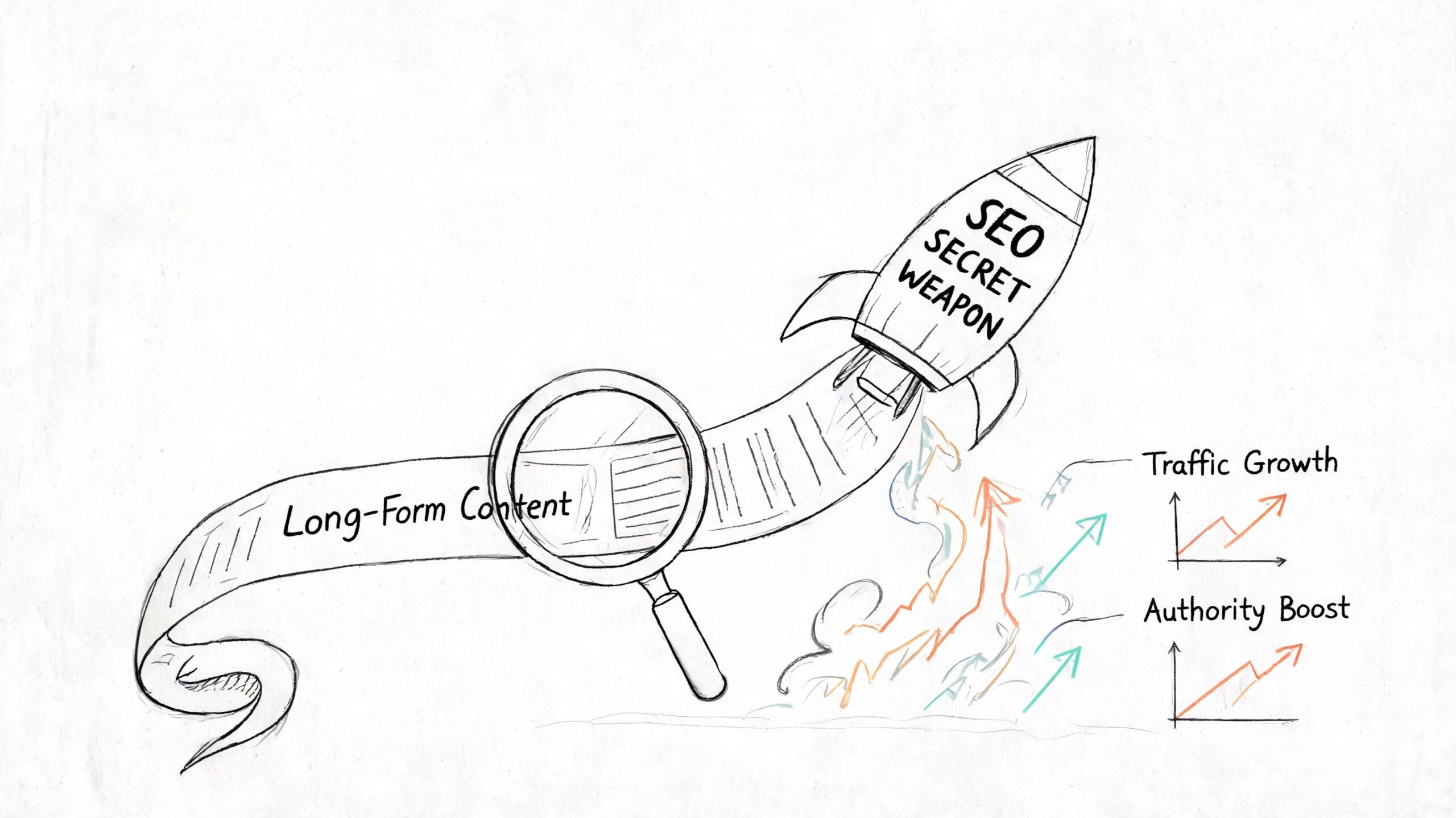
    Focus on:

    • Keyword movement: Are your core buyer-intent pages climbing for the terms that matter?
    • Qualified organic traffic: Are the right pages attracting visitors from search?
    • Lead conversions: Are contact forms, calls, demo requests, or purchases tied to those visits?
    • Assisted conversions: Are people reading content before they convert later through another page?
    • Internal page flow: Are readers clicking deeper into service pages, category pages, or related guides?

    Traffic without commercial relevance is just activity. Track what helps revenue.
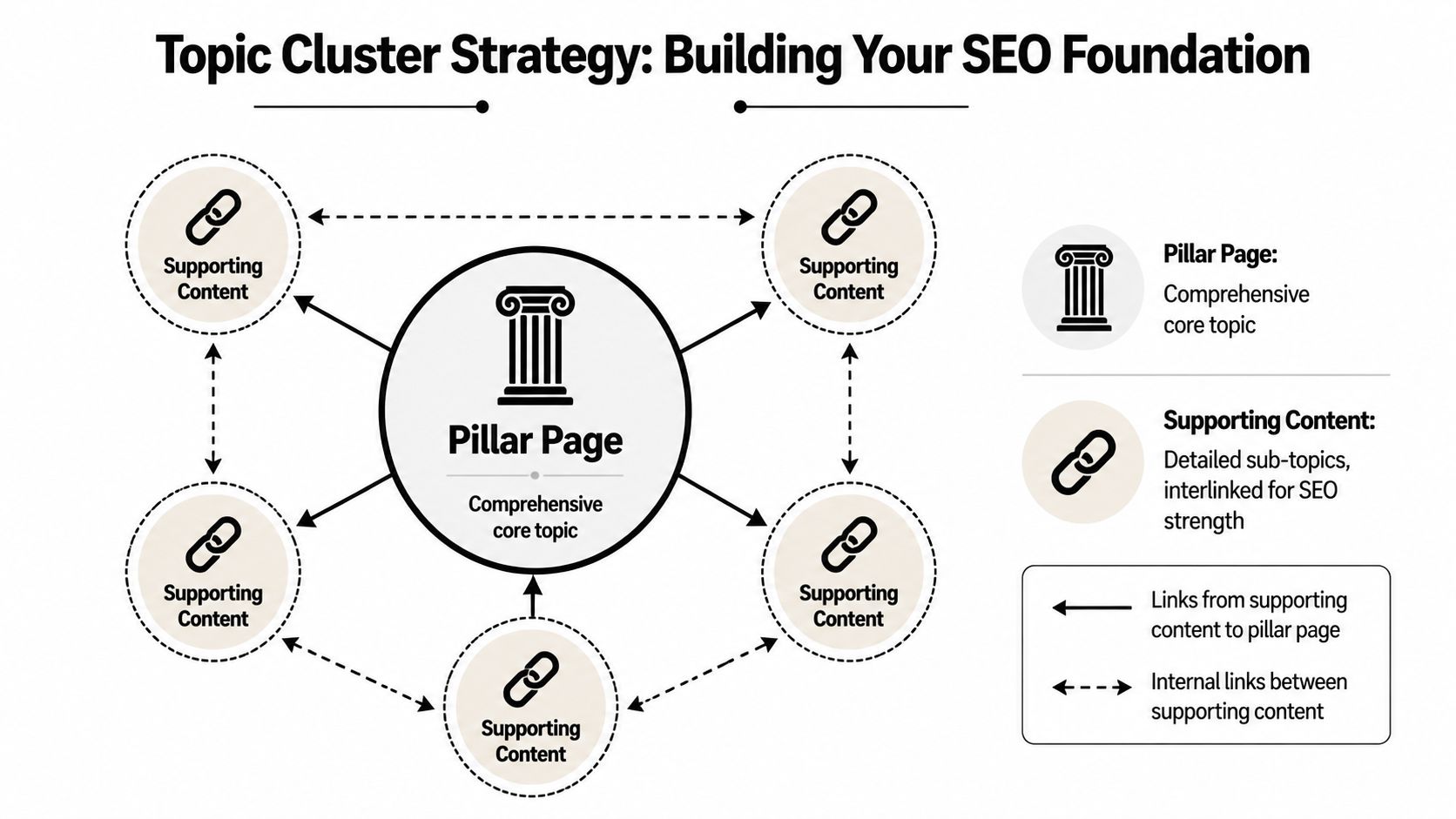
    Don't panic if a strong article takes time to mature. Long form content often compounds because one page can rank for many related searches and strengthen nearby pages through internal links.

    What to check in Search Console and GA4

    You don't need an expensive analytics stack to get useful answers. Google Search Console and GA4 are enough for most SMBs.

    In Search Console, check which queries trigger impressions for your long form pages. Look for signs that one article is starting to rank for a wider set of related searches than you originally targeted. That's usually a sign the topic is gaining traction.

    In GA4, create a habit of checking which landing pages bring organic sessions and what those users do next. Watch whether readers continue to service pages, product pages, contact pages, or checkout steps. If the article earns traffic but nobody moves deeper, the page may be attracting the wrong intent or failing to push the next action clearly enough.

    A practical review routine looks like this:

    • Monthly review: Check which articles gained visibility, clicks, and downstream actions.
    • Content refresh decisions: Improve pages that show promise but need better structure, stronger intros, or clearer internal links.
    • Pruning decisions: Merge or redirect weak overlap pages that dilute the cluster.
    • Expansion decisions: Double down on subtopics that start surfacing new relevant queries.

    This is how you prove ROI without guesswork. Not by asking whether content “feels valuable,” but by seeing whether your content engine is increasing search presence and moving prospects toward revenue.

    Your Final Playbook for Long Form Content Success

    Long form content is one of the few SEO plays that still gives small businesses a real structural advantage. It lets you compete on usefulness instead of budget. That matters because larger competitors usually win on brute force. You win on precision, depth, and consistency.

    The playbook is straightforward.

    Build around revenue-connected topics, not random blog ideas. Turn those topics into clusters, not isolated posts. Write articles that answer the main question early, cover the decision thoroughly, and guide readers toward the next step. Then stop treating publishing as the finish line. Repurpose the article, distribute it, and use short-form channels to bring more people back to the full asset.

    Most important, make the process repeatable. The businesses that get outsized SEO results aren't always the ones with the best writer in the room. They're the ones that keep publishing useful, structured, authoritative content without dropping the ball after three weeks.

    If you're a solo founder or lean in-house team, don't wait for ideal conditions. Start with one cluster. Publish one serious pillar. Add supporting content. Track outcomes. Tighten the workflow. Then scale with tools that remove bottlenecks and keep production moving.

    That's how long form content turns from “something we should do” into a durable acquisition channel.


    Agency Secrets gives small business owners a practical path to do exactly that. If you want an agency-free SEO system built around buyer-intent keyword research, authoritative article production, backlinks, and compounding evergreen growth, start with Agency Secrets. It’s the clearest next step if you want to build a long form content engine instead of publishing one-off posts.