
Chasing every Google alternative is a poor use of a small business owner's time.
The SEO question is simpler. Which search engines can bring qualified traffic or citations without creating a second full optimization workload?
Google still sets the pace, and for many businesses it will remain the main source of search visibility. That does not make the rest of the field irrelevant. Buyers use Bing on work devices, privacy-focused users rely on DuckDuckGo and Brave, and answer engines are starting to influence which brands get cited before a click ever happens. If your business depends on search, putting all discovery risk in one platform is a weak position.
The practical upside is that these engines do not all require separate campaigns. Some rely heavily on Bing or Google results. Some use their own index. Some matter less for raw traffic and more for brand discovery, citation visibility, or reaching audiences that behave differently from standard Google users.
This guide focuses on the business and SEO implications of each option. The point is to help you decide where direct indexing work matters, where strong technical SEO already carries over, and where extra effort is unlikely to pay back.
For a local service company, ecommerce brand, solo operator, or lean in-house team, that prioritization matters more than a feature list. The goal is not to be everywhere. The goal is to get found in the places that can expand visibility with the least wasted effort.
Table of Contents
- 1. Microsoft Bing
- 2. DuckDuckGo
- 3. Brave Search
- 4. Startpage
- 5. Kagi
- 6. Mojeek
- 7. Qwant
- 8. Ecosia
- 9. You.com
- 10. Perplexity
- Top 10 Google-Alternative Search Engines Comparison
- How to Prioritize Alternative Search Engines for Your Business
1. Microsoft Bing
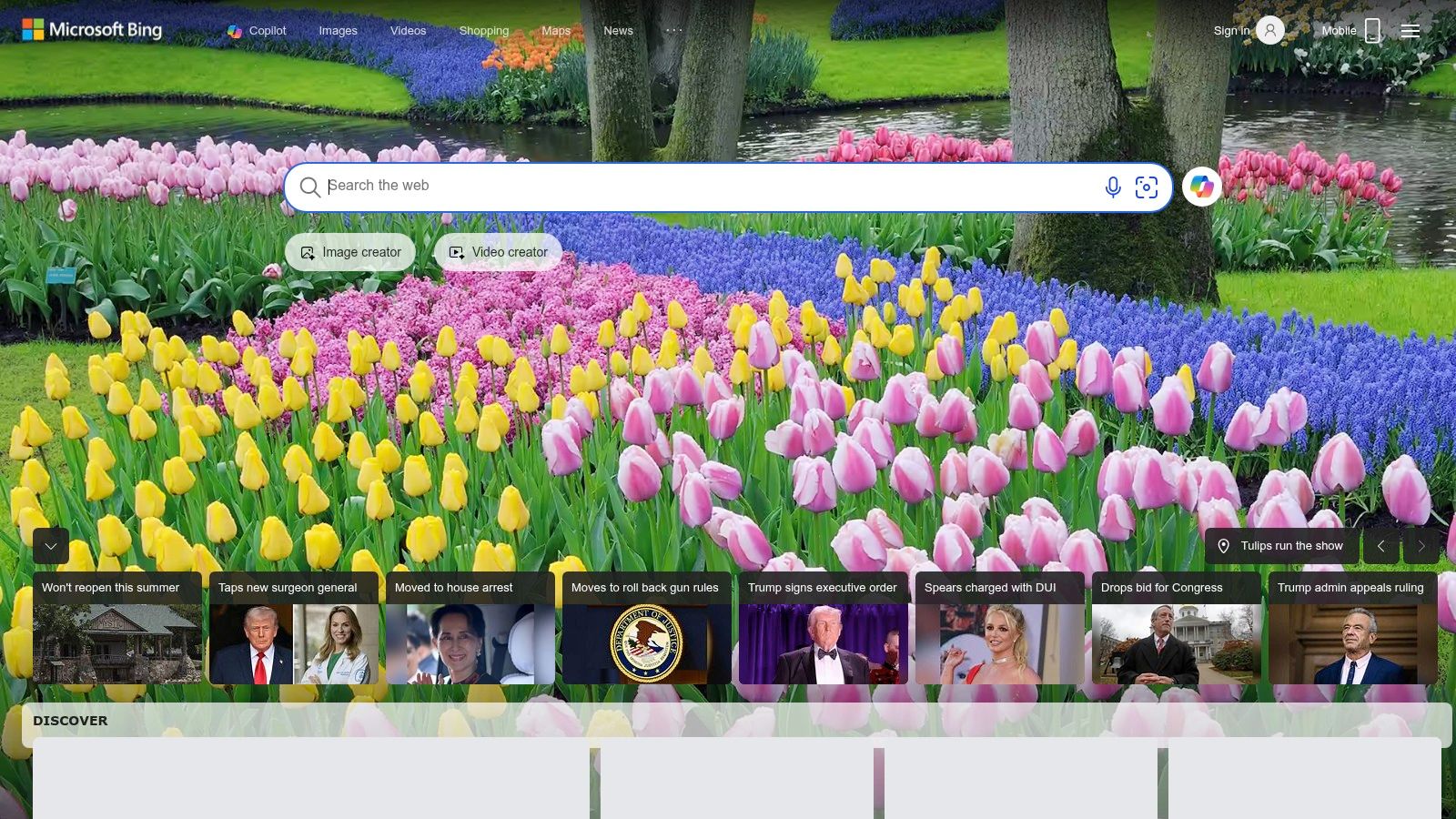
Small businesses often overestimate how many Google alternatives deserve active SEO work. Bing is the exception. If resources are tight, this is usually the first platform to treat as a real acquisition channel, not a nice-to-have side project.
The reason is practical. Bing has enough usage, enough commercial intent, and enough overlap with existing SEO workflows that the return can show up without building a separate search strategy from scratch. That makes it the best starting point for businesses that want to diversify search exposure without spreading effort across ten minor engines.
Why Bing matters first
Bing is usually the highest-priority alternative because the operational lift is low and the upside is real. In many accounts I have worked on, Bing traffic converts more like paid search traffic than experimental referral traffic. Users skew more desktop-heavy, often older, and often closer to purchase for local services, B2B research, and product comparison queries.
It also has multiplier value. Bing powers Yahoo search, so better Bing visibility can extend into another search property without extra optimization work. Yahoo still operates at meaningful scale across search and media properties, which gives Bing more business relevance than its headline reputation suggests.
For a small business owner, the useful question is not "How different is Bing from Google?" The better question is "What prevents my existing site from being understood and indexed cleanly by Bing?"
The answer is usually one of three things:
- Bing Webmaster Tools is not set up: No sitemap submission, no indexing diagnostics, no crawl visibility.
- Local and entity signals are weak: Business name, address, phone, service area, and category details are inconsistent or vague.
- Pages are clear to humans but muddy to crawlers: Important service pages lack direct headings, supporting copy, or obvious topical focus.
Practical rule: If your site performs reasonably on Google but barely appears on Bing, check crawl access, indexation, and page clarity first. In a lot of cases, Bing has not fully processed the site rather than rejecting the content.
Bing also tends to reward straightforward SEO. Clear titles, descriptive headings, strong internal site structure, and explicit location or service information go a long way. Businesses that rely on thin city pages, weak category architecture, or brand-heavy copy often underperform here.
That is the trade-off. Bing can be easier to improve than Google, but it is less forgiving when your site structure is vague. If you want one alternative search engine to prioritize first, Bing usually earns that spot because the path from technical cleanup to measurable traffic is shorter than on the smaller players.
2. DuckDuckGo
DuckDuckGo matters less as a platform you optimize for directly and more as a distribution layer you influence through the sources it trusts. That distinction matters for small businesses, because it changes the work. The goal is usually not to build a separate DuckDuckGo SEO playbook. The goal is to make sure your site is readable, indexable, and strong in the ecosystems DuckDuckGo draws from.
That makes DuckDuckGo a second-priority engine for many local and service businesses. It can send qualified traffic, especially from users who want cleaner results and less tracking. But it rarely deserves the same level of direct effort as Bing, because you have fewer levers to pull.
What actually improves visibility on DuckDuckGo
The businesses that do best here usually get the basics right and avoid overcomplicating things.
- Get your core pages into shape: Service pages need clear headings, plain language, and obvious topical focus.
- Treat Bing performance as an input: DuckDuckGo often reflects how well other sources can understand your site, so weak visibility upstream usually shows up here too.
- Answer the query fast: Pages that bury the main answer under branding, vague intros, or filler tend to underperform.
- Build for trust, not SERP gimmicks: Strong page structure, accurate business details, and useful copy matter more than chasing every search feature.
DuckDuckGo is also a good reality check for businesses that rely too heavily on personalization-driven assumptions. Users here are more likely to see a cleaner, less customized result set. If your page only wins when search history, location cues, or heavy brand familiarity do the work, that weakness becomes easier to spot.
For local SEO, the trade-off is straightforward. DuckDuckGo can produce useful exposure, but its local experience is often thinner than Google for map-heavy, high-intent searches. A plumber, dentist, personal injury lawyer, or med spa should treat it as a supporting channel, not the main local acquisition engine.
Practical rule: If your business depends on nearby customers finding you at the moment they need help, improve your site and local signals for broader search visibility first. DuckDuckGo benefits usually follow from that work rather than from channel-specific tweaks.
This is why I would prioritize DuckDuckGo after Bing, not before it. For a small business owner, the upside is real but the path is indirect. Clean technical SEO, strong service pages, and consistent business information do most of the work. If those pieces are weak, DuckDuckGo will not give you a shortcut.
3. Brave Search
Brave Search deserves more attention than it usually gets. Small businesses often dismiss it because the audience is smaller than Google or Bing. For SEO, that misses its true benefit.
Brave runs on its own index to a much greater extent than many privacy-first search tools. That matters because it gives you a cleaner read on whether your pages are understandable, well-linked, and useful without leaning so heavily on Google or Bing's interpretation of the web.
I use Brave less as a volume play and more as a diagnostic tool.
If a service page ranks in Google and Bing but disappears or slides badly in Brave, I do not treat that as random noise. It usually points to one of a few problems. The page may be too template-heavy, the entity signals may be weak, the copy may say the same thing as every competitor, or the internal linking may not give the page enough context. Brave can expose those weaknesses faster than another round of rank tracking inside the same two major ecosystems.
Where Brave is useful for businesses
Brave is worth checking if your customers skew toward privacy-aware users, software buyers, technical audiences, crypto-native communities, or younger web users who have already switched browsers. For those segments, Brave traffic may stay modest but commercially relevant.
It also has a clear SEO use case beyond traffic. Brave helps answer a practical question. Does your site have enough topical depth to travel across indexes?
From a business and prioritization standpoint, Brave is useful in three ways:
- Independent-index visibility check: Search your core terms in Brave to see whether your main money pages still surface without the same ranking assumptions you see in Google and Bing.
- Content planning from real discussions: Brave's Discussions feature can reveal forum threads and community conversations that point to objections, pain points, and phrasing worth using in content.
- Competitive gap spotting: On some queries, Brave gives smaller publishers more room. That makes it easier to see whether a large brand is winning because it is better or because the dominant engines already trust it.
There is a trade-off. Brave can be less consistent on obscure long-tail searches, especially in very narrow local or niche B2B categories. A small business owner should not treat that as a reason to ignore it. Treat it as a signal about channel priority. If your revenue depends on broad local pack visibility or high-volume commercial terms, Bing usually deserves work first. If you publish educational content, comparison pages, or niche expertise pieces, Brave is a smart secondary check because it shows whether your authority travels outside the usual ranking stack.
That is why I would rank Brave below Bing for direct acquisition, but above a lot of smaller alternatives for SEO diagnosis. It helps you find weak pages, thin topic coverage, and over-optimized copy before those issues spread across the rest of your search visibility.
4. Startpage
Startpage is the easiest search engine on this list to misunderstand. Users often treat it as a completely separate alternative. For SEO, that's usually the wrong frame.
Startpage is best understood as a privacy layer in front of Google-style results. Users choose it because they want Google's relevance without Google's tracking footprint. For a business owner, that changes the tactical question from "How do I optimize for Startpage?" to "Am I already strong enough in Google's core organic results to benefit when users choose a privacy wrapper?"
What Startpage means for your SEO
For most sites, there isn't a separate Startpage playbook. If your pages already rank well in Google, you have the best chance of appearing well in Startpage's results too. That makes Startpage less of a new SEO channel and more of a hedge against users who are leaving Google at the interface level, not necessarily at the results level.
That said, there are trade-offs:
- Great for preserving existing SEO gains: If you already publish strong evergreen content, Startpage can extend visibility to privacy-first users.
- Less useful as a direct optimization target: You won't usually get special tactics to gain Startpage-specific traffic.
- Different SERP features: Some rich-result behaviors won't look identical, so click behavior can change.
What works here is boring and effective. Publish pages with clear search intent, answer the main query early, avoid fluff, and make sure your page can earn a click without depending on flashy SERP extras. That's especially true for service pages, buying guides, and category content.
Startpage is a reminder that privacy shifts don't always create a new ranking game. Sometimes they just reroute users to a cleaner version of the old one.
If your Google rankings are weak, Startpage won't save you. If your Google rankings are strong, it can preserve reach among users who don't want to search inside Google's front door.
5. Kagi
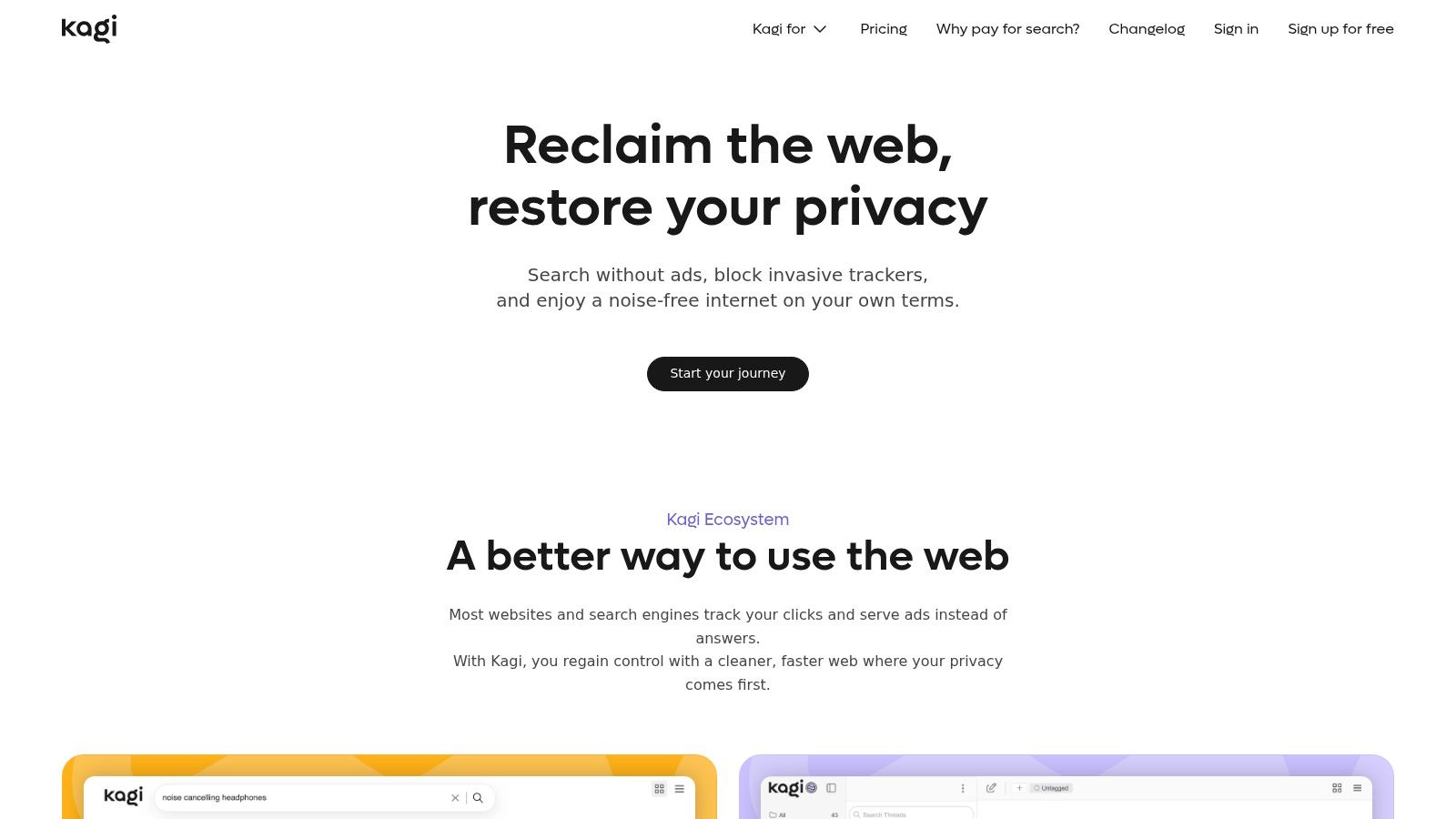
Kagi matters less for volume than for signal.
It runs on a paid model, not an ad model, which changes the kind of user it attracts and the kind of pages that tend to hold up. Kagi searchers are usually paying to avoid clutter, recycled advice, and pages built to capture clicks before they deliver value. For a business owner, that makes Kagi less of a traffic play and more of a quality filter.
That filter is useful. If your site performs well in Kagi, you're often doing something right at the content level, not just checking technical SEO boxes.
Who should care about Kagi visibility
Kagi belongs higher on the priority list for B2B SaaS companies, consultants, niche publishers, technical service firms, and premium ecommerce brands. These businesses often sell to buyers who research carefully and have a low tolerance for fluff.
Local service businesses can mostly treat Kagi as a secondary channel. A roofer, dentist, or emergency plumber is unlikely to see enough demand there to justify Kagi-specific work unless the brand also publishes strong educational content that reaches a national audience.
The practical SEO takeaway is simple. Do not build a separate Kagi strategy. Use Kagi as a pressure test for whether your pages deserve to rank in any serious search environment.
What usually works on Kagi:
- Original expertise: First-hand insight, strong opinions, and real examples beat generic summaries.
- Clear topical focus: Sites with a defined niche tend to make more sense here than broad sites covering everything.
- Clean page experience: Heavy popups, ad clutter, and bloated templates work against the expectations of Kagi users.
- Direct answers: Pages that get to the point quickly have a better shot than pages padded for word count.
I like Kagi as an audit tool for high-consideration businesses. Search your main commercial and informational terms there. If thin comparison pages or vague listicles outrank your best work, the problem usually is not that Kagi is broken. The problem is that your content is easier to index than to trust.
For small businesses, that is the essential value of Kagi. It helps you separate visibility from credibility.
6. Mojeek
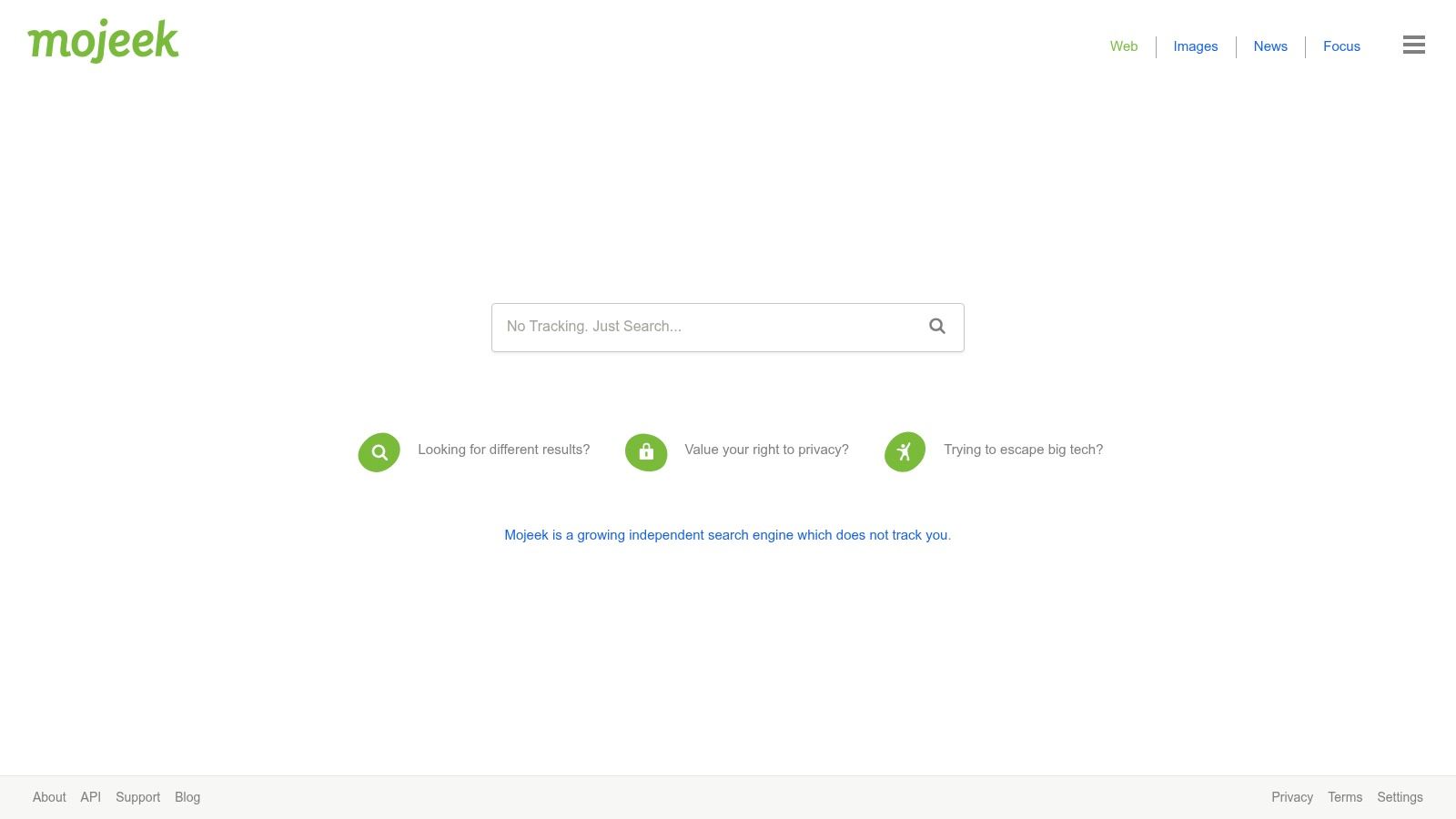
Mojeek is a true independent crawler, and that independence is its biggest strength and biggest weakness.
For businesses, Mojeek is rarely a major traffic source. But it does something useful that larger engines often don't. It gives you another reading on whether your pages are discoverable and understandable without leaning on a dominant ecosystem's assumptions.
When Mojeek is worth the effort
If you're a publisher, technical founder, privacy-focused brand, or niche ecommerce operator, Mojeek can be worth checking manually. For everyone else, it sits lower on the action list.
Its practical value comes from contrast:
- Index independence: You're not just seeing a recycled version of the same ranking stack.
- Smaller ecosystem: Thin authority or weak site structure shows up faster.
- Limited local depth: If you rely on maps, business profiles, and local intent modifiers, Mojeek won't be your primary growth lever.
The downside is obvious. Result relevance can be mixed, especially for very specific or local queries. That aligns with the broader issue noted earlier: independent engines can struggle with niche long-tail precision. For a plumber or med spa, that limits the upside. For a specialist blog or high-expertise site, it can still be a useful secondary check.
Use Mojeek like a diagnostic tool, not a primary acquisition channel.
If your content is clear, crawlable, and tightly focused, you'll usually have a better chance of surfacing across independent engines over time. If your pages only perform when massive platforms validate them, Mojeek tends to expose that quickly.
7. Qwant
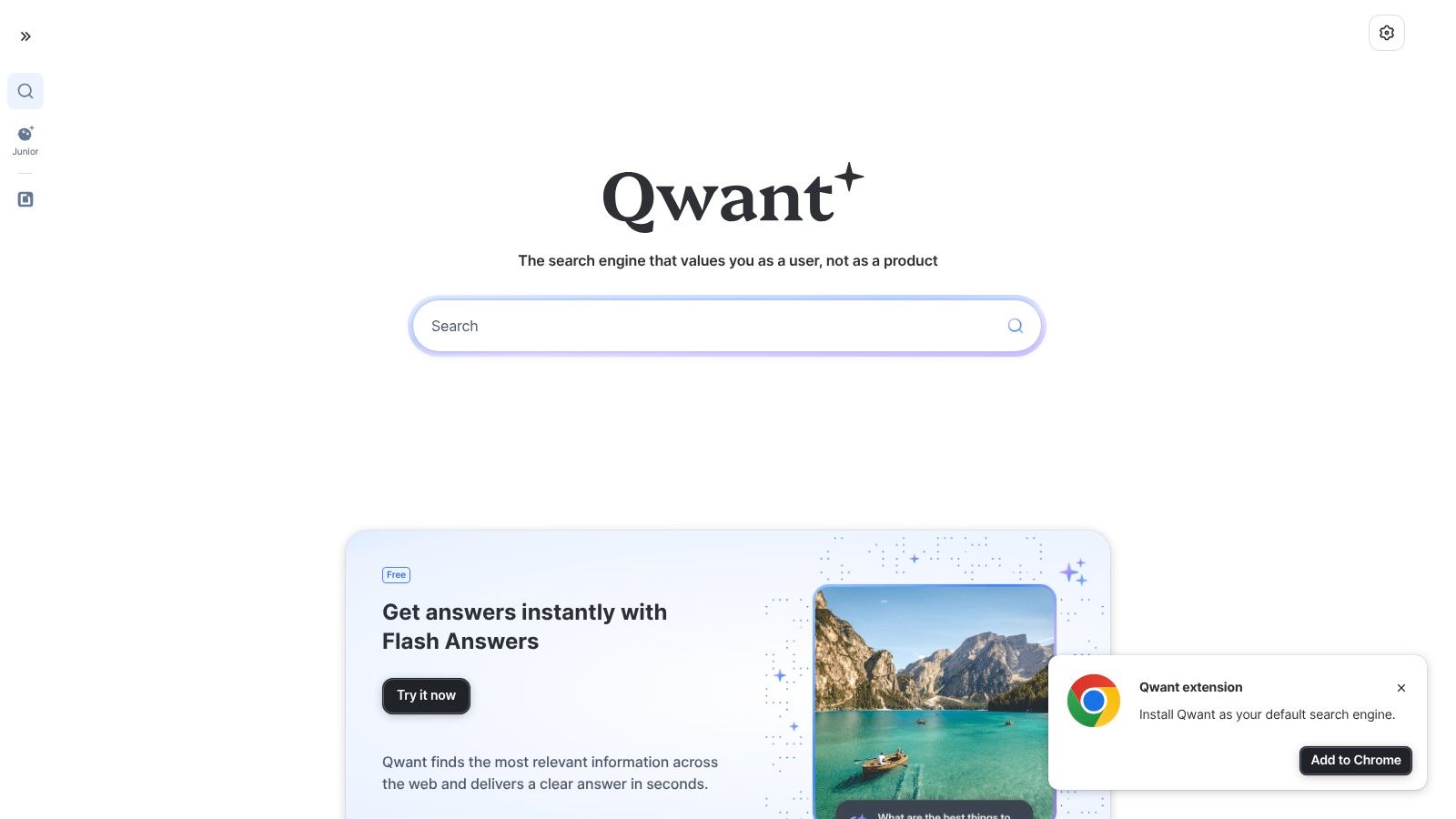
Qwant sits in an interesting middle ground. It's privacy-oriented, Europe-leaning, and useful for businesses that care about visibility beyond a US-only search mindset.
If your customers are concentrated in Europe, or your brand story leans hard into privacy and data restraint, Qwant deserves more attention than most US-centric SEO guides give it.
Best fit for Qwant
Qwant isn't usually where a local US roofer or dentist should spend extra time. But for SaaS companies, ecommerce brands shipping across Europe, publishers with multilingual content, and regulated industries that benefit from a more privacy-aware audience, it can be relevant.
The practical trade-off is familiar. Coverage can rely partly on outside infrastructure, so your success often still depends on strong core SEO fundamentals rather than Qwant-specific tricks.
A few situations where Qwant matters more:
- European market positioning: If your business sells to privacy-aware European buyers, search alignment matters.
- Brand trust: A privacy-forward search environment can be a better fit for serious informational content than ad-heavy SERPs.
- Multilingual support: Clear language targeting and structured site architecture matter more than clever SEO hacks.
Qwant is not a volume-first opportunity for most small businesses. It's a fit-first opportunity. If your market and message align, that's enough reason to include it in your periodic visibility checks.
8. Ecosia
Ecosia is often treated as a feel-good consumer choice. For business owners, it matters more than that because mission-driven search behavior can overlap with purchase behavior.
Users who choose Ecosia aren't only making a privacy or convenience choice. They're signaling values. If your brand sells eco-friendly products, sustainable services, ethical fashion, refill systems, local goods, or low-waste home solutions, Ecosia traffic can be unusually aligned even if it isn't massive.
What Ecosia changes for small businesses
Ecosia works best as a drop-in search alternative, and that means your SEO gains usually come from solid underlying indexing rather than bespoke optimization. If your site already performs well in mainstream search, especially on non-brand informational and commercial queries, you have a better chance of earning visibility here too.
That creates a useful strategic filter:
- Strong fit for values-led brands: Sustainable brands can benefit from audience alignment.
- Weak fit for SERP-feature dependence: If your strategy relies on rich shopping units or heavy local pack behavior, the upside is narrower.
- Good support channel, not core channel: Treat it as diversified demand, not your main acquisition engine.
The brands that do best with Ecosia usually don't change their SEO just for Ecosia. They improve category pages, publish specific buying guides, and make trust signals obvious. Certifications, sourcing details, product materials, shipping info, and transparent business practices matter because the audience cares.
That same discipline helps everywhere else too. Ecosia rewards clarity and values alignment more than gimmicks.
9. You.com
You.com is less useful as a classic search engine comparison and more useful as a signal about where search behavior is heading. People use it to blend web search, AI assistance, summarization, and task completion in one place.
That matters if your business produces content that needs to be cited, summarized, or surfaced as an answer instead of just clicked as a blue link.
How to think about You.com traffic
I wouldn't build a small business SEO plan around You.com traffic alone. The interface and product direction can evolve fast, which makes it a poor candidate for channel dependency. But it is a good place to pressure-test your content architecture.
Pages that tend to surface well in AI-forward environments usually share a few traits:
- Direct question-answer structure: The page states the answer early.
- Scannable hierarchy: Headings map cleanly to subtopics.
- Distinctive value: The content adds expertise, examples, or a point of view instead of remixing common advice.
If you run a B2B service, software product, agency, or education-led brand, You.com is worth monitoring because your buyers may use it during research, not just casual browsing. They may never visit your homepage first. They may encounter your explanation inside an AI-assisted result path.
That changes how you write. Dense brand copy and vague positioning pages don't travel well in these environments. Crisp definitions, strong comparisons, and practical guidance do.
10. Perplexity
Perplexity matters less as a traffic channel than as a preview of where organic visibility is heading. It rewards pages that can be cited inside an answer, not just pages that win a click from a results page.
For a small business, that changes the SEO question. The goal is no longer only "Can this page rank?" It is also "Would an answer engine trust this page enough to quote it?"
How to evaluate Perplexity for SEO
Perplexity is still a secondary priority compared with Bing for direct traffic and compared with Google for overall demand capture. I would not treat it as a primary acquisition channel for a local service business, a simple ecommerce catalog, or branded searches.
It matters more if your sales process includes research. That usually applies to B2B services, software, healthcare, finance, education, legal content, and any business where buyers compare options before they contact you.
Pages that tend to perform better in Perplexity usually share a few practical traits:
- They answer the core question early: The reader and the model can find the main point fast.
- They support claims clearly: Facts, examples, methodology, and firsthand experience are easy to identify.
- They separate topics cleanly: Strong headings and focused sections make the page easier to parse and cite.
- They add something specific: Original examples, comparisons, or expert commentary give the page a reason to be referenced.
One pattern shows up often. Thin SEO pages can still rank in traditional search for lower-competition queries, but they are weaker candidates for citation. Perplexity tends to favor content that explains, compares, and substantiates.
That is the trade-off.
If your team publishes short landing pages built around keyword variations, Perplexity is unlikely to become a meaningful visibility source. If you publish decision-stage guides, product comparisons, pricing explainers, FAQ hubs, and expert-led articles, it is worth tracking now.
The business implication is straightforward. Do not build a full SEO plan around Perplexity traffic, but do use it as a quality filter. If your page cannot earn a citation in an answer engine, it often needs stronger structure, clearer claims, or more original insight anyway.
Top 10 Google-Alternative Search Engines Comparison
| Engine | Core Strengths (✨) | SEO Value & Features (🏆) | UX & Quality (★) | Best For (👥) | Pricing / Value (💰) |
|---|---|---|---|---|---|
| Microsoft Bing | ✨Broad web/image/video/shopping + AI answers | 🏆Strong commercial intent coverage; webmaster/indexing tools | ★★★★☆ Fast, mainstream SERPs (ads present) | 👥E‑commerce, local businesses, Windows/Edge users | 💰Free (ad‑supported) |
| DuckDuckGo | ✨Privacy‑first; “!bang” shortcuts | 🏆Good for private SERP checks; fewer partner verticals | ★★★★ Simple, ad‑light UI | 👥Privacy‑conscious users & developers | 💰Free (privacy‑focused) |
| Brave Search | ✨Independent index, Goggles & Discussions | 🏆Transparent indexing; useful for ranking experiments | ★★★★ Growing feature set, privacy‑forward | 👥Researchers, bias‑sensitive searchers | 💰Free (opt. paid features) |
| Startpage | ✨Proxy for Google results with strong privacy | 🏆Google‑grade relevance anonymously (good testbed) | ★★★★ Minimal, familiar Google‑like UX | 👥Users wanting Google relevance without tracking | 💰Free (some premium options) |
| Kagi | ✨Ad‑free, domain boosts/blocks & Lenses + Assistant | 🏆Clean, research‑oriented SERPs; less SEO clutter | ★★★★★ Premium, research‑friendly | 👥Researchers, professionals, power users | 💰Subscription required (premium value) |
| Mojeek | ✨Own crawler + strict privacy | 🏆Independent coverage; good for cross‑checking indexes | ★★★ Compact, utilitarian UX | 👥SEO auditors & independence‑seeking users | 💰Free (independent value) |
| Qwant | ✨European privacy defaults & region focus | 🏆Europe‑centric perspective; mixed partner sources | ★★★ Simple, ad‑light interface | 👥EU users and privacy‑minded audiences | 💰Free (ad‑light) |
| Ecosia | ✨Search funds tree‑planting; transparent mission | 🏆Everyday queries with basic privacy protections | ★★★ Easy, eco‑focused UX | 👥Environmentally conscious users | 💰Free (mission‑driven value) |
| You.com | ✨AI chat + app‑like verticals & developer APIs | 🏆Retrieval + summarization; integration friendly | ★★★★ Versatile, experiment‑friendly | 👥Teams building AI workflows & developers | 💰Free + paid tiers/APIs |
| Perplexity | ✨Source‑backed answers with inline citations | 🏆Great for multi‑step research & competitive intel | ★★★★ Fast, synthesis‑oriented UX | 👥Researchers, analysts, content strategists | 💰Free / Pro / Enterprise tiers |
How to Prioritize Alternative Search Engines for Your Business
Seeing a list like this can push small businesses into the wrong mindset. You don't need a ten-engine optimization program. You need a sensible order of operations.
Start with Bing. It is the most practical second engine for most businesses, especially if you sell in the US, rely on desktop traffic, or want visibility that can extend into other search experiences connected to Microsoft's ecosystem. Set up Bing Webmaster Tools, submit your sitemap, inspect index coverage, and make sure your core service, category, and location pages are crawled. This is not optional.
After that, think in clusters instead of individual engines. DuckDuckGo and often other privacy-first alternatives reward the same foundational work. Strong indexing, clear page structure, useful content, and solid authority signals carry farther than platform-specific tinkering. If your site is thin, slow, or unclear, these engines won't rescue it. If your site is authoritative and easy to understand, they often pick it up with very little extra effort.
The next tier is where strategy matters more than volume. Startpage matters if you want to preserve reach among users who still want Google-grade relevance without using Google directly. Brave matters if you want exposure in a more independent search environment and a better read on whether your content stands on its own. Qwant and Ecosia matter when audience fit is stronger than headline traffic. That includes European reach, privacy-sensitive markets, and mission-led branding.
Then come the answer engines and premium tools. Kagi, You.com, and Perplexity probably won't replace your main organic acquisition channel today. But they do affect how serious buyers research, compare, and validate options. If your content is generic, over-optimized, or built only for traditional rankings, these platforms expose that fast. If your content is clear, original, and structured around real questions, you're in a much better position.
The biggest mistake I see is trying to "optimize for every engine" instead of building content that travels well across engines. Strong evergreen articles, tight internal linking, obvious topical authority, and pages that answer the query immediately still win. That's why a systemized publishing process matters so much. Agency Secrets points business owners toward that exact model through keyword research, authoritative article creation, backlinks, and the compounding effect of evergreen SEO. The broader point is sound even if your stack is different. Build assets once, and make them discoverable everywhere.
Alternative google search engines aren't a side project anymore. They're part of a resilient search strategy. The businesses that treat them that way will be less dependent, easier to find, and better prepared for the next shift in how people search.
If you want a practical way to build that kind of multi-engine visibility without hiring an agency, Agency Secrets is worth a look. It focuses on the parts that move SEO for small businesses: buyer-intent keyword research, publishing authoritative evergreen content, earning strong backlinks, and creating compounding organic growth over time. Its recommended workflow with OutRank is built for owners and lean teams who need execution, not theory.
Built with the Outrank tool
Leave a Reply