
You've put time into your website. You wrote service pages, posted a few articles, maybe shared them on LinkedIn or Instagram, and then waited for Google to notice. Weeks later, nothing. Your site feels like a storefront on a side street with no foot traffic.
That's where most small businesses start.
A plumber writes “5 winter pipe tips.” A dentist publishes “what causes tooth pain.” A local ecommerce shop adds product copy from the manufacturer and hopes it's enough. The problem usually isn't effort. It's priority. Most owners spend time on SEO tasks that feel productive but don't change rankings in any meaningful way.
If you want to learn how to improve Google rankings, think less about hacks and more about triage. Pick the pages with the clearest business value. Match one keyword to one page. Make that page the strongest answer on the topic. Fix the pages already close to page one before creating a pile of new content. And if you're a local business, stop mixing local SEO and regular organic SEO into one blurry checklist. They overlap, but they are not the same job.
This playbook is built for people who don't have an SEO team. It's for the owner, the office manager, the in-house marketer, or the founder doing this after hours. The focus is simple. Do the work that has the highest chance of moving rankings, calls, and sales.
Table of Contents
- Your Starting Point The Unseen Force Behind Rankings
- Find Keywords That Actually Drive Sales
- Create Content That Google Trusts and Readers Love
- Improve Rankings with Simple Technical Fixes
- Build Authority with Backlinks and Local SEO
- Measure Scale and Automate Your SEO Workflow
Your Starting Point The Unseen Force Behind Rankings
A small business owner publishes three new posts, updates the homepage, then checks rankings a month later and sees the same pages stuck in the same spots. I see this pattern all the time. The problem usually is not effort. It is starting with the wrong model of how ranking works.
Google tries to match a page to what the searcher wants, then decide whether that page deserves one of the top spots. For a business site, that usually comes down to three practical questions. Does the page match the intent behind the search? Is it clearly about that topic, not five loosely related ones? Does it look trustworthy enough to beat the other options?
Small business sites often slip on one of those points.
A service page tries to cover every service, every city, and every customer type at once. A blog post brings in curious readers who were never close to buying. A solid page answers the main question but skips the proof, examples, pricing context, or service details that would make it the obvious choice.
Use a simple gut check. If a real customer searched this exact phrase, would this page feel like the right answer within 10 seconds?
That question also helps separate organic SEO from local SEO, which many guides blur together. A page targeting a broad non-local query competes mostly on relevance, clarity, and authority. A page or profile trying to rank for local intent, like "family lawyer near me" or "emergency plumber in Austin," also depends on signals tied to your business presence, not just what is written on the site.
That distinction matters because the work gets prioritized differently. If you are a local service business, polishing blog content while your business details are inconsistent across the web is often a poor trade. If you sell nationally, spending hours on local profile tasks may do little for your main revenue pages. The right starting point depends on the kind of ranking that drives leads for your business.
This is also why page 2 is such an important place to look. Pages there usually do not need a full rewrite or a six-month SEO campaign. They often need a clearer match to intent, better on-page depth, stronger internal support, or a cleaner local signal set, depending on the query type.
SEO works more like triage than publishing for publishing's sake. Start by identifying which bucket each priority page belongs in: general organic, local, or page-2 opportunity. That gives you a workable order of operations, which is what resource-strapped teams need most.
Find Keywords That Actually Drive Sales
Good keyword research saves small businesses from a common SEO mistake. Spending weeks chasing traffic that looks good in a report and does nothing for revenue.
The first filter is simple. Would a person searching this phrase be close to buying, booking, calling, or requesting a quote?
If not, it belongs lower on the list.
Start with buyer intent, not search volume
Broad informational terms attract attention, but attention is not the goal. Revenue is the goal. A bakery does not need to win "how bread rises" before it can rank for "custom wedding cakes in Denver." A law firm does not need to own every legal definition before it can rank for "DUI lawyer free consultation."
Intent matters more than raw volume for resource-strapped teams. A smaller keyword with clear commercial intent often beats a bigger keyword with vague intent, because it is easier to rank for and far more likely to convert.
Here is the fast way to sort keywords:
| Search type | What it usually means | Priority for a small business |
|---|---|---|
| Informational | The searcher wants to learn | Useful if it supports a service or product decision |
| Commercial | The searcher is comparing options | High priority for service, category, and comparison pages |
| Transactional | The searcher wants to take action | Top priority for revenue pages |
| Local intent | The searcher needs a nearby provider | Top priority for local service businesses |
This is also where many small business SEO plans go sideways. General organic and local ranking are not the same job.
If you sell nationwide, "best accounting software for contractors" and "construction invoicing software" may deserve the focus. If you run a plumbing company in Phoenix, "water heater repair phoenix" matters far more than a broad blog post about water heater parts. The keyword set should match the way the business gets paid.
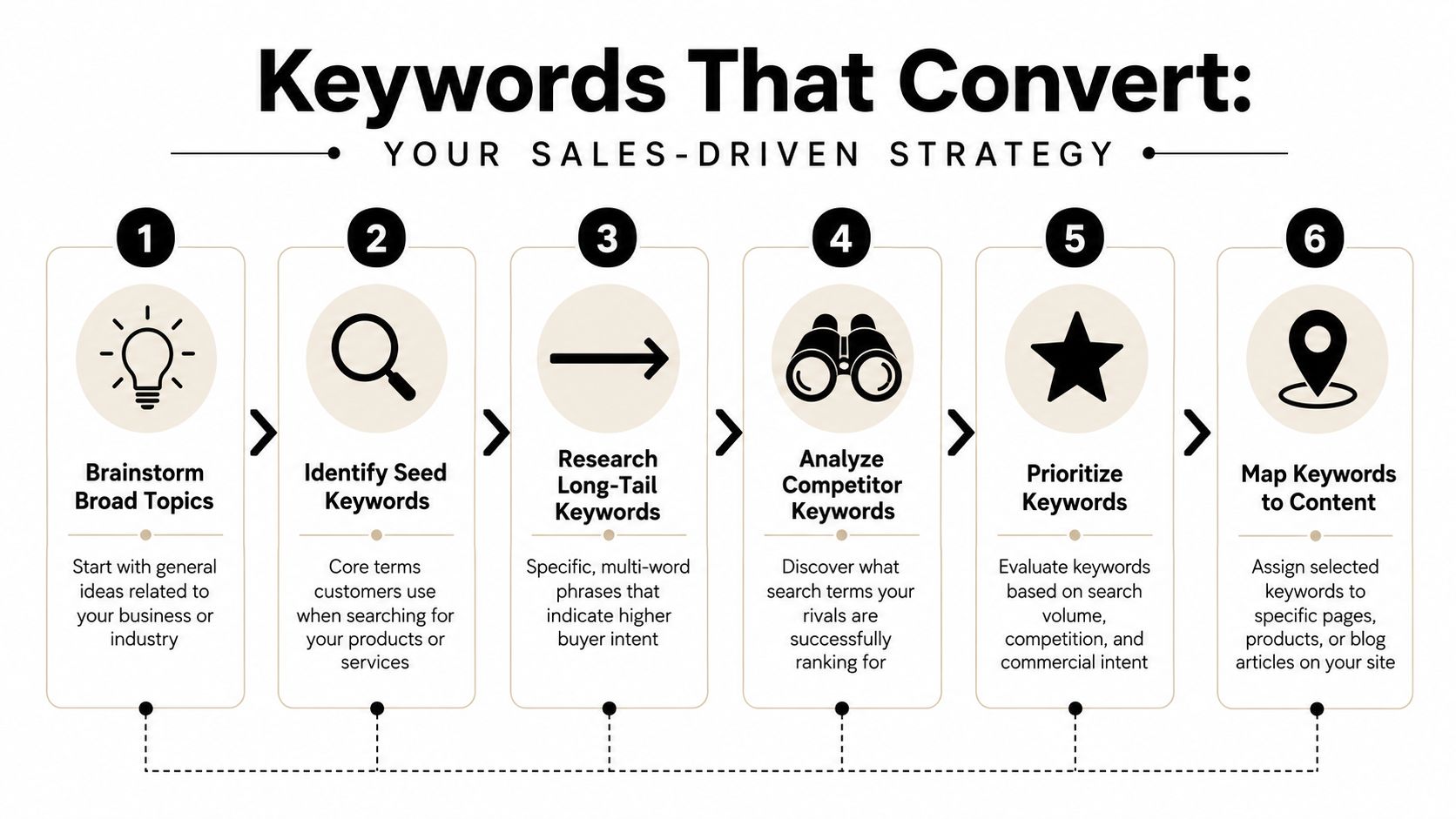
Use a lean workflow you can keep up with
You do not need expensive software to find strong keywords. Start with tools that show real demand and real traction:
- Google Search Console for queries where you already earn impressions
- Google autocomplete for phrasing customers use
- People Also Ask and related searches for adjacent questions and modifiers
- Ahrefs Webmaster Tools for a free view of site performance and basic competitor research
- Semrush if you already pay for it and will use it regularly
- Google Sheets or Airtable to keep one working keyword map
The order matters.
List money pages first.
Start with core services, top product categories, and higher-margin offers. If a page cannot help the business make money, it should not be first in line.Pull language from customers, not just tools.
Review sales calls, estimate requests, contact form submissions, and support emails. Customers say "same day AC repair" or "accountant for small restaurant," not the polished phrases SEO tools suggest.Check Search Console for page-2 opportunities.
Pages sitting in positions 11 to 20 often need refinement, not reinvention. Those are usually the quickest wins for a busy team because Google already sees the page as relevant.Compare the current result page before choosing the term.
Search the keyword. If the results are all local map listings, service pages, or product pages, do not target it with a generic blog post. If the results are guides and comparisons, a service page may struggle.Study competitors to find gaps.
Look for missing subtopics, weak proof, unclear headings, thin FAQs, or poor alignment with search intent. Do not copy their page. Fix what your page leaves unanswered.
One page should have one clear primary target. Closely related variations belong on that page too, but forcing five different intents onto one URL usually weakens all of them.
Build a keyword map that prevents self-competition
A lot of small business sites create ranking problems for themselves. The homepage targets one term, two service pages target the same term, and three blog posts circle around it with slight wording changes. Google has to guess which page matters most. That guess is often wrong.
A simple map fixes this:
- Homepage targets branded searches and your broad business category
- Service pages target direct buyer-intent phrases
- Location pages target city or area-specific service terms
- Blog posts support the decision with questions, objections, comparisons, and use cases
- Category pages target ecommerce comparison and shopping intent
Here is the practical rule I use. If two keywords would lead a searcher to expect the same page, they can usually live together. If they suggest different needs, split them.
For example, a roofer can often cover "roof leak repair" and "emergency roof repair" on the same page if the service and intent overlap. "Roof replacement cost" is different. That searcher needs pricing context, project scope, and buyer guidance. It deserves its own page.
Prioritize by value, not by keyword difficulty alone
Keyword difficulty scores can help, but they can also waste time if you treat them like marching orders. A hard keyword tied to a high-margin service may still deserve effort. An easy keyword with weak buying intent may not deserve any.
Use a simple priority filter:
- High business value
- Clear intent
- Reasonable fit with the page type Google is already ranking
- A realistic chance to improve within the next few months
That framework is especially useful for page-2 URLs. If a page already ranks close to page 1 for a term tied to leads or sales, that page usually deserves attention before a brand new article. Small businesses do better with focused upgrades than with endless publishing.
Keyword research is not a hunt for the biggest list. It is a sorting job. Pick the terms that match how customers buy, separate local intent from broader organic intent, and give each important page one clear purpose. That is how rankings start turning into revenue.
Create Content That Google Trusts and Readers Love
A small business page usually wins or loses in the first few seconds.
Someone clicks your result, scans the top of the page, and asks a simple question: "Am I in the right place?" If the answer is unclear, they bounce. If the page gets specific fast, you keep the visit and give Google better engagement signals over time.
Content that ranks and content that converts are usually the same thing. Clear answer first. Useful detail next. Proof throughout.
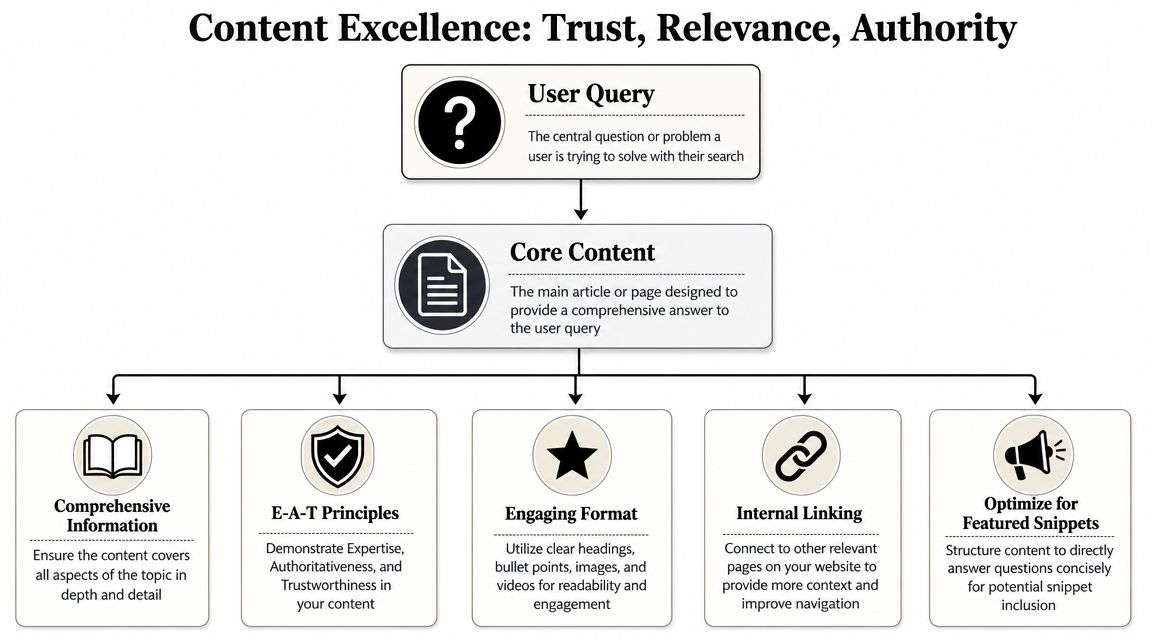
Trust starts with the answer
Pages get stuck because they bury the point under filler.
If the page is about emergency drain cleaning, say who needs it, what problem it solves, how fast you respond, and what the customer should do next. If the page compares two product options, give the short recommendation near the top, then explain the trade-offs. If it is a service page, show the scope of work, what is included, what is not, and who the service fits best.
That structure works well on page-2 URLs. In practice, I often find these pages do not need a rewrite from scratch. They need a stronger opening, better examples, and clearer proof that the business knows the job.
A practical content order looks like this:
- Answer the main query in the first few lines
- Show who the page is for
- Cover the questions a buyer asks before contacting you
- Add real examples, photos, process details, or outcomes
- Give a clear next step
That last point matters more than people think. A good page reduces uncertainty. It does not just "cover the topic."
Make experience visible on the page
Small businesses often have real expertise and weak presentation.
A plumber may know exactly why one fix lasts and another fails in six months. A clinic may have a clean intake process that puts nervous patients at ease. A local service company may know which jobs can be quoted by phone and which require an on-site visit. If that knowledge stays in the owner's head, the page reads like every other generic competitor page.
Show the work. Show the judgment. Show the limits.
Useful trust signals include:
- Specific service details instead of vague claims
- Original photos from jobs, products, staff, or your location
- Process explanations that reflect hands-on experience
- Credentials, licenses, years in business, or relevant training
- Clear contact information and service area details
- Examples that answer practical buyer concerns
- Internal links to closely related pages
For local SEO, trust often comes from real-world signals such as service area clarity, local proof, and consistency with your business details elsewhere online. For broader organic rankings, the page usually needs stronger topical coverage and a better explanation than the average result. Those are related jobs, but they are not the same job. Small businesses waste a lot of time when they treat local and organic content as one bucket.
Cover the whole decision, not just the keyword
A page can match a keyword and still feel thin.
The fix is usually not adding more words. It is covering the decision points behind the search. What does the buyer need to know before they call, book, or buy? What could make them hesitate? What mistakes are common? What changes the price, timeline, or fit?
For example, a "roof replacement cost" page should not stop at broad pricing language. It should explain what changes the quote, what homeowners tend to overlook, when repair is still realistic, and what happens during an inspection. That kind of detail builds trust because it matches how people make decisions.
This is also where page-2 pages often move. They already have some relevance. What they lack is completeness, specificity, or a strong enough answer to beat the results above them.
Structure the page so it can be skimmed
Good structure helps readers and search engines understand the page quickly.
Use one clear H1. Use H2s for major questions or subtopics. Use H3s when a section needs a clean breakdown. Keep paragraphs short enough to scan. Use bullets for comparisons, steps, and lists of symptoms, features, or objections.
Here is the difference in practice:
| Weak page pattern | Strong page pattern |
|---|---|
| Slow intro with generic background | Direct answer near the top |
| Repeats the keyword awkwardly | Uses natural language tied to the topic |
| Long blocks of text | Clear headings and skimmable sections |
| Claims like "high quality service" | Specific proof, examples, and process detail |
| Covers only the main term | Covers the follow-up questions buyers actually have |
If the query is question-based, give a short answer early in the section before adding depth. If the query is commercial, make the page easy to compare, evaluate, and act on.
The best small-business content feels like talking to someone who has done the work for years and knows where customers get stuck. That tone is hard to fake, and it is often what pushes a good page into the top results.
Improve Rankings with Simple Technical Fixes
A lot of small-business SEO gains come from boring cleanup work on pages that are already close. If a service page sits at position 12, that is not a content strategy problem first. It is usually a refinement problem.
The fastest wins tend to come from pages already ranking in positions 11 through 20. They have traction. Google already sees them as relevant enough to test. The job is to remove friction, tighten the page, and make it easier for both crawlers and visitors to get what they need.
Start with pages already close to page one
For a business with limited time, Search Console is the best triage tool you already have. Pull up the queries and pages report, then look for URLs with one of these patterns:
- Strong impressions, average positions between 11 and 20
- Pages getting seen but not clicked
- Commercial pages that rank for valuable terms but feel out of date
- URLs that match the query loosely, but not cleanly enough to win
Smith Digital's guidance on page-two optimization points to improving content depth, titles, internal links, and technical issues on those pages before publishing more content or chasing more links.
That order makes sense in practice. A page on page two is already in the race. Reworking that page often beats writing three new blog posts that start from zero.
A solid page-two pass usually includes a sharper title tag, a clearer first screen, better internal links from related pages, refreshed details, and a quick technical check for anything slowing the page down or muddying relevance.
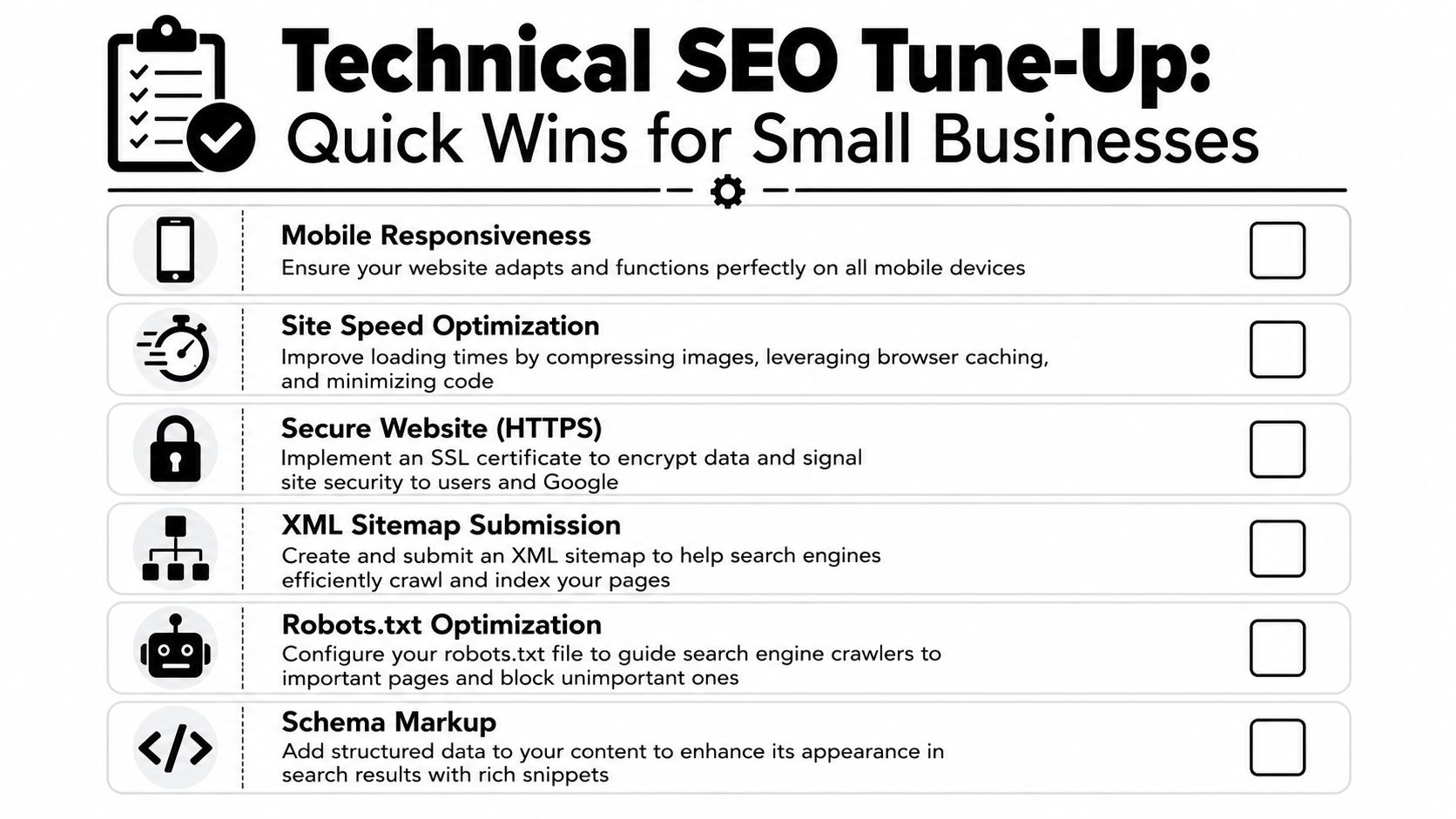
The technical fixes that usually matter first
Technical SEO gets sold like a developer-only discipline. For most small businesses, the useful version is simpler. Focus on the issues that block crawling, weaken click-through, or make the page annoying to use.
Start here:
Indexing and crawl checks
Make sure the page is indexable, included in your sitemap if appropriate, and not blocked by accident through noindex tags, canonicals, or robots settings.Mobile usability
Open the page on your phone. If text is cramped, buttons are hard to tap, or a quote form breaks halfway through, fix that before worrying about advanced reports.Speed basics
Compress oversized images, trim unnecessary plugins or scripts, and avoid uploading giant files straight from a camera roll. You do not need a perfect score. You need a page that loads fast enough that people stay.Internal broken links
Run a crawl with Screaming Frog or Ahrefs Webmaster Tools and clean up dead links, redirect chains, and orphaned pages where relevant.Title tags and meta descriptions
If a page gets impressions but weak clicks, the snippet may be underselling it. A clearer title can improve traffic without changing rank much.Canonical and duplicate checks
Make sure Google is ranking the page you want, not a duplicate version, filtered URL, or thin variant.
A helpful walkthrough sits below if you want a visual primer before touching anything.
What to ignore until the basics are clean
Small teams waste months chasing technical trivia. I see this a lot. They spend hours inside audit tools fixing low-impact warnings while their money pages still have weak titles, thin internal linking, slow hero images, or clunky mobile layouts.
Use a simple order of operations:
- Fix indexability and crawl problems
- Improve titles, headings, and snippet appeal
- Strengthen the target page
- Add or clean up internal links
- Improve speed and mobile experience
That sequence is usually the highest-return use of limited time.
One more distinction matters for small businesses. General organic ranking and local ranking overlap, but they are not the same system. Technical cleanup helps both, especially on mobile, but it will not replace local signals like reviews, Google Business Profile work, and location consistency. Keep the lanes separate so you can prioritize correctly.
Build Authority with Backlinks and Local SEO
You fix the page, tighten the title, clean up the technical issues, and it still sits on page 2. That is usually an authority problem. For small businesses, the next move depends on which system you are trying to improve. Organic rankings rely heavily on page strength, internal support, topical depth, and backlinks. Local rankings rely on Business Profile signals, reviews, citations, and proximity.
Treating those as one job wastes time.
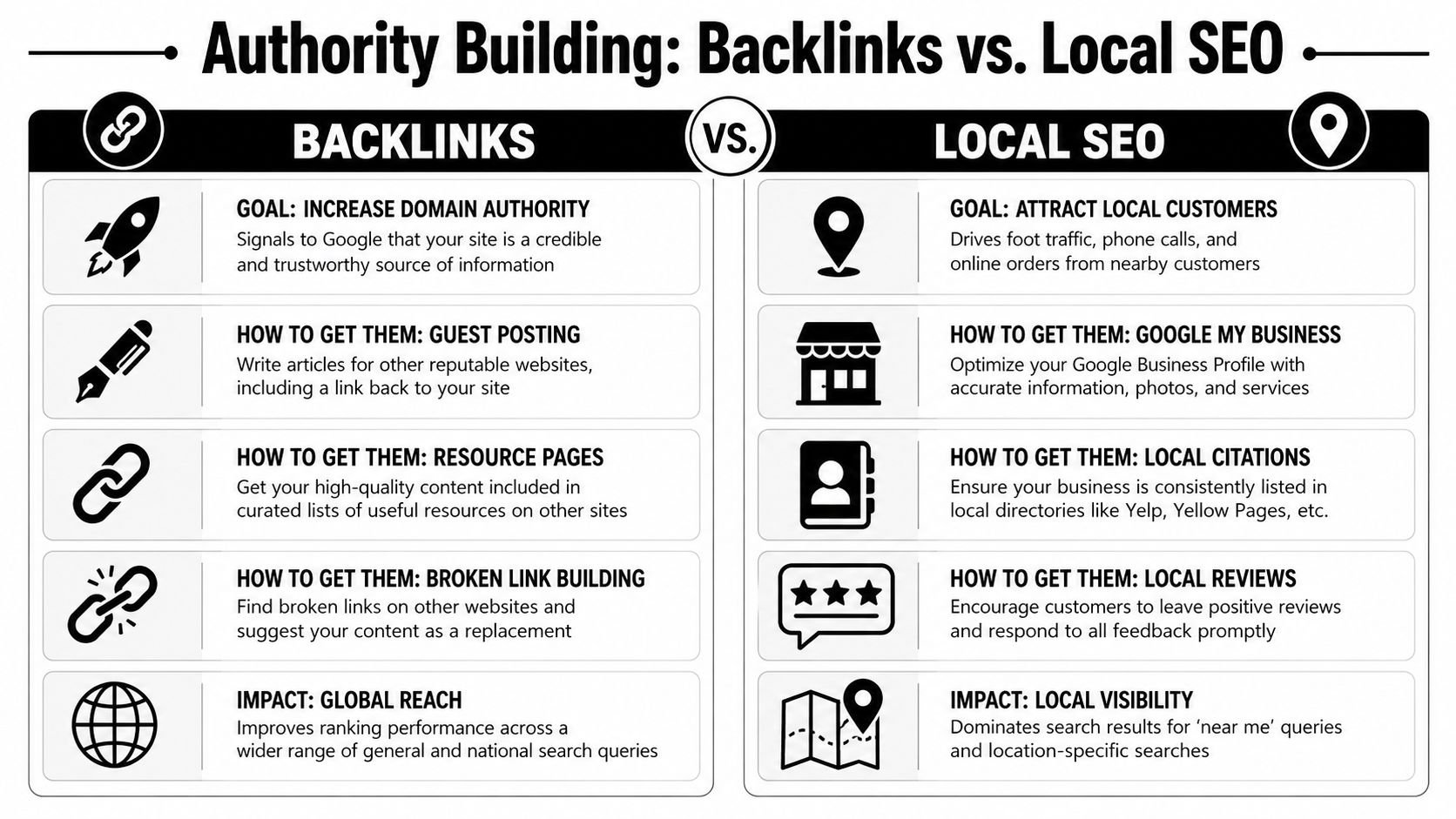
Backlinks help pages break through in organic search
Backlinks still matter because they help Google trust that other sites find your page worth citing. The links that move rankings tend to come from relevant sites with some editorial judgment. CultureHive's SEO guide to help you climb the rankings in Google points to off-page tactics such as guest posts, PR mentions, resource pages, and credible directories, while warning against manipulative link schemes.
That matches what I see in client work. One good link from a respected local publication, trade association, or niche resource page can do more than a pile of low-quality directory links.
The easiest wins usually come from assets you already have or can create cheaply:
- Practical guides that answer a question customers ask before they buy
- Local resource pages tied to your city, service area, or community
- Data, examples, or checklists that another site can cite
- Expert commentary you can offer to local reporters, podcasters, or industry blogs
A few examples:
- An accountant publishes a plain-English tax deadline guide and pitches it to the local chamber.
- A roofer creates a storm damage checklist that neighborhood blogs and insurance-related resources can reference.
- A niche ecommerce brand publishes a care guide that product reviewers and category publishers can cite.
Those links make sense because they help the reader. That is the filter to use.
If your team is short on time, skip broad outreach campaigns. Start with one page that is already close to ranking. A page sitting in positions 11 to 20 often needs a little more authority and a little better internal support, not a six-month digital PR program.
Local SEO runs on a different set of signals
A common question is how to improve Google rankings, when the true need is stronger local visibility. Scorpion's guide on improving local rankings emphasizes complete Google Business Profile details. For local businesses, that work sits alongside review management, citation consistency, and local relevance signals.
This matters because the prioritization is different.
If you are a plumber, dentist, med spa, or law firm serving a specific area, local SEO often produces faster returns than chasing national backlinks. If you run a SaaS company or ecommerce brand with no geographic service area, Google Business Profile work may do little for your core rankings.
Use the right checklist for the right goal:
| Goal | Main signals |
|---|---|
| Rank a service page organically | Page quality, search intent match, internal links, earned backlinks |
| Show up better in local search | Google Business Profile completeness, reviews, citation consistency, local relevance |
That distinction gets missed in a lot of SEO advice. Small businesses end up mixing local tasks and organic tasks into one vague backlog, then wonder why progress feels slow.
What to prioritize first
For organic authority, focus on the pages already within reach. In Search Console, look for commercial pages getting impressions with average positions on page 2. Those are your best candidates for link outreach. It is easier to push an almost-winning page than to rescue a weak page no one wants to reference.
For local authority, clean up the basics before you chase more advanced tactics:
- Complete your Google Business Profile with correct categories, services, hours, photos, and business details
- Keep your business name, address, and phone consistent across major listings
- Ask for reviews steadily from real customers, then respond to them
- Build location relevance with city-specific proof, service-area details, and local references where they fit
- Earn local mentions and links from associations, sponsorships, events, and nearby organizations
Reviews and local links are often the highest-return work here. A polished profile with no review velocity and no local mentions usually stalls.
A practical monthly plan for lean teams
Keep this simple. One authority task for organic. One for local.
- Choose one page stuck on page 2
- Create or improve one asset worth citing
- Reach out to a short list of relevant sites
- Ask recent customers for a few new reviews
- Fix one batch of inconsistent citations or profile gaps
That rhythm is boring. It also works.
For tools, low-cost is enough for most small teams. Use Search Console to find page-2 opportunities. Use Ahrefs Webmaster Tools or Screaming Frog for link and page checks. Track outreach, reviews, and citations in a spreadsheet. If you want more automation, Agency Secrets presents OutRank as a tool that handles keyword research, competitor analysis, article generation, publishing, and backlink support in one system, which suits teams that need process help more than custom consulting.
Authority builds when your site is worth citing, the right pages get support, and your local presence matches reality.
Measure Scale and Automate Your SEO Workflow
A common small-business SEO problem looks like this. You publish a few posts, tweak a service page, check rankings once in a while, then get too busy to keep the thread. Three months later, the site has activity but no clear momentum.
Rankings improve faster when SEO becomes a simple operating system instead of a pile of one-off tasks. For a lean team, the goal is not more reporting. The goal is knowing what to revisit, what to ignore, and what to scale.
Measure the pages that matter
Use a short scorecard for the pages tied to revenue. That usually means core service pages, top category pages, and a small set of blog posts that assist sales. If a page gets traffic but never leads to calls, form fills, or booked jobs, it should not get the same attention as a page that does.
Track these fields for each priority page:
- Primary query target
- Search Console impressions and clicks
- Average position trend
- Leads or sales tied to the page
- Internal links pointing to the page
- Last meaningful update date
- Page type, such as organic service page, local landing page, or supporting article
That last field matters more than many owners realize. General organic ranking and local ranking run on overlapping but different signals. A city service page that needs stronger local proof should not be judged the same way as a non-local informational post targeting broader searches.
I usually keep this in a spreadsheet first. Fancy dashboards are fine later. Early on, a plain sheet forces better decisions because you can see, page by page, where effort is paying off and where it is being wasted.
Build a workflow you can repeat
A monthly cycle works well for small teams because it is frequent enough to catch movement and light enough to maintain.
Week one
Review Search Console and your spreadsheet. Flag three buckets: pages rising, pages slipping, and pages stuck on page 2.Week two
Improve one or two priority pages. Tighten the title, strengthen the opening, answer missing questions, add internal links, and refresh weak proof.Week three
Publish one supporting asset that helps a money page rank. That could be a FAQ, comparison page, short case study, or location-specific proof page.Week four
Handle cleanup and scale work. Fix indexing or internal link issues, update old pages, and queue the next batch of content or outreach.
This rhythm works because it matches how small businesses operate. You are not trying to run an enterprise content machine. You are trying to make steady gains on the pages that can produce revenue.
Use automation where repetition slows you down
Automation should handle recurring tasks, not strategy. Good candidates include page tracking, content briefs, internal link opportunities, publishing checklists, and reminder systems for updates. Poor candidates include final keyword choices, local page positioning, and deciding whether a page needs a rewrite or just better intent matching.
One practical rule helps here. Automate collection and formatting. Keep judgment manual.
For example, set up a lightweight process like this:
- Export Search Console data monthly
- Sort for pages with growing impressions but weak clicks
- Highlight pages ranking just off page 1
- Assign one action to each page, rewrite, expand, improve CTR, or add links
- Record the change date so you can review impact next month
That gives you a real workflow, not a vague promise to "do SEO regularly."
If content production is the bottleneck, standardize the parts that should be standard. Use templates for service pages, article briefs, title tag rules, image alt text, and internal linking checks. Keep the page-specific parts human. That includes the offer, the local proof, the examples, and the sales angle.
Page-2 pages deserve special handling. They are often the fastest wins. In many cases, they do not need a full rewrite. They need tighter intent match, a better title, stronger internal links, fresher proof, or a cleaner answer near the top of the page.
If you want a practical system for doing SEO without hiring an agency, Agency Secrets is built for that kind of operator. It focuses on buyer-intent keyword research, authoritative content, backlinks, and evergreen workflows, with guidance aimed at small businesses trying to grow through search without adding a big team.
Leave a Reply