Tag: seo strategy

  • Free SEO Roadmap Template for Strategic 2026 Growth

    Free SEO Roadmap Template for Strategic 2026 Growth

    Your SEO work probably lives in five places right now. A few notes in Google Docs. A half-finished audit in Screaming Frog. Keywords dumped into a spreadsheet. A plugin nagging you about metadata. Maybe a freelancer telling you to “build backlinks” without saying which pages matter first.

    That's where most small businesses get stuck.

    The problem usually isn't effort. It's sequence. You can spend weeks “doing SEO” and still have no clear path to more leads, more booked calls, or more sales. That's why a real SEO roadmap template matters. Not as a prettier to-do list, but as a way to decide what deserves your limited time, what can wait, and what should be ignored for now.

    If you're building your first serious plan without an agency, you need a roadmap that acts like an operating system. It should connect business goals to SEO actions, assign ownership, force prioritization, and leave room for changes when search shifts again.

    Table of Contents

    From SEO Chaos to a Clear Action Plan

    Monday morning, you open your SEO notes and see 47 ideas. Update title tags. Write three blog posts. Fix Core Web Vitals. Build citations. Ask for backlinks. Refresh old pages. Somewhere in that pile are a few actions that could bring in leads. The rest can wait, but without a plan, they all feel urgent.
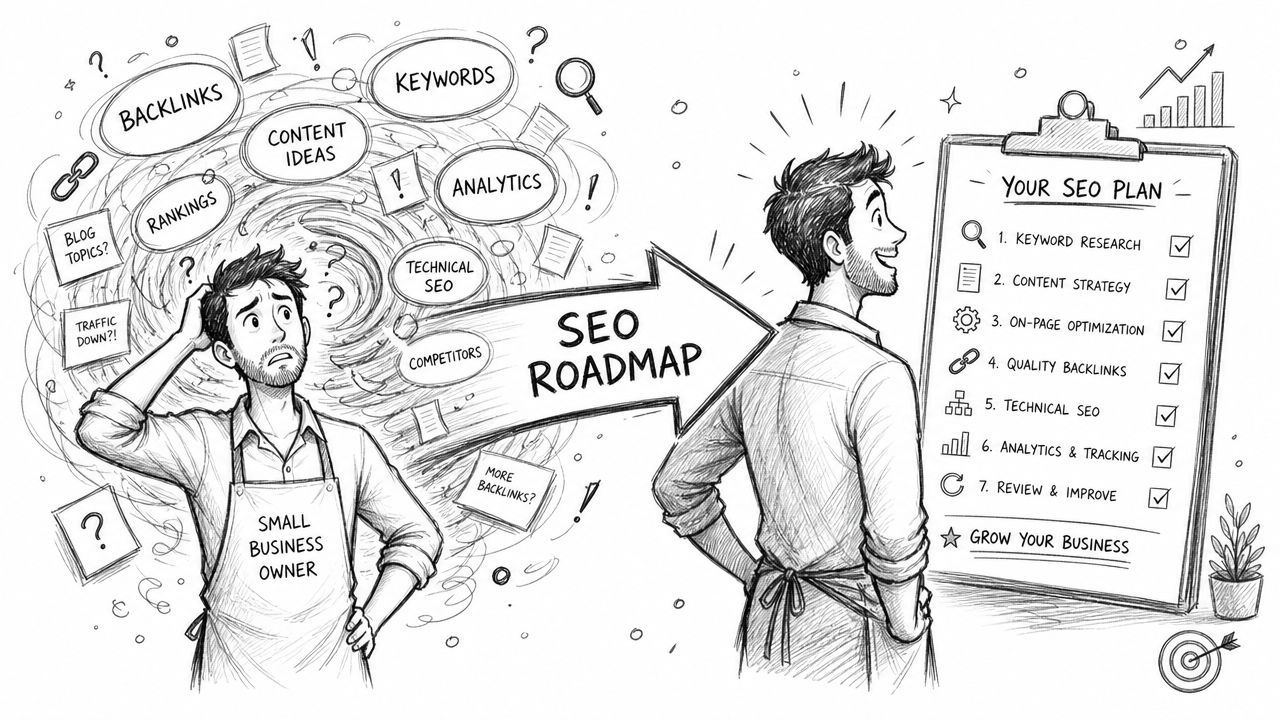
    A small business owner transitioning from confused SEO planning to a clear organized seven step roadmap.

    That is the core SEO problem for a small business. It is rarely a lack of ideas. It is a lack of prioritization. A roadmap solves that by turning SEO from a pile of tasks into a resource-allocation tool. It helps you decide what earns time this month, what gets scheduled later, and what does not deserve attention yet.

    For a team with limited budget and limited hours, that matters more than having a long checklist. I have seen small businesses lose months on activity that looked productive but had no path to revenue. Publishing top-of-funnel articles before the main service pages are clear. Obsessing over minor on-page tweaks while key pages are not indexed. Starting outreach before the site has anything worth linking to. The roadmap prevents that kind of drift.

    What changes when you use a real roadmap

    Work gets tied to constraints. You assign an owner, set a deadline, estimate effort, and write down the business reason. That last piece is where DIY SEO usually breaks. Business owners often know the ingredients of SEO. The hard part is choosing the right sequence for the team, budget, and sales goal in front of them.

    Practical rule: If a task does not have an owner, a due date, and a reason it matters to revenue, it is not part of a roadmap. It is just a note.

    A useful roadmap also creates permission to defer work. That matters even more now that AI search is changing how people discover businesses. You do not need to react to every new SEO trend. You need pages that clearly explain what you sell, strong site architecture, evidence of trust, and a publishing plan you can maintain. The roadmap keeps you focused on assets that compound instead of busywork that expires.

    What an effective roadmap tells you not to do

    Generic templates usually fail here. They tell you what SEO includes, but they do not help you make hard calls.

    For example:

    • Do not chase broad blog topics if your service pages barely explain what you sell.
    • Do not spend weeks polishing minor metadata if Google cannot properly crawl or understand your core pages.
    • Do not start link outreach before your most important landing pages deserve links.
    • Do not build twenty content ideas at once if your real publishing capacity is two strong pieces a month.

    A strong SEO roadmap gives a small business owner a working answer to one expensive question: given our limits, what should we do first?

    The Anatomy of a High-Impact SEO Roadmap

    Most roadmap templates look fine until you try to run a quarter of work through them. Then you realize they're missing the fields that help you choose between competing priorities. A strong template needs both strategic pillars and decision columns.
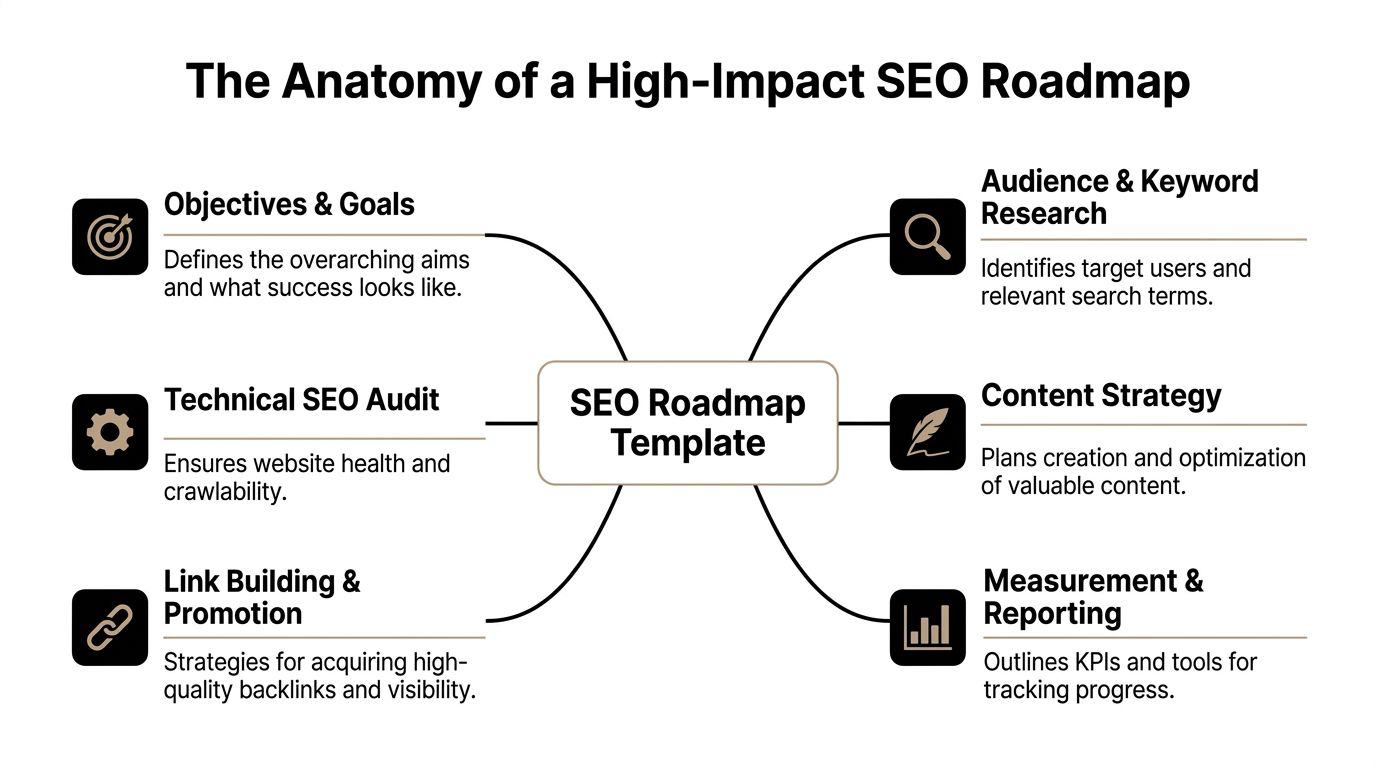
    A diagram outlining the key components of an SEO roadmap template, including research, strategy, and technical audits.

    What the roadmap must contain

    I like to organize a small-business roadmap into four working pillars. It keeps the plan focused without turning it into enterprise theater.

    • Technical foundations
      This covers crawlability, indexing, mobile usability, speed issues, redirects, broken pages, and structured data basics. If search engines or users hit friction here, everything else works harder for less return.

    • Content engine
      This is the system for service pages, category pages, pillar pages, support articles, and internal linking. It's where keyword research becomes publishable assets.

    • Authority building
      This includes backlinks, digital PR, local mentions, and broader entity signals. Small businesses often overestimate how much of this they need early on, but they still need a plan for it.

    • Measurement and reporting
      Measurement and reporting involves tracking whether work is producing movement in the KPIs that matter. It also keeps the roadmap from drifting into busywork.

    A roadmap should behave like an operating document. If you can't scan it and see the business opportunity, level of effort, and likely impact of each initiative, it won't guide real decisions.

    That idea matches a stronger planning approach from The Gray Company's roadmap framework, which recommends capturing the action item, business opportunity, priority, level of effort, scope, goal alignment, status, and estimated SEO impact before ranking work against available resources.

    The spreadsheet fields that make decisions easier

    You don't need fancy software to make this work. A Google Sheet, Airtable base, or ClickUp board is enough. The key is using fields that force clarity.

    Here's a simple structure.

    Task/Initiative Pillar (Content, Tech, Links) Impact (1-5) Effort (1-5) Priority Score (Impact/Effort) Target KPI Status
    Rewrite top service page Content 5 2 2.5 Leads from organic Not started
    Fix noindex on key pages Tech 5 1 5 Indexed core pages In progress
    Build partner outreach list Links 3 2 1.5 Referring domains Planned

    Each field does a specific job:

    • Task or initiative keeps the item concrete.
    • Pillar stops the roadmap from leaning too heavily toward one kind of work.
    • Impact forces you to estimate upside.
    • Effort protects your calendar.
    • Priority score gives you a simple way to sort.
    • Target KPI ties the task to a business result.
    • Status keeps execution visible.

    A stronger SEO roadmap template can add more columns later, such as owner, deadline, dependency, or notes. But this core version is enough to start making better choices today.

    Setting Objectives and Prioritizing Your First 90 Days

    A small business usually hits the same wall in month one of SEO. The owner has a long list of fixes, a writer wants topics, a developer has limited hours, and every task sounds important. Without a clear order of operations, the quarter disappears into low-impact work.

    The first 90 days need to function as a resource-allocation plan, not a wish list. Keep a 12-month direction in view, but make quarterly decisions based on what you can ship with your current team, budget, and sales goals. That discipline matters even more now that AI search can reduce clicks on broad informational queries. For many small businesses, the safer bet is to prioritize pages and topics that influence leads, calls, and sales directly.
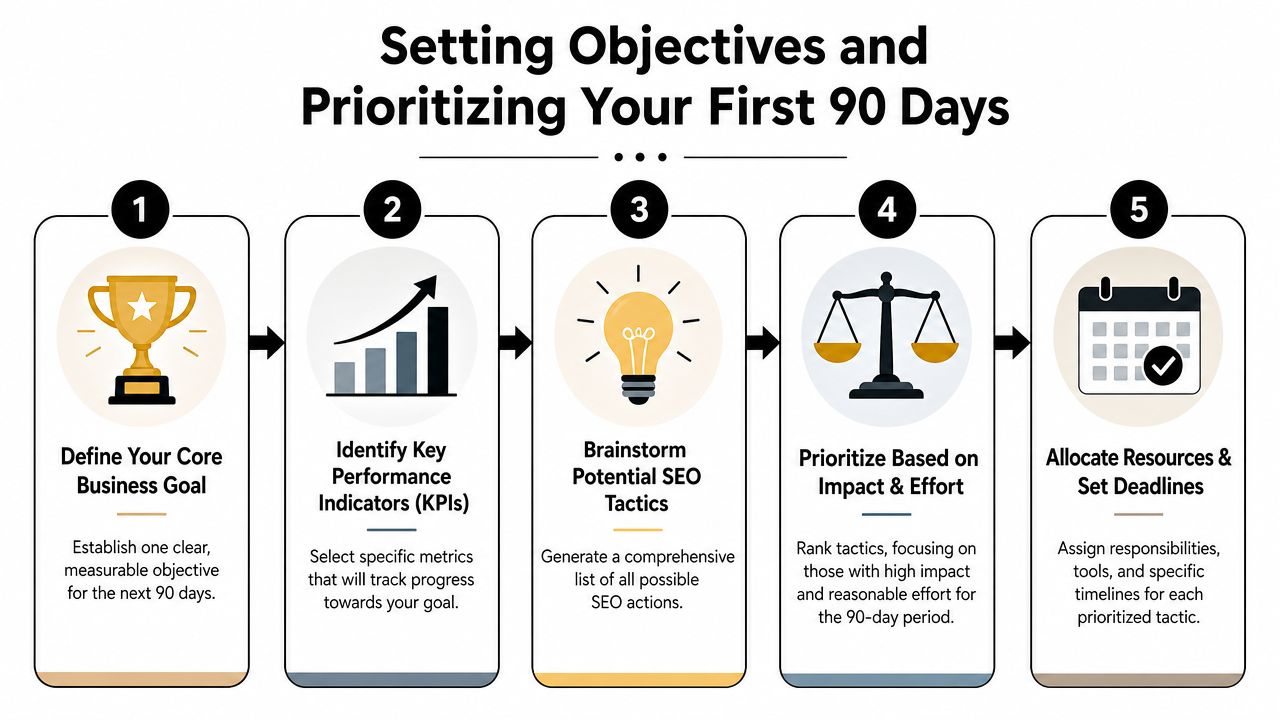
    A five-step infographic guide titled Setting Objectives and Prioritizing Your First 90 Days for business strategy.

    Start with one business goal

    Choose one outcome for the quarter. A good objective ties organic search to revenue or pipeline, not vanity metrics.

    Strong first-quarter goals include:

    • Generate more leads from service pages
    • Increase sales from product category pages
    • Grow booked consultations from high-intent searches
    • Improve visibility for one core service in one target market

    That choice should make trade-offs easier. If booked calls are the goal, service pages, local landing pages, and conversion points deserve attention before broad blog content. If ecommerce revenue is the goal, category pages, product filters, internal linking, and merchant feed issues may matter more than publishing three new articles.

    Pick a small set of KPIs that help you decide what to do next. Good examples include organic form submissions, calls from local pages, demo requests, revenue from organic landing pages, or non-brand clicks to a priority service page. If a metric will not change next month's priorities, it does not belong at the center of the roadmap.

    For a practical walkthrough of this 90-day planning process, the video below breaks down each step.

    Use impact versus effort to make hard calls

    Once the goal is clear, build a raw backlog of SEO initiatives. Get the ideas out of email, Slack, and your head, then score them against reality.

    Common first-quarter items include:

    • Content work such as rewriting thin service pages, improving category copy, or creating a tightly scoped support article
    • Technical fixes such as repairing crawl problems, resolving duplicate pages, improving mobile usability, or adding structured data
    • Authority tasks such as reclaiming unlinked mentions, improving local profiles, asking partners for links, or running focused outreach

    Then score each item on two factors:

    1. Impact
      How likely is this task to improve qualified traffic, conversions, or visibility on pages tied to revenue?

    2. Effort
      How difficult is it for your actual business to complete, given your people, tools, approvals, and available time?

    I usually tell small business owners to be brutally honest on effort. A task that looks simple to an agency can become a six-week delay if it needs developer support, legal review, and new copy. The best 90-day plans favor work that reaches a money page fast and can be completed without heroic coordination.

    That often puts these items near the top:

    • Fixing indexation issues on pages with buying intent
    • Rewriting title tags, headings, and copy on core service or category pages
    • Adding internal links from existing content to commercial pages
    • Publishing one strong pillar asset with a few support pieces, instead of trying to fill an entire editorial calendar

    Put your reporting on a rhythm

    A roadmap loses value when nobody revisits it until the quarter ends.

    Use a simple review cadence:

    • Weekly check-ins for shipped tasks, blockers, and new issues
    • Monthly reviews for KPI movement and priority changes
    • Quarterly reviews for bigger shifts in strategy, budget, and team capacity

    At this point, many first-time SEO plans break down. The problem is rarely the template itself. The problem is treating the roadmap like a static document instead of a live set of choices. If AI Overviews start reducing clicks to one content cluster, or a service page begins driving qualified leads after a rewrite, the roadmap should reflect that quickly.

    A useful SEO roadmap template helps you choose what to do, what to delay, and what to drop. That is how a small business gets traction in the first quarter without wasting time on busywork.

    Building Your Core SEO Workstreams

    A good roadmap stops being useful if each workstream is just a label. "Content," "technical SEO," and "link building" do not help a small business decide what gets done this week, what waits until next month, and what is not worth touching yet. Each workstream needs a clear job, an owner, a level of effort, and a direct tie to leads or sales.

    For a lean team, I usually set up three workstreams: content that helps money pages rank and convert, technical fixes that remove friction, and authority work that supports pages already worth promoting. That structure keeps the plan focused on resource allocation, not activity for its own sake.

    Content engine

    Content work should earn its place on the roadmap. If a service page, collection page, or product category is thin, unclear, or missing the terms buyers use, fix that before adding another blog post.

    Small businesses get more from a tight content system than a large publishing calendar. One strong commercial page update can beat five low-intent articles that never influence revenue. One useful topic hub can create support content for months without forcing the team to start from scratch every week.

    A practical content workstream looks like this:

    • Upgrade priority commercial pages with clearer search intent targeting, stronger headings, better copy, and sharper calls to action
    • Create one primary topic asset that supports a core offer and gives you something worth linking to
    • Publish supporting articles only if they answer real pre-sale questions and can pass internal link value back to a service or category page
    • Add internal links on purpose from existing traffic pages to revenue pages
    • Refresh aging content that already has impressions or rankings before creating net-new pieces

    Keep the scope tight. A "content sprint" should name the URL, target query, business goal, owner, and publish or update date. If the task says only "write blog post," it is too vague to prioritize properly.

    AI search changes the bar here. Informational content that only repeats basic advice is easier to replace in search results. Pages that combine first-hand experience, product detail, local context, pricing guidance, comparison points, or service-specific proof are harder to ignore. That is where a small business can still win.

    Technical foundation

    Technical SEO deserves time only when it clears a real blockage. A clean audit spreadsheet does not create revenue by itself. The roadmap should separate issues that stop important pages from performing from issues that are mostly cosmetic.

    Start with the pages that matter most to the business. If those pages are hard to crawl, slow on mobile, broken by redirect chains, or missing basic markup, fix that first. Leave low-impact cleanup for later unless it can be bundled into work already planned by your developer.

    Use this filter for every technical task: does it help a priority page get indexed, load better, rank better, or convert better?

    A focused technical workstream usually includes:

    • Resolve crawl or indexation problems on service, product, or location pages
    • Improve mobile page experience where it affects form fills, calls, or checkout behavior
    • Fix broken internal links, redirect loops, and duplicate page versions that waste crawl attention or confuse users
    • Add or validate structured data on pages where it supports search understanding
    • Group larger development requests into planned sprints instead of scattering them across the quarter

    Trade-offs matter. A template bug affecting every title tag may deserve immediate attention. A minor page speed gain on low-value blog posts probably does not. Small teams do better when they treat technical SEO as a support function for revenue pages, not a separate perfection project.

    Authority building

    Authority work should match the business model and the team's actual capacity. A local contractor, med spa, or accounting firm rarely needs a large digital PR program in month one. They usually need cleaner citations, stronger business profiles, better review support, and links from organizations they already know.

    For a local or service business, start with reachable wins:

    • Claim or clean up important listings and profiles
    • Request links from suppliers, trade groups, chambers, and referral partners
    • Turn offline relationships into online mentions
    • Recover unlinked brand mentions where someone already referenced the business

    For e-commerce and B2B companies, authority work often needs stronger assets behind it. Comparison pages, buying guides, original examples, implementation checklists, and glossary pages give other sites a reason to link. Generic outreach to weak guest post sites usually adds little and eats time a small team does not have.

    The rule is simple. Promote pages that deserve visibility already. If the landing page is thin, confusing, or weak on conversion, fix the asset before spending hours trying to get links to it.

    A useful roadmap turns authority building into a prioritization decision, not a standing monthly chore. If the team only has five hours this month, spend them on the highest-probability links to the highest-value page. That discipline matters more than the size of the outreach list.

    Real-World SEO Roadmap Examples

    The value of an SEO roadmap template shows up when two businesses with the same checklist make completely different decisions. That's what small operators need to see. The right plan depends on business model, sales cycle, and constraints.
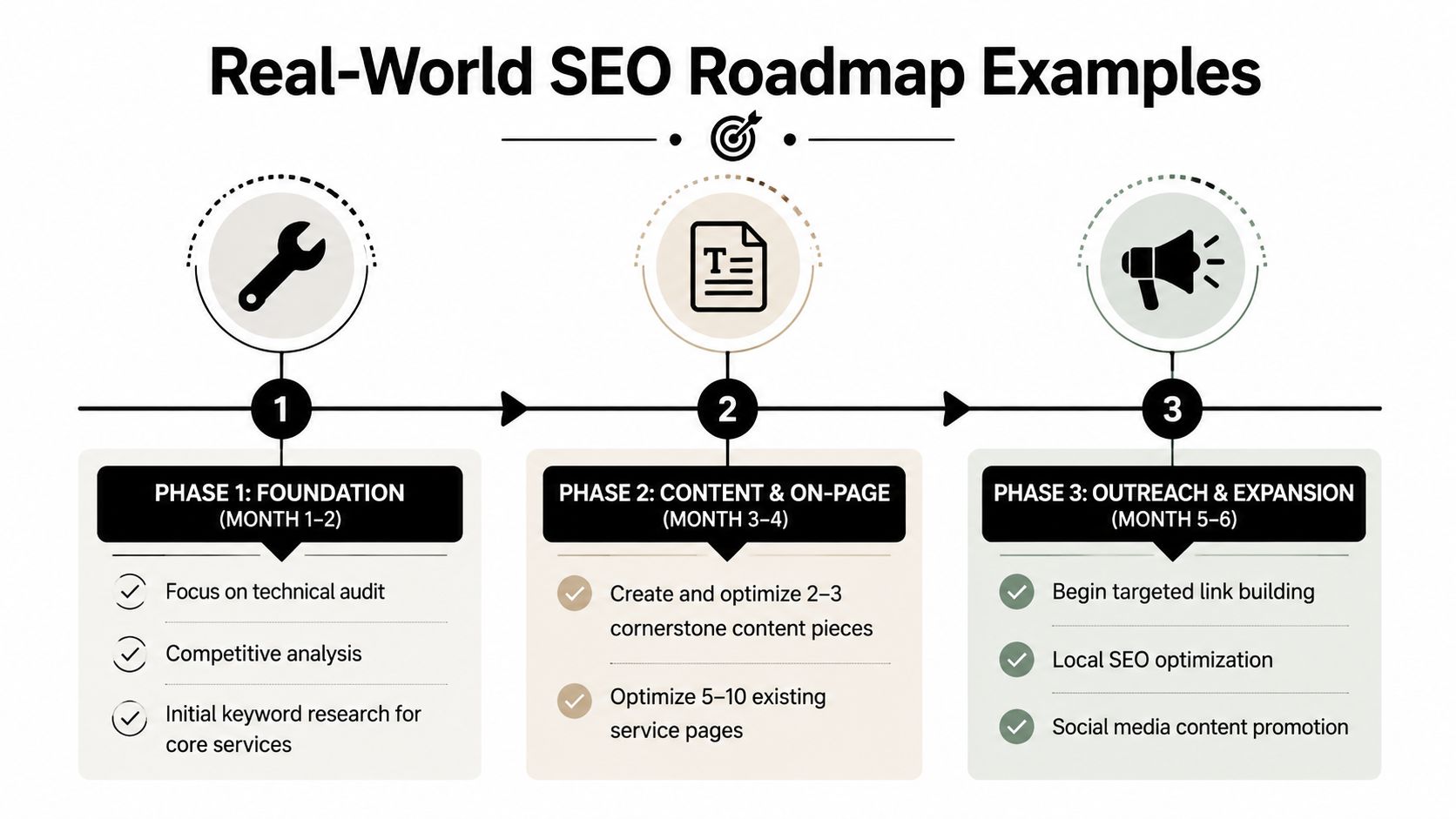
    A three-phase SEO roadmap infographic illustrating foundation, content creation, and outreach strategies over six months.

    Most generic templates miss this. They tell you what belongs on the list, but not what gets delayed when time, staff, or cash are tight. That gap is exactly why a smaller team needs the roadmap to act as a resource-allocation tool, as highlighted in ClickUp's discussion of SEO roadmap templates.

    Local service business

    A plumbing company doesn't need a giant blog machine first. It needs stronger local intent coverage and cleaner service pages.

    Their first three months might look like this:

    • Month one focuses on fixing service page titles, rewriting thin location pages, cleaning up Google Business Profile details, and tightening internal links.
    • Month two adds FAQ content for urgent service queries, improves mobile UX, and builds out structured local information across core pages.
    • Month three starts authority work through local directories, supplier relationships, chamber listings, and review-support workflows.

    What gets deferred? Broad educational content with weak buying intent. Fancy link campaigns. Deep technical edge cases.

    The best roadmap for a local business usually makes the shortest path from search to phone call easier.

    E-commerce store

    A handmade goods store has a different problem set. Category pages, collection structure, filters, and product discoverability matter more than publishing endless blog content.

    A practical opening roadmap might prioritize:

    Focus area First moves Work left for later
    Site structure Clean category hierarchy, improve internal links, remove index bloat risks Large-scale content expansion
    Commercial pages Rewrite category copy, sharpen metadata, improve image and product context Broad top-of-funnel publishing
    Authority Reach out to creators, niche gift guides, and relevant communities General guest posting

    This business may still need content, but not in the generic “write blogs for traffic” sense. Better assets might be gift guides, comparison pages, seasonal collection hubs, and evergreen care guides that support product discovery.

    B2B consulting firm

    A consulting firm often has long sales cycles and high-value leads. That changes the roadmap again. Here, authority and trust matter more than volume.

    The first quarter often works best when it includes:

    • Rebuilding service pages around actual buyer problems
    • Publishing one strong thought-leadership pillar tied to a core service
    • Adding supporting articles that answer comparison, process, and implementation questions
    • Improving author credibility signals and clearer conversion paths
    • Starting selective outreach to podcasts, industry sites, and partner ecosystems

    This type of business usually should not chase a large keyword footprint right away. It needs a tighter set of pages that show expertise and support sales conversations.

    Each of these examples uses the same SEO roadmap template. The difference is prioritization. That's the whole game.

    Your Roadmap Is a Living Document for an Evolving Web

    An SEO roadmap that isn't reviewed regularly becomes a stale spreadsheet. Search changes. Your offers change. Competitors change. The roadmap only stays useful if you treat it as a working document and revisit it on a steady rhythm.

    That matters even more now because search behavior isn't as simple as rankings and clicks anymore. Some current roadmap advice still underplays how much AI search is changing discovery. As noted in The Stacc's analysis of SEO roadmap templates, many templates still fail to account for AI search volatility, even as Gartner has projected significant declines in traditional search volume. A modern roadmap needs room for zero-click results, entity optimization, and content shaped for AI citation.

    So keep the document flexible.

    Review technical issues and task progress monthly. Re-rank your backlog quarterly. Watch whether your best pages are still the right pages. Test whether your content is structured clearly enough to be summarized, cited, or surfaced outside classic blue-link results. If not, adapt.

    The businesses that get value from an SEO roadmap template aren't the ones with the prettiest spreadsheet. They're the ones that use it to make better choices every month, with less guesswork and more discipline.


    If you want the agency-free version of this playbook, Agency Secrets is built for exactly that. It helps small business owners turn SEO into a practical growth system instead of a vague marketing project, with clear execution guidance and tools that make keyword research, publishing, and backlink growth far easier to manage.


  • Content Gap Analysis SEO: Boost Traffic and Outrank

    Content Gap Analysis SEO: Boost Traffic and Outrank

    You're updating service pages, publishing blog posts, maybe even recording videos, and the result is the same. Little movement. Rankings stall. Leads don't noticeably improve.

    That usually isn't a work ethic problem. It's a targeting problem.

    Most small businesses don't need more content. They need better-selected content. The fastest way to find that is through content gap analysis for SEO, which shows where competitors are already winning attention, trust, and buyer intent that your site still misses.

    Table of Contents

    Stop Guessing and Start Winning with Content Gaps

    A lot of business owners are stuck in the same loop. Publish something. Share it. Wait. Then open analytics and see almost nothing worth reacting to.

    That isn't unusual. It's the default outcome when content gets planned from internal guesses instead of search reality. According to RiseOpp's summary of Ahrefs' study of about 14 billion web pages, 96.55% of pages get no traffic from Google. That's the backdrop for every content decision you make. Most pages disappear.

    A frustrated content creator staring at a zero traffic dashboard while ghosts hold his unread blog posts.

    Content gap analysis SEO fixes that by replacing opinion with evidence. You compare your site against the pages and domains already ranking for the searches you care about. Then you identify what they cover that you don't, where their pages satisfy intent better, and where your existing content is too thin to compete.

    Why random publishing fails

    Small businesses often make one of three mistakes:

    • They chase broad topics that look relevant but don't connect to buying behavior.
    • They publish duplicate angles of content they already have, which creates overlap instead of reach.
    • They target keywords one by one without noticing that search engines rank pages that cover a topic thoroughly.

    That's why two companies can publish the same number of pages and get very different outcomes. One is building toward search demand that already exists. The other is writing into the void.

    Practical rule: If a competitor repeatedly ranks for a topic cluster and you don't, that's not a creative problem. It's a coverage problem.

    The value of content gap analysis isn't that it gives you more ideas. It gives you fewer, better ideas. For a lean team, that matters more. You don't have the luxury of spending months on traffic that never turns into calls, quote requests, demo bookings, or sales.

    What winning usually looks like

    The most useful gap analysis doesn't start with, “What can we write about?” It starts with, “Where are buyers already showing intent that competitors are capturing first?”

    That shift changes everything. You stop treating content like a publishing calendar and start treating it like market reconnaissance. You look for proven demand, visible ranking patterns, and missing pages that are likely to move revenue, not just impressions.

    That's what turns content from a cost center into an acquisition channel.

    Define Your Battlefield Goals and True Competitors

    The fastest way to waste time with content gap analysis is to make it too broad. If you define success as “more traffic,” every missing keyword looks tempting. That's how small teams end up with huge spreadsheets and no clear next move.

    A sharper approach starts with business intent.

    Set a business outcome before you open any tool

    Before you compare a single domain, decide what counts as a win on your site. For most small businesses, it's not raw sessions. It's one of these:

    • Lead generation: booked calls, form submissions, estimate requests, consultation requests
    • Ecommerce sales: product page visits from qualified searches, category page visibility, revenue-driving product comparisons
    • Local demand: location + service queries, urgent problem searches, “best” and “near me” modifiers
    • Sales support: pricing, alternatives, comparisons, implementation questions that buyers ask before purchase

    Those outcomes tell you which gaps deserve attention. A local HVAC company shouldn't spend its best content effort on broad educational topics if competitors are winning with pages around repair costs, service comparisons, and urgent issue queries. A B2B software firm shouldn't obsess over glossary traffic while competitors rank for pages that help prospects compare options.

    Pick a business result first. Then find the search gap attached to that result.

    Find search competitors, not just business competitors

    Your real competitors in Google often aren't the same companies you think of offline. A local rival may barely rank. Meanwhile, a directory, niche publisher, SaaS competitor, or regional brand may dominate the searches your customers use before they ever contact you.

    That's why the baseline matters. Semrush recommends reviewing at least 90 days of organic performance data in GA4 so you don't react to short-term swings, and so you can identify patterns at the topic level instead of chasing isolated keywords.

    Use that window to look at:

    1. Landing pages already attracting organic visits
    2. Topics that have held visibility over time
    3. Queries tied to your core services or products
    4. Pages that almost perform but don't break through

    Then search your important terms manually and note who appears repeatedly. Those are your SERP competitors.

    Some will be obvious. Others won't be. That's normal.

    A useful litmus test is simple: if a site shows up across multiple searches that matter to your buyers, include it. If it's a direct business rival that almost never appears, don't force it into the analysis.

    Keep the scope tight

    For small businesses, tight beats exhaustive. Start with one product line, one service category, or one region if you serve multiple markets. A focused content gap analysis produces pages you can act on quickly.

    Broad analyses often create noise. Narrow analyses create publishable decisions.

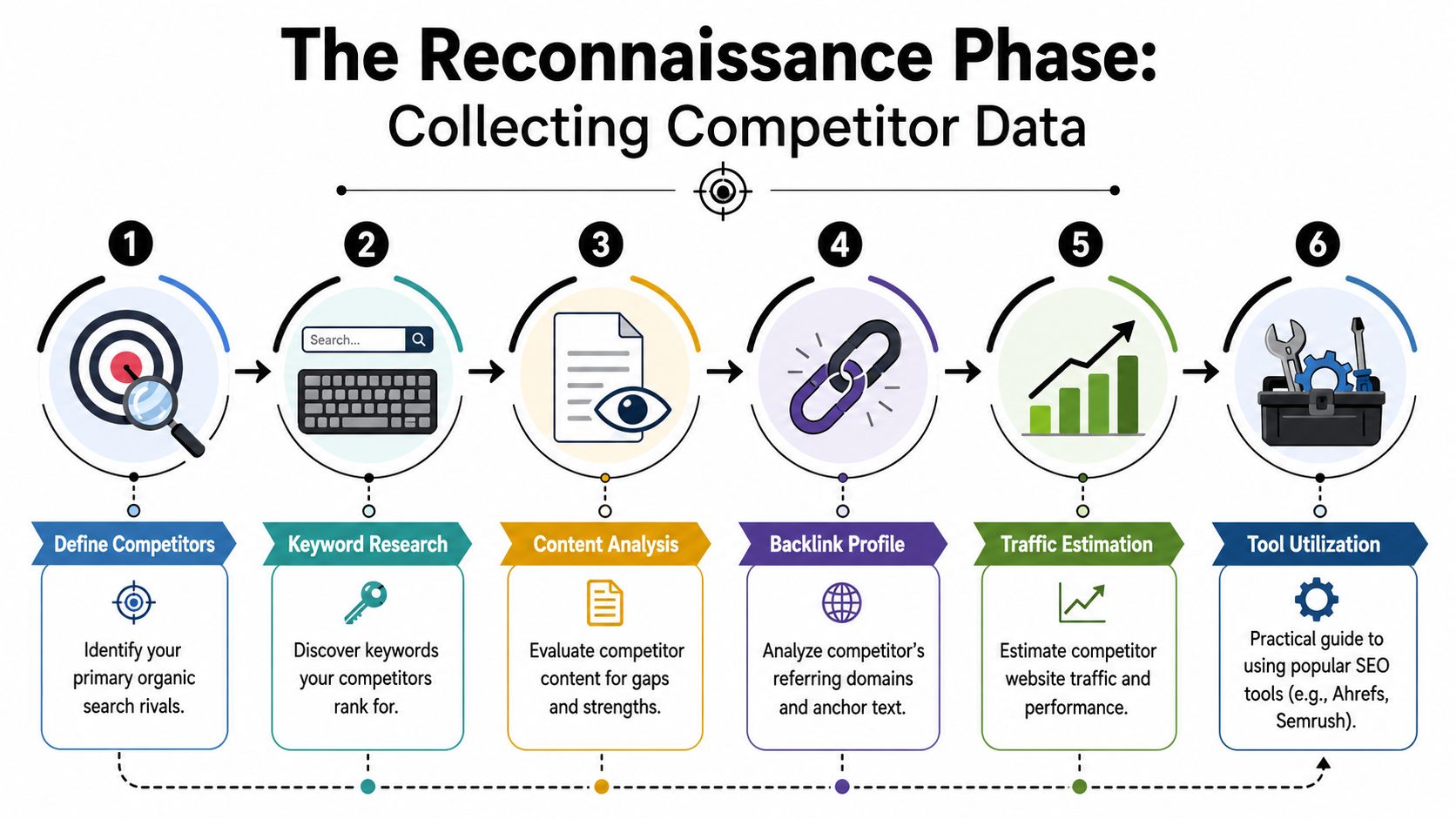
    The Reconnaissance Phase Collecting Competitor Data

    Once goals are clear and competitors are chosen, you need evidence you can work with. This step isn't about downloading the biggest possible keyword export. It's about collecting the shortest path to usable opportunities.

    Start with the gap features inside the major tools. That gives you a cleaner starting point than building everything from scratch.

    A six-step infographic detailing the process of gathering SEO competitor data for reconnaissance strategy.

    Pull the right keyword sets

    A solid practitioner workflow is straightforward. Moz recommends identifying true SERP competitors first, then using a keyword gap tool to compare your domain against up to four competitors and filtering for “Missing” and “Untapped” terms. That's a practical way to find opportunities without drowning in irrelevant exports.

    In tools like Semrush, Ahrefs, or similar platforms, the process usually looks like this:

    • Compare your domain against actual ranking rivals: Don't load in companies just because you know them. Use sites that repeatedly appear for your valuable searches.
    • Start with Missing keywords: These are the cleanest signs that your site has no meaningful presence for a relevant topic.
    • Review Untapped terms next: These often reveal category opportunities where some competitors have moved earlier than others.
    • Export ranking URLs, not just keywords: The page attached to the term often tells you more than the keyword itself.

    The biggest mistake here is relying only on the phrase list. Keywords can hide intent differences. URLs expose page type, depth, structure, and angle.

    After you've collected initial data, it helps to watch a walkthrough before refining your own process:

    Clean the list before you trust it

    Raw exports are messy. They usually contain brand terms, irrelevant geographies, jobs-related queries, support terms, and topics that don't fit your offer. If you skip cleanup, your prioritization will be distorted from the start.

    Filter aggressively:

    • Remove branded competitor searches unless comparison intent matters to your business
    • Strip out unrelated locations if you only serve specific markets
    • Delete duplicate intent variations that should live on one page
    • Flag obvious page types such as blog, service, collection, comparison, or pricing

    A keyword export is reconnaissance, not a content plan. It only becomes useful after you remove what your business shouldn't chase.

    This is also where smaller operators can beat larger brands. Big sites often rank for massive topic footprints. You don't need to copy all of them. You need to isolate the subset that overlaps with your buyer journey and your ability to produce a better page.

    A lean analysis usually beats an ambitious one because it gets implemented.

    From Data to Gaps How to Spot Your Opportunities

    Most keyword lists feel useful until you try to act on them. Then the problem shows up. You're staring at hundreds of rows with no clear sense of which terms deserve new pages, which belong on existing pages, and which should be ignored.

    The fix is categorization.

    Sort keywords into decisions, not just lists

    Once you've exported the overlap data, split it into buckets based on what action each group requires. Modern content gap work commonly uses categories like Missing, Weak, Untapped, and Shared. The point isn't the label. The point is assigning the right response.

    Gap Type Definition Your Action
    Missing Competitors rank, but you don't Create a new page or add a new topic cluster if it fits your offer
    Weak You rank, but competitors rank better Upgrade the existing page. Improve intent match, depth, structure, and internal links
    Untapped Some competitors rank, and you don't Investigate. This may be an emerging or niche opportunity worth claiming early
    Shared You and competitors both rank Compare page quality and look for angle, completeness, or conversion improvements

    Many businesses often misread the data. They assume every missing term deserves a net-new article. That's rarely true. Sometimes you already have the right page, but it only covers part of the topic. Other times multiple terms belong to one stronger commercial page instead of several smaller posts.

    The best gap analyses reduce page sprawl. They don't increase it.

    Turn keyword overlap into topic clusters

    A page rarely wins because it uses a keyword more times. It wins because it handles the topic in a way that matches search intent better and covers the supporting questions users expect.

    That means you should group terms by topic and page purpose:

    • “cost,” “pricing,” and “how much” terms often belong together
    • “best,” “top,” and “comparison” terms often map to commercial evaluation content
    • “service + city” and “near me” variants usually point to local landing pages
    • “how to,” “why,” and “what is” searches often support awareness-stage content

    If you stop at keyword absence, you'll miss the core issue. As modern guidance on topic coverage stresses, strong analysis looks beyond keyword lists and evaluates semantic depth, intent alignment, page structure, internal linking, and whether the page answers the full topic instead of grazing it.

    A useful manual check is to open the top-ranking pages for a cluster and compare:

    1. What subtopics they cover that you don't
    2. What format they use, such as service page, long-form guide, collection page, or comparison page
    3. What proof elements appear, such as examples, process explanations, FAQs, trust signals, or local details
    4. What they leave out, which may give you room for a better angle

    That's when content gap analysis SEO becomes strategic. You're no longer asking, “What keyword am I missing?” You're asking, “What page type and topic treatment is Google rewarding for this buyer need?”

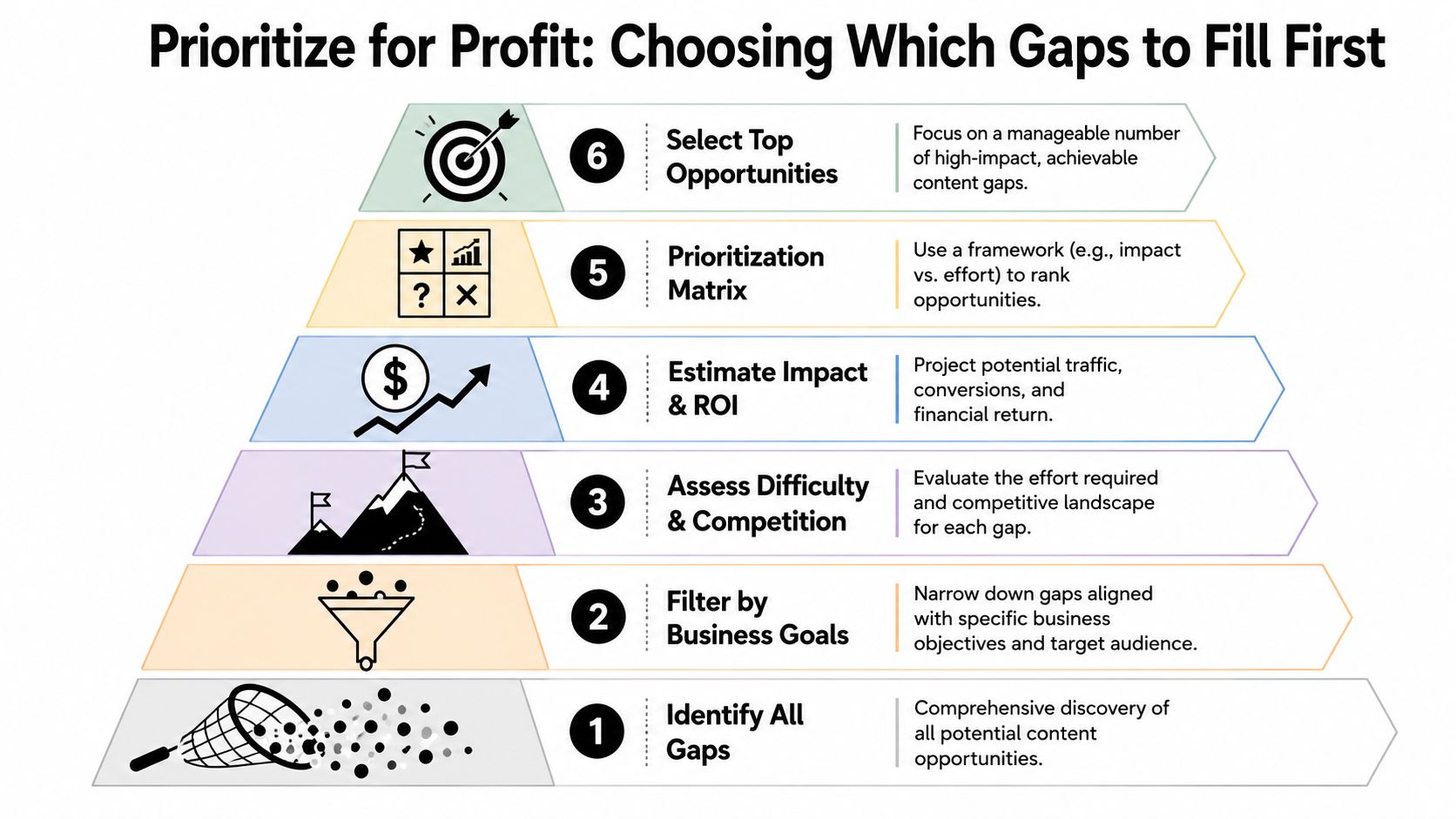
    Prioritize for Profit Choosing Which Gaps to Fill First

    At this stage, most small businesses either gain momentum or burn months.

    The common mistake is chasing the biggest-looking topic first. High search volume feels important, but volume alone is a weak prioritization method when resources are limited. A page that attracts casual readers can still produce almost no business value.

    The better question is simpler. Which gaps are closest to money?

    A six-step funnel diagram illustrating the process of prioritizing content gaps to maximize SEO profitability.

    Commercial intent beats vanity traffic

    For small businesses, GW Content notes that the strongest opportunities often come from high-commercial-intent topics such as comparison, pricing, and local-service queries. Those topics may bring less traffic than broad educational terms, but they often attract people who are much closer to acting.

    That distinction matters more than most guides admit.

    A search like “what is cloud accounting” may be relevant to an accounting software company, but a search like “best cloud accounting software for small business” usually sits much closer to a buying decision. For a local contractor, “how roof leaks happen” may draw curiosity, while “roof repair cost” or “emergency roof repair [city]” signals a more urgent lead.

    If you can only publish a few pages this quarter, publish the pages buyers use before they contact someone.

    The point isn't to ignore informational content. It's to put it in the right order. Informational pages often support authority and internal linking later. Commercial pages deserve earlier attention because they're more likely to influence revenue directly.

    Use a simple small-business priority filter

    A practical triage model is:

    1. Commercial intent first
      Give priority to searches that suggest evaluation, urgency, pricing, provider selection, or local service need.

    2. Ranking feasibility second
      Look for gaps where the current results are beatable. That may mean weaker pages, thin local competitors, outdated content, or forums and directories ranking because nobody has produced a strong dedicated page.

    3. Search volume third
      Use volume as a tie-breaker, not the main driver. A smaller but qualified query can outperform a larger low-intent one for an SMB.

    Use this filter on every candidate page.

    For example, if you run a dental practice, a “veneers vs bonding” page may matter more than a general oral health article. If you sell software, a pricing explainer or alternatives page may matter more than another definition post. If you're a home services company, city-specific service pages with buying intent can outrank months of broad blogging in actual business impact.

    What usually goes to the top of the queue

    The highest-value gaps often fall into a few recurring types:

    • Comparison pages: service A vs service B, tool A vs tool B, treatment A vs treatment B
    • Pricing pages: cost ranges, pricing models, what affects price
    • Problem-solution pages: symptom to service, pain point to fix
    • Local intent pages: service + city, neighborhood, or region
    • Use-case pages: pages tied to buyer scenarios rather than generic category explanations

    These aren't glamorous. They work because they align with how people search when they're narrowing options.

    A lot of small businesses delay these pages because they think they need to sound polished or corporate. They don't. They need to be clear, specific, and more helpful than what's already ranking.

    Launch Your Attack Creating and Tracking Your Content

    A good analysis that never turns into pages is just admin work. The payoff only starts when you convert the prioritized gaps into stronger content assets and track whether they move business outcomes.

    That means building pages around topics, not isolated phrases.

    Build pages that answer the whole topic

    A common failure in content gap analysis SEO is treating the gap as a missing keyword rather than a missing topic treatment. Martech Space's discussion of modern gap analysis highlights this pitfall and stresses semantic depth, intent alignment, and page structure, not just keyword lists.

    In practice, that means every content brief should answer a few hard questions before writing starts:

    • What is the dominant intent in the SERP?
      Is Google rewarding service pages, comparison pages, listicles, local pages, or guides?

    • What must this page cover to feel complete?
      Include the core question, likely follow-up questions, objections, examples, and conversion points.

    • What can you add that competitors can't easily copy?
      Use firsthand experience, local context, product knowledge, process detail, original framing, or structured facts unique to your business.

    That last point matters more now. If AI systems can summarize the generic consensus from a dozen similar pages, your safest edge is information gain. Give searchers something specific enough to cite, trust, and act on.

    Strong pages don't just match the topic. They add something the current results don't provide.

    Make the process repeatable

    A simple operating rhythm works better than occasional big audits. Keep it lean:

    • Build a brief from the winning pages: note format, subtopics, common headings, and obvious weaknesses
    • Publish the best-fit page type: don't force every opportunity into a blog post
    • Link related pages together: connect service pages, comparisons, FAQs, and supporting guides
    • Review performance over time: watch rankings, landing page traffic, and actual conversions tied to the page
    • Refresh weak pages before creating too many new ones: sometimes a better update beats another URL

    This loop matters because search visibility compounds when your site becomes easier to understand topically. One strong page can help another if the internal linking, page hierarchy, and topic coverage make sense.

    The businesses that win with content gaps usually aren't publishing the most. They're publishing with tighter intent, better prioritization, and more discipline after launch.


    Agency Secrets helps small business owners turn this kind of SEO work into a practical system instead of a pile of spreadsheets. If you want an agency-free playbook for buyer-intent keyword research, consistent publishing, backlinks, and competitor analysis, take a look at Agency Secrets.

  • 8 Keyword Research Examples: A 2026 Blueprint

    8 Keyword Research Examples: A 2026 Blueprint

    Tired of keywords that don't drive traffic? You've spent hours in keyword tools, found terms that looked reasonable, published the article, and waited for the lift that never came. The page gets indexed, maybe even impressions, but the visits don't turn into leads, calls, demos, or sales.

    That usually happens for one reason. The keyword wasn't wrong, but the strategy behind it was. Good keyword research examples don't stop at "find a phrase with volume." They connect query, intent, SERP format, page type, and business value. If one of those pieces is off, you can rank and still get nothing useful from the effort.

    The other problem is scale. Most search demand lives in the long tail, not in flashy head terms. Ahrefs reports that 94.74% of keywords get 10 monthly searches or fewer, and only 0.0008% get more than 100,000 monthly searches. That is why broad vanity targets rarely carry a small business SEO plan by themselves.

    What works is a repeatable blueprint. Start with a seed topic, expand into related terms and questions, inspect the SERP, assign one page per intent, and write a brief that gives the page a real chance to rank and convert. That's the practical shift from random keyword collection to a defensible content map.

    Table of Contents

    1. Long-Tail Keyword Research with Buyer Intent

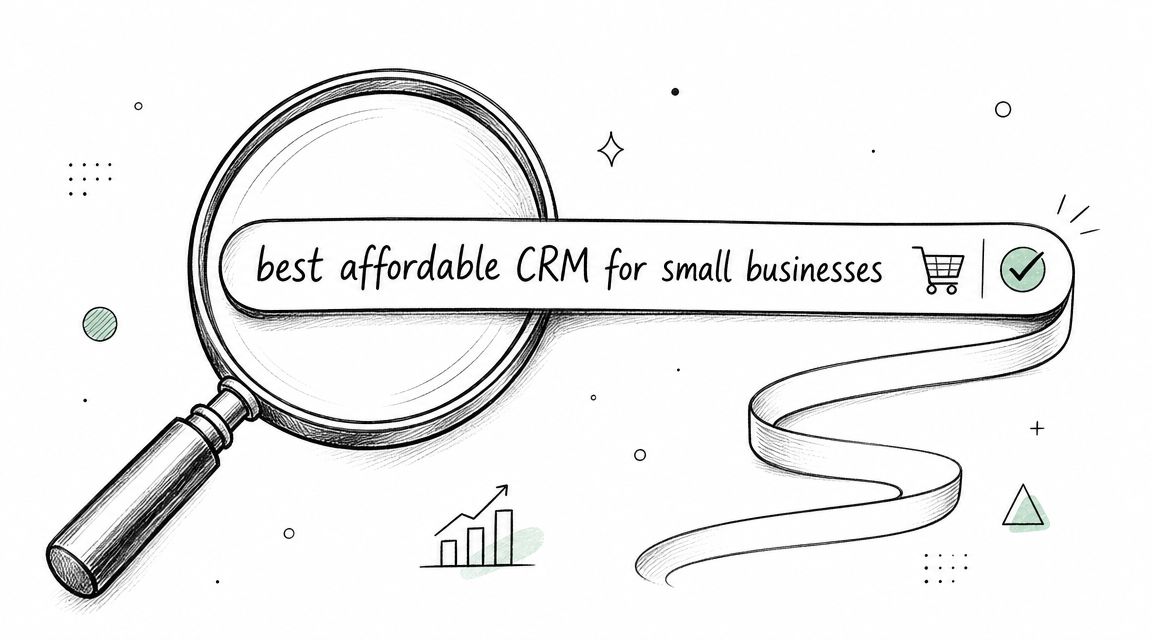
    Long-tail keyword research is where most small businesses should start. Broad terms like "CRM software" or "plumber" look attractive, but they bundle too many intents together. A searcher who types "affordable project management tool for freelancers" is telling you far more about what page they want and how close they are to acting.

    keyword research examples

    A practical workflow starts with one seed term, then expands outward. Ahrefs says its free keyword generator returns 20 related keywords and 20 related questions per seed keyword, which is enough to build an initial intent cluster instead of forcing one phrase into one page.

    Why this blueprint works

    Buyer-intent modifiers do the heavy lifting. Words like "best," "for freelancers," "near me," "same day," "size 9," or "open now" narrow the audience and usually sharpen the page type you need.

    Practical rule: If the keyword contains a constraint, use that constraint in the page structure, not just the title.

    For example, an ecommerce store selling hiking gear shouldn't target only "hiking boots." A stronger cluster could include "waterproof hiking boots for women," "lightweight hiking boots for wide feet," and "best hiking boots for wet trails." Those phrases don't belong on three random blog posts. They usually belong in a comparison guide, a filtered collection page, or a buying guide with product blocks.

    Mini-case blueprint

    Take a small SaaS tool serving independent consultants.

    • Seed keyword: project management
    • Target cluster: affordable project management tool for freelancers, best project management software for solo consultants, project tracker for client work
    • Observed SERP pattern: comparison pages, product roundups, lightweight software lists, feature-focused landing pages
    • Best page type: commercial comparison page with a clear product CTA

    Content brief snippet

    • Primary intent: commercial investigation
    • Working title: Best Project Management Tools for Freelancers Who Manage Client Work
    • Must-cover sections: pricing simplicity, client-facing features, invoicing or integrations, setup friction, best fit by use case
    • Internal CTA: start trial, book demo, or view pricing

    What doesn't work here is writing a generic "What Is Project Management?" article and hoping it leads to signups. That page may attract curiosity, but it won't satisfy a buyer comparing lightweight tools for solo work.

    2. Competitor Keyword Gap Analysis

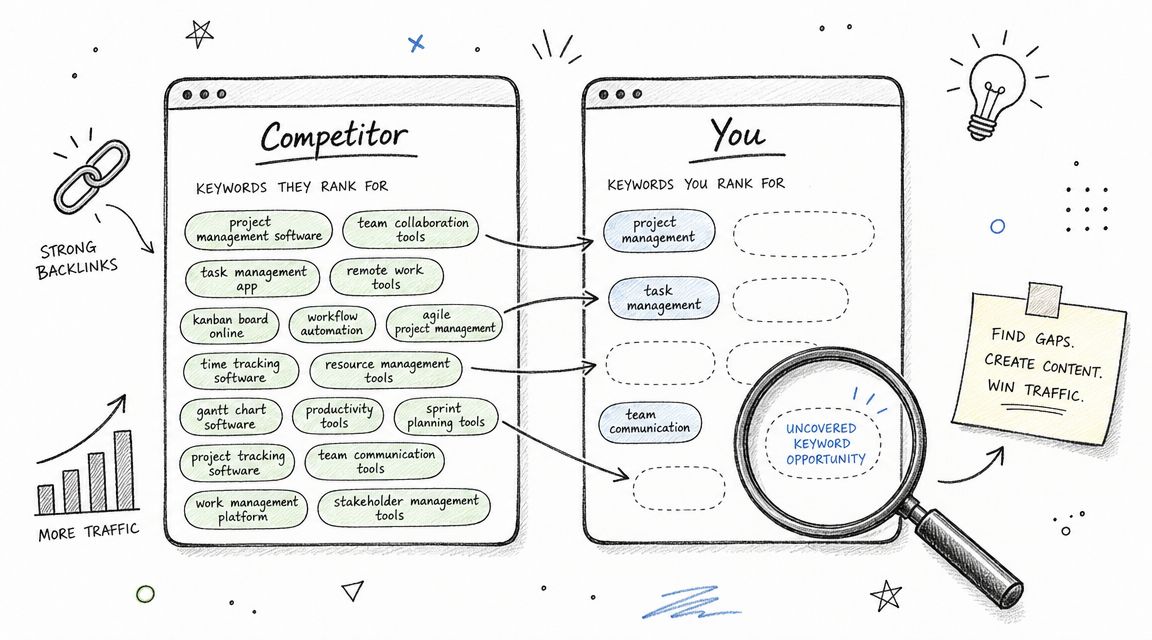
    Competitor gap analysis works best when you stop treating the top-ranking giant as your only benchmark. The useful gaps often sit one layer below the market leader, inside the content libraries of direct competitors who serve the same buyers but haven't covered every use case cleanly.

    Start with the companies a prospect would compare you against. Then inspect which keywords they rank for, which page types win, and where the SERP looks weak.

    keyword research examples

    What to steal and what to ignore

    Don't copy every ranking keyword. Copy patterns.

    A local plumbing company might notice a competitor has a strong page for "drain cleaning near me" but weak or missing coverage for "emergency drain cleaning at night" or "clogged kitchen sink urgent repair." The gap isn't just a missing phrase. It's a missing service-intent page tied to urgency.

    • Steal underserved intents: pages competitors almost rank for, but don't fully satisfy
    • Ignore vanity terms: broad phrases that mainly reward brands with more authority
    • Steal structural clues: pricing blocks, local proof, service-area language, FAQs, and review placement

    Good gap analysis asks, "What intent is under-served?" not "What keyword did they rank for?"

    Mini-case blueprint

    Consider a DTC skincare brand competing in a crowded category.

    • Competitor signals: rivals rank for ingredient pages and "best" listicles, but few have pages around use-case phrases
    • Target cluster: niacinamide serum for oily skin, fragrance-free serum for sensitive acne-prone skin, beginner skincare serum for redness
    • Observed SERP pattern: educational product pages, ingredient explainers, recommendation posts
    • Best page type: hybrid collection and guide page

    Content brief snippet

    • Primary intent: commercial with educational support
    • Working title: Best Serums for Oily and Sensitive Skin Without Harsh Fragrance
    • Must-cover sections: who the product is for, ingredient rationale, how to layer, common irritation concerns, product recommendations
    • Conversion element: shop module above the fold and "how to choose" section below

    If you want a quick visual walkthrough of how SEOs inspect rival rankings and spot openings, this breakdown is useful before you build your own process.

    What doesn't work is publishing a clone of the competitor's top page with a rewritten intro. If the SERP already has ten near-identical pages, your page needs a sharper angle, better alignment with a sub-intent, or a more useful format.

    3. Search Intent Segmentation

    Keyword lists get messy when every phrase sits in the same spreadsheet without an intent label. A term can look relevant and still be useless if you send it to the wrong page type. Search intent segmentation fixes that early.

    The model I use is simple. Split keywords by what the searcher is trying to accomplish, then match that to the page that should exist. Google's own search results usually tell you the answer faster than any spreadsheet.

    A simple intent model

    You can use TIARA as a working frame:

    • Topic-based: broad education and awareness
    • Intent-driven: explicit need clarification
    • Action-oriented: ready to compare or act
    • Revenue-generating: product, service, or money pages
    • Audience-building: useful educational content that attracts future buyers

    Google Keyword Planner helped formalize this kind of workflow because it gives marketers average monthly search volume, three-month percentage change, and market targeting options. That shifted keyword research from guesswork toward a process built around measurable demand and page planning.

    Mini-case blueprint

    Take a bookkeeping service for freelancers.

    • Topic keyword: how to separate business and personal expenses
    • Intent keyword: do freelancers need bookkeeping software
    • Action keyword: best bookkeeping service for freelancers
    • Revenue keyword: freelance bookkeeping service monthly
    • Audience keyword: tax basics for first-year freelancers

    The SERP will usually split these into different winners. The first one tends to reward guides. The third often rewards comparison pages. The fourth belongs on a service landing page.

    Content brief snippet

    • Primary page: bookkeeping service for freelancers
    • Supporting pages: educational guide, software comparison, FAQ article
    • Internal links: guide to service page, comparison to service page, FAQ to consultation page
    • SERP check: if page one is mostly service pages, don't force a blog post into that slot

    What fails here is mixing intents on one page. A page that tries to be a beginner guide, software comparison, and sales page at once usually satisfies nobody.

    4. Question-Based Keyword Research

    Question-based keyword research is where you find language that tools often flatten into generic variants. Real buyers don't always search with polished category terms. They search with hesitation, context, and objections.

    That makes FAQ mining valuable, especially if you serve buyers who need reassurance before they act. Questions often reveal the hidden blockers behind a sale.

    Where the best questions come from

    The best sources are usually visible in plain sight. Advanced keyword research guidance regularly points to Reddit, Quora, niche forums, People Also Ask, autocomplete, and related searches as places to surface real buyer questions and map them to awareness, consideration, and decision stages.

    A dental clinic, for example, might see more value in "does teeth whitening damage enamel" than in another broad article about cosmetic dentistry. That question reveals fear. Fear is often what stops booking.

    Most FAQ pages fail because they answer company questions, not customer questions.

    Mini-case blueprint

    Take a home security SaaS product for small retail shops.

    • Seed topic: store security system
    • Question cluster: can I monitor my shop from my phone, what's the best camera setup for a small retail store, do I need professional installation for store security cameras
    • Observed SERP pattern: how-to explainers, software pages, YouTube walkthroughs, People Also Ask expansions
    • Best page type: question-led resource hub that feeds product and demo pages

    Content brief snippet

    • Primary intent: informational with commercial progression
    • Working title: Can You Monitor a Small Retail Store From Your Phone
    • Must-cover sections: what setup is required, app features, installation paths, privacy concerns, when professional support helps
    • CTA: compare plans or request a demo

    This method also works well for ecommerce. A footwear brand can target "how do I know what shoe size I need" with a size guide that links directly into filtered collections. The trick is not to stop at the answer. The answer should naturally move the searcher toward the next logical page.

    5. Local Keyword Research with Geographic Modifiers

    Local keyword research isn't just city-name stuffing. Good local pages combine service, geography, urgency, and proof. Searchers don't want a generic service page with a neighborhood pasted into the headline. They want confirmation that you serve the area and can solve the exact problem there.

    That changes the keyword list. "Plumber in Austin" and "emergency plumber South Austin open now" do not deserve the same page.

    What local SERPs are really asking for

    In local SEO, modifiers often signal different contexts:

    • City terms: broad service discovery
    • Neighborhood terms: stronger local relevance and often stronger service intent
    • Near me terms: immediate need, especially on mobile
    • ZIP or district terms: useful in large metros where service boundaries matter

    A dental office might build separate assets around "family dentist in [city]," "same-day dentist near me," and "[service] near [neighborhood]." A home service company might need location-service combinations such as drain cleaning, water heater repair, and emergency repairs by area.

    Mini-case blueprint

    Take a locksmith serving a metro area with distinct neighborhoods.

    • Target cluster: emergency locksmith near me, car locksmith in Midtown, house lockout service downtown
    • Observed SERP pattern: local pack, service pages, map results, review-heavy business profiles
    • Best page type: dedicated service-area landing pages supported by a strong Google Business Profile

    Content brief snippet

    • Primary intent: transactional local
    • Working title: Emergency Locksmith in Midtown for Home, Car, and Office Lockouts
    • Must-cover sections: response scenarios, areas served, common lockout cases, trust signals, call CTA, map and service hours
    • Page rule: include local references that are real and useful, not decorative

    What doesn't work is generating dozens of thin city pages with the same body copy. Local SERPs are unforgiving when every page feels templated and untrustworthy.

    6. Seasonal and Trending Keyword Research

    Some keywords don't need more authority. They need better timing. Seasonal research is less about finding a magical trend and more about publishing the right page early enough that it can settle into the SERP before demand peaks.

    This matters for ecommerce, tax and finance services, clinics, home services, and any business tied to recurring events or weather-driven demand.

    Timing matters more than volume

    A retailer selling outdoor gear should not wait until peak winter shopping to create "best winter hiking gloves" pages. A tax preparer shouldn't start their filing-season content when everyone else has already published. Seasonal terms reward preparation and refresh cycles.

    A strong workflow looks like this:

    • Map recurring events: holidays, weather shifts, tax periods, school calendars, industry cycles
    • Create evergreen-seasonal pairs: one stable guide plus one time-sensitive angle
    • Refresh instead of replacing: update pages with current examples, revised intros, and new product blocks
    • Check SERP freshness: if current-year pages dominate, stale pages struggle

    Publish for the next demand wave, not the current one.

    Mini-case blueprint

    Take a landscaping company.

    • Seasonal cluster: spring yard cleanup service, summer irrigation repair, fall leaf removal, holiday outdoor lighting installation
    • Observed SERP pattern: local service pages, seasonal guides, image-heavy galleries
    • Best page type: service landing page supported by seasonal blog content

    Content brief snippet

    • Primary intent: transactional with local urgency
    • Working title: Spring Yard Cleanup Service for Overgrown Lawns and Garden Beds
    • Must-cover sections: what's included, when to book, who it's for, before-and-after examples, estimate CTA
    • Supporting content: spring prep checklist, common yard cleanup mistakes, when cleanup becomes a drainage issue

    What fails here is building one generic "seasonal services" page and expecting it to rank for every spike. Searchers usually want the exact seasonal service, not a category summary.

    7. Keyword Research for Content Clusters and Topic Authority

    Content clusters work when each page earns a distinct job. They fail when teams call something a cluster but publish overlapping posts that all target the same core phrase with minor wording changes.

    The upside is real. Since most useful opportunities sit across many specific phrases rather than a few giant terms, cluster planning is often the most practical way to cover a topic completely. That's especially true when your site doesn't have the authority to win broad head terms outright.

    keyword research examples

    How to build the cluster without cannibalizing yourself

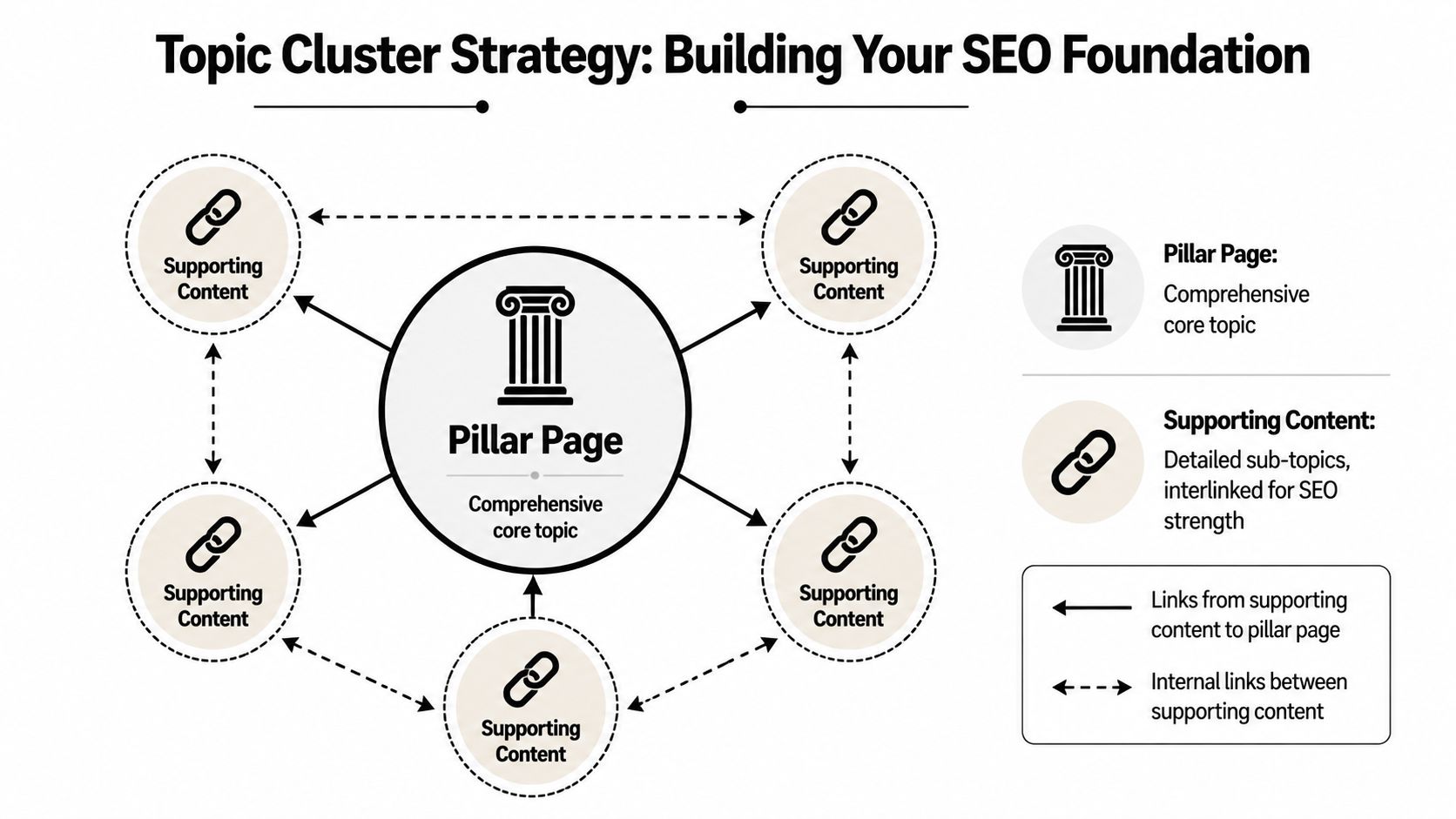
    The page map matters more than the raw list. Evidence-based guidance stresses assigning one canonical page per intent to avoid self-competition and cannibalization, with search volume used as a tie-breaker rather than the main decision factor, as explained in this guide to mapping keywords to pages and avoiding overlap.

    For a small business accounting site, that might look like this:

    • Pillar page: small business accounting basics
    • Cluster page: invoice templates for freelancers
    • Cluster page: bookkeeping mistakes new founders make
    • Cluster page: expense tracking for service businesses
    • Cluster page: choosing between cash and accrual accounting

    Mini-case blueprint

    Take an agency serving local businesses with SEO services.

    • Pillar keyword: SEO for small businesses
    • Target clusters: keyword research for small business, local SEO basics, service page SEO, internal linking for SMB sites
    • Observed SERP pattern: long guides, practical walkthroughs, beginner frameworks, downloadable templates
    • Best page type: one pillar guide plus tightly scoped support articles

    Content brief snippet

    • Primary intent: informational with service qualification
    • Working title: SEO for Small Businesses Without a Large Marketing Team
    • Must-cover sections: keyword strategy, on-page basics, local SEO, content cadence, measurement
    • Internal linking rule: every cluster page points back to the pillar, and the pillar clearly routes readers to the matching subtopic

    What doesn't work is publishing "keyword research for small business," "small business keyword research tips," and "how small businesses do keyword research" as separate pages. That's one intent wearing three outfits.

    8. E-A-T Keyword Research and Expertise Positioning

    Some niches punish weak credibility harder than weak optimization. If you're in health, finance, legal, or any category where bad advice can cause real harm, keyword research has to start with expertise boundaries.

    The mistake is assuming every commercially attractive keyword is fair game. Often it isn't. The SERP tells you whether Google expects recognized expertise, strong editorial signals, or institutional trust.

    Where expertise changes the keyword list

    In these spaces, the smartest keyword research examples usually narrow the topic until the brand can speak with authority. A fitness coach may have no business targeting a page that reads like medical treatment advice. That same coach may be credible on habit-building, recovery routines, sleep hygiene basics, or beginner exercise planning.

    A financial educator may struggle to rank for highly sensitive investment terms but can earn traction with grounded budgeting topics for a defined audience. The point is not to think small. It's to align the keyword set with what the business can defend.

    Credibility is part of keyword difficulty, even when tools don't score it directly.

    Mini-case blueprint

    Take a freelance financial coach serving self-employed creatives.

    • Target cluster: budgeting tips for freelancers, irregular income budgeting method, how to pay yourself as a freelancer
    • Avoided cluster: complex investing advice and highly regulated financial topics
    • Observed SERP pattern: expert explainers, publication-style guides, templates, calculators
    • Best page type: educational guide with clear author bio and practical examples

    Content brief snippet

    • Primary intent: informational with trust qualification
    • Working title: Budgeting Tips for Freelancers With Irregular Monthly Income
    • Must-cover sections: income smoothing, expense categories, tax set-asides, pay-yourself method, worksheet or template
    • Trust elements: clear author background, methodology, practical implementation examples, careful scope boundaries

    What doesn't work is trying to "sound authoritative" on topics the business can't credibly support. In E-A-T-sensitive SERPs, shallow confidence is easy to spot.

    8 Keyword Research Strategies Compared

    Strategy Implementation Complexity 🔄 Resource Requirements 💡 Speed / Time-to-impact ⚡ Expected Outcomes ⭐📊 Ideal Use Cases
    Long-Tail Keyword Research with Buyer Intent Moderate, focused, granular research 🔄 Low–Medium, keyword tools + time 💡 Fast–Medium, quicker wins for new domains ⚡ Higher conversion, qualified traffic; easier to rank (⭐⭐⭐) 📊 Small businesses, bootstrapped teams, niche product pages
    Competitor Keyword Gap Analysis Medium–High, comparative multi-site analysis 🔄 Medium–High, paid tools (Ahrefs/SEMrush), time 💡 Medium, faster validation but execution takes effort ⚡ Reveals proven opportunities; prioritizes high-impact content (⭐⭐⭐) 📊 Businesses entering competitive markets or chasing rivals
    Search Intent Segmentation (TIARA Framework) High, requires classification and mapping 🔄 Medium, tools + manual SERP and audience research 💡 Medium, improves ROI as content aligns with intent ⚡ Better conversion alignment; clearer content priorities (⭐⭐⭐) 📊 Content strategy planning, ROI-focused small businesses
    Question-Based Keyword Research (FAQ Mining) Low–Medium, extract and structure queries 🔄 Low–Medium, PAA, forums, AnswerThePublic 💡 Medium, featured snippets can deliver quick visibility ⚡ Improved authority, featured-snippet potential, engagement (⭐⭐) 📊 Educational content, top-of-funnel awareness, authority building
    Local Keyword Research with Geographic Modifiers Low–Medium, local optimization + GBP setup 🔄 Low–Medium, GBP, local citation tools, landing pages 💡 Fast, quick local rankings and Map Pack opportunities ⚡ Higher local conversions; easier to dominate local SERPs (⭐⭐⭐) 📊 Trades, clinics, franchises, local e‑commerce pickup
    Seasonal and Trending Keyword Research Medium, trend monitoring and timing planning 🔄 Low–Medium, Google Trends, editorial calendar 💡 Fast, large short-term traffic spikes if timed well ⚡ Big temporary traffic surges; time-bound conversions (⭐⭐) 📊 E‑commerce campaigns, holiday promos, event-driven content
    Keyword Research for Content Clusters & Topic Authority High, extensive planning and linking strategy 🔄 High, substantial content creation and monitoring 💡 Slow, long-term authority build (6–12+ months) ⚡ Strong topical authority, sustained rankings, better UX (⭐⭐⭐) 📊 Sites aiming for niche dominance, E‑E‑A‑T and content hubs
    E-A-T Keyword Research & Expertise Positioning High, credential alignment and credibility work 🔄 High, expert content, citations, PR/backlinks 💡 Slow, authority and trust take time to establish ⚡ Sustainable high-authority rankings; higher quality leads (⭐⭐⭐) 📊 YMYL niches (health/finance/legal), expert-led organizations

    Your Actionable Keyword Research Playbook

    Effective keyword research isn't about collecting the longest spreadsheet. It's about making fewer, better decisions. The teams that get results usually follow the same sequence. They choose a seed topic tied to revenue, expand it into related terms and questions, inspect the SERP to see what Google rewards, then map one intent to one page.

    That page mapping step is where most weak SEO plans fall apart. People gather a pile of ideas, then publish whatever feels easiest first. Months later, they have overlapping blog posts, no clear route to money pages, and no way to explain why one article exists instead of another. Better keyword research examples solve that problem up front. They force a decision about page type, intent, and business value before content production starts.

    If you're doing this with a small team, don't try to run all eight blueprints at once. Pick the one that matches your immediate constraint.

    • If you're new or underpowered, start with long-tail buyer intent.
    • If competitors keep outranking you, run a gap analysis.
    • If traffic comes but conversions don't, segment by intent.
    • If buyers ask the same objections repeatedly, mine question-based terms.
    • If you serve a physical area, build local keyword combinations.
    • If your revenue swings through the year, work the seasonal calendar.
    • If your site feels scattered, build clusters with one canonical page per intent.
    • If trust is the bottleneck, narrow your keyword universe to what your expertise can support.

    There's also a practical trade-off to remember. Volume alone is a poor decision-maker. Relevance, SERP fit, and business potential usually matter more. A smaller keyword with a clean intent match and a page designed to convert will beat a broader keyword that attracts the wrong audience. This is especially true for small businesses, local operators, and bootstrapped SaaS teams that can't afford to waste six months on vanity topics.

    My advice is to build every keyword target as a mini brief, not a row in a sheet. Include the primary keyword, supporting phrases, search intent, page type, SERP notes, internal links, and the action you want the reader to take. That one habit prevents a lot of bad content.

    If you want to automate more of this workflow, platforms like OutRank can help execute the mechanics, from research to article production and publication. That doesn't remove the need for strategy. It removes some of the manual overhead that slows small teams down. Used well, that gives you more time to make the decisions that change rankings and revenue.


    Agency Secrets gives small business owners a practical way to apply these keyword research examples without hiring an agency-sized team. If you want a clearer SEO playbook built around buyer-intent keywords, consistent publishing, backlinks, and evergreen growth, explore Agency Secrets. It also points you toward OutRank if you want help handling the heavy lifting from keyword research through publication.

  • Get High Authority Backlinks: 2026 Guide

    Get High Authority Backlinks: 2026 Guide

    Most backlink advice is backward. It tells small businesses to chase volume, buy placements, or obsess over DA screenshots. That approach burns money and usually builds a backlink profile full of links nobody reads, nobody trusts, and Google can safely ignore.

    A better approach is smaller, sharper, and much more realistic if you're running the business yourself. You don't need hundreds of links. You need the right links from relevant sites, useful pages, and real editorial contexts. That's how a solo operator can compete with bigger brands that waste budget on bloated SEO campaigns.

    The practical way to get high authority backlinks is to treat link building like business development. Find the right targets. Create one or two assets worth citing. Reach out with a useful reason. Vet every opportunity. Then track whether those links improve rankings, traffic, and leads. That workflow is slower than buying junk links, but it holds up.

    Table of Contents

    What Actually Counts as a High Authority Backlink

    High authority is not a vanity score. It is a link from a site that people in your market trust, placed on a page that makes editorial sense, and strong enough to pass real visibility and credibility to your business.

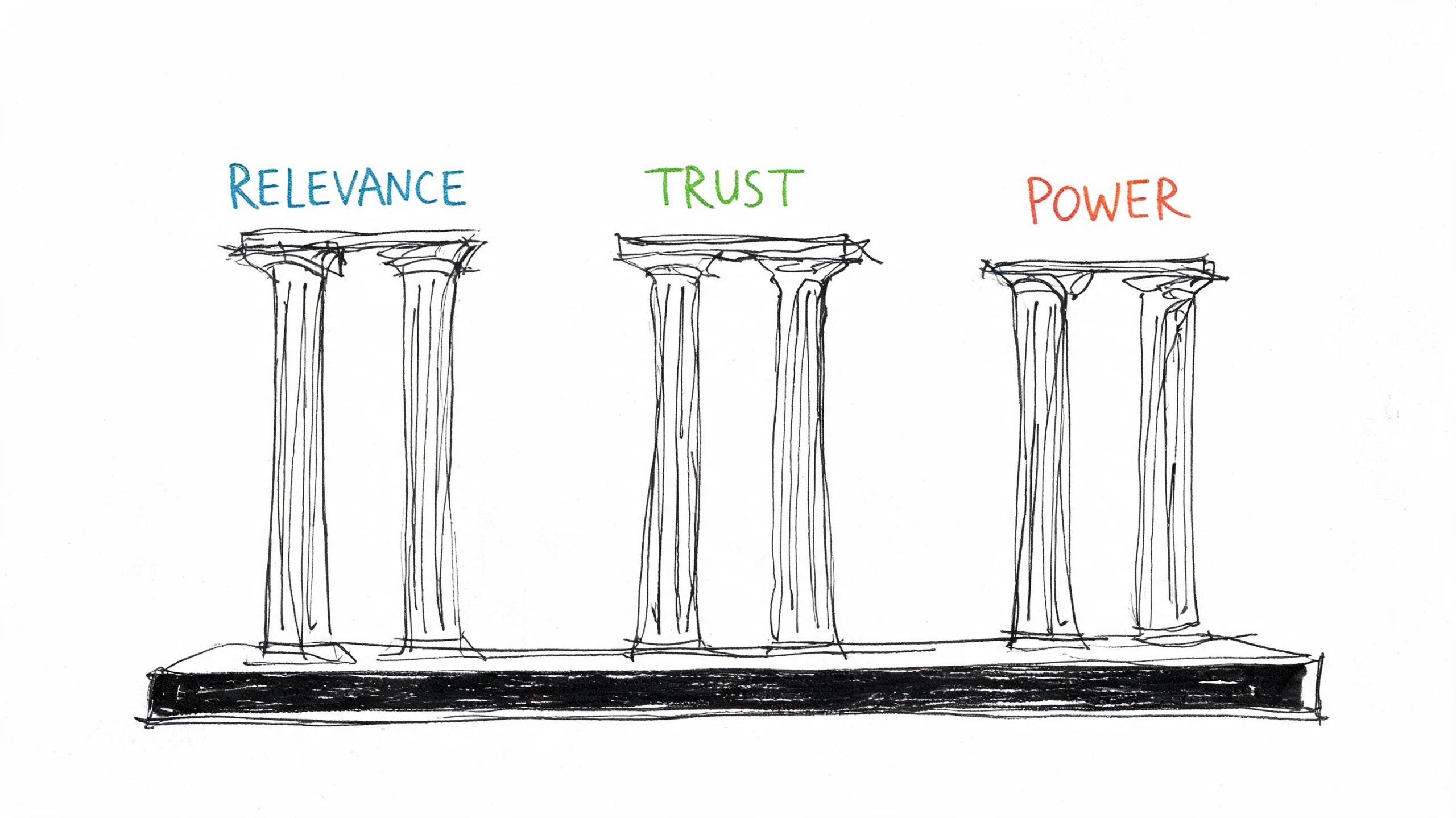
    A hand-drawn sketch of three architectural pillars labeled Relevance, Trust, and Power on a dark base.

    Authority starts with relevance

    A local clinic will usually get more SEO value from a respected healthcare publication than from a high-DR marketing blog. An industrial supplier will usually benefit more from a trade journal than from a broad business site with no subject overlap. Search engines do not treat every strong domain as equally meaningful. Context changes the value of the link.

    Metrics still help with screening. They just should not make the decision for you. A useful benchmark is this: high-authority backlinks from sites with DA above 60 to 70 are foundational for SEO, and a single DA 75+ link can equal the value of 5 to 10 links from DA 30 sites, according to Rock The Rankings on high-authority backlinks.

    For a solo business owner, the practical definition is simpler than the SEO industry makes it sound:

    • Relevant: The site covers your niche, your customer problem, or a close adjacent topic.
    • Trusted: The site has real authors, real readers, and content that exists for more than selling links.
    • Powerful: The link sits inside the main content of a page that already earns attention and trust.

    That is the filter.

    If a link would send you qualified referral traffic, strengthen your reputation, or help a prospect trust you faster, it is probably worth pursuing. If it only looks good inside a spreadsheet, skip it.

    Trust and placement matter more than raw domain metrics

    A DA 70 link in a weak article can be mediocre. A DA 45 link from the right industry site can be excellent. I see small businesses waste money when they buy based on domain score alone and ignore the page, the topic, the anchor text, and the company the link keeps.

    Ask basic questions. Is the article indexed? Does the site publish on one topic or dozens of unrelated ones? Do the outbound links look editorial, or do they look rented? Would you be comfortable showing that placement to a customer who is doing due diligence on your business?

    That standard keeps you out of trouble and saves budget.

    For small businesses, the goal is not to build the biggest backlink profile in the category. The goal is to earn a compact set of links that make your business look like a credible choice in a narrow market. One mention from a trade association, local news site, software partner, or respected niche publisher can do more than twenty low-trust links that never should have been built.

    Finding Link Opportunities Worth Your Time

    The bottleneck in link building is rarely outreach. It is picking targets that were never realistic in the first place. A solo business owner does not need a list of 500 sites. You need 20 to 30 prospects with a clear reason to care about your business, your expertise, or an asset you can produce without hiring an agency.

    A house connected by a dotted line to a magnifying glass revealing a glowing yellow chain link.

    Start with competitor patterns, not raw backlink exports

    Ahrefs and Semrush are useful here, but the goal is not to download every referring domain and copy it. The goal is to identify repeatable link types you can earn with limited time.

    Pull two or three direct competitors. Then sort their links into buckets:

    1. Resource page links from curated tools, guides, and recommended vendor pages.
    2. Contributed content links from industry blogs, podcasts, and expert roundup posts.
    3. Partner links from software vendors, distributors, associations, or complementary service providers.
    4. Editorial citations where a journalist, publisher, or blogger quoted them or referenced a useful asset.

    Then ask one practical question for each link. What caused it?

    Sometimes the answer is a decent template. Sometimes it is a founder quote, a local data point, a case study, or a niche page that solved a specific problem better than the generic results already ranking. That cause matters more than the backlink itself, because it tells you what to build and who to pitch.

    Small operators can beat bigger brands in this area. Large companies often win on volume. You can win on fit.

    Build a short list you can qualify by hand

    A prospect is worth your time if you can answer three questions quickly:

    • Is the site relevant to your market?
    • Is there an obvious page or format where your business belongs?
    • Can you explain the value of your inclusion in one or two sentences?

    If any answer is fuzzy, skip it.

    I would rather see a local accountant work a list of 15 association pages, local business publications, software partner directories, and niche finance blogs than spend a week emailing national publications that will never reply. Relevance and accessibility usually beat prestige when time is tight.

    Resource pages and niche lists still produce wins

    Resource pages get dismissed because so many bad ones exist. The good ones still work. They are maintained, selective, and built to help a specific audience find credible options.

    Search like a customer or editor would search. Use queries tied to your niche plus phrases such as "recommended tools," "helpful resources," "best vendors," "member directory," or "industry association." Then review the page manually.

    A strong resource-page opportunity usually checks these boxes:

    • The page serves readers first.
    • Your page or business fills a real gap in the list.
    • The site is active enough that someone may still review suggestions.

    Keep the outreach tight. Mention the exact page. Explain what your resource adds. Make it easy for the editor to say yes or ignore you without reading a long pitch.

    Weak fit kills response rates faster than weak copy.

    Use journalist requests as an ongoing channel

    HARO-style outreach is one of the few channels where a solo business owner can get strong editorial links without paying for placement, but it only works if you treat it like a routine. Analysts at Digital Applied's link building strategies found that using HARO can deliver DR 50+ editorial links with a 15 to 25% selection rate for optimized responses. The same analysis found that replying in under 2 hours improved selection odds, and that a brief daily habit can produce links from sites with strong authority signals.

    The trade-off is consistency. You may send many useful replies before one lands. That is still a good exchange if the process only takes 20 to 30 focused minutes a day.

    Use a simple workflow:

    • Choose narrow categories. Only respond where you have direct experience.
    • Reply fast. Journalists often use the first credible answers they receive.
    • Lead with the quote. Put the usable insight in the first lines.
    • Write like an operator. Specific examples beat polished marketing language.
    • Keep your byline clean. Name, role, company, website.

    If you run a local service business, a small ecommerce brand, or a specialized consultancy, you already have material worth quoting. Client patterns, pricing shifts, operational mistakes, buyer objections, and regional trends are all usable if you explain them plainly.

    That is the agency-free advantage. You are closer to the work, so your answers can be more specific, faster, and more useful than generic PR copy.

    Creating Content That Naturally Earns Links

    A lot of business owners spend too much time chasing links and too little time building pages that deserve them. If the asset is weak, outreach turns into begging. If the asset is useful, outreach becomes simple distribution.

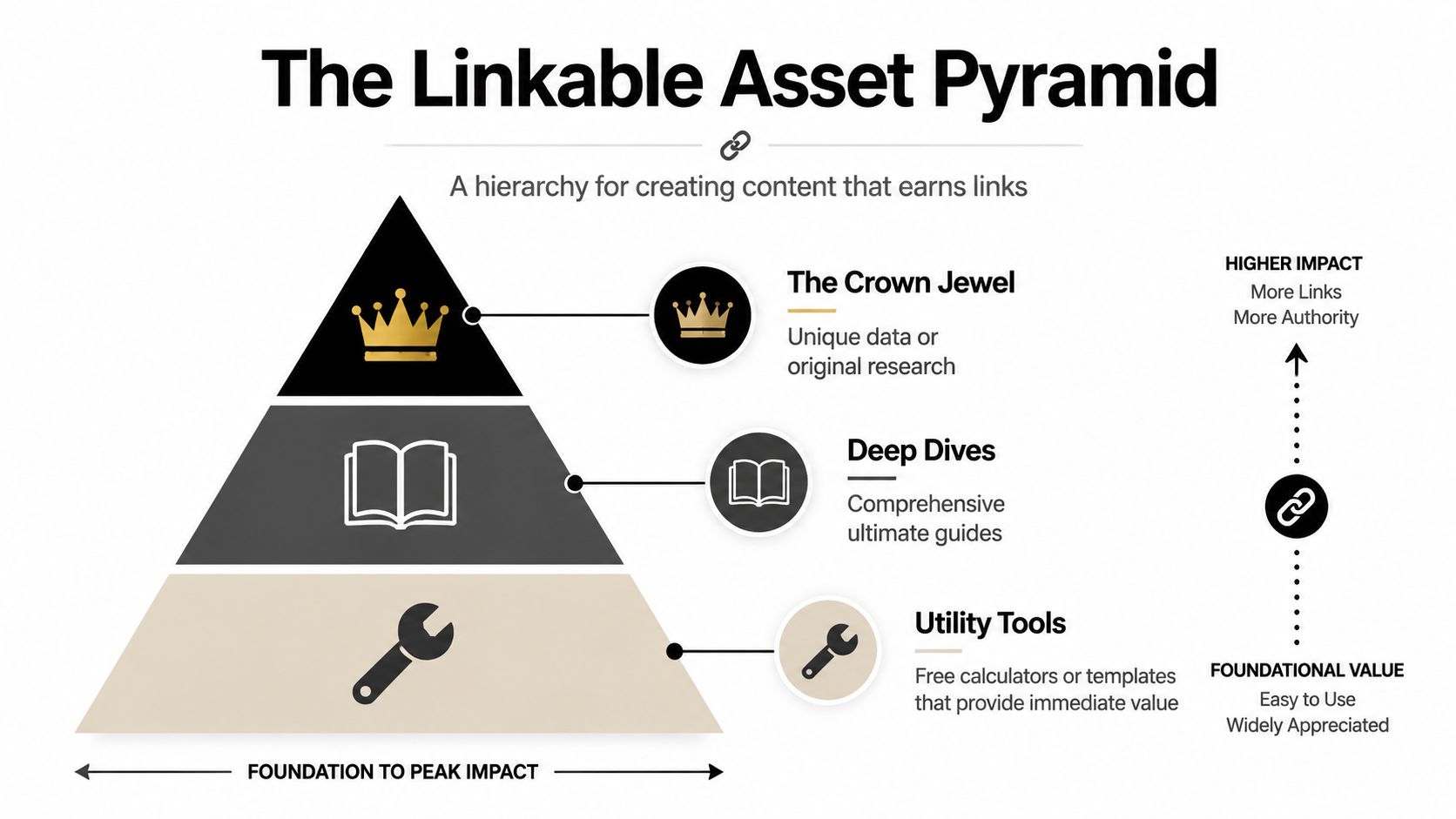
    A hierarchical pyramid diagram illustrating the different types of content assets that earn high authority backlinks.

    For a solo operator, the goal is not to publish more. The goal is to publish a small set of pages that other sites can cite without hesitation. Good linkable assets usually do one of three jobs. They explain something clearly, help someone complete a task, or add evidence from real-world experience.

    The three asset types worth building first

    I would start with one asset in each of these categories, then improve them over time instead of constantly creating new posts.

    Utility tools are the fastest win. Calculators, checklists, templates, intake forms, scripts, and worksheets earn links because they save people time. A local accountant can publish a quarterly tax checklist. A wedding photographer can publish a shot-list template. A B2B consultant can publish a vendor evaluation worksheet. None of these require a design team.

    In-depth guides work when the topic has search demand and weak existing resources. The page needs clear structure, plain-English explanations, examples, and a point of view shaped by actual client work. Publishing a longer article alone is not enough. It has to be the page another writer trusts as a reference.

    Original insight pages have the highest ceiling. That does not require a formal study. You can publish a pricing breakdown, a benchmark page, a summary of patterns from sales calls, or a list of recurring mistakes you see in projects. If the insight comes from doing the work, it can earn citations.

    Why some pages get cited and others get ignored

    Writers, editors, and site owners link for a practical reason. They are usually looking for one of four things:

    • Definition support: a page that explains a term without fluff
    • Evidence support: a source that strengthens a claim
    • Utility support: a tool, template, or checklist readers can use
    • Comparison support: a page that helps readers evaluate options

    That is why format matters.

    A 600-word opinion post rarely earns links unless the author already has a strong audience. A useful calculator can earn links with almost no promotion. A comparison page can attract citations from buyers, bloggers, and service pages if it stays current. A well-structured guide can become the source other writers reference when they need to explain a concept quickly.

    That is the agency-free advantage here. You do not need a content calendar packed with twenty article ideas. You need a few assets that are easier to cite than the alternatives.

    A practical content mix for small businesses looks like this:

    Asset type Best use Why it earns links
    Concept guide Explain a core topic in your niche Writers need a clear reference
    Template or checklist Help people take action fast Useful resources get cited
    Comparison page Clarify differences between options Supports buyer research
    Original observations Add perspective from real work Builds credibility and quotable material

    One warning. Do not start with an infographic, a glossy trend piece, or a broad “ultimate guide” unless you already know people in your field want that format. In small-budget link building, practical beats impressive.

    The best linkable assets reduce friction for another writer. They explain, prove, or simplify something that writer needs.

    A simple workflow works better than chasing content trends:

    1. List repeated questions. Pull them from sales calls, emails, and customer objections.
    2. Match each question to an asset type. Explanation, tool, comparison, or insight.
    3. Build the easiest high-value version first. A checklist often beats a large article.
    4. Add proof from real work. Screenshots, examples, numbers from your process, or common scenarios.
    5. Update the page quarterly. Freshness matters more on comparison and data-driven assets.

    If time is tight, start with the page another site can cite in one sentence and their reader can use in five minutes.

    The Art of Effective Outreach Without Being Spammy

    Cold outreach is overrated. Page-specific outreach is what gets links.

    A hand holding an envelope with a network node diagram rising from it, symbolizing digital communication and connectivity.

    A solo business owner does not need to send 500 emails a month. You need 20 to 30 well-chosen prospects, a real reason to contact each one, and a page worth linking to. That is how you compete with bigger teams without burning time on inbox churn.

    Editors and site owners ignore outreach for one simple reason. The email creates work instead of removing it. If your message asks them to review a random article, trust your claims, and decide where it fits, you are giving them another task. Good outreach does the opposite. It points to a specific page, a specific gap, and a specific fix.

    Start with a reason tied to the page

    The strongest outreach angle usually falls into one of four buckets:

    • A broken outgoing link on their page
    • An outdated recommendation or stat
    • A missing resource their readers would use
    • A section where your example, quote, or tool improves the article

    That is why the Skyscraper Technique can still work. Executed with precision, it can yield a 20 to 40% response rate. But 70% of campaigns fail because the pitches are generic. Showing a side-by-side comparison of value can boost replies by 35% or more, according to Search Logistics on link building statistics.

    The useful lesson is not "copy this tactic." It is simpler than that. Show why your page helps their reader more than what is there now.

    Before you email anyone, write down your reason in one sentence. If you cannot explain the fit that clearly, skip the prospect.

    Write like a person who noticed something useful

    Short emails work because they respect attention, not because they are clever. Keep the note specific, easy to scan, and low pressure. I tell clients to remove anything that sounds like a compliment written for ten other websites.

    Use these as starting points, then customize them.

    Broken link replacement

    Subject: Broken link on your [topic] page

    Hi [Name],

    I was reading your page on [topic] and noticed one resource in the [section name] appears to be broken.

    If you're updating it, I have a current guide on [topic] addressing the same angle here: [Your Page]

    If it's useful, feel free to swap it in. Either way, I thought you'd want to know about the broken link.

    Best,
    [Your Name]

    Resource page suggestion

    Subject: Possible addition to your [page title]

    Hi [Name],

    I found your resource page for [audience/topic] and saw you list tools and guides for [specific use case].

    We published a [guide/template/tool] on [topic] that could fit the [relevant section] because it helps readers [specific value].

    If helpful, I can send the direct link and a one-line summary for quick review.

    Thanks,
    [Your Name]

    Two small details improve reply rates. Use the recipient's page title or section name so they know you looked. Then make the ask easy to evaluate in under 30 seconds.

    One more thing helps. Study examples before you start sending emails.

    Follow up without becoming a nuisance

    A lot of good pitches get missed the first time. Inbox timing is messy. People save things and forget them. That is normal.

    The fix is a short follow-up sequence, not a bigger sales routine.

    • First email: State the page, the issue or opportunity, and your suggested resource.
    • Second email: Send a brief follow-up a few days later. Mention the same page and keep it to one or two sentences.
    • Third email: Close the loop. Give them an easy out and stop there.

    A clean follow-up looks like this:

    Just checking in on this resource suggestion for your [page/topic] page. If it's not a fit, no problem at all.

    That works because it sounds like a professional note, not a campaign trying to squeeze one more reply out of a list.

    The agency-free way to handle outreach is boring on purpose. Build a short prospect list. Match each site to one useful asset. Send personalized emails. Track replies in a simple spreadsheet. Keep the angles that get traction, and drop the ones that waste your week.

    Your Link Vetting Checklist To Avoid Penalties

    A decent outreach campaign can still create problems if you say yes to the wrong sites. Many business owners are harmed at this stage. They finally get traction, then accept links from sites that exist mainly to sell links.

    A good link prospect passes a common-sense test

    Don't overcomplicate vetting. Open the site and ask basic questions. Does it look like a publication someone reads? Are there named authors? Are the articles coherent? Do outbound links feel selective, or does every post push to unrelated businesses?

    Then use your tools. Ahrefs, Semrush, and even a manual Google search can tell you a lot. You're looking for topical consistency, signs of organic visibility, and pages that appear to serve users first.

    The strongest prospects usually share these traits:

    • Editorial clarity: Articles have a purpose, not just filler paragraphs around a link.
    • Relevant topic coverage: The site regularly publishes in your niche or a close adjacent one.
    • Reasonable outbound linking: It doesn't spray links to casinos, crypto schemes, payday loans, or unrelated software in every post.
    • Healthy publishing pattern: New content appears, old content still exists, and the site doesn't look abandoned.

    If a site looks like it was built for link sellers, treat it that way.

    Link Vetting Checklist

    Check What to Look For (Green Flag) What to Avoid (Red Flag)
    Relevance The site covers your industry or a tightly related topic The site publishes on every topic under the sun
    Editorial quality Named authors, readable articles, clear standards Thin content, anonymous posts, obvious AI slop
    Link placement Link appears naturally in the article body Footer, sidebar, author bio, or forced paragraph insertion
    Outbound profile Selective links to credible businesses and sources Frequent links to spammy or unrelated industries
    Site health Consistent publishing and signs of real readership Abandoned blog, broken pages, erratic updates
    Intent The placement makes sense for readers The page exists mainly to host outbound links

    Red flags that should end the conversation

    Some prospects don't deserve a second thought. Walk away if you see patterns like these:

    • Topic mismatch: A site about fashion wants to link to your B2B accounting page.
    • Paid-placement language: The editor immediately offers "dofollow packages" across multiple sites.
    • Recycled guest posts: Every article follows the same template with different anchor text.
    • Sketchy neighbors: The site links to industries you wouldn't want your brand near.
    • No real standards: The publisher accepts anything as long as someone pays.

    The safest mindset is simple. If you'd be embarrassed to show the site to a customer, don't want the link.

    Measuring ROI and Scaling Your Link Building

    A link is only valuable if it improves a page that matters to the business.

    Small business owners get into trouble when they measure link building by volume. Ten new links can look productive in a report and still do nothing for rankings, leads, or sales. The better approach is simpler. Tie every link effort to a page with a job to do, then check whether that page gained more visibility, better traffic, or more conversions over time.

    Track the signals that connect to revenue

    Start with four numbers:

    • Referring domains to your money pages
    • Ranking movement for the linked page
    • Referral traffic from the linking site
    • Leads or sales assisted by organic visits to that page

    That gives you a practical scorecard without turning this into a data project.

    Google Search Console shows whether impressions and clicks are rising. Google Analytics shows whether the page attracts useful visits and assists conversions. Your SEO tool helps you confirm whether the page is gaining stronger referring domains over time. For a solo operator, that is enough to spot whether the work is paying off.

    Patience still matters. Link building usually pays back over months, not days. A strong placement on the right site can support rankings long after the outreach work is done, especially if it points to a commercial page or a linkable asset that feeds internal authority to revenue pages.

    Review links at the page level, not just the domain level

    This is the part many small businesses skip.

    Do not ask, "Did link building work?" Ask, "Did links to page A improve page A's performance enough to justify the time spent getting them?" That question is much easier to answer, and it helps you stop wasting effort on pages that were never likely to produce business value.

    A simple monthly review works well:

    • Pick the 5 to 10 pages you actively built links to
    • Compare current rankings against the previous month
    • Check organic clicks and assisted conversions
    • Note any new referring domains to each page
    • Flag pages that improved, stalled, or declined

    After two or three cycles, patterns show up. Some pages respond quickly to a few strong links. Others need better on-page work, stronger search intent alignment, or a better offer before more links will help.

    Scale the parts that do not require your judgment

    A solo business owner should keep control of the work that affects quality. That means choosing targets, deciding the angle, writing or editing the outreach that needs a human touch, and building real publisher relationships.

    The repeatable tasks can be systemized:

    • prospect collection
    • contact research
    • content briefs
    • asset updates
    • reporting
    • internal linking support

    I usually advise owners to build one repeatable link workflow before trying to expand. For example, if resource page outreach is producing decent links at a reasonable time cost, keep that engine running before adding digital PR, guest posts, and broken link campaigns on top of it. One process executed consistently beats four half-finished tactics.

    Scaling link building without an agency usually means getting more selective, not doing more. Cut low-response prospect lists. Reuse winning outreach angles. Update the assets that already attracted links instead of constantly publishing from scratch. Protect your time for the small set of actions that earn placements.

    Frequently Asked Questions About High Authority Links

    Are high authority backlinks always expensive

    No. The expensive route is usually the shortcut route, paid placements on sites that exist to sell links. A solo business owner does better by earning links through useful assets, partner mentions, resource pages, journalist requests, and broken link outreach. The cash cost can stay low. The actual cost is time, follow-up, and choosing opportunities carefully.

    Should you care about DA and DR

    Use DA and DR to filter prospects fast, then move on.

    They are screening metrics, not decision-makers. A relevant link from a well-run niche site often does more for rankings and qualified traffic than a higher-metric link from an off-topic site with weak editorial standards. Check the site, the page, and the context of the link before you spend an hour on outreach.

    How long does link building take

    Longer than most owners expect.

    High-quality links usually come from repeated outreach, better assets, and steady relationship-building, not one clever email. That is why solo operators need a process, not a pile of tactics. Pick a page worth promoting, build a short list of strong prospects, send useful outreach, track what earns replies, and keep improving the asset. Done right, link building compounds, but it rarely pays off in a week.

    Should you buy backlinks

    I would not build a small business SEO strategy around bought links. The risk is not just Google penalties. It is wasting money on links that never move rankings, never send traffic, and sit on sites with no real audience.

    If you have budget, put it into assets people want to reference, cleaner outreach, and better prospect research. That gives you something you can keep using next month instead of starting over.

    What's the best first step if you're doing this alone

    Start with one page.

    Choose the page that already has business value, a service page, a strong guide, or a useful local resource. Improve it until another site has a real reason to cite it. Then build a short target list using competitor backlinks, relevant resource pages, and media request platforms. One page with a clear angle and focused outreach beats ten pages with weak positioning.

    If you want a practical, agency-free SEO system instead of random tactics, Agency Secrets is a smart place to start. It shows small business owners how to combine keyword research, content production, high authority backlinks, and evergreen SEO into one workflow, with OutRank handling much of the heavy lifting so you can stay focused on the parts that need your judgment.

  • How to Rank for Low Competition Keywords in 2026

    How to Rank for Low Competition Keywords in 2026

    Most SEO advice still pushes small businesses toward the biggest keywords in the room. That's backwards.

    If you're a local service business, solo founder, ecommerce operator, or lean in-house marketer, you probably don't lose in search because your product is worse. You lose because you're trying to compete on terms built for companies with bigger sites, larger teams, and stronger backlink profiles. Going after broad keywords too early burns time, drains budget, and usually ends with a page stranded far from page one.

    The underdog play is different. You win by being more precise. You target the phrases larger competitors ignore, the ones tied to specific problems, narrow use cases, and clear buyer intent. That's how smaller sites start ranking, earn trust, and build momentum without hiring an agency.

    Table of Contents

    Why Chasing High-Volume Keywords Is a Losing Game

    Small businesses get trapped by search volume.

    A founder opens a keyword tool, sees a giant term in the niche, and assumes that's the prize. So they publish a page for something broad like "marketing software," "plumber," or "project management app." Then they wait. And wait. Meanwhile, the search results are crowded with massive brands, old domains, layered content hubs, and backlink-heavy pages that have been accumulating authority for years.

    That isn't a content problem. It's a strategy problem.

    Broad keywords look attractive because they suggest scale. But for a smaller site, they often create the worst mix possible: vague intent, strong competition, and a long path to any meaningful return. Even if you do rank someday, the traffic can be messy because broad terms pull in people who are early in research mode, casually browsing, or looking for something adjacent to what you sell.

    Go where the giants aren't paying attention. That's usually where the practical revenue lives.

    A better path is to stop treating SEO like a popularity contest and start treating it like market positioning. Precision beats brute force. A narrow keyword with the right intent can bring in fewer visitors and still produce more leads, calls, demos, or sales than a flashy head term.

    Here are the trade-offs most smaller businesses learn the hard way:

    • Big volume usually means bigger incumbents. You aren't just competing with pages. You're competing with domain strength, content depth, and brand familiarity.
    • Broad intent creates weak conversion paths. A visitor searching a general term may not be close to action.
    • Longer timelines create fragile commitment. When a page takes too long to move, teams stop publishing or start chasing the next shiny keyword.
    • Low competition keywords stack. One page rarely changes a business. A focused set of pages does.

    This is why underdogs should build from the edges inward. Rank for the specific query first. Earn clicks, links, and internal topical relevance. Then move one layer broader.

    That approach isn't glamorous. It works.

    What Makes a Keyword Low Competition

    A low competition keyword isn't just a phrase with lower search volume. It's a keyword where the current search results give you a realistic opening.

    Think of SEO like choosing a route. A high-competition keyword is the packed highway at rush hour. Everyone wants it, everyone is fighting for position, and the biggest vehicles dominate the lane. A low competition keyword is the backroad. Fewer cars. Less pressure. You still reach the destination, but you don't waste resources forcing your way through traffic.

    According to Semrush's low-competition keyword methodology, low-competition keywords are often identified by Keyword Difficulty scores below 30 to 40, and scores under 30% are labeled "Easy", which makes them feasible for new or low-authority domains. The same source notes that SMBs focusing on KD below 30% clusters saw 150% to 300% organic traffic uplifts in case studies from 2020 to 2025.

    A diagram illustrating the four key factors that define low competition keywords for content strategy.

    The highway versus backroad test

    When I assess whether a keyword is low competition, I don't stop at a tool score. I look for four conditions working together.

    • Lower difficulty. This is the obvious one. If the keyword sits in the easier range, it deserves attention.
    • Specific wording. Narrow phrases usually mean a narrower SERP. That's good for smaller sites.
    • Intent clarity. A keyword with obvious purpose is easier to satisfy with a focused page.
    • Weaker existing results. If the top pages are thin, outdated, off-intent, or from forums and mixed directories, you have a shot.

    A keyword can have modest volume and still be far more useful than a broad term because the visitor knows what they want. That's why long-tail and use-case-driven phrases often outperform the obvious targets for underdog sites.

    Practical rule: If the current top results look generic, loosely matched, or half-finished, the keyword may be easier than the number suggests.

    Keyword Difficulty thresholds that matter

    KD isn't perfect, but it's useful when you treat it as a filter rather than a verdict.

    KD Score Range Competition Level What It Means for Your Business
    0-29 Easy Best hunting ground for newer sites, local businesses, and smaller brands
    30-39 Low to moderate Possible if intent is clear and the current SERP is weak
    40+ Competitive Usually not the first place an underdog should spend energy

    Many businesses struggle with this specific step. They use one number in isolation. But KD only tells part of the story. Search results can still be beatable if the ranking pages don't solve the query well.

    Look for signs like these:

    • Forum-heavy SERPs. Google may be struggling to find a strong page.
    • Mismatched content types. Product pages ranking for informational searches, or blog posts ranking for commercial queries.
    • Thin local pages. Common in service niches where competitors haven't invested in content.
    • Weak topical depth. The top page answers the core question but leaves obvious follow-up questions untouched.

    Low competition keywords aren't magic. They're just winnable. That's enough.

    A Practical Workflow for Discovering Hidden Gem Keywords

    Most businesses don't need more keyword ideas. They need a better way to separate useful ideas from junk.

    Start manually. Tools help later. If you skip the manual step, you'll end up with a list that looks clean in a spreadsheet but has no connection to how customers search.

    A hand holding a magnifying glass over a hand-drawn map to identify a hidden gem niche concept.

    Start where customers already complain and compare

    The best low competition keywords often show up in places where people describe their problem in plain language.

    Search these sources with a notebook open:

    1. Reddit threads
      Product comparisons, frustration posts, niche subreddits, and "what should I use for…" questions are full of raw keyword phrasing.

    2. Quora and industry forums
      Not because the answers are always good, but because the questions reveal recurring demand.

    3. Google autocomplete
      Type a seed phrase and run the alphabet soup method. Add letters after the phrase and note what keeps appearing.

    4. People Also Ask
      This is one of the fastest ways to map adjacent questions and supporting subtopics.

    5. Competitor navigation and page titles
      If a competitor has a page for a narrow use case, that's often a sign the query has value.

    Build a list from these sources first. Don't judge it too early. You're trying to capture language, not declare winners.

    Then sort the list by theme. A local roofer might end up with clusters like emergency repair, insurance claims, leak diagnosis, and neighborhood-specific searches. A software company might see clusters around alternatives, integrations, pricing, and use-case pages.

    Use tools to narrow the list, not to replace judgment

    Once you have themes, move into a keyword tool and filter aggressively.

    According to SEOptimer's overview of high-volume low-competition keywords, high-volume low-competition keywords are defined as terms with 1,000 or more monthly searches and low KD scores below 30, and sites targeting long-tails with 100 to 1,000 volume achieved 40% to 60% first-page ranking rates within 90 days, compared with 5% to 10% for high-KD terms in Ahrefs and Semrush data from 2020 to 2025.

    That doesn't mean you should only chase the highest numbers inside the easy range. It means you should prioritize combinations that are still realistic.

    Use filters like these:

    • Minimum relevance first. If the term doesn't connect to what you sell, cut it.
    • Low KD second. Keep the list focused on terms your site can plausibly win.
    • Volume as a tiebreaker. Use it to prioritize among good options, not to override intent.
    • SERP sanity check last. Open the results and look at what's ranking.

    A practical shortlist usually includes three buckets:

    Bucket What it looks like Why it matters
    Quick wins Narrow problem-focused phrases Easier to rank and useful for early traction
    Commercial terms Alternatives, reviews, best-for pages Stronger buying intent
    Authority builders Closely related informational topics Support internal links and topical coverage

    After you've built that shortlist, watch this walkthrough for another angle on researching easier terms:

    One more thing matters here. Don't confuse weird with valuable. Some low competition keywords are easy because nobody searching them is likely to buy, call, or care. The point isn't to find obscure phrases. The point is to find overlooked phrases that map to real demand.

    Validating Keywords for Profit Not Just Traffic

    A keyword isn't good because it can bring visits. It's good if those visits can turn into business.

    Many small sites waste months at this stage. They publish informational content that attracts curious readers, students, and people with no intention to buy. The analytics dashboard looks alive, but the pipeline doesn't move.

    A hand balancing a scale with traffic represented by a cloud and profit represented by a gold coin.

    Traffic can distract you from revenue

    Bottom-of-funnel keywords deserve more attention than they usually get, especially for lean businesses. According to this YouTube discussion on BOFU keyword opportunities, specific buyer-intent phrases such as "best zero-based budgeting app for freelancers" are often undertargeted and can rank in weeks rather than months compared with broader terms.

    That's the kind of asymmetry underdogs should exploit.

    Someone searching a broad educational query may only want a definition. Someone searching an alternative, review, best-for, or near-me phrase is much closer to taking action. Those keywords often have less competition precisely because they're narrow. Large publishers prefer scale. Small businesses need qualified demand.

    If a keyword sounds like something a real buyer would type five minutes before making a decision, pay attention.

    A simple intent checklist

    Before adding any keyword to your calendar, run it through this screen:

    • Does the searcher want information, comparison, or action?
      Action and comparison terms usually deserve priority if leads or sales matter now.

    • Can your business satisfy the intent directly?
      If the searcher wants a tool comparison and you sell one, great. If they want free templates and you only sell consulting, think harder.

    • Would the ideal customer search it?
      Not every relevant keyword is commercially useful. Relevance alone isn't enough.

    • Can one page answer the query cleanly?
      If the topic is too broad or mixes multiple intents, it may need a different angle.

    • Is there a natural next step?
      Strong pages make the conversion path obvious. Book a call. Request a quote. Start a trial. View pricing.

    Here's a quick lens for judging intent:

    Intent type Example pattern Priority for a small business
    Informational how to, what is, why does Useful when tightly connected to your offer
    Commercial best, review, alternative, comparison Usually high priority
    Transactional buy, near me, pricing, quote Highest priority when relevant
    Navigational brand names, login, support Usually low priority unless it's your brand

    The hard truth is simple. A smaller business doesn't need the most traffic. It needs the right traffic first.

    Content and Link Building for Low Competition Terms

    Once you've chosen the keyword, don't overcomplicate the page.

    Low competition keywords usually don't require a giant content production machine or an expensive backlink campaign. What they do require is a page that matches intent better than what's already ranking. That means relevance, clarity, structure, and a strong internal link network.

    Build the page that should rank

    For easier terms, content quality often wins before raw authority does. But quality in SEO doesn't mean "long." It means the page earns the click and then satisfies the search.

    A page targeting a specific low competition keyword should usually do these things:

    • Answer the main question early. Don't hide the value in paragraph eight.
    • Match the content type already favored by the SERP. If searchers want a comparison page, don't force a generic blog post.
    • Cover obvious follow-up questions. Use subheadings that reflect how buyers think.
    • Show real specificity. Mention use cases, constraints, trade-offs, and who the option is best for.
    • Link to supporting pages. Build clusters so the page isn't isolated.

    A focused page with sharp intent usually beats a bloated page that tries to rank for everything.

    Internal linking matters more than most small businesses realize. If you publish a page about "best accounting software for freelance designers," link to it from broader pages about freelancer accounting, tax workflows, invoicing, and software comparisons. That helps search engines understand the page belongs inside a real topical system, not as a random one-off article.

    A simple cluster often includes:

    1. A commercial page targeting the main buyer-intent term
    2. Supporting informational pages that answer adjacent questions
    3. A broader category or hub page that links the topic together

    Earn links you can actually get

    You don't need a heroic outreach campaign for every low competition keyword. Many smaller sites stall because they think link building means sending hundreds of cold emails. Usually, they would be better off earning a handful of highly relevant mentions.

    Realistic tactics include:

    • Podcast guesting. Niche shows often link to your homepage or resource page.
    • Expert commentary. Journalists, newsletters, and industry writers need usable quotes.
    • Partnership pages. Suppliers, software integrations, and associations often maintain member or partner listings.
    • Local relevance links. Chambers, sponsorships, neighborhood guides, and event pages can help local service sites.
    • Original utility assets. A calculator, checklist, template, or comparison table gives people something to cite.

    What doesn't work well for most underdogs is building links to pages that don't deserve them. If the content is vague, over-optimized, or written without first-hand usefulness, even a decent link won't save it.

    The best sequence is simple. Pick a narrow keyword. Publish the page that answers it cleanly. Support it with nearby content. Then earn a few relevant links that make contextual sense.

    How to Automate and Scale Your Keyword Strategy

    The manual playbook is enough to get traction. It isn't enough to maintain consistency once the business gets busy.

    That's where automation helps. Not as a shortcut for weak strategy, but as a way to apply a strong process repeatedly without rebuilding it from scratch every week.

    A hand-drawn sketch of a business process automation workflow labeled as Agency Secrets on notebook paper.

    Good automation follows a clear process

    If your workflow is fuzzy, automation just helps you make mistakes faster. But if your workflow is already sound, automation can remove the repetitive parts that slow teams down.

    That usually means systematizing work like this:

    • Keyword discovery based on low competition and clear intent
    • Clustering related phrases into pages instead of creating cannibalized content
    • Content briefs that reflect the actual SERP and intent
    • Publishing cadence that doesn't collapse when the founder gets busy
    • Internal linking across related pages and categories

    Where AI actually helps

    According to Seoprofy's discussion of low-competition keyword workflows, an emerging trend is using AI tools with precise prompts to find low-competition keyword clusters for low-DA sites, and tools that integrate People Also Ask and social data can automate discovery and publication of up to 30 articles per month while helping build authority 2x faster.

    That matters because the biggest challenge for smaller teams usually isn't knowing one good keyword. It's turning one good keyword into a durable publishing system.

    Used well, AI can help with:

    • Expanding seed topics into clusters
    • Finding long-tail variations that reflect real customer language
    • Drafting faster around a validated outline
    • Maintaining consistency across many supporting pages

    Used badly, AI floods your site with generic content around weak keywords. That's worse than publishing slowly.

    The winning setup is simple: humans decide the market, intent, offer, and trade-offs. Automation handles the repetition.


    Agency Secrets gives small business owners a practical way to run this playbook without hiring an agency. It focuses on buyer-intent keyword research, consistent publication, relevant backlinks, and evergreen compounding, then pairs that strategy with OutRank to automate the heavy lifting. If you want an agency-free system for finding low competition keywords, publishing at scale, and growing organic traffic while you run the business, explore Agency Secrets.

  • Long Form Content: The SMB Guide to SEO Dominance

    Long Form Content: The SMB Guide to SEO Dominance

    Long form content gets an average of 77.2% more links than short articles. That single number should change how most small businesses think about SEO.

    If you're still publishing thin blog posts because they feel easier to produce, you're choosing the hardest path to growth. Bigger competitors already have stronger domains, larger teams, and more brand recognition. You won't beat them by publishing more noise. You beat them by publishing assets that deserve rankings, links, and leads.

    Long form content works because it gives Google and real buyers what short posts usually don't: complete answers, clear structure, strong internal links, and enough depth to signal authority. For a small business, that's not a branding exercise. It's a distribution strategy. One strong long form system can compound for months without paying an agency, funding nonstop ads, or hiring a full editorial team.

    Table of Contents

    What Is Long Form Content and Why It’s Your SEO Secret Weapon

    Articles in the top results are often long for a reason. Backlinko’s analysis of Google search results found that the average first-page result contains 1,447 words. That does not mean you should chase a word count target. It means search winners usually cover the topic with enough depth to satisfy the search.

    Long form content is a page built to finish the job. It answers the core question, handles the obvious follow-up questions, addresses objections, and gives the reader a clear next step. For an SMB, that could be a service page, buyer’s guide, comparison post, or pillar article. The format matters less than the outcome. The page should reduce uncertainty and move a prospect closer to action.

    A hand-drawn illustration showing a rocket labeled SEO Secret Weapon launching from long-form content.

    That is why long form content works so well for SEO. Google rewards pages that solve the search, not pages that hit a cute word count. Readers reward pages that save them another 10 tabs.

    Short posts usually miss on both fronts.

    Why short posts keep losing

    A 600-word post can work for a narrow query. It fails for anything tied to evaluation, comparison, pricing, implementation, or trust. Those searches need substance. If your page only scratches the surface, readers bounce and keep looking.

    Short posts also create an efficiency problem for small teams. You publish more often, but each post has less ranking range, fewer internal link opportunities, and less chance of becoming the page people reference, bookmark, or share. You stay busy without building an asset base.

    Here’s the practical filter:

    • Use short content for updates, announcements, single-answer FAQs, and support docs.
    • Use long form content for topics that influence revenue, require trust, or involve multiple decision points.
    • Prioritize depth anywhere a prospect is comparing options, costs, timelines, risks, or providers.

    If a topic can help someone choose whether to buy, hire, book, or request a quote, give it a serious page.

    Why this matters more for SMBs than big brands

    Big companies can afford wasted content. Small businesses cannot. You need every article to do more than fill a calendar slot. It should rank, support sales, answer repeated customer questions, and create material you can reuse in email, social, and sales conversations.

    That is the genuine advantage of long form content for SMBs. One strong article can become a working asset. Ten strong articles built from the same system can become a lead engine.

    Smaller teams can beat bigger competitors through this approach. You are closer to customer pain points. You hear the same objections on calls. You know what buyers ask before they commit. Put that knowledge into structured long form pages and you can publish content that is sharper than the bland, committee-written pieces larger brands push out.

    The win does not come from writing one heroic 3,000-word article. It comes from building a repeatable system to produce useful long form content every month. That is exactly why tools like OutRank matter for resource-strapped teams. They help you research faster, organize content around real search demand, and keep publishing without hiring an agency or stalling out after three posts.

    Long form content is not a writing style. It is a production model for turning what your business already knows into search traffic, trust, and qualified leads.

    Building Your Strategic Foundation with Topic Clusters

    If you publish random long articles, you'll get random results. You need a structure that tells Google what your site is about and helps readers move from one question to the next.

    That structure is the topic cluster.

    A diagram illustrating the SEO topic cluster strategy featuring a central pillar page and supporting content pieces.

    Think like a library, not a blog

    A good cluster works like a small reference library. The pillar page is the main book on the shelf. It covers the broad subject in an all-encompassing way. The supporting articles are the specialist volumes. Each one expands a subtopic and links back to the pillar and to related pages.

    That internal structure matters. Search Engine Land’s guide to longform content notes that pillar pages of 2,000 to 5,000 words linking to 10 to 20 supporting articles can yield 40 to 50% higher domain authority scores. That's the kind of advantage small businesses need because it lets one focused content system do more work than disconnected posts ever can.

    Later in the section, watch this breakdown if you want a visual explanation of how clusters support SEO performance.

    What a usable cluster looks like

    Let's say you run a local dental clinic. Don't publish one article on “teeth whitening tips” and call it content strategy. Build a pillar around a broader commercial theme such as cosmetic dentistry or teeth whitening treatments. Then support it with articles that answer the decision-level questions buyers ask.

    A practical cluster might include:

    • Core pillar page: Your complete guide to teeth whitening options, candidates, risks, maintenance, and booking considerations.
    • Comparison article: In-office whitening versus take-home kits.
    • Concern-driven article: How long whitening results last.
    • Local intent article: What to ask a clinic before booking treatment in your city.
    • Eligibility article: Whether whitening works for stains, crowns, or sensitive teeth.

    A cluster gives Google context and gives buyers a path. Both matter.

    Many SMBs overcomplicate things. You don't need fifty topics. You need a few revenue-connected themes and the discipline to build depth around each one.

    Start with buyer intent. Pick topics tied to services, categories, or repeated sales questions. Then map the cluster before writing anything. When every article has a job, content stops feeling like a guessing game and starts behaving like infrastructure.

    The Anatomy of a Perfect Long Form Article

    Google’s first-page results average 1,447 words, according to Backlinko research cited in Network Solutions’ overview of long-form content. That number matters for one reason. Winning pages usually cover the topic with enough depth to satisfy the searcher and move them toward a decision.

    For an SMB, that changes how you should write. Stop treating long form content like a school assignment. Build each article like a sales asset you can repeat, templatize, and publish at scale with a tool like OutRank.

    A strong long form article does four jobs. It answers the core question fast, organizes the topic into clear decision points, proves credibility, and gives the reader a next step.

    Start with the answer

    Business owners often waste the first 200 words on scene-setting. That hurts rankings and conversions.

    Lead with the direct answer. If the search is “how long does commercial epoxy flooring last,” open with the actual range, then explain what changes the outcome. After that, break down traffic level, installation quality, maintenance, cost tradeoffs, and replacement timing.

    Your introduction should handle three things immediately:

    1. Confirm the reader is in the right place
    2. Give the short answer in plain language
    3. Show what the article will help them decide

    That structure improves engagement because the visitor gets value before they commit to reading the full page.

    Build the article around decision points

    Good long form content is structured around the questions a buyer asks before taking action. That is what keeps the article useful instead of bloated.

    Use sections that match real intent:

    • Definition or quick answer: What it is, who it is for, or the short verdict
    • Key variables: What affects the result, price, timeline, or outcome
    • Comparisons: Option A versus Option B
    • Common mistakes: What buyers get wrong
    • Proof and evidence: Experience, examples, specifications, cited sources
    • Next step: What to do now

    This is the difference between a page that ranks and a page that helps sell. For SMBs producing content consistently, this structure also gives you a repeatable template. You do not need to reinvent the article format every time. OutRank or a similar workflow can speed up drafting, but the underlying structure still needs to be sound.

    Format for skimming

    Readers scan first. If your page looks heavy, they leave before your best point shows up.

    Use formatting that makes the article easy to move through:

    • Clear H2 and H3 headings built from real sub-questions
    • Short paragraphs that keep one idea per block
    • Bullets and numbered lists for steps, comparisons, and checklists
    • Tables when the reader needs to compare options quickly
    • Trust signals such as firsthand experience, product details, expert input, and cited sources

    Put the strongest information high on the page and make it easy to spot. Summaries, subheads, and clean visual flow improve usability. They also make your content easier to scale because every article follows the same reading pattern.

    Long Form Content Best Practices Checklist

    Element Best Practice Why It Matters
    Headline Promise a clear outcome or answer Improves relevance and qualifies the click
    Introduction Answer the main query in the opening lines Reduces bounce and sets expectations fast
    Structure Use H2s and H3s based on sub-questions Makes the page easier to scan and understand
    Paragraphs Keep them short and focused Improves readability on desktop and mobile
    Evidence Use cited studies, product details, and real expertise Builds credibility and supports E-E-A-T
    Internal linking Link to related supporting pages naturally Strengthens topical relevance and supports deeper journeys
    Visual flow Break up text with bullets, tables, and callouts Helps scanners find useful information quickly
    Conclusion End with a decision, summary, or next step Turns attention into action

    One more rule. Every section must earn its place.

    Do not pad the article to hit an arbitrary word count. Do not repeat the same point in three different headings. Do not add generic FAQ fluff if it does not help the buyer decide. The best long form content feels complete because it is tightly organized, easy to scan, and built from a system your business can repeat every month.

    Your Scalable Workflow for Publishing High-Impact Content

    One excellent article won't change your business. A repeatable publishing system might.

    That's the difference between content as a project and content as a growth engine.

    Amra & Elma’s roundup of long-form marketing statistics says that by 2026, 61% of marketing strategies incorporate long-form content, up from 42% in 2023, and 74% of marketers rank long-form blogging as the top-performing format for lead generation. Treat that as a projection and a warning. If you wait until everyone around you has built a content engine, you'll be catching up from behind.

    An illustration showing a four-step content production process from idea generation to publishing high-impact content.

    The workflow that keeps you consistent

    A practical SMB workflow doesn't need a newsroom. It needs a sequence you can repeat without burning out.

    Here's the model I recommend:

    1. Choose one commercial theme

      Start with a service line, product category, or problem tied to revenue. Ignore vanity topics unless they support a money page.

    2. Build a content map

      Create one pillar topic and a list of supporting article angles. This removes guesswork before writing starts.

    3. Outline before drafting

      Your outline should include the primary question, major sub-questions, internal links to add, and the action you want the reader to take.

    4. Draft fast, edit hard

      Don't write and edit at the same time. Get the substance down, then tighten the structure, examples, and readability.

    5. Publish and interlink immediately

      New pages should connect to relevant existing pages on day one. A lonely post is wasted effort.

    Where automation actually helps

    Most founders don't fail because they lack ideas. They fail because the process is too heavy to sustain. Keyword research takes time. Outlining takes time. Drafting takes time. Publishing takes time. Link building takes time.

    Tools like OutRank become useful. Not because software replaces judgment, but because it removes repetitive work. If the platform can handle keyword discovery, draft generation, publishing support, competitor analysis, and backlink workflows, a small team can maintain output without turning content into a full-time internal job.

    Use automation for the repeatable parts:

    • Research support: Surface keyword opportunities and related subtopics.
    • Production speed: Generate structured drafts faster than starting from a blank page.
    • Publishing rhythm: Keep articles moving instead of leaving them stuck in a backlog.
    • Cluster expansion: Turn one strong topic into a planned series, not a one-off post.

    The real win isn't writing faster. It's publishing consistently enough that your site becomes difficult to ignore.

    If you're resource-strapped, that's the entire game. Not perfection. Not endless polishing. A reliable system that keeps producing strong long form content month after month.

    From Post to Powerhouse Repurposing Your Content

    Most businesses publish a long article, share it once, and abandon it. That's wasteful.

    A strong article should feed your email, social, sales enablement, and short-form content for weeks. Long form content is expensive in attention. Squeeze everything out of it.

    Turn one article into a content pack

    Take a finished guide and strip it for parts. Each subsection, objection, example, or checklist can become a distribution asset.

    Useful repurposing formats include:

    • Email sequence: Pull three to five sections into short educational emails that lead back to the full article.
    • LinkedIn post series: Turn one article into opinion posts, common-mistake posts, and buyer-question posts.
    • Sales follow-up asset: Send the article after discovery calls to handle objections at scale.
    • Carousel outline: Break the article into a step-by-step visual summary for social.
    • FAQ snippets: Rework subheadings into short answers for product pages or service pages.

    One article should create a small orbit of supporting content. That's how you increase reach without constantly inventing new ideas.

    Use a shorts-to-long-form funnel

    Short-form video gets attention quickly. It usually doesn't build the same value as a deep article. That's why the better play is to let short content attract interest and let long form content do the serious selling and ranking work.

    VirVid’s discussion of the Shorts-to-long-form funnel says YouTube Shorts have 5.91% engagement, but low monetization, and marketers use short clips to drive traffic into long-form assets. The same source describes this funnel as growing channels 41% faster. For a small business, the lesson is simple. Use short content for discovery. Use long form content for depth, trust, and conversion.

    A simple funnel looks like this:

    • Clip one strong insight: Pull a sharp claim, mistake, or myth from your article.
    • Create a short script: Keep it focused on one question only.
    • Use the article as the destination: Send viewers to the full guide, not your homepage.
    • Match the message: If the short talks about a specific problem, link to the article that solves that exact problem.

    This works especially well for local services and niche ecommerce because your short content can stay narrow and practical. You don't need to become a creator. You need to become useful.

    Measuring the True ROI of Your Content Engine

    If you measure long form content by likes, you'll miss the point and probably kill the strategy too early.

    Content should be judged by whether it brings the right visitors, improves search visibility, and helps produce leads or sales. These are the key metrics; everything else is secondary.

    Track business metrics, not vanity metrics

    The best content programs use a short list of hard metrics. Keep it simple enough that you'll review it.

    Focus on:

    • Keyword movement: Are your core buyer-intent pages climbing for the terms that matter?
    • Qualified organic traffic: Are the right pages attracting visitors from search?
    • Lead conversions: Are contact forms, calls, demo requests, or purchases tied to those visits?
    • Assisted conversions: Are people reading content before they convert later through another page?
    • Internal page flow: Are readers clicking deeper into service pages, category pages, or related guides?

    Traffic without commercial relevance is just activity. Track what helps revenue.

    Don't panic if a strong article takes time to mature. Long form content often compounds because one page can rank for many related searches and strengthen nearby pages through internal links.

    What to check in Search Console and GA4

    You don't need an expensive analytics stack to get useful answers. Google Search Console and GA4 are enough for most SMBs.

    In Search Console, check which queries trigger impressions for your long form pages. Look for signs that one article is starting to rank for a wider set of related searches than you originally targeted. That's usually a sign the topic is gaining traction.

    In GA4, create a habit of checking which landing pages bring organic sessions and what those users do next. Watch whether readers continue to service pages, product pages, contact pages, or checkout steps. If the article earns traffic but nobody moves deeper, the page may be attracting the wrong intent or failing to push the next action clearly enough.

    A practical review routine looks like this:

    • Monthly review: Check which articles gained visibility, clicks, and downstream actions.
    • Content refresh decisions: Improve pages that show promise but need better structure, stronger intros, or clearer internal links.
    • Pruning decisions: Merge or redirect weak overlap pages that dilute the cluster.
    • Expansion decisions: Double down on subtopics that start surfacing new relevant queries.

    This is how you prove ROI without guesswork. Not by asking whether content “feels valuable,” but by seeing whether your content engine is increasing search presence and moving prospects toward revenue.

    Your Final Playbook for Long Form Content Success

    Long form content is one of the few SEO plays that still gives small businesses a real structural advantage. It lets you compete on usefulness instead of budget. That matters because larger competitors usually win on brute force. You win on precision, depth, and consistency.

    The playbook is straightforward.

    Build around revenue-connected topics, not random blog ideas. Turn those topics into clusters, not isolated posts. Write articles that answer the main question early, cover the decision thoroughly, and guide readers toward the next step. Then stop treating publishing as the finish line. Repurpose the article, distribute it, and use short-form channels to bring more people back to the full asset.

    Most important, make the process repeatable. The businesses that get outsized SEO results aren't always the ones with the best writer in the room. They're the ones that keep publishing useful, structured, authoritative content without dropping the ball after three weeks.

    If you're a solo founder or lean in-house team, don't wait for ideal conditions. Start with one cluster. Publish one serious pillar. Add supporting content. Track outcomes. Tighten the workflow. Then scale with tools that remove bottlenecks and keep production moving.

    That's how long form content turns from “something we should do” into a durable acquisition channel.


    Agency Secrets gives small business owners a practical path to do exactly that. If you want an agency-free SEO system built around buyer-intent keyword research, authoritative article production, backlinks, and compounding evergreen growth, start with Agency Secrets. It’s the clearest next step if you want to build a long form content engine instead of publishing one-off posts.

  • SEO for Small Business: The 2026 Playbook

    SEO for Small Business: The 2026 Playbook

    You’re probably doing what most small business owners do. You post on social media when you remember, boost a few posts, maybe run some ads, and hope something sticks. Then a month later you’re looking at the spend, looking at the leads, and wondering why marketing feels like rent instead of an asset.

    That’s exactly why seo for small business matters. Done right, it doesn’t behave like a campaign. It behaves like an engine. One useful page ranks, brings in customers, and keeps working long after you publish it. The problem is that most DIY SEO advice turns that engine into a second full-time job.

    You don’t need a giant checklist. You need the few actions that move revenue. This playbook strips SEO down to the work that drives sales, local visibility, and long-term growth, without forcing you to become a full-time marketer.

    Table of Contents

    Why SEO Is Your Best Investment in 2026

    You put money into ads on Monday, get calls on Tuesday, and watch the pipeline go quiet the week you cut budget. That cycle burns small businesses out. SEO gives you a system that keeps working after the initial setup, which is exactly why it deserves a bigger share of your 2026 marketing budget.

    Google’s own SEO starter guide makes the core point plain. Search visibility comes from building useful pages that search engines can understand and users can trust. For a small business, that matters because one well-built page can keep bringing in calls, quote requests, and store visits long after you publish it.

    A hand drawing a line graph illustrating SEO growth alongside a chaotic marketing spend black hole.

    Paid attention is rented

    Paid traffic is useful for launches, promotions, and short-term demand. It is not a durable growth engine for a budget-conscious business.

    SEO gives you owned visibility. A service page, location page, or product page can keep attracting buyers without daily babysitting. That is the difference small business owners should care about. You are building a sales asset, not feeding a meter.

    Practical rule: If a customer asks the question before they call, search for it, or compare options online, your site needs a page that answers it clearly.

    SEO compounds while ads reset

    The compounding effect is what DIY guides often miss. You do not need 200 blog posts and a color-coded content calendar. You need the few pages that drive revenue, a site structure that supports them, and a simple workflow to keep them updated.

    That is the 80/20 play. Publish the pages closest to a sale. Improve the pages already getting impressions. Automate the repetitive work, like performance checks, review requests, schema generation, and routine content updates. Small businesses win with consistency, not content volume.

    Here’s the blunt takeaway:

    Marketing channel What happens when you stop spending Long-term value
    Paid ads Traffic drops fast Limited unless continuously funded
    Social posting Reach fades quickly Inconsistent
    SEO Pages can keep attracting customers High if built well

    If your budget is tight, SEO is the practical investment. It lowers your dependence on ads, turns your website into a sales tool, and scales better when you use automation instead of doing everything by hand.

    Find Keywords That Drive Sales Not Just Clicks

    Most keyword research advice is useless because it trains you to chase volume instead of buyers. Traffic alone won’t save your business. You need search terms that map to money.

    The fastest way to improve seo for small business is to split keywords into three buckets: informational, commercial, and transactional. Then prioritize the phrases closest to revenue first.

    A funnel diagram illustrating three types of SEO keywords: informational, commercial investigation, and transactional.

    Stop chasing broad traffic

    A keyword like “how to fix a leaking pipe” may bring visitors. But if you’re a plumber, that search could be full of DIY people who never hire anyone. A keyword like “emergency plumber near me” is different. That search comes from someone who has a problem now and wants to pay someone to fix it.

    Use this lens when you evaluate every keyword:

    • Informational keywords help you build trust. They answer questions.
    • Commercial keywords catch people comparing options.
    • Transactional keywords bring in people ready to buy, book, call, or visit.

    Broad traffic feels productive. Buyer-intent traffic pays the bills.

    A busy owner should build pages in this order:

    1. Core service and product pages first. These target the searches closest to a sale.
    2. Location pages second. These win local demand.
    3. Supporting articles third. These answer questions and feed authority into the money pages.

    How a local service business should think

    Let’s say you run a plumbing company. Don’t start by writing general advice articles. Start with what a customer types when there’s urgency or intent.

    Good targets look like this:

    • Service plus city such as “water heater repair in Denver”
    • Problem plus city such as “drain cleaning in Denver”
    • Urgency plus service such as “emergency plumber near me”
    • Comparison intent such as “best plumber for sewer line repair”

    Now check Google itself. Type the phrase in. Look at autocomplete, People Also Ask, and the businesses already ranking. You’re not trying to be clever. You’re trying to match the wording customers already use.

    Then map each phrase to a dedicated page. Don’t cram five different services onto one vague page called “Our Services.” That’s lazy, and Google knows it.

    How an ecommerce store should think

    If you sell products online, the mistake is similar. Owners often write top-of-funnel content and ignore collection pages, product pages, and comparison content.

    Focus on searches like:

    • Product plus modifier such as “waterproof hiking backpack”
    • Use case searches such as “best backpack for weekend travel”
    • Comparison searches such as “leather tote vs canvas tote”
    • Brand or model intent if relevant to your catalog

    A simple workflow works well:

    Keyword type Best page type Business value
    Transactional Product page or collection page Highest direct conversion potential
    Commercial Comparison article or category guide Strong buying influence
    Informational Blog article or FAQ Builds trust and supports internal linking

    If you only have a few hours a month, don’t spend them writing random blog posts. Build the pages that answer “what do you sell,” “where do you sell it,” and “why should I choose you.” That’s where small business SEO gets practical.

    Structure Content That Ranks and Converts

    Most small business websites don’t have a content problem. They have a structure problem. The information exists, but it’s buried, vague, or written like a brochure.

    Google wants clarity. Customers want clarity too. If your page makes people hunt for the answer, it loses.

    A hand-drawn flowchart illustrating a website layout with an introduction, key benefits section, and call to action.

    The page structure that works

    A strong page should answer the main question immediately. Don’t spend four paragraphs warming up. If the page is about “roof repair in Austin,” say what you do, who you serve, and how to take the next step near the top.

    Use a clean hierarchy:

    • Headline that matches the search intent
    • Short opening that gives the answer fast
    • H2 sections for key subtopics
    • H3 sections for details, examples, FAQs, or proof
    • Call to action placed naturally, not hidden at the bottom

    This isn’t just for blog posts. It applies to service pages, product pages, location pages, and resource content.

    If a visitor can’t understand your offer in a quick scan, your page is underperforming before rankings even matter.

    Internal links are not optional

    Internal linking is one of the most ignored levers in seo for small business. It helps search engines understand what pages matter, and it helps visitors move from research to action.

    If you write a guide about “how to choose the right water heater,” link it to your water heater installation page. If you have a city page for “HVAC repair in Phoenix,” link it from broader service pages and related articles. This builds topical relevance and directs real users toward conversion pages.

    A good internal link system does three jobs:

    • Shows relevance by connecting related pages
    • Passes authority toward revenue pages
    • Improves navigation so visitors don’t stall on one page

    Here’s a useful explainer if you want to see how content structure supports rankings:

    A simple example

    Say you own a med spa. A weak site has one general services page and a few disconnected blog posts. A strong site looks more like this:

    1. A main Botox page
    2. Separate location pages for each target area
    3. Supporting articles like “Botox vs fillers” and “How long Botox lasts”
    4. Internal links from those articles back to the Botox service page and booking page

    That structure helps Google understand the site’s topic. It also helps a real customer move from curiosity to appointment.

    Don’t write content to “have a blog.” Write content that supports your service pages and gives your site a clear center of gravity.

    Master the Technical Basics That Matter

    Technical SEO scares small business owners because it sounds like developer territory. Most of it isn’t. You do not need to become technical. You need to stop ignoring the few technical basics that directly affect rankings, clicks, and usability.

    The highest-impact fixes are Core Web Vitals, mobile performance, and structured data.

    Fix speed first

    According to the 2026 SEO checklist for small businesses from AMST, the key projected Core Web Vitals benchmarks for 2026 are LCP under 2.5 seconds, CLS under 0.1, and INP under 200ms. The same source says optimizing for these can lower bounce rates by 24%.

    In plain English, this means your site should load fast, stay visually stable, and respond quickly when someone taps or clicks.

    Start with this checklist:

    • Audit before guessing using Google PageSpeed Insights or Lighthouse in Chrome DevTools.
    • Compress large images with tools like TinyPNG and use lazy loading where appropriate.
    • Minify CSS and JavaScript with tools such as Autoptimize, and defer non-critical scripts.
    • Use a CDN like Cloudflare if your site serves visitors across regions.
    • Check mobile first because that’s where weak sites usually break.

    If your site runs on WordPress, watch plugin bloat. Too many plugins, heavy themes, and page builders can turn a normal site into a slow one.

    Use schema so Google understands your business

    Structured data helps search engines interpret your pages more clearly. For small businesses, the most useful schema types are LocalBusiness, Product, Review, and FAQ.

    The Gen3 Marketing guide on advanced small business SEO tactics says implementing structured data can boost click-through rates by 20% to 30%, and notes strong use cases for rich snippets and AI overviews.

    A simple LocalBusiness JSON-LD example looks like this:

    <script type="application/ld+json">
    {
      "@type":"LocalBusiness",
      "name":"Business Name",
      "address":{
        "@type":"PostalAddress",
        "streetAddress":"123 Main St",
        "addressLocality":"City"
      },
      "telephone":"+1-xxx-xxx-xxxx",
      "openingHours":"Mo-Fr 09:00-17:00"
    }
    </script>
    

    Use Google’s Structured Data Markup Helper if you want assistance generating it, then validate it with Google’s Rich Results Test.

    Keep the technical stack lean

    Small business owners often make one technical mistake that causes five others. They stack tools, themes, widgets, and plugins until the site becomes fragile.

    Keep the setup simple:

    Technical area What to do What to avoid
    Speed Compress images, defer scripts, test mobile Oversized media and plugin overload
    Schema Add only relevant schema types per page Duplicated or invalid markup
    Hosting Choose reliable hosting and monitor performance Cheapest hosting with slow response

    Technical SEO doesn’t need to be advanced. It needs to be clean.

    If you only fix one part of your site this month, fix the pages that already attract impressions and leads. That’s where technical improvements pay off fastest.

    Win Your Local Area and Build Authority

    For most small businesses, national rankings don’t matter. Your market is local. Your revenue is local. Your authority should start there too.

    That means two things. First, you need a Google Business Profile that helps you win. Second, you need local trust signals that make your website look credible, not isolated.

    A sketched illustration of a red map location pin inside a glowing shield surrounded by small houses.

    Treat your Google Business Profile like a sales page

    A neglected profile is a wasted asset. Fill out every field you can. Make sure your business name, address, phone number, hours, service categories, and photos are accurate. Then keep it active.

    Here’s the practical standard:

    • Complete every core field so Google has no ambiguity about what you do.
    • Use real photos of your location, team, work, or products.
    • Collect reviews consistently and respond to them like a business owner, not a robot.
    • Match your site and listings so your contact details stay consistent everywhere.

    If you serve multiple nearby areas, create useful location pages on your site that support the profile. Don’t duplicate the same page and swap city names. Write pages that reflect actual services, neighborhoods, and customer needs.

    Local SEO works best when your profile, website, and customer reviews tell the same story.

    Build local authority the practical way

    Most small businesses don’t need some elaborate digital PR campaign. They need credible local mentions and relevant links.

    Good link opportunities usually come from things you’re already doing:

    • Sponsor something local such as a school event, charity run, or community program.
    • Join business organizations where your profile includes a real website link.
    • Partner with nearby businesses for local guides, resource pages, or event pages.
    • Publish useful local resources that people in your area would refer to.

    Examples work better than theory. A family law firm might publish a plain-English local guide to filing paperwork. A gardening professional might build a seasonal planting guide for the region. A pediatric clinic might create a back-to-school health checklist for local parents.

    Those pages do more than rank. They give chambers, local blogs, community groups, and nearby businesses something worth linking to.

    Keep your standards high. Don’t buy junk links. Don’t stuff city names into every paragraph. Don’t confuse “local SEO” with spam. The goal is simple: become the obvious local result for the services you provide.

    Scale Your SEO Without an Agency

    A common failing of small business SEO advice is this: The strategy might be sound, but the execution assumes you have spare time, a content team, and the patience to do repetitive work forever.

    You don’t.

    Manual SEO breaks small teams

    The core problem is capacity. According to the Network Solutions small business SEO guide, 70% of small businesses are solo-operated or have tiny teams. The same source says AI-driven automation tools can deliver 4x traffic growth in 6 months for bootstrapped sites, without the typical $5k per month agency fee.

    That’s why the usual advice fails. Manual keyword research, manual briefs, manual writing, manual publishing, manual optimization, manual outreach. It sounds disciplined on paper. In real life, it becomes another job you won’t sustain.

    The owners who win usually do one thing differently. They remove repetitive work from the process.

    What to automate first

    You should still control strategy. You should not personally handle every task inside the system.

    Automate the parts that are slow, repetitive, and easy to standardize:

    • Keyword discovery so you keep finding buyer-intent opportunities
    • Content production workflows so pages publish consistently
    • Optimization checks so articles follow clear on-page rules
    • Backlink support so authority grows without endless manual chasing
    • Competitor monitoring so you can react when rivals create better pages

    That doesn’t mean handing everything to a black box and hoping for miracles. It means building a repeatable workflow that keeps your site moving without constant willpower.

    Track a few simple signals in Google Search Console:

    Metric Why it matters
    Impressions Shows whether Google is surfacing your pages more often
    Clicks Shows whether titles and rankings are earning traffic
    Queries Reveals what buyers actually find you for
    Top pages Helps you identify winners worth improving further

    If you’re a solo founder or running lean, this is the right way to think about seo for small business. Keep your judgment. Automate the grind. Consistency beats intensity every time.


    If you want a practical, agency-free system for doing this without turning SEO into another full-time job, Agency Secrets is worth your attention. It breaks SEO down into the work that effectively drives growth, and its recommended workflow helps small business owners handle keyword research, content publishing, backlinks, and evergreen compounding without building a big team.

  • Evergreen Content Strategy: Boost Traffic & Sales in 2026

    Evergreen Content Strategy: Boost Traffic & Sales in 2026

    Evergreen content generates three times more traffic than time-sensitive articles, according to a 2026 HubSpot finding summarized here. That should change how most small businesses think about content.

    A lot of owners are still trapped in a publishing cycle that looks productive but creates very little lasting value. They post a quick reaction piece, a seasonal update, a short promotional blog, then repeat the process next week because traffic falls off almost immediately. The work never stops, yet the asset base never grows.

    An evergreen content strategy fixes that by shifting the goal. You stop treating content as disposable output and start treating it as infrastructure. A useful guide, tutorial, checklist, or pillar page can keep attracting search traffic, assist sales conversations, support email nurture, and answer customer questions long after it’s published.

    That matters even more for lean teams. If you run a local service business, an e-commerce store, or a small B2B company, you probably don’t need more random posts. You need a content system that keeps working when you’re busy serving customers.

    Table of Contents

    Stop the Content Treadmill Start Building Assets

    Most small businesses don't have a content problem. They have an asset problem.

    They publish often enough, but too much of that work is tied to short-lived topics. A promotion expires. A platform update changes. A trend cools off. Then the post that took hours to write stops pulling its weight. The team moves on, but the workload stays.

    That cycle feels like momentum because something is always getting published. In practice, it acts more like rent than investment. You keep paying for attention, but you don't build much equity.

    Why more content often produces less leverage

    Time-sensitive content has a role. It can capture a spike of interest, support a launch, or give your brand a reason to comment on something current. The problem starts when it becomes the whole strategy.

    When every article depends on novelty, your calendar controls you. You have to keep feeding it. That usually creates three issues:

    • The archive loses value: Old posts stop helping because they were never built to last.
    • Sales teams get weak support: Reps can't keep reusing content that goes stale fast.
    • SEO compounds slowly: Search performance gets scattered across disconnected posts instead of strengthening a topic over time.

    Practical rule: If a piece won't still help a prospect months from now, it probably shouldn't be the core of your content plan.

    What an asset-first mindset looks like

    An evergreen asset does more than rank. It answers a durable question your customers keep asking. Think "how to choose the right HVAC system," "what affects shipping costs," or "how to compare bookkeeping software for a small business."

    Those topics don't depend on a news cycle. They map to recurring customer intent.

    A strong evergreen content strategy treats each piece as something that can serve multiple jobs:

    Content type Short-term role Long-term role
    Buyer guide Supports active prospects Keeps attracting search traffic
    Tutorial Reduces pre-sale friction Becomes a reusable support asset
    FAQ hub Helps conversion pages Builds topical relevance over time

    This is the shift that matters. You stop asking, "What can we post this week?" and start asking, "What can we publish once, improve over time, and use everywhere?"

    For a small business, that's a much better game.

    What Is an Evergreen Content Strategy

    Think of content like a garden.

    A trending content garden needs constant replanting. You get a burst of color, then it fades. If you stop planting, it stops producing. An evergreen content strategy works more like a perennial garden. You choose the right plants, put them in the right places, maintain them on a schedule, and they keep growing back stronger.

    A hand-drawn illustration depicting plants labeled Evergreen, Sustainable Growth, and Seasonal to contrast growth strategies.

    That analogy helps because evergreen isn't about age. It's about continued relevance. A page can be published today and still be evergreen if the topic stays useful over time.

    What counts as evergreen

    Evergreen topics solve recurring problems, explain stable concepts, or guide buyers through decisions that don't disappear. Good examples include:

    • How-to guides: step-by-step instructions tied to enduring needs
    • Beginner explainers: pages that answer foundational questions
    • Comparison resources: content that helps buyers evaluate options
    • Operational checklists: repeatable processes customers want to follow
    • Core FAQs: answers your team gives repeatedly in sales or support

    These formats work because they align with persistent intent. People keep searching for them, and businesses keep benefiting from having them published.

    What doesn't count

    Some content should never be mistaken for evergreen:

    • News reactions
    • Seasonal promotions
    • Year-specific trend posts
    • Short-lived platform updates
    • Announcements with an expiration date

    That content isn't bad. It's just not a durable foundation.

    Evergreen content should still feel useful after the original campaign ends.

    The strategy is bigger than the article

    A lot of teams misunderstand evergreen by treating it as a writing style. It isn't. It's an operating model.

    The strategy includes topic selection, keyword filtering, content format, internal linking, update cadence, and repurposing. It also includes deciding where current content fits. Some businesses need a few trend-driven pieces for social reach or launch support, but those should sit on top of a stable evergreen base, not replace it.

    A practical way to judge a topic is simple. Ask three questions:

    1. Will customers still care about this later?
    2. Can sales or support reuse it?
    3. Can it connect to other pages on the same topic?

    If the answer is yes to all three, you're probably looking at evergreen potential.

    The Compounding ROI of an Evergreen Approach

    The primary advantage of an evergreen content strategy isn't that it sounds disciplined. It's that the economics are better.

    A trending article often acts like a campaign expense. It gets attention, then tapers off. An evergreen asset behaves more like owned media. It can keep producing traffic, support conversions, and create linking opportunities long after publication. That changes the return profile of every hour you put into content.

    Start with the right content mix

    A useful baseline comes from Allied Insight's evergreen versus trending analysis, which states that an 80/20 evergreen-to-trending content ratio serves as the optimal baseline for B2B strategies, and that one original piece often generates five additional assets like infographics, videos, and case studies.

    That mix works because it protects both sides of the business. You keep enough timely content to stay relevant, but the bulk of your effort goes into pages that can keep earning results.

    For small businesses, that usually means your monthly calendar should be built around assets first, then topped up with reactive pieces only when they serve a clear purpose.

    Why the return compounds

    Evergreen content can improve performance in several ways at once:

    • Search value accumulates: A useful page can keep collecting impressions, clicks, and backlinks over time.
    • Sales enablement improves: One guide can answer objections in calls, emails, and landing pages.
    • Repurposing gets cheaper: A strong original article can become a short video, email series, lead magnet, or FAQ page without starting from zero.
    • Update costs stay lower than replacement costs: Improving an existing winner is usually more efficient than inventing a new post every week.

    That last point is where many owners miss the opportunity. They keep commissioning net-new content when a stronger move is often to expand, improve, and redistribute assets that already proved demand.

    Owner mindset: Don't ask whether a post performed in week one. Ask whether it can keep helping your business next quarter.

    Asset value versus activity value

    Here’s the trade-off in plain terms.

    Approach What you get fast What you keep later
    Trending-heavy publishing Short-term spikes and social hooks Limited residual value
    Evergreen-heavy publishing Slower early momentum in some cases Reusable assets and steadier search value

    This is why the system matters. If your team is always optimizing for immediate activity, you'll produce a lot and retain little. If you're building evergreen assets, each publication can strengthen the next one.

    A guide can become a cluster. A cluster can support a category page. A category page can help your whole domain rank better on a commercial theme. That isn't abstract theory. That's what sustainable content economics look like.

    The Core Components of a Winning Strategy

    A strong evergreen content strategy usually stands or falls before the writing starts. Most weak results come from one of three mistakes. The topic isn't durable, the format doesn't fit the intent, or the keyword target was chosen because it sounded good instead of because demand looked stable.

    A six-step infographic outlining a comprehensive evergreen content strategy blueprint for long-term marketing success and growth.

    Choose topics that survive your next campaign

    The best evergreen topics come from repeated customer questions. Look at sales call notes, chat transcripts, support tickets, quote requests, and product demos. If people keep asking the same thing, that topic has staying power.

    Good examples by business type:

    • Local services: repair timelines, cost factors, buying criteria, service comparisons
    • E-commerce: sizing guides, material care, compatibility, product selection help
    • B2B services: implementation steps, vendor evaluation, pricing models, common mistakes

    Bad topic selection usually sounds more exciting than useful. "Big changes in the market" gets attention for a minute. "How to compare payroll providers for a growing company" keeps earning its place.

    Pick formats built for long shelf life

    Format matters more than people think. Some formats naturally support skimming, updates, and internal links. Others age badly.

    The formats I trust most for evergreen work are:

    • Pillar guides for broad educational topics
    • Step-by-step tutorials for process-driven searches
    • Checklists for operational tasks
    • Comparison pages for evaluation-stage intent
    • FAQ libraries for recurring objections

    These formats hold up because they are modular. You can revise a section, add examples, improve structure, and keep the URL intact. That's hard to do with content built around novelty or opinion.

    A durable format makes maintenance easier. That becomes critical once your library grows.

    Filter keywords for staying power

    A simple technical filter can save you from a lot of wasted effort. Leadspanda's evergreen guidelines state that targeting keywords with sustained search volume of at least 1,000 monthly searches is a critical benchmark, because it signals durable interest rather than a short-lived spike.

    That doesn't mean every small business should ignore lower-volume terms. It means this threshold is a useful benchmark when you're evaluating whether a topic has broad, lasting demand.

    Use tools like Google Search Console, GA4, and your keyword platform of choice to check whether interest looks stable. Favor queries that are question-based, problem-based, or decision-based. Be careful with keywords that depend on dates, product releases, or temporary events.

    A practical planning table helps:

    Component What to look for What to avoid
    Topic Recurring customer problem Trend-driven curiosity
    Format Update-friendly structure One-off commentary
    Keyword Stable informational intent Short-term spike terms

    When those three line up, you don't just have an article idea. You have something worth building into a system.

    A Practical Playbook for Evergreen Execution

    Execution is where most evergreen plans fall apart. Teams either overcomplicate the process or they publish isolated articles with no structure behind them.

    A better approach is simple. Build one authoritative page, surround it with closely related support content, then maintain the cluster on a schedule.

    A hand selecting the Optimize step within a four-part marketing workflow process diagram.

    Start with one pillar, not ten blog posts

    Most businesses should begin with a pillar page. This is the main resource on a core topic your audience cares about. It should be thorough, well structured, and designed to answer the major questions around that topic in one place.

    That structure isn't just neat. It's effective. According to GWI's evergreen content strategy write-up, employing topic clusters, with a central pillar page linking to supporting articles, can lift cluster rankings by 15-25% within 6 months, and longer formats of 2,000-4,000 words rank 2x higher for informational intent.

    That makes the choice pretty clear. Don't scatter effort across thin posts. Build one strong hub.

    Build the cluster around real buying questions

    Once the pillar exists, create supporting pages that go deeper on subtopics. Each one should answer a specific question and link back to the pillar with clear anchor text. The pillar should also link out to those supporting pages where relevant.

    A simple cluster might look like this:

    • Pillar page: Complete guide to choosing a home security system
    • Support article: Wired versus wireless systems
    • Support article: What installation typically involves
    • Support article: Common mistakes when comparing providers
    • Support article: Maintenance checklist for homeowners

    This model works because it matches how people search. Some want the broad overview. Others want one narrow answer. Your cluster lets both paths strengthen the same topic.

    Internal links should help readers finish a decision, not just satisfy an SEO checklist.

    Use a simple editorial calendar

    Small businesses don't need a fancy content operation. They need consistency.

    Here’s a practical monthly rhythm:

    Week Primary task Output
    Week 1 Research core topic and search intent Pillar outline
    Week 2 Publish pillar page Main evergreen asset
    Week 3 Publish support article Cluster expansion
    Week 4 Refresh older page and re-promote Maintenance and distribution

    If you have more capacity, add another support article. If you have less, keep the rhythm but slow the volume. The system still works.

    Later in the process, this video gives a useful view of how evergreen planning fits broader SEO execution:

    Refresh before content decays

    Publishing is only half the job. Evergreen content needs upkeep.

    A lightweight refresh checklist keeps pages useful:

    1. Review search intent: Does the page still match what searchers want?
    2. Update examples: Remove anything dated or unclear.
    3. Strengthen internal links: Add links to new supporting pages.
    4. Improve readability: Tighten headings, bullets, tables, and summaries.
    5. Check conversion paths: Make sure the next step is obvious.

    What doesn't work is random rewriting. Keep the core URL and topic stable. Improve the page without turning it into something else. That's how you preserve momentum while making the asset stronger.

    Automate and Scale Your Strategy with OutRank

    The biggest myth about evergreen content is that it's low-effort. It isn't. It's lower waste.

    That distinction matters. A good evergreen content strategy still needs research, production, internal linking, optimization, republishing, and refresh cycles. For a solo founder or a small in-house team, that workload becomes the bottleneck long before strategy becomes the problem.

    A hand presses a red OutRank button to transform complex SEO strategy and analytics into optimized content results.

    Manual upkeep is where small teams get stuck

    At this stage, many content plans frequently falter. The first few articles go live, then daily business pulls attention elsewhere. No one updates old pages. No one expands clusters. No one checks which rankings slipped.

    That problem isn't theoretical. Evergreen Feed's analysis notes that evergreen content requires "active maintenance" to preserve authority, as static assets can see 20-30% traffic drops after 12 months, and it specifically frames this as a challenge for SMEs.

    If you're running payroll, handling service delivery, and answering leads, manual maintenance usually loses.

    What automation should handle

    Here, a tool like OutRank becomes useful. Not because it replaces strategy, but because it removes repetitive production work that small businesses struggle to do consistently.

    The right automation layer should help with:

    • Keyword discovery: surface relevant search opportunities tied to stable intent
    • Content production: generate structured drafts at a consistent publishing pace
    • Competitor analysis: identify gaps and themes worth covering
    • Publishing workflow: reduce the friction between draft and live page
    • Update cycles: flag assets that need revision before they slide

    For a lean operator, that changes the math. You don't need to build a mini agency inside the business just to keep your evergreen system alive.

    Automation should take over repeatable steps. Humans should still decide positioning, accuracy, and commercial relevance.

    What not to automate blindly

    There are real trade-offs here.

    Don't hand your strategy to a tool and assume output equals authority. If your offers are poorly positioned, your topics are off-target, or your internal linking is sloppy, automation will produce more of the wrong thing faster.

    Use tools for speed, but keep editorial judgment on these points:

    • Topic priority
    • Brand voice
    • Offer alignment
    • Accuracy checks
    • Conversion paths

    The businesses that win with automation don't abandon discipline. They use automation to protect discipline. That's what makes an evergreen content strategy accessible to small teams instead of just large marketing departments.

    Build Your Traffic Engine for 2026 and Beyond

    The businesses that get the most from content don't act like publishers chasing constant novelty. They act like asset builders.

    That's the key lesson behind an evergreen content strategy. You choose durable topics. You package them in formats that hold up. You structure them into clusters. You maintain them before they lose value. Then you automate the repetitive parts so the system keeps moving even when the team is busy.

    This approach is better for ROI because it reduces waste. It is better for SEO because it builds topical depth. It is better for sales because prospects keep finding useful answers at the exact moment they need them. And it is better for small businesses because it doesn't require a giant budget to work.

    The trade-off is patience. Evergreen content usually asks for more planning up front and more discipline after publication. But the alternative is the treadmill. More posts, more scrambling, more short-lived spikes, and very little compounding value.

    A sustainable traffic engine isn't built from random output. It's built from a repeatable system.

    If you want content to keep helping your business months from now, start with one pillar page on a recurring customer problem. Build a cluster around it. Put a refresh date on the calendar. Then use automation where manual effort would otherwise stall the whole process.


    If you want a practical, agency-free way to put this into action, Agency Secrets shows small business owners how to build an SEO system around buyer-intent keywords, strong evergreen articles, relevant backlinks, and consistent publishing. It also points you to OutRank, which can automate large parts of that workflow so you can create, publish, and maintain search-driven assets without hiring a full team. Start there, test the system on one core topic, and build your traffic engine from the ground up.

    Refined using the Outrank tool