Organic SEO is the process of earning unpaid, sustainable traffic from search engines by becoming the best answer to a customer's question. Unlike paid ads, which stop sending visitors the moment you stop paying, organic search can keep bringing in demand over time, and it already drives about 53% of all website traffic overall.
If you're reading this, you're probably in one of three situations. You're spending on ads and wondering why growth feels rented. You've heard SEO matters but it still feels vague, technical, or slow. Or you've been pitched SEO before and couldn't tell whether you were buying strategy or just a monthly task list.
That confusion is normal. Most explanations of what Organic SEO is either stay too abstract or get lost in jargon. Business owners don't need another lecture about algorithms. They need to know what SEO does, why it matters to revenue, and how to execute it without turning their company into a publishing factory.
The useful way to think about organic SEO is simple. It's not a trick for “getting rankings.” It's a system for earning visibility when buyers go looking for help, products, answers, or providers. Done well, it reduces dependence on ad spend, creates a durable acquisition asset, and makes growth less fragile.
Table of Contents
- Organic SEO vs Paid Search Owning Your Web Traffic
- The Four Pillars of a Modern Organic SEO Strategy
- How to Measure SEO Success for Your Business
- Three Costly SEO Mistakes Business Owners Make
- Your Actionable SEO Playbook to Get Started Today
- Your Questions Answered Organic SEO FAQs
Organic SEO vs Paid Search Owning Your Web Traffic
The real estate analogy that makes SEO click
Paid search is like renting a billboard on a busy road. The moment you stop paying rent, your sign comes down.
Organic SEO is closer to buying a storefront on that same road. It takes more work upfront. You need the right location, a well-built building, and a reason for people to walk in. But once it's established, it keeps attracting visitors without charging you for every single person who enters.
That difference matters because search isn't a side channel. According to SEO Inc's summary of organic search traffic, organic search generates about 53% of all website traffic overall, and a separate Clutch analysis found 33% of traffic across seven major industries comes from organic search. For an owner, that's the clearest reason SEO belongs in the growth conversation. Buyers already use search. The question is whether they find you or someone else.
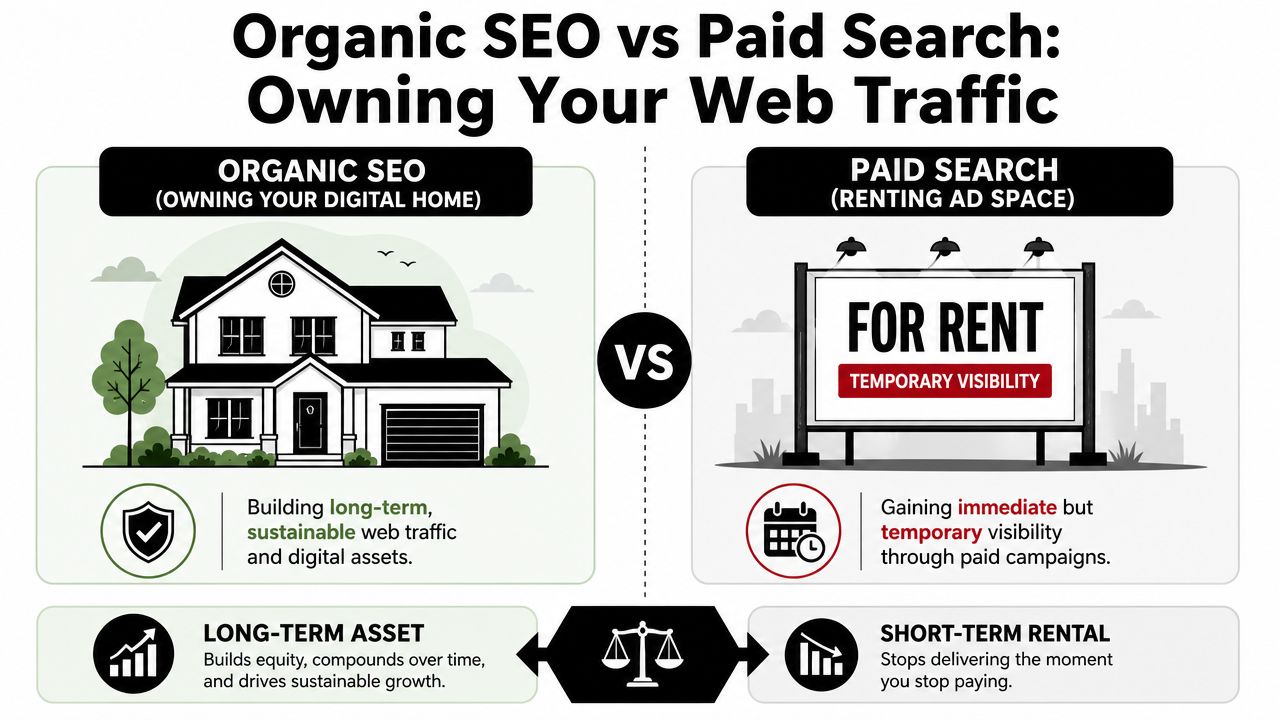
Paid search still has a role. It's useful when you need immediate visibility, want to test offers fast, or need leads while your organic footprint is still small. But it has a built-in weakness. Every click has a cost. Organic SEO works differently. You invest in assets such as pages, articles, category pages, service pages, internal links, and site improvements that can keep producing long after publication.
Practical rule: If paid search is your only acquisition engine, your growth is rented. If organic SEO is working too, your business owns part of its demand capture.
Organic SEO vs Paid Search at a Glance
| Attribute | Organic SEO | Paid Search (PPC) |
|---|---|---|
| Traffic source | Unpaid search visibility | Paid ad placement |
| Speed | Slower to build | Immediate |
| Cost structure | Upfront investment in content, technical setup, and authority | Ongoing spend for every campaign and click |
| Durability | Can keep driving traffic after publication | Stops when budget stops |
| Best use | Long-term demand capture | Fast testing and short-term lead flow |
| Core risk | Inconsistent execution | Rising dependence on spend |
A smart business usually uses both. But if you have to choose your foundation, choose the one that compounds.
The Four Pillars of a Modern Organic SEO Strategy
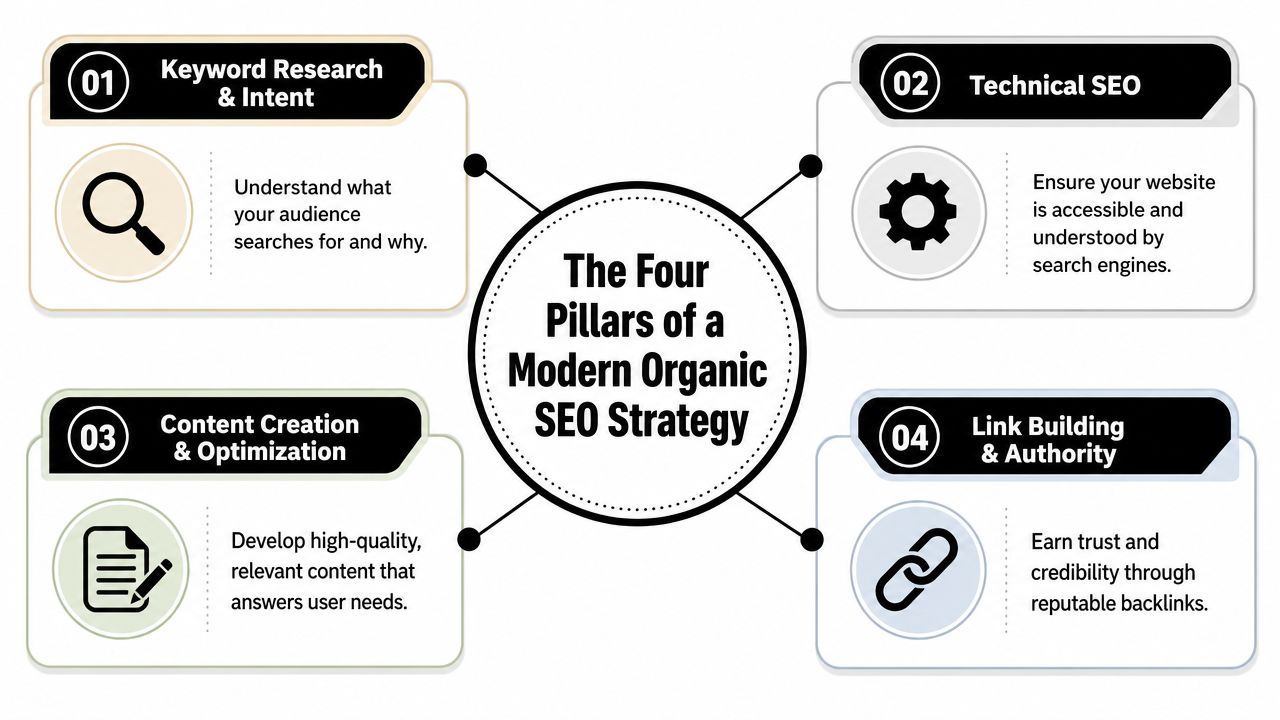
Organic SEO looks complicated when people present it as a pile of unrelated tasks. It gets clearer when you treat it like a four-part operating system. Each part supports the others. If one pillar is missing, performance usually stalls.
Intent comes first
The first pillar is keyword intent research. Owners often find this area confusing. A keyword isn't just a phrase with search volume. It's a clue about what the buyer wants right now.
Someone searching “best CRM for plumbers” is in a different mental state than someone searching “what is CRM.” One query suggests evaluation. The other suggests education. If you map the wrong page to the wrong intent, you can attract visitors and still miss revenue.
The second pillar is content quality and on-page optimization. Once you know the intent, you build the page that deserves to rank. That means using the core topic naturally in titles and headings, answering the main question early, and structuring the page so both readers and search engines can follow it.
The third pillar is technical SEO. This is the plumbing behind the walls. Search engines need to crawl your site, understand it, and trust it. That's why details like XML sitemaps, robots.txt, HTTPS, and structured data matter. Semrush's overview of organic SEO explains these as core elements of how pages become discoverable and eligible for enhanced search results.
Authority needs proof
The fourth pillar is link authority. Backlinks are still one of the strongest ways the web signals trust. But the modern version of SEO isn't about collecting links like baseball cards. Relevance and quality matter more than raw volume.
A useful analogy is commercial real estate. If five respected businesses in town recommend your firm, that carries weight. If fifty random strangers do, it means far less. Search engines think in a similar way. Relevant sites linking to your best pages help validate that your brand belongs in the conversation.
Technical quality also affects what your content can achieve. DigiTech India's KPI guide for organic SEO notes that Time to First Byte between 200 and 500 ms is a practical benchmark, with lower being better. That matters because slow server response can delay rendering and crawling, and it can frustrate users before your message even loads.
Here's the blueprint in plain terms:
- Intent research finds the right demand.
- Content answers that demand better than competitors.
- Technical SEO makes the answer accessible and trustworthy.
- Links strengthen authority so search engines take your pages seriously.
Strong SEO usually fails for boring reasons. The site targets the wrong searches, publishes thin content, loads slowly, or never earns trust from the rest of the web.
When founders understand those four pieces, SEO stops feeling mystical. It becomes operational.
How to Measure SEO Success for Your Business
The biggest measurement mistake is focusing on rankings as if they're the goal. They're not. Rankings are a means to an outcome.
The outcome is qualified traffic that turns into leads, booked calls, quote requests, purchases, demo signups, or repeat customers. If a page ranks and doesn't help the business, it's not a win. It's just visible.

Watch business signals, not vanity signals
A useful SEO dashboard for an owner is small. It doesn't need to track everything. It needs to show whether search is producing commercially relevant movement.
Focus on signals like these:
- Organic traffic to revenue-driving pages. Look at service pages, category pages, product pages, and high-intent articles. Home page traffic alone won't tell you much.
- Visibility for buyer-intent terms. Not every keyword matters equally. “Emergency dentist near me” matters more than a broad educational query if you run a dental clinic.
- Goal completions from organic visitors. Track form fills, phone calls, booked appointments, purchases, and demo requests.
- Page quality indicators. If users bounce because a page is slow, vague, or off-target, SEO work upstream won't carry through to revenue.
A simple owner dashboard
If I were advising a founder, I'd ask for one monthly sheet with only three questions:
| Question | What to review | Why it matters |
|---|---|---|
| Are more qualified people arriving? | Organic visits to commercial pages | Measures traffic quality |
| Are they taking action? | Leads, sales, bookings, or signups from organic search | Connects SEO to business output |
| Are our best pages improving? | Movement on priority pages and terms | Shows whether execution is working |
This keeps the conversation grounded. It also protects you from bad SEO reporting. Many businesses get dazzled by long ranking reports while the actual pipeline stays flat.
If your SEO report can't show which pages attracted qualified visitors and what those visitors did next, it's a report about activity, not impact.
That's the standard to hold any agency, freelancer, in-house marketer, or tool against.
Three Costly SEO Mistakes Business Owners Make
SEO problems usually don't start with Google. They start with business decisions.
Mistake one chasing traffic that won't buy
You might be doing this if your team celebrates pageviews but can't tie those visits to inquiries or sales.
This happens when companies target broad informational keywords because they look appealing on paper. The site gets visitors, but most of them were never close to buying. A law firm doesn't need every person searching legal definitions. It needs people looking for legal help in its practice area.
A better question is, “What would someone search ten minutes before contacting us?” That's often where the commercial value sits.
Mistake two treating SEO like a project
You might be doing this if you redesigned the site, published a few pages, and assumed the work was done.
SEO isn't a one-time launch. It behaves more like reputation building. Pages age, competitors publish, links shift, and search results change. Businesses that win in organic search usually keep refining existing pages while adding new ones around core services and themes.
That doesn't mean endless busywork. It means consistent maintenance. Review the pages that matter most, improve weak sections, add internal links, and keep publishing where demand exists.
Mistake three ignoring the site foundation
You might be doing this if the site looks polished but search performance still feels stuck.
A beautiful website can still have weak SEO plumbing. Pages might be hard to crawl. Important content might not be structured clearly. Key pages may load too slowly or lack the signals that help search engines interpret them.
Common issues include:
- Missing crawl guidance. Search engines need clean navigation, working internal links, and supporting files that help them find important pages.
- Weak page structure. If headings are vague and the page buries the answer, users and search engines both struggle.
- Poor page performance. A slow page creates friction before the visitor even evaluates your offer.
Owners often treat these as “technical details.” They're not. They affect whether the market can reliably find and trust your storefront.
Your Actionable SEO Playbook to Get Started Today
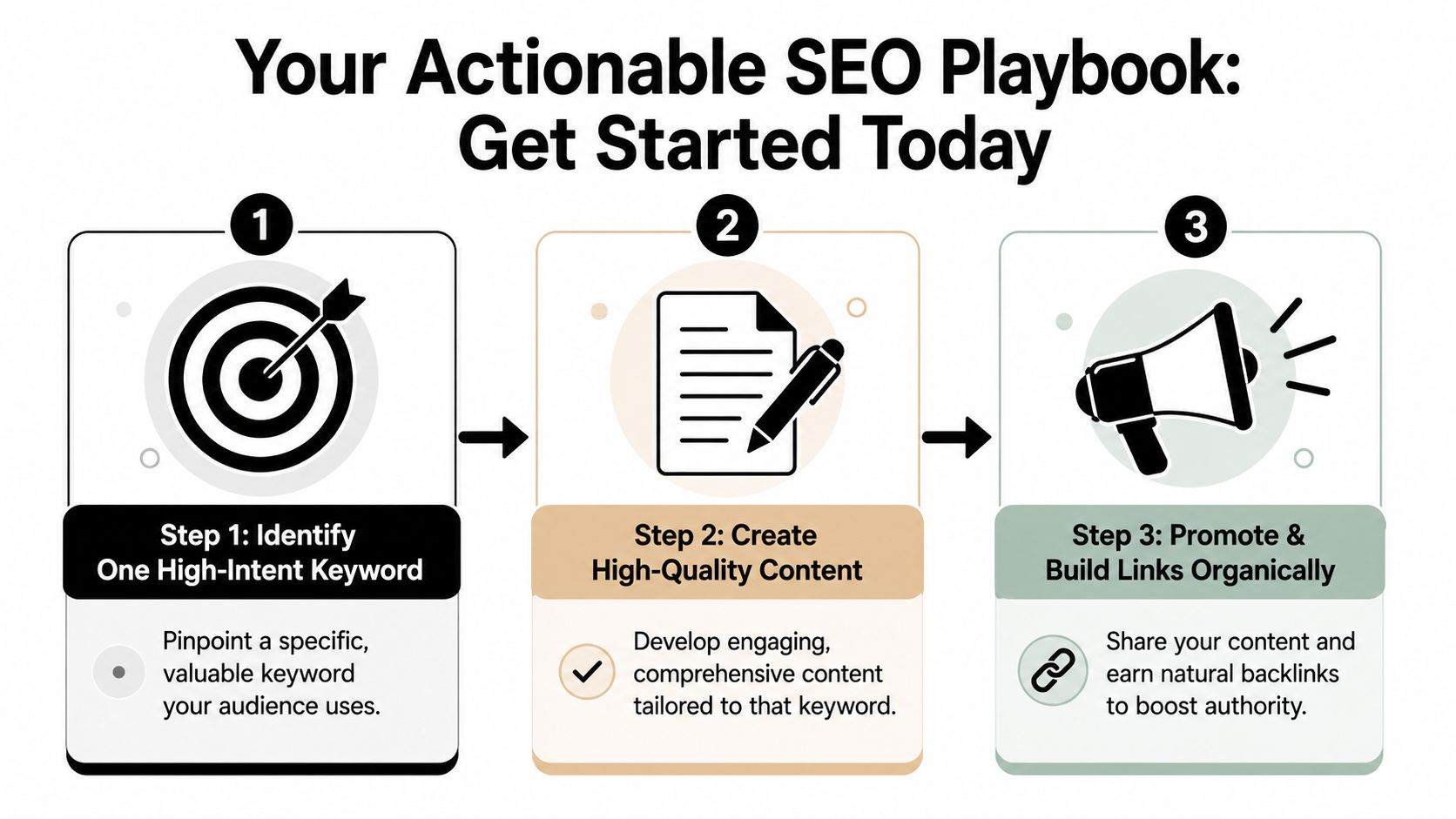
If SEO has felt too big, shrink the scope. Don't start with a giant content calendar or a sitewide audit that never ends. Start with one high-value page and one repeatable loop.
Step one find one money keyword
Choose one keyword a buyer would search right before taking action. For a local roofer, that might be a service-plus-location phrase. For a software company, it might be a comparison or solution query tied to purchase intent. For an ecommerce store, it could be a category-level product search.
The key is intent, not volume. One strong commercial query usually matters more than a pile of vague informational ones.
Step two publish the best answer
Build one page that answers the query better than what's already ranking. That doesn't mean longer for the sake of longer. It means clearer, more useful, more credible, and easier to act on.
This matters even more now because SEO Sherpa's 2025 SEO statistics roundup reports that an estimated 58% to 60% of Google searches are now zero-click. Users often get answers directly on the results page. So “being on page one” isn't enough. Your content needs to be structured well enough to compete for featured snippets, SERP features, and answer-style visibility.
A practical format looks like this:
- Lead with the answer. Don't hide the main point after a long introduction.
- Use clear headings. Break the topic into scannable sections.
- Support with proof. Add examples, specifics, and plain-language explanations.
- Make the next step obvious. Include a clear service CTA, product path, or contact option.
Here's a useful walkthrough before you build your first page:
Step three earn one relevant link
Once the page is live, get it in front of people who already operate in your niche. That could mean partners, suppliers, associations, local organizations, industry publications, or complementary businesses.
One relevant link to the right page often helps more than a scattershot batch of weak mentions. As a result, many founders overcomplicate SEO. You don't need to “do link building” in the abstract. You need to give the web a reason to reference something useful on your site.
A simple starting playbook:
- Pick one page with buying intent
- Improve it until it deserves attention
- Promote it until someone relevant links to it
That loop is small enough to execute and strong enough to compound. Once it works on one page, repeat it across services, categories, and topics that matter to your business.
Your Questions Answered Organic SEO FAQs
Does SEO work differently for local businesses and ecommerce stores
Yes. The principle stays the same, but the implementation changes a lot.
For local businesses, SEO often depends on proximity and trust signals tied to a specific service area. Search Endurance's guide to organic SEO notes that local businesses need Google Business Profile optimization and location-specific signals, while ecommerce sites need to solve faceted navigation and large-scale product page indexing.
For a local service company, strong SEO usually includes:
- Google Business Profile work so the business can appear credibly in local search experiences
- Location pages for the cities or service areas that matter
- Review signals that help reassure both buyers and platforms
- Service pages aligned to what people search in each market
For an ecommerce brand, the issues are different:
- Category page optimization because category pages often capture high-intent product demand
- Product page indexing so important products can be found and evaluated
- Faceted navigation control to avoid messy site structures and diluted crawl paths
- Internal linking that helps search engines understand site hierarchy
A plumber and an online shoe store both need intent match, useful pages, and authority. But the page types, site architecture, and conversion mechanics aren't the same.
How long does SEO take to matter
It usually matters before it fully matures.
Owners often expect SEO to behave like ads. It doesn't. Ads can switch on today. SEO builds momentum as pages get indexed, improved, linked to, and trusted over time. That's why the best way to reduce risk is to start with pages tied closely to revenue, not vanity topics.
If you're judging too early, use leading indicators. Are important pages being indexed? Are they earning impressions for relevant searches? Are better-fit visitors arriving? Are those visitors converting at all? Those are signs the system is taking hold.
Is AI changing organic SEO
Yes, but not in the way many people assume.
AI search experiences make weak, generic content easier to ignore. They also raise the standard for clarity. If your page is vague, bloated, or says nothing original, it's easier for search systems to summarize the topic without sending you traffic.
That pushes SEO toward substance. The winners are the brands that publish useful, well-structured pages that answer real questions clearly and support those answers with expertise, examples, and trust signals.
Write pages that deserve to be referenced, not pages that merely exist to target a phrase.
That's still SEO. It's just better SEO.
If you want a simpler way to execute this without hiring an agency or building a large in-house team, Agency Secrets offers a practical SEO playbook for business owners. It focuses on the fundamentals that move results: buyer-intent keyword research, authoritative content, relevant backlinks, and repeatable execution.