Your practice may deliver excellent care, run on time, and have a loyal patient base. But if a new patient searches for your specialty in your city and finds weak directory listings, an outdated website, or a half-finished Google profile, that quality stays invisible.
That's a key problem with most advice on SEO for medical practices. It treats healthcare like any other local business. It isn't. Medical marketing sits under stricter trust expectations, tighter compliance boundaries, and higher patient anxiety. A law firm visitor might comparison-shop. A patient may be searching while worried, in pain, or trying to make a decision for a family member.
The playbook that works best is patient-first, local-first, and HIPAA-conscious. It focuses less on vanity traffic and more on the moments that lead to calls, direction requests, form fills, and appointment bookings.
Table of Contents
- Your Foundation for Patient Discovery Local SEO
- Building Your Digital Practice A Technical SEO Checklist
- Creating Content That Builds Trust and Attracts Patients
- Establishing Your Authority with Reviews and Backlinks
- Measuring What Matters and Your Implementation Roadmap
Your Foundation for Patient Discovery Local SEO
A common scenario plays out like this. A well-run clinic launches a clean website, adds a few blog posts, and expects search visibility to follow. Patients still book with the practice across town because its Google Business Profile is complete, its reviews answer common concerns, and its location details are consistent everywhere a patient looks.
That is why local SEO comes first for medical practices. Generic SEO advice often starts with publishing content. For a clinic, the first job is simpler and more immediate. Show up clearly when a patient searches nearby, and give them enough confidence to call or book.
Google states that local results are based on relevance, distance, and prominence in its guidance on how local ranking works. Siteimprove also cites BrightLocal's 2024 survey finding that 98% of consumers used the internet to find information about local businesses in the last year, which reinforces why local profile optimization deserves attention early (Siteimprove's healthcare SEO analysis).
Why local visibility comes first
A patient searching for “pediatrician near me” or “urgent care in [city]” is close to a decision. They are not asking for a polished brand story. They want to confirm that you are nearby, open, credible, and easy to contact.
Your Google Business Profile often shapes that decision before the website visit happens. If the profile shows old hours, missing services, weak photos, or conflicting contact information, trust drops before your staff ever has a chance to help.
For healthcare, this matters even more because patients are weighing risk, not just convenience.
Practical rule: Before publishing another article, make sure your practice can win the click and the call from the map result.
How to optimize your Google Business Profile properly
Start with accuracy. Then improve completeness.
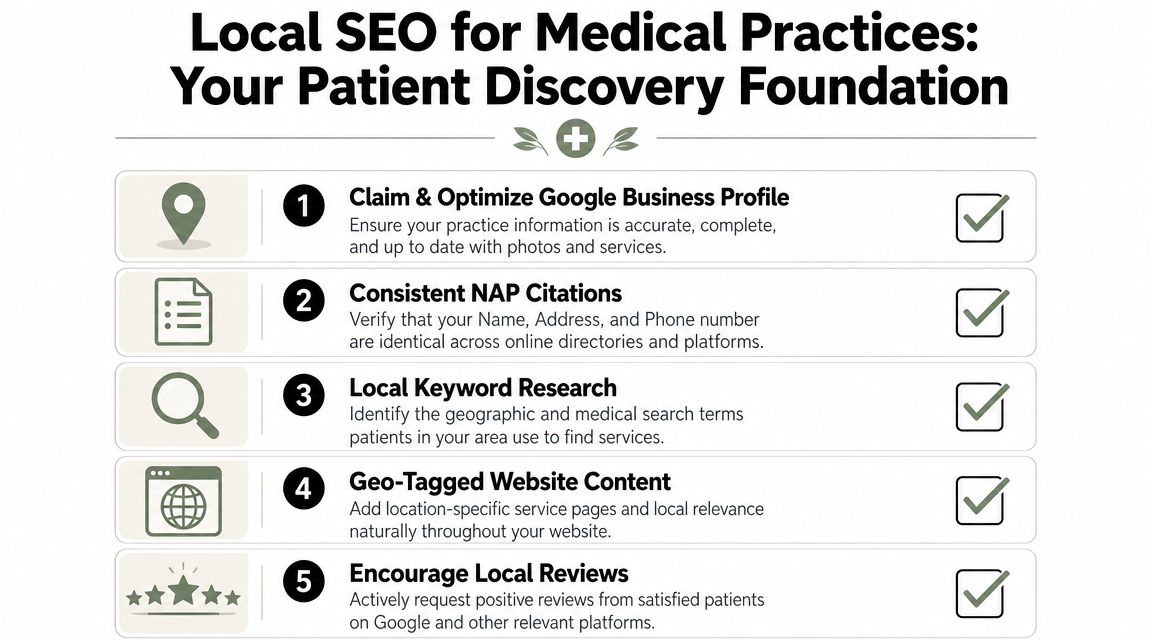
- Choose precise categories: Pick a primary category that matches the core service patients search for. Use secondary categories only for services you offer and can support operationally.
- Complete every core field: Add office hours, phone number, website link, appointment link, services, accessibility details, and a business description.
- Write the description for patients: State what the practice treats, who it serves, and what a first visit looks like. Clear language beats promotional copy.
- Upload credible photos: Include the building exterior, entrance, signage, waiting area, treatment rooms where appropriate, and professional provider photos.
- Use Q&A proactively: Add answers to recurring front-desk questions such as parking, insurance, telehealth, age groups served, and what patients should bring.
- Publish updates through Google Posts: Use them for schedule changes, new providers, seasonal service reminders, and patient education. Skip anything that sounds like empty promotion.
One caution matters here. In healthcare, profile content should inform without creating privacy risk. Do not reference identifiable patient cases, and do not answer public questions in a way that exposes protected health information.
What medical practices usually get wrong
The first mistake is treating local SEO like a setup task instead of an operating habit. Hours change. Clinicians join and leave. Service lines expand. Holiday schedules shift. If those updates do not reach your profile and citations quickly, patients see confusion.
The second mistake is inconsistency across listings. Your name, address, and phone number should match exactly across your website, major directories, and Google Business Profile. Small differences sound harmless. In practice, they create friction for patients and weaken local trust signals.
The third mistake is chasing visibility with tactics that look cheap. Stuffing city names into descriptions, adding categories that do not fit, or posting thin updates for the sake of activity makes a medical practice look less credible, not more credible.
I usually tell new practice clients to judge local SEO by one standard. Does this make it easier for a cautious patient to choose you today?
If the answer is no, fix that first. Traffic can wait. Patient trust and local visibility cannot.
Building Your Digital Practice A Technical SEO Checklist
A patient finds your practice in Google, taps through on a phone between appointments, and tries to answer three questions fast. Do you treat the problem they have, do you take their insurance, and can they book without hassle? If the site loads slowly, hides service details, or breaks on mobile, that visit often ends there.
Technical SEO matters because it protects both visibility and trust. In medical marketing, I treat it as site hygiene with business consequences. A clean setup helps search engines crawl the site, but the main payoff is simpler. Patients can find the right page, confirm the right details, and take action without second-guessing the practice.

Your required technical checklist
Use this checklist to audit the parts of the site that affect discoverability, usability, and patient confidence.
Confirm HTTPS is active across the full site
Every page should load on the secure version, not just the homepage or contact form. Browser security warnings create doubt fast, especially for patients deciding whether to submit forms or call.Test the mobile experience on a real phone
Skip desktop previews alone. Check menus, tap targets, click-to-call buttons, maps, intake forms, provider bio pages, and location pages on an actual device. If staff cannot book a test appointment easily from a phone, patients will struggle too.Give each core service its own indexable page
A multi-specialty or procedure-driven practice needs distinct pages for distinct services. One broad services page usually leaves patients with vague information and gives search engines very little context about what the practice offers.Use schema markup that matches the practice
Add the appropriate local business and medical schema types. If the site includes physicians, locations, FAQs, and accepted insurance information, mark up what is accurate and useful. Do not add markup for content that is thin, misleading, or missing from the visible page.Maintain an XML sitemap and keep it current
This helps search engines find important pages after a redesign, location expansion, provider update, or content refresh. It also reduces the chance that old URLs linger while key service pages go unnoticed.Reduce avoidable page bloat
Large images, stacked plugins, heavy page builders, unnecessary tracking scripts, and redirect chains slow many healthcare sites down. The trade-off is common. Teams want features, chat tools, and design effects, but every extra script competes with speed and usability.Check indexation and duplicate page issues
Important pages should be crawlable and indexable. Thank-you pages, internal search results, duplicate location variations, and thin tag pages usually should not compete in search. This matters more after site migrations or quick website edits made by multiple vendors.Make booking and contact paths easy to complete
Technical SEO is not limited to crawlability. If appointment requests fail, forms send to the wrong inbox, or phone numbers are not clickable, the site is losing patients after the search click. That is a revenue problem, not just a web problem.
What to delegate and what to verify yourself
A physician owner or practice manager does not need to write schema or debug crawl issues personally. That work belongs with a developer or SEO lead. The practice still needs to verify what is published, because technical accuracy means very little if the operational details are wrong.
Use a simple ownership split:
| Item | Best Owner | What to verify |
|---|---|---|
| HTTPS and sitemap | Developer | Site loads securely and key pages are accessible |
| Mobile responsiveness | Practice manager | Booking, contact, and form actions work on a phone |
| Schema markup | Developer or SEO lead | Practice type, location, provider, and service details are accurate |
| Service page structure | Marketing lead | Each service has a clear, patient-friendly page |
| Hours and contact info | Front office manager | Matches actual operations and local listings |
One caution matters in healthcare. Technical changes can create compliance risk if vendors add third-party tools without reviewing how patient data is handled. Appointment forms, chat widgets, call tracking, and analytics setup should be checked with HIPAA in mind before they go live.
Technical SEO supports patient acquisition best when it stays practical. The goal is not a perfect score in a reporting tool. The goal is a fast, accurate, easy-to-use website that helps the right patient book with confidence.
Creating Content That Builds Trust and Attracts Patients
A patient wakes up worried, searches their symptoms on a phone, clicks three practice websites, and leaves two of them within seconds. The practice that keeps their attention is usually the one that answers the immediate question clearly, explains next steps without hype, and makes it easy to book.
That is the standard for content in healthcare SEO. Pages should help a cautious patient decide, “This office understands my concern, respects my time, and looks trustworthy.”
Google has reported that people conduct over 1 billion health-related searches every day, which is why organic visibility matters so much for healthcare providers (Sermo on healthcare search demand). For medical practices, that search volume only matters if the content meets patient intent and supports booking behavior. Traffic without trust does not fill schedules.
Write for patient intent, not for search engines alone
Medical content performs poorly when it is written to satisfy a keyword target instead of a patient question. I see this often with new practice sites. They publish broad pages like “GI Services” or “Family Medicine Treatments” and wonder why rankings stall and calls stay flat. Those pages rarely match what a patient wants to know.
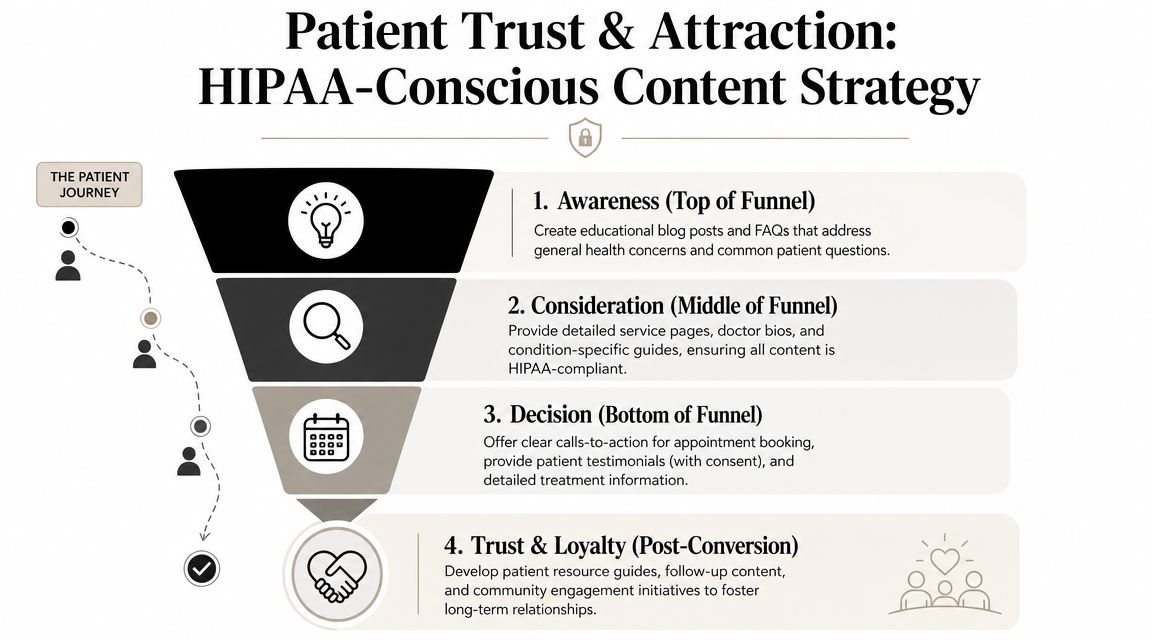
A search like “what to expect during a colonoscopy consultation” calls for a reassurance page. It should explain preparation, what happens in the visit, common questions, and when to call the office. A search like “dermatologist for acne scar treatment in [city]” needs a service page with treatment options, candidacy, downtime, and scheduling details. Different search. Different page.
Use a simple content map:
- Service pages for high-intent searches tied to booking
- Condition pages for patients comparing symptoms and treatment paths
- FAQ pages for practical concerns like insurance, referrals, prep, recovery, and follow-up
- Educational articles for earlier research-stage questions
The trade-off is time. A small practice does not need fifty thin blog posts. It needs a focused library of pages that reflect real patient conversations from the front desk, exam room, and billing desk. The National Library of Medicine has noted that patients frequently turn to online health information before seeking care, which makes clarity and readability a patient trust issue, not just a marketing one (MedlinePlus guide to evaluating online health information).
Two content templates that move patients forward
Service page template
A strong service page helps a patient decide whether to contact the practice now.
Use this structure:
- Who this service is for: Describe symptoms, diagnoses, or patient scenarios in plain language.
- How evaluation and treatment work: Cover consults, testing, treatment options, or procedural steps.
- What patients should expect: Explain timing, preparation, recovery, and follow-up at a practical level.
- Why patients choose this practice: Include relevant experience, approach to care, access, technology, or convenience.
- How to book: Place the phone number, request form, and appointment CTA where it is easy to find.
Local specificity matters here. “Pediatric Asthma Care in [City]” is more useful than a generic page titled “Asthma Services.”
Trust-building educational article template
Educational content should reduce uncertainty and move the patient one step closer to action.
A practical structure:
- The patient question
- A clear explanation in plain language
- Signs that warrant a medical evaluation
- What happens at the first appointment
- A soft invitation to call or schedule
Examples include “What to Expect During Your First Cardiology Visit” or “When Is a Child's Fever Serious Enough to Call a Pediatrician?”
Write the page your front desk wishes every new patient had read before calling.
How to stay useful and HIPAA-conscious
Healthcare content has a narrower margin for error than general local SEO content. The goal is to sound informed and reassuring without drifting into personal medical advice, privacy mistakes, or claims that create legal exposure.
Use these rules:
- Keep examples general: Use patterns you see in practice, not details from a real patient encounter.
- Handle testimonials carefully: Only publish approved testimonials and do not add medical details a patient did not share publicly.
- Show who wrote or reviewed the page: Physician review, clinical editing, and update dates increase trust.
- Review medical accuracy on a schedule: Outdated treatment guidance weakens credibility quickly.
- Avoid fear-based copy: Patients respond better to clarity than pressure.
Good medical content sounds calm, specific, and respectful. It answers the question, sets expectations, and gives the patient a clear next step. That is the playbook. Build fewer pages, make them more useful, and keep patient trust at the center of every draft.
Establishing Your Authority with Reviews and Backlinks
Search visibility for a medical practice isn't only about what you publish on your own website. Google also looks for outside signals that indicate your practice is real, respected, and relevant in your community.
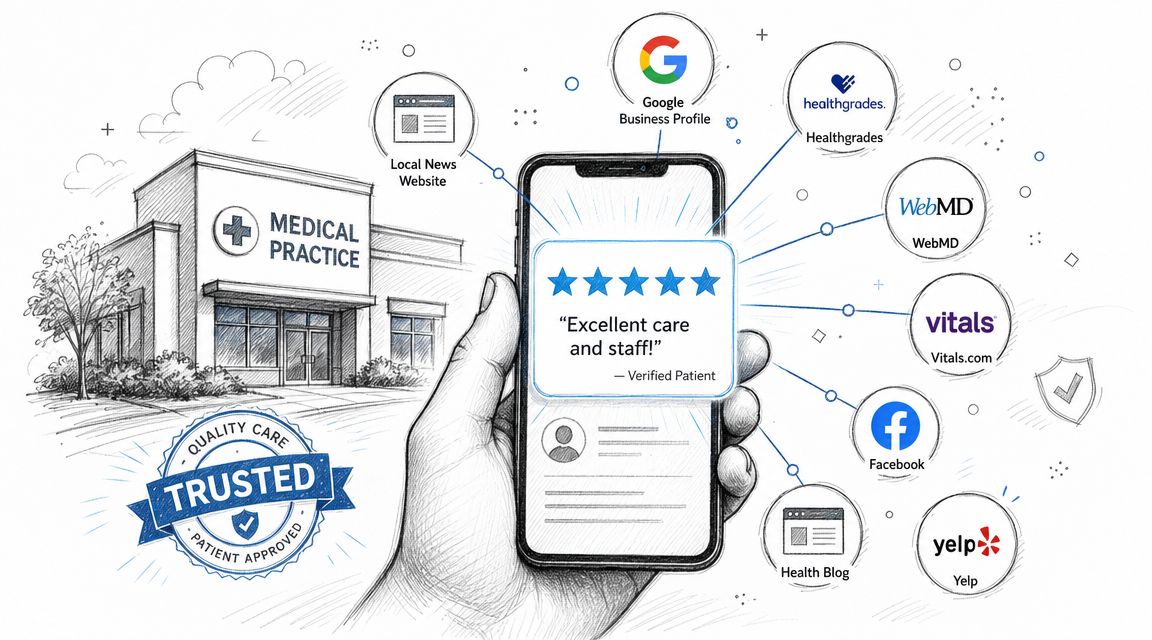
For local healthcare, the authority signals that matter most usually fall into three groups: reviews, citations, and backlinks. They aren't equal. Reviews shape patient trust directly. Citations reinforce local consistency. Backlinks support broader authority, but only when they come from relevant, credible places.
Reviews are trust signals first
A review strategy for healthcare has to be compliant, simple, and consistent. It should never pressure patients or create the impression that positive feedback is expected in exchange for care.
A workable review system looks like this:
- Ask at the right time: After a positive visit or successful resolution, send a follow-up request through your approved workflow.
- Make the path easy: Use a direct review link and clear instructions.
- Train staff on neutral language: Staff can invite feedback, but they shouldn't script patients into praise.
- Respond carefully: Thank reviewers without confirming treatment details or patient identity beyond what they disclosed publicly.
Bad response: “We're glad your knee injection helped and that your pain improved.”
Better response: “Thank you for your feedback. We appreciate you taking the time to share your experience.”
A review reply is public communication, not a private patient conversation.
What a good healthcare backlink strategy looks like
Backlinks still matter, but most medical practices approach them the wrong way. They buy cheap links, submit to irrelevant directories, or hire vendors that chase quantity over fit.
The best backlink profile for a clinic usually grows from legitimate local and professional relationships.
Consider sources like these:
| Backlink source | Why it helps | What makes it worthwhile |
|---|---|---|
| Local chamber or business association | Confirms local presence | Relevant to your city and business identity |
| Hospital or partner organization pages | Reinforces professional relevance | Tied to real affiliations |
| Local news coverage | Builds credibility and awareness | Editorial context, not paid spam |
| Community sponsorship pages | Connects your practice to local activity | Genuine participation |
| Reputable health directories | Supports discoverability | Accurate listing and specialty alignment |
After you've built your basic review workflow and citation consistency, a few focused outreach efforts often outperform a long list of low-value links. Sponsor a community event. Contribute medical expertise to a local publication. Participate in a health fair that lists partners online. These actions help your SEO and your reputation at the same time.
A short walkthrough on local visibility and trust signals can help your team align on execution:
What to avoid
Avoid mass directory blasts, paid link packages, spun guest posts, and anything that looks detached from your actual market or specialty. Those tactics create noise, not authority.
Also avoid turning every reputation request into a marketing campaign. In healthcare, trust compounds when the practice behaves professionally and consistently. Patients can tell when a clinic is managing its reputation with care and when it's gaming the system.
Measuring What Matters and Your Implementation Roadmap
A common failure point looks like this: the physician owner asks why rankings have not improved for a broad term, the office manager is fielding calls from the website, and nobody has a clean view of which pages are producing appointment demand. That is where medical SEO gets misread.
For a practice, the goal is not more traffic in the abstract. The goal is more qualified patient actions without creating compliance headaches. Reporting should show whether local search is producing calls, appointment requests, and visits from patients in your service area. Rankings and traffic help with diagnosis, but they are not the scorecard.
Track actions that reflect patient intent
Start with the actions that connect to revenue and patient acquisition:
- Phone call clicks from the website: Pay close attention to mobile users on service and location pages.
- Appointment request submissions: Include forms, online scheduling tools, and contact workflows.
- Driving direction clicks: This is one of the clearest local intent signals.
- Google Business Profile engagement: Monitor calls, website visits, and map interactions.
- Top landing pages from organic search: This shows which service pages and education pages are attracting demand.
I usually tell medical clients to keep measurement boring and useful. Set up Google Analytics and Search Console correctly. Then confirm that phone clicks, forms, scheduling actions, and location interactions are being tracked in a way your team can review monthly. If a report cannot help you decide what to fix on the site, it is noise.
Use a simple reporting rhythm
A monthly review is enough for many practices. Keep it focused on decisions:
- Which pages brought in qualified organic visits from your target geography?
- Which pages led to calls, form submissions, or booking activity?
- Which service or location pages need clearer conversion paths?
- Which content needs revision because it is outdated, thin, or underperforming?
- Which local trust signals need cleanup, such as reviews, hours, or listing accuracy?
This is also where HIPAA discipline matters. Reporting should measure demand without pulling protected health information into marketing tools or spreadsheets. Many practices create risk here by over-sharing form details internally. Keep the reporting tied to counts, sources, and page-level performance, not patient-specific information.
If reporting does not guide the next action, it is decoration.
Medical Practice SEO Implementation Checklist
| Phase | Task | Why It Matters | Status (Not Started, In Progress, Complete) |
|---|---|---|---|
| Foundation | Claim and verify Google Business Profile | Establishes your core local presence | Not Started |
| Foundation | Audit NAP across website and directories | Prevents trust and consistency issues | Not Started |
| Foundation | Select accurate primary and secondary profile categories | Improves local relevance | Not Started |
| Foundation | Add services, hours, images, and appointment links to profile | Helps patients choose and contact you | Not Started |
| Foundation | Build or refine core location pages | Supports local discovery and conversion | Not Started |
| Technical | Confirm HTTPS across all key pages | Reinforces trust and site security | Not Started |
| Technical | Test mobile usability on real devices | Reduces patient friction | Not Started |
| Technical | Add LocalBusiness and MedicalClinic schema | Helps search engines understand the practice | Not Started |
| Technical | Generate and submit XML sitemap | Improves crawlability | Not Started |
| Technical | Improve page speed and reduce unnecessary redirects | Supports usability and crawl efficiency | Not Started |
| Content | Identify patient-intent keywords by service and condition | Aligns content with real search behavior | Not Started |
| Content | Create dedicated service pages for major offerings | Captures high-intent searches | Not Started |
| Content | Publish FAQs and condition guides | Builds trust earlier in the patient journey | Not Started |
| Content | Add internal links to booking, contact, and related pages | Moves visitors toward action | Not Started |
| Content | Review and refresh medical content regularly | Prevents factual drift and weak pages | Not Started |
| Authority | Build a compliant review request process | Strengthens reputation and local trust | Not Started |
| Authority | Train staff on review response guardrails | Reduces HIPAA and messaging risk | Not Started |
| Authority | Clean up directory listings and specialty citations | Reinforces local accuracy | Not Started |
| Authority | Pursue relevant local backlinks and partnerships | Builds credible off-site authority | Not Started |
| Measurement | Set up Google Analytics and Search Console | Enables ongoing performance monitoring | Not Started |
| Measurement | Track calls, forms, and direction clicks | Measures patient-intent outcomes | Not Started |
| Measurement | Review monthly performance and prioritize fixes | Keeps execution focused and consistent | Not Started |
Practices that win in search tend to be disciplined, not flashy. They improve local visibility, make the site easy to use, publish content that answers real patient questions, and review performance often enough to correct weak points before they turn into bigger problems.
If you want a practical way to execute this without hiring a full agency team, Agency Secrets is worth a look. It's built for owners and lean teams who want a clear SEO playbook, stronger content execution, and a more manageable path to organic growth without turning medical marketing into a full-time internal project.