
Most advice on backlinks gives you a number because numbers feel comforting. Get 50 links. Get 100 links. Hit some quota and rankings will follow.
That's not how this works.
If you're asking how many backlinks should a website have, the intent is right. You want a target. You want to know whether your site is weak, average, or competitive. But a universal number is usually the wrong answer, because backlinks only make sense in context. A local plumber, a niche Shopify store, and a finance publisher are playing completely different games.
The better question is this: how many relevant referring domains do the pages already ranking for your target terms have, and what is the gap between them and you? Once you look at it that way, backlink planning stops being guesswork and starts becoming a practical SEO workflow.
Table of Contents
- The Wrong Question With the Right Intent
- Why Quality and Relevance Outrank Quantity
- How to Calculate Your Specific Backlink Target
- Setting Realistic Link Building Timelines and KPIs
- Actionable Tactics for Earning High-Quality Links
- Integrating Backlinks With Content and Topical Authority
The Wrong Question With the Right Intent
“How many backlinks do I need?” sounds precise, but it usually sends people toward the wrong plan.
The intent behind the question is valid. A business owner wants to know what it will take to compete, how long it may take, and whether the budget makes sense. Those are the right concerns. The problem is that a universal backlink number does not answer them.
Earlier benchmark data makes one point clear. A huge share of pages never attract links at all. That matters because many business owners assume they need a giant link profile before they can rank for anything. In practice, the useful question is narrower and more commercial: how many relevant referring domains does this page need to compete against the pages already ranking?
That shift changes the work.
Why the old question keeps misleading people
A blanket number hides the only context that matters. Search results vary by query, page type, location, and market maturity. A local plumber targeting “water heater repair in Boise” is not playing the same game as a national SaaS company targeting “CRM software.”
I see the same mistake over and over. Owners compare their site to a household-name brand, conclude they are hopelessly behind, then either give up or buy cheap links in bulk. Both choices come from starting with the wrong benchmark.
A better approach is to treat backlinks like a competitive gap, not a quota.
Practical rule: Stop asking for a universal number. Calculate the gap between your target page and the pages already winning the search results.
What business owners usually get wrong
The patterns are consistent:
- They measure raw backlink totals instead of comparing page-level competitors. That inflates the target and leads to bad decisions.
- They look at site-wide numbers when the ranking battle is usually happening on one URL. A strong domain helps, but the page still has to compete.
- They copy the strongest outlier in the results. One dominant competitor can distort the picture and make the target look larger than it needs to be.
- They buy links before checking whether content, intent match, and on-page SEO are already holding the page back. More links do not fix the wrong page.
The straight answer is simple: a website should have enough relevant authority to close the gap with its real search competitors.
Sometimes that number is lower than expected. Sometimes it is much higher. Either way, the right target comes from comparison, not folklore.
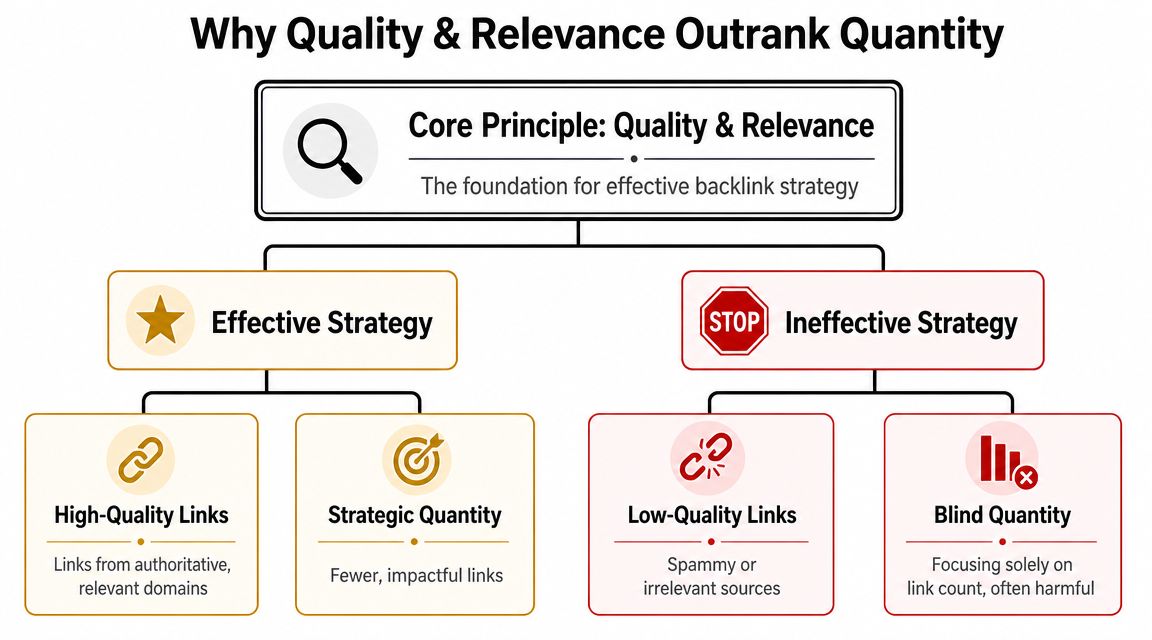
Why Quality and Relevance Outrank Quantity
Backlink counts are easy to obsess over because they give you a clean number. Rankings do not work that cleanly.
Google weighs links by who is linking, why they are linking, and how closely that source fits the topic of the page. A single mention from a trusted industry site can move the needle more than dozens of low-value links built on irrelevant pages. I have seen small sites outrank larger competitors with fewer links because their referring domains were more relevant and better placed.
Count referring domains, not every stray link
For planning and comparison, referring domains are usually the cleaner metric than total backlinks.
The reason is simple. One website can link to you once in an article, then again in a sidebar, footer, author bio, and archive page. SEO tools may count all of that, but it is still one source making one broad endorsement. If you are trying to judge whether a page has enough authority to compete, unique relevant sites matter more than inflated link totals.
That is also why bulk link packages look stronger in reports than they do in search results. They pad the count without adding many real signals of trust.
Relevance changes the value of every link
A link should make sense on the page where it appears.
If you run a local accounting firm, a link from a regional business association, chamber of commerce, local paper, or tax resource is usually more useful than a random link from a lifestyle blog with no business audience. If you sell industrial equipment, a mention from a trade publication often beats ten links from general sites that happen to accept guest posts.
This is the trade-off business owners need to understand. Relevant links are harder to earn, slower to get, and often less scalable. They are still the links that tend to hold value over time.
Industry context changes the target
The strength of the market still matters. Some search results are light on authoritative links. Others are crowded with established brands, publishers, and directories that have been earning links for years.
That is why generic advice fails here. A local service business may only need a modest set of good, relevant referring domains to become competitive on its core pages. A national finance, legal, or software term can require far more authority, and links alone may not close that gap if the competing sites also have stronger content and broader topical depth.
Here is the practical read:
| Market type | What backlink reality usually looks like |
|---|---|
| Local or niche business | A smaller number of relevant local or industry links can be enough if the SERP is not dominated by major brands. |
| Mid-competition commercial topic | You usually need steady growth in page-level referring domains from credible, related sites. |
| Aggressive national category | Strong links are required, but they only work when paired with better content, stronger internal linking, and broader authority on the topic. |
What quality looks like
High-quality links usually share a few traits:
- Topical fit: The linking page serves an audience that overlaps with yours.
- Editorial placement: The link is placed inside real content because it supports the point being made.
- Page-level relevance: The specific page linking to you is related to the topic, not just the domain in general.
- Traffic potential: A real visitor could click the link and find your page useful.
- Credibility: The site is maintained, readable, and selective about what it publishes.
Low-value links follow a different pattern. They come from thin sites built to sell placements, junk directories, irrelevant guest posts, sitewide footers, profile pages, and pages with no real audience. They can increase the number in a tool without improving your position in search.
The useful question is not how many backlinks a website has in total. The useful question is whether your target page has enough relevant referring domains to compete with the pages already ranking. That is the standard that matters.
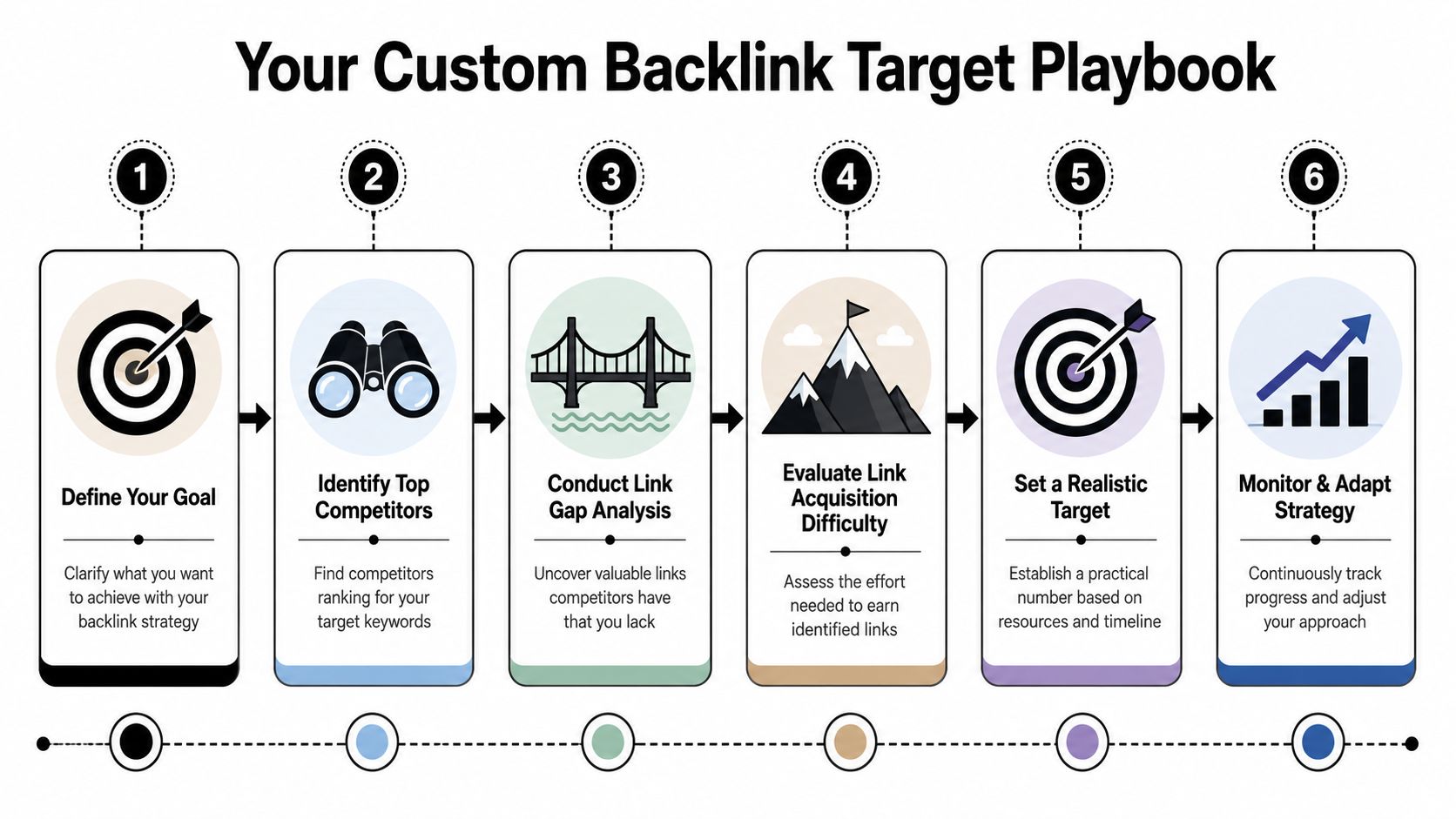
How to Calculate Your Specific Backlink Target
There is no useful universal backlink number. The practical answer is page-specific and SERP-specific.
The right target comes from link gap analysis. Compare your page to the pages already ranking for the query you want, then calculate the gap in relevant page-level referring domains. That gives you a working target based on the market in front of you, not a quota pulled from a blog post.
Start with the page, not the whole site
As noted earlier, OutRank recommends treating backlink planning as a link gap exercise. The useful comparison is between your target page and the pages already winning the same search intent, with page-level referring domains as the main planning metric.
That approach works because Google ranks pages, not abstract domain totals.
Here's the workflow I use:
- Pick one target page. Choose a service page, category page, or article with clear search intent.
- Choose one keyword cluster. Group the closely related terms that page should rank for.
- Pull the live SERP. Use Ahrefs, Semrush, Moz, or a rank tracker that lets you inspect the pages ranking.
- Filter out bad comparisons. Ignore pages that rank for reasons you cannot realistically match, such as giant marketplaces, government sites, or major publishers with overpowering brand demand.
- Record page-level referring domains for relevant competitors. Focus on the pages competing on the same intent, not the entire domain profile.
A local service page targeting “emergency dentist in Austin” should be benchmarked against other local intent pages. A national health publisher in the results may be interesting, but it usually should not define your target.
Here's a quick explanation of the mindset in video form:
Use the median, not the loudest competitor
Business owners often make the same mistake here. They look at the strongest ranking page, see a huge link profile, and assume they need to match it link for link.
That usually leads to bad budgeting and worse decisions.
Use the middle of the competitive set. Look closely at the pages ranking in the range you want to reach, especially the ones just above you. Record their page-level referring domains, then find the median. That gives you a realistic benchmark instead of a fear-based one.
A few judgment calls matter:
- Check intent match first. If a page ranks because it answers a slightly different query type, do not use it as a benchmark.
- Review link quality manually. If a page is propped up by irrelevant placements or obvious spam, do not treat those links as a model.
- Watch for authority inflation. Some URLs rank because the domain is unusually strong. Your page may need better content support or stronger internal linking before more links make a difference.
If the pages above you win on content depth, trust, and intent match, adding links to a weak page will not fix the ranking problem.
Turn the gap into a working target
Once you have the benchmark, convert it into a test plan.
If your page sits meaningfully below the median for relevant referring domains, that difference is your initial gap. Do not turn that gap into a rigid promise like “we need 50 links.” Use it to set a first-round target you can test, then reassess after the page responds.
That is the part many link building conversations miss. The goal is not to hit a round number. The goal is to close enough of the gap to see whether links are the limiting factor.
A practical model looks like this:
| Step | What to do |
|---|---|
| Baseline | Measure your page's current referring domains. |
| Benchmark | Compare against ranking pages that match your search intent. |
| Gap | Estimate how many relevant domains separate you from the median or better. |
| Test batch | Build a small round of strong links first. |
| Recheck | Watch rankings, impressions, clicks, and competitor movement before expanding. |
In practice, I prefer a measured first batch over an oversized campaign. Some pages move once the link gap narrows. Others stay flat because the underlying problem is weak content, poor internal linking, or a mismatch between the page and the query.
That is how to answer the backlink question without guessing. Calculate the number page by page, based on the competitors that matter, then adjust after you see how the page responds.
SEO tools can speed up the research, but they do not replace judgment. The method stays the same whether you use a spreadsheet or a premium platform. You are not chasing a vanity number. You are measuring the gap between your page and the pages already taking the traffic.
Setting Realistic Link Building Timelines and KPIs
Backlink building is rarely a quick fix. It behaves more like sales outreach or reputation building than a switch you flip.
That's why impatient campaigns so often go sideways. A business owner disappears for months, panics when rankings stall, buys a burst of questionable links, then wonders why nothing meaningful improved. The problem isn't just the links. It's the stop-start behavior.

Avoid feast or famine link building
The safest pattern is usually steady, intentional acquisition tied to content worth promoting.
For a small business, that often means setting a pace your team can sustain with quality. I'm not going to invent a universal monthly quota, because the right pace depends on your niche, budget, outreach ability, and how much content support you already have. What matters is consistency. A slow stream of relevant links built around real pages usually beats occasional bursts built around desperation.
A few practical rules help:
- Match effort to opportunity. Don't try to build links to thin pages, expired offers, or weak location pages.
- Keep campaigns narrow. One strong service page and one strong guide are easier to support than ten average assets.
- Expect uneven movement. Rankings may sit still, then shift once the page clears a trust threshold.
- Treat outreach as pipeline work. Some links land quickly. Others take follow-up or arrive much later.
Track outcomes, not just link totals
The wrong KPI is “we got links.” That's activity, not business impact.
Track the page the links point to and watch what changes around it:
| KPI | Why it matters |
|---|---|
| Target keyword movement | Tells you whether the page is becoming more competitive for the terms that matter. |
| Organic traffic to the target page | Shows whether visibility is turning into visits. |
| Referral traffic from earned links | Confirms whether those placements have audience value, not just SEO value. |
| Lead or sale quality from the page | Keeps the campaign tied to business outcomes. |
Good link building should improve more than a dashboard metric. It should strengthen a page that has a real job on your site.
The businesses that get the best results usually do one thing well. They stop treating backlinks as a separate trick and start treating them as support for revenue-driving pages.
Actionable Tactics for Earning High-Quality Links
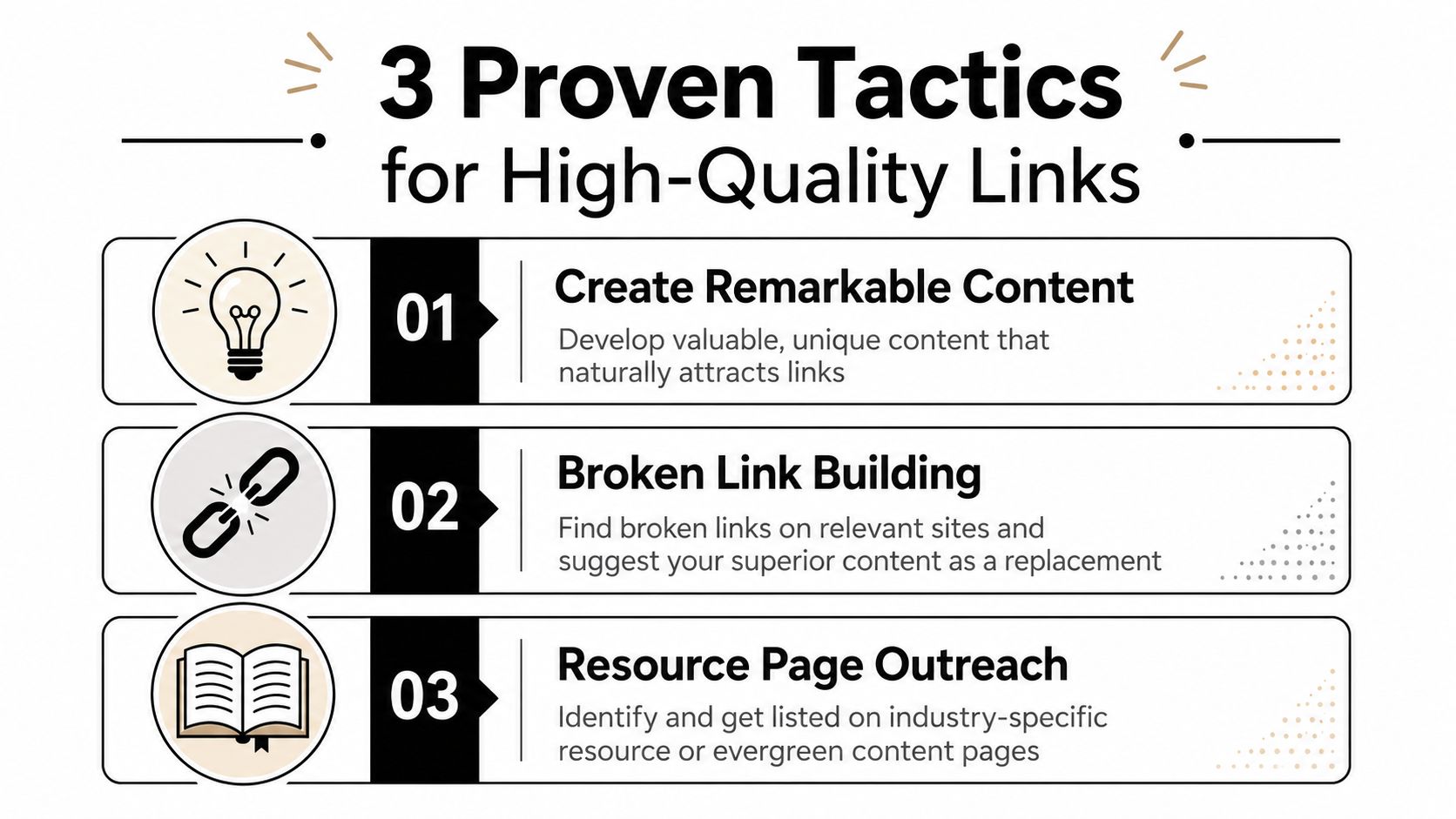
Most small businesses don't need twenty link building tactics. They need a few that are realistic, repeatable, and aligned with the assets they can produce.
The best tactics aren't the ones that sound clever in an SEO forum. They're the ones you can run consistently without torching your brand or wasting a month on junk placements.
Guest posting that actually helps
Guest posting still works when you treat it as audience access, not a link vending machine.
A good guest post target has a real readership, a clear editorial standard, and overlap with the people you want to reach. If you sell bookkeeping services for freelancers, a freelancer publication or small business operations blog makes sense. A random lifestyle blog that accepts anything does not.
A solid process looks like this:
- Choose relevance first. Ignore flashy authority metrics if the audience fit is poor.
- Pitch topics the host would publish anyway. Editors want useful articles, not disguised link inserts.
- Link naturally to a supporting asset. A detailed guide, original framework, or useful resource works better than a hard sales page.
- Keep the relationship alive. One strong publishing relationship can produce multiple opportunities over time.
Digital PR for small businesses
You don't need a huge brand to do digital PR. You need something cite-worthy.
That could be a local trend roundup, an expert commentary angle, a practical industry guide, or a page built around a question journalists and bloggers already ask. The key is giving publishers a reason to reference you that goes beyond “please link to my website.”
Here's what tends to work better than generic outreach:
- Local expertise: Service businesses often have useful seasonal or regional insight.
- Operator experience: Founders can comment on process, customer behavior, or common mistakes.
- Original packaging: Even without proprietary data, a well-organized resource can earn citations if it's more useful than what already exists.
Publish something another site would feel comfortable citing in its own content. That's the threshold.
Resource page outreach
Resource page links are underrated because they're not flashy.
They work best when you already have a useful asset. Think checklists, glossaries, beginner guides, local guides, tools, or evergreen explainers. Then find websites that maintain “helpful resources,” “recommended tools,” or “further reading” pages in your niche.
The outreach is simple when the fit is real. Brief note, clear reason, direct URL, no fluff.
A few things make this easier:
- Build the right asset first. Outreach can't rescue a weak page.
- Qualify pages manually. If the resource page is abandoned or stuffed with junk, move on.
- Explain the match clearly. Tell them why your page helps their readers specifically.
- Update your own asset. Resource-worthy pages need maintenance.
If I were advising a small business with limited time, I'd start with one linkable guide, a short guest posting list, and a focused batch of resource page outreach. That's often enough to build momentum without turning link building into a full-time job.
Integrating Backlinks With Content and Topical Authority
Backlinks are powerful, but they don't perform miracles.
If the target page is thin, vague, outdated, or mismatched to search intent, better links may lift it a little but won't fix the core issue. Strong rankings usually come from a combination of useful content, clear topical alignment, sound internal linking, and a backlink profile that reinforces the page's credibility.
Links amplify quality
The best page to build links to is rarely your homepage by default. It's the page that deserves to rank and can convert the attention.
That usually means a page with clear intent match, original value, and enough depth to satisfy the search. A service page should answer buyer questions plainly. A guide should teach. A category page should help people compare and choose. When those basics are in place, backlinks act like an amplifier.
A simple content cluster helps too. If you want one main page to rank, surround it with related supporting content that addresses adjacent questions and subtopics. That gives search engines a stronger topical map of your site.
Internal links make earned authority travel
A backlink points to one URL. Internal links help distribute that value through the rest of the site.
That's why smart site architecture matters. If your strongest guide has earned links but sits isolated from your money pages, you're wasting part of the benefit. Link from authority pages into relevant service pages, supporting guides, comparison pages, and key conversion paths where it makes sense for readers.
Here's the bigger picture:
- Build content people can cite. No link strategy saves forgettable pages.
- Earn links to pages with strategic value. Not every page deserves promotion.
- Use internal links intentionally. Help authority flow to related pages.
- Stay within your topic lane. Topical consistency makes every earned link work harder.
If you've been asking how many backlinks should a website have, the honest answer is still “it depends.” But now you have the version that's useful. Calculate the gap, build the right links, support the right pages, and judge success by rankings and revenue, not by a vanity number.
Agency Secrets helps small business owners turn this kind of SEO work into a repeatable system instead of a guessing game. If you want practical help with keyword targeting, content production, backlink strategy, and competitor analysis without hiring an agency, take a look at Agency Secrets.