Tag: organic growth

  • SaaS SEO Platform: A Guide to Automated Growth in 2026

    SaaS SEO Platform: A Guide to Automated Growth in 2026

    You've probably tried to make SEO work with a patchwork stack. One tool for keywords. Another for writing. A spreadsheet for internal links. A freelancer for blog posts. Maybe an agency that promised strategy but mostly sent reports. Months later, you've got content published, money spent, and no clear sense of what moved rankings or leads.

    That's where a SaaS SEO platform changes the game. Not because software magically ranks pages, but because the right platform turns SEO into a repeatable operating system. It connects research, content, site structure, publishing, links, and tracking into one workflow that a small team can run without chaos.

    The businesses that win with SEO now aren't always the ones with the biggest team. They're the ones with the cleanest system.

    Table of Contents

    Why Traditional SEO Fails Most Businesses

    Most small businesses don't fail at SEO because they're lazy. They fail because the work is fragmented, slow, and easy to do in the wrong order.

    A founder writes blog posts without a keyword map. A marketer publishes service pages but never builds supporting content. An agency delivers a content calendar but ignores technical issues. A writer produces articles that never link to money pages. Everything gets done in isolation, and the results stay isolated too.
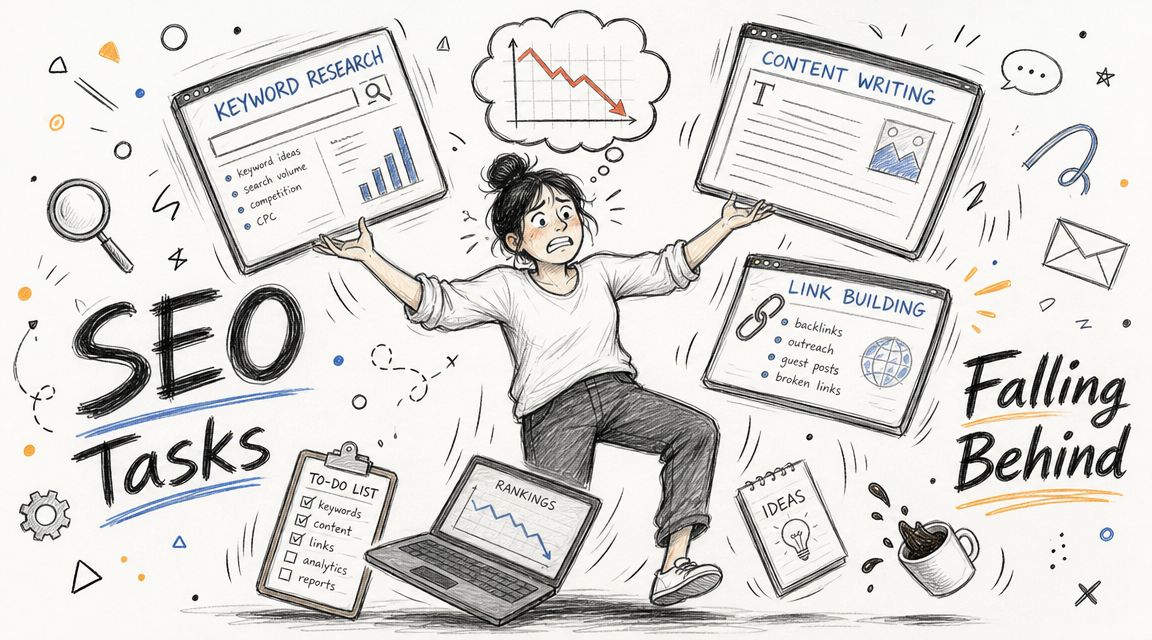
    A stressed woman juggling various SEO tasks like keyword research, content writing, and link building amid rankings decline.

    The market doesn't forgive that kind of inconsistency. An industry summary cited by SmartClick's SaaS SEO statistics estimates the worldwide SaaS market at $466 billion and projects it to reach $793.10 billion by 2029, with 33,200+ SaaS companies globally. That matters because buyers compare, search, and shortlist online long before they talk to sales or submit a form.

    Manual SEO breaks in predictable ways

    A traditional approach usually stalls for one of these reasons:

    • Research stays shallow: Teams target broad topics because they're easy to brainstorm, not because they match buyer intent.
    • Publishing becomes irregular: Content depends on whoever has time that week.
    • Links become an afterthought: The site publishes pages but never builds the authority needed to rank them.
    • No one owns the system: One person handles content, another checks rankings, and nobody sees the full picture.

    Practical rule: If your SEO process depends on memory, Slack messages, and a spreadsheet only one person understands, it won't scale.

    Bigger competitors aren't always smarter

    They're often just more systematic. They've got repeatable briefs, better page templates, cleaner internal linking, and a process for improving pages after publication. Small teams can compete, but not with random acts of content marketing.

    That's why a SaaS SEO platform matters. It reduces coordination overhead. It gives one place to manage demand research, content production, publishing flow, link support, and reporting. Instead of asking, “What should we do next?” every week, you run a workflow that already answers the question.

    What Is a SaaS SEO Platform

    A SaaS SEO platform is software that runs the full SEO workflow inside one system. The easiest way to think about it is this: it's the self-driving car for content-led growth. You still choose the destination, but the platform handles navigation, route corrections, and a lot of the repetitive driving.

    That's very different from buying a keyword tool, an AI writer, and a rank tracker separately.
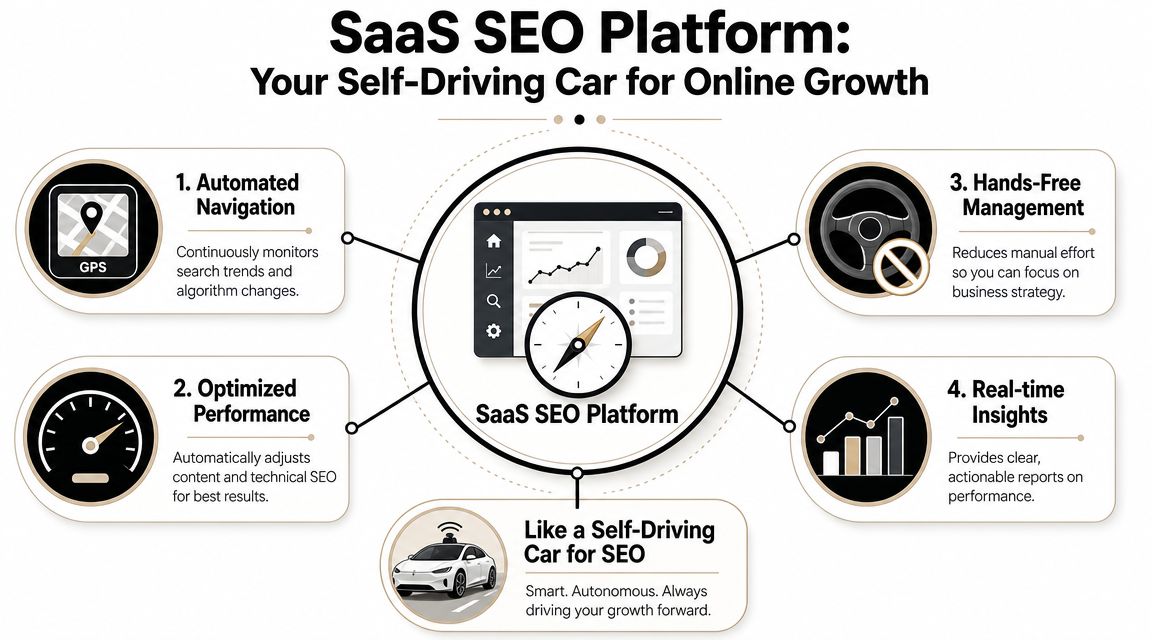
    A diagram comparing a SaaS SEO platform to a self-driving car for automating online business growth.

    Why disconnected tools break momentum

    Point solutions can be useful. Ahrefs can help with research. Surfer can support optimization. Google Search Console is essential for visibility checks. But disconnected tools create handoff problems.

    You research in one place, export to a doc, brief a writer elsewhere, paste content into your CMS, then try to remember which pages should link to what. By the time the article is live, the original strategy is already diluted.

    That's where many businesses lose momentum:

    • The keyword target gets softened during writing.
    • The page structure gets weakened during editing.
    • Internal links get skipped during publishing.
    • Performance review happens too late to fix weak pages quickly.

    A real platform closes those gaps.

    Here's a quick visual on the idea in action:

    What a real platform actually does

    A mature SaaS SEO platform usually combines these functions:

    • Demand discovery: It identifies keyword opportunities, clusters related topics, and helps you prioritize pages by intent.
    • Content operations: It creates briefs, drafts content, applies on-page optimization, and supports direct publishing.
    • Authority support: It tracks backlink needs or integrates link acquisition into the workflow.
    • Measurement: It shows which pages are gaining rankings, which topics are underperforming, and where competitors are pulling ahead.

    The point isn't automation for its own sake. The point is removing the lag between strategy and execution.

    The strongest platforms also don't treat SEO as “blog production.” They act more like an operating layer for growth. That means they help you choose the right pages, publish in the right sequence, and reinforce those pages with links and internal architecture so the work compounds.

    When people buy the wrong tool, they usually buy for output. More articles. Faster drafts. Easier reporting. When they buy the right platform, they're buying a machine that turns SEO into a controlled process.

    The Four Pillars of an Automated SEO Engine

    A platform only works if it supports a complete method. The Agency Secrets approach is practical because it doesn't treat SEO as a pile of tasks. It treats it as a system with four connected pillars.
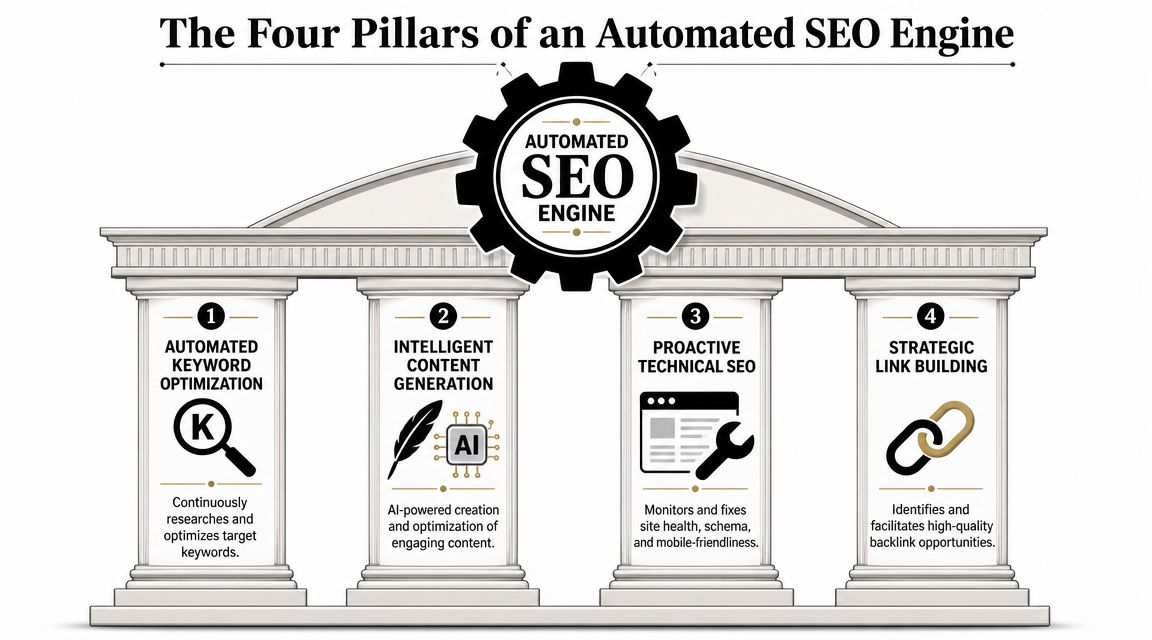
    A graphic depicting four pillars of an automated SEO engine including keyword research, content, technical, and links.

    Pillar one keyword and topic clustering

    The essential need isn't for more keywords; it's for improved organization.

    A good platform groups related queries into clusters so you can build one strong page, then support it with adjacent content instead of publishing five weak pages that cannibalize each other. As a result, strategy stops being abstract. You can see which page is the hub, which articles support it, and how each asset fits the buyer journey.

    This also matters technically. Enterprise SaaS SEO guidance from SERPsculpt on technical SEO for enterprise SaaS emphasizes consolidating fragmented URLs into fewer, stronger pages through a hub-and-spoke architecture to improve crawl efficiency and indexability across large content inventories.

    A platform that automates clustering does more than save research time. It protects your site from becoming bloated and disorganized.

    Pillar two content generation and publishing

    Most automation tools stop too early. They draft content, then leave the rest to you.

    A stronger platform handles the full editorial chain:

    • Brief creation: It frames the topic, angle, headings, and likely supporting entities.
    • Draft production: It generates a first version that can be edited to match your offer and voice.
    • On-page formatting: It structures headings, FAQs, internal links, and metadata.
    • Publishing workflow: It pushes content into WordPress, Webflow, Shopify, or your chosen CMS.

    The key trade-off is speed versus control. Full automation is fast, but it can flatten nuance. Human-only workflows protect voice, but they're slow and expensive. The sweet spot is assisted automation. Let the platform handle structure and repetition, then use editorial review for positioning, examples, and conversion clarity.

    Pillar three backlink acquisition

    Content without authority often just sits there.

    Most businesses underinvest in links because outreach is tedious and agency retainers are expensive. A useful platform either manages backlink acquisition directly or makes link opportunities easier to identify and track. What matters is relevance. A page about pricing software doesn't need random links. It needs contextually sensible links that strengthen the exact topic and page group you want to rank.

    If the platform can publish pages but can't support authority growth, you're only solving half the problem.

    This is also where the workflow matters more than the feature list. Link building should support your most commercially important clusters first, not your least important blog posts.

    Pillar four analytics and competitor tracking

    SEO gets expensive when you can't tell what's working.

    A proper platform should show:

    • Which target pages are moving
    • Which clusters are gaining traction
    • Where rankings are stuck
    • Which competitors own the terms you need
    • What to update next

    The best reporting doesn't drown you in charts. It tells you what action to take. Refresh this page. Add links to that cluster. Expand this comparison page. Consolidate those overlapping URLs.

    That's what makes the platform an engine instead of a dashboard. It doesn't just display performance. It supports the next decision.

    Who Wins with an All-in-One SEO Platform

    Not every business needs the same SEO stack, but certain operators get a huge advantage from an all-in-one system because they can't afford waste.

    The solo founder

    A solo founder usually has the right instincts and no spare time. They know they need pages for problems, features, comparisons, and use cases. What they don't have is the bandwidth to research terms, brief writers, edit drafts, publish consistently, and monitor results every week.

    With a platform, they can turn one afternoon of planning into a repeatable queue. Topics get prioritized. drafts move faster. Internal links aren't forgotten. The founder stays focused on product and sales instead of spending nights patching together SEO tasks.

    The e-commerce operator

    An e-commerce business has a different problem. Product and collection pages often exist, but supporting search demand is scattered across category descriptions, buying guides, and comparison content. Rankings get split across too many thin pages or ignored because the team treats SEO like merchandising copy.

    An all-in-one platform helps by creating structure around product-adjacent content. It supports category hubs, problem-solving pages, and question-based content that feeds revenue pages instead of living in a disconnected blog archive.

    The local service business

    A clinic, contractor, legal practice, or home service company doesn't need a hundred random articles. It needs location pages, service pages, and trust-building content that answers the exact questions buyers ask before calling.

    The wrong setup leads to generic city pages and blog posts nobody reads. The right platform helps the business build a clean footprint around real service intent. That means tighter page targeting, better internal linking between service and location pages, and a publishing cadence that doesn't depend on a busy owner remembering to “do SEO.”

    Small local teams often don't lose because they lack expertise. They lose because they never turn that expertise into searchable pages.

    The in-house generalist

    This is the most common profile in growing SMEs. One marketing manager owns paid, email, web updates, content, and reporting. SEO gets pushed down the list because it takes too many moving parts.

    A platform gives that person leverage. Instead of managing vendors, chasing drafts, and stitching reports together, they can run a centralized workflow. They still need judgment. They don't need more admin.

    The businesses that win here aren't the ones chasing every feature. They're the ones reducing friction enough to execute every week.

    Your Evaluation Checklist for Choosing the Right Platform

    A lot of SEO software demos look convincing because they show output. They show keyword lists, article drafts, colorful graphs, and a publishing button. None of that tells you whether the platform can help you rank pages that matter to revenue.

    The right way to evaluate a SaaS SEO platform is to ask questions that expose workflow quality, not just features.

    Questions that expose weak platforms fast

    Start with content quality. Ask how briefs are built, how search intent is handled, and what controls exist for voice, structure, and internal links. If the answer is mostly about generating volume, that's a warning sign.

    Then ask about technical performance. Google's mobile-first indexing and Core Web Vitals make page experience a critical factor, and SEOmator's SaaS technical SEO guidance says a good platform should ensure efficient delivery with TTFB at or below 800 ms and optimized assets. If a provider can publish content but has no view on asset weight, render-blocking resources, or script bloat, the workflow is incomplete.

    You should also ask how the platform handles these trade-offs:

    • Content scale versus content usefulness
    • Automation versus editorial control
    • Publishing speed versus technical cleanliness
    • Ranking reports versus business reporting

    Good platforms reduce manual work. Weak platforms relocate it.

    SaaS SEO Platform Evaluation Checklist

    Evaluation Area Key Question to Ask Why It Matters
    Content strategy How do you decide which pages to create first? You need buyer-intent prioritization, not random topic generation.
    Brief quality How are headings, entities, and internal links planned? Poor briefs create generic pages that are hard to rank.
    CMS workflow Can content move from draft to publish without copy-paste chaos? Friction slows consistency and creates formatting errors.
    Technical SEO How do you handle site speed, rendering, schema, and indexability? More pages only help if search engines can crawl and process them well.
    Site architecture Can the platform support clusters, hubs, and page consolidation? Authority builds faster when related pages reinforce each other.
    Link support What's the backlink process for priority pages? Ranking competitive terms usually requires authority, not just content.
    Reporting Do reports connect rankings to leads, trials, or sales? Traffic without business context leads to bad decisions.
    Workflow ownership Who is this platform built for day to day? If it assumes a full SEO team, it may fail inside a small business.

    A provider doesn't need perfect answers to every question. But if they can't explain the system clearly, they probably don't have one.

    The Agency Secrets Playbook for Implementation

    Most businesses don't need a bigger SEO plan. They need a sequence they can stick to. That's the core value behind the Agency Secrets method. It turns SEO into a weekly operating rhythm instead of a burst of disconnected projects.
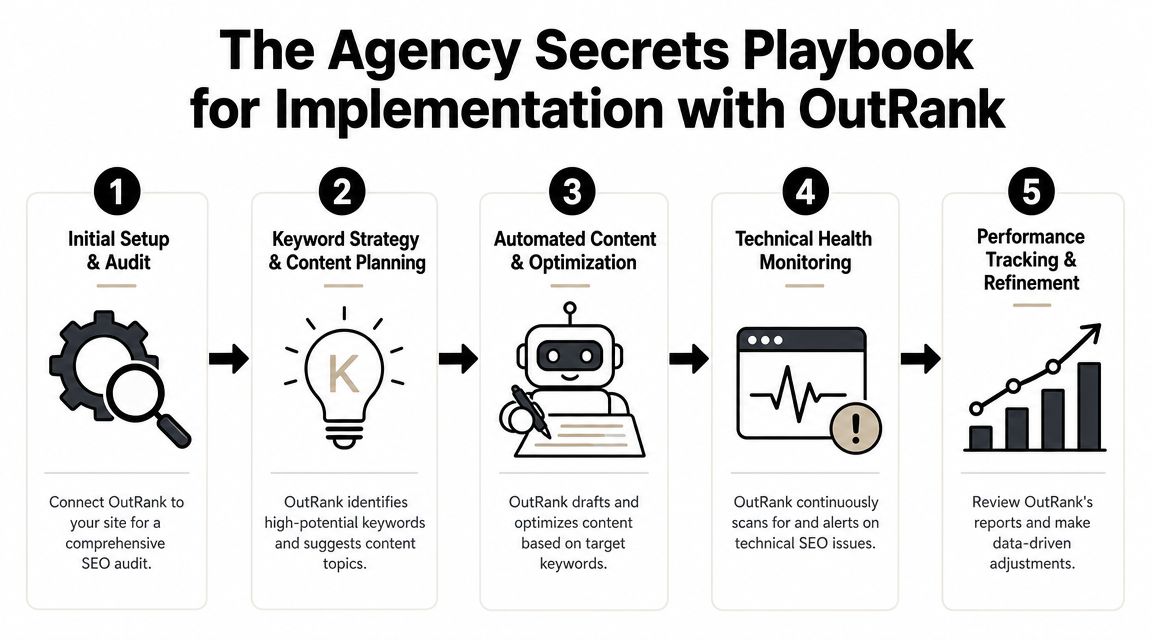
    A five-step workflow diagram illustrating the implementation process for the OutRank SaaS SEO platform.

    Start with revenue pages not vanity traffic

    One of the biggest mistakes in SaaS SEO is overinvesting in broad educational blogs while neglecting comparison pages, problem-specific landing pages, and other commercial assets. RankScience's SaaS guidance specifically notes that many teams neglect comparison pages and problem-specific landing pages that map more directly to buyer intent and conversion.

    That insight changes implementation order.

    Start by listing the pages closest to revenue:

    1. Comparison pages for alternatives and competitor-adjacent searches
    2. Use-case pages tied to specific buyer problems
    3. Feature or solution pages aligned to core product value
    4. Documentation or help content that answers pre-purchase questions
    5. Supporting educational content that feeds authority into those pages

    This is the part many agencies get backward. They build a blog first because it's easier to produce. The smarter move is to build the pages that can convert first, then support them with topic clusters.

    Build the system before you chase scale

    Once the priority pages are defined, run the playbook in order:

    • Map one core cluster: Choose a high-intent topic and define the main page plus supporting articles.
    • Publish with internal links from day one: Don't wait until later to connect the cluster.
    • Set a realistic cadence: Consistency beats bursts. A sustainable publishing rhythm matters more than occasional content sprints.
    • Review winners and laggards monthly: Expand the pages that gain traction. Rework the ones that miss intent.
    • Add links to the pages that matter most: Support commercial pages and their nearest supporting content first.

    A tool like OutRank fits naturally. It's built to automate keyword research, article generation and publishing, backlink support, and competitor analysis inside one workflow, which makes this agency-free system easier for a small team to execute without stitching together separate vendors and tools.

    A practical SEO playbook should tell you what to publish first, what to reinforce next, and what to ignore for now.

    The businesses that get traction don't publish everything. They publish in sequence. That's what makes growth more predictable.

    Measuring Success and Calculating Your ROI

    The simplest way to know whether your platform is working is to watch the metrics in the right order.

    First, track visibility on the pages tied to buyer intent. Then track organic traffic to those pages. After that, measure leads, demos, trials, or sales generated from organic visits. If rankings rise but the wrong pages get traffic, your targeting is off. If traffic rises but conversions don't, your page intent or offer alignment needs work.

    You also need patience with a standard. According to SeoProfy's SaaS marketing statistics, B2B SaaS SEO delivers about 702% ROI, with a break-even period of roughly 7 months. The same source notes that the #1 result in Google gets nearly 27.6% of all clicks. That's why even modest ranking improvements on high-intent terms can have outsized business value.

    Focus on a short scoreboard:

    • Commercial keyword rankings
    • Organic traffic to revenue pages
    • Conversions from organic search
    • Page-level improvement after updates
    • Cost versus revenue contribution over time

    SEO becomes far easier to defend when you measure it like an acquisition channel instead of a publishing program.


    If you want an agency-free system instead of another pile of SEO tasks, Agency Secrets lays out a practical playbook you can run. It's built for owners, operators, and lean marketing teams that want a clear workflow for keywords, content, links, and compounding organic growth without hiring a full agency.
  • Long Form Content: The SMB Guide to SEO Dominance

    Long Form Content: The SMB Guide to SEO Dominance

    Long form content gets an average of 77.2% more links than short articles. That single number should change how most small businesses think about SEO.

    If you're still publishing thin blog posts because they feel easier to produce, you're choosing the hardest path to growth. Bigger competitors already have stronger domains, larger teams, and more brand recognition. You won't beat them by publishing more noise. You beat them by publishing assets that deserve rankings, links, and leads.

    Long form content works because it gives Google and real buyers what short posts usually don't: complete answers, clear structure, strong internal links, and enough depth to signal authority. For a small business, that's not a branding exercise. It's a distribution strategy. One strong long form system can compound for months without paying an agency, funding nonstop ads, or hiring a full editorial team.

    Table of Contents

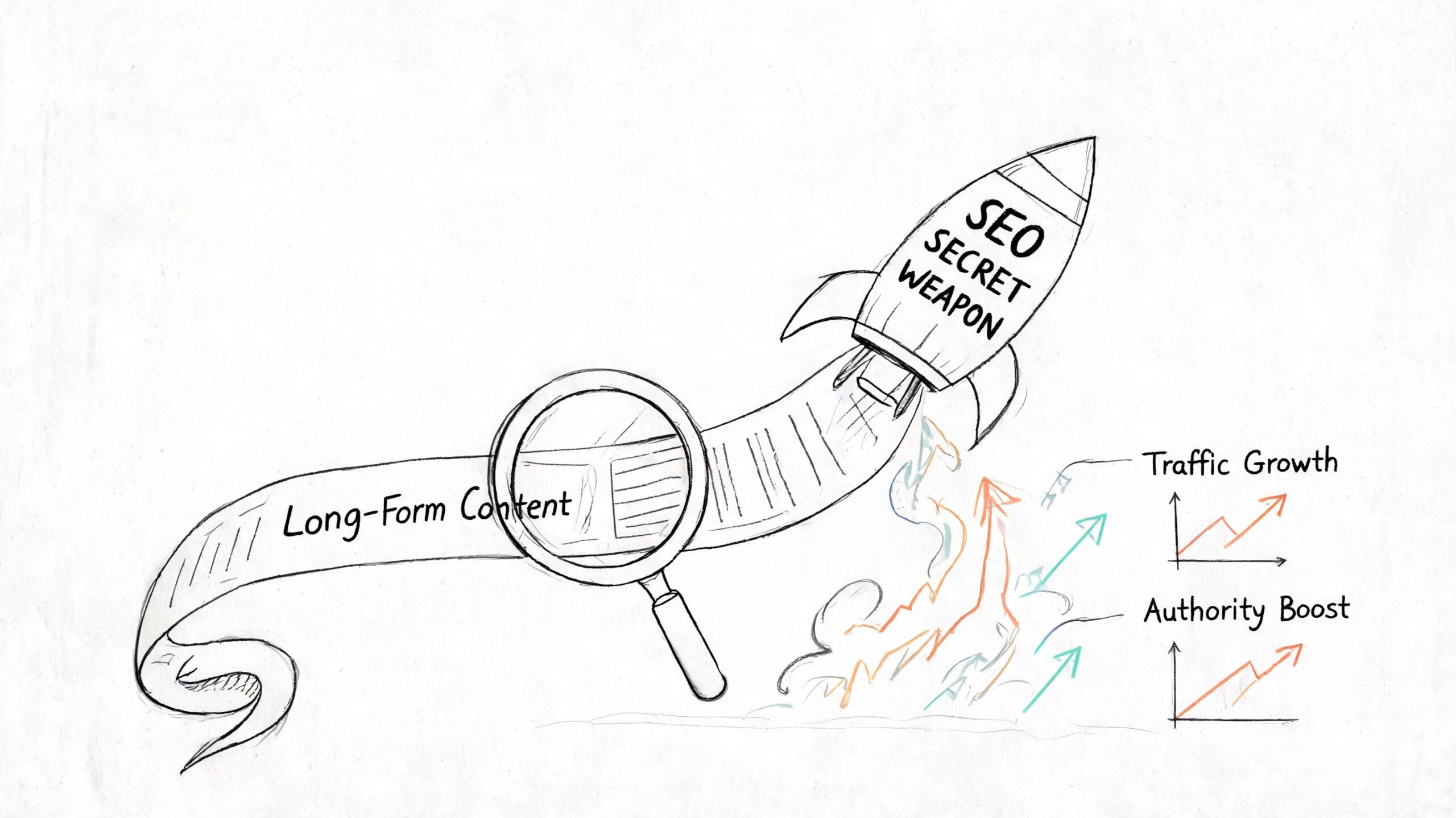
    What Is Long Form Content and Why It’s Your SEO Secret Weapon

    Articles in the top results are often long for a reason. Backlinko’s analysis of Google search results found that the average first-page result contains 1,447 words. That does not mean you should chase a word count target. It means search winners usually cover the topic with enough depth to satisfy the search.

    Long form content is a page built to finish the job. It answers the core question, handles the obvious follow-up questions, addresses objections, and gives the reader a clear next step. For an SMB, that could be a service page, buyer’s guide, comparison post, or pillar article. The format matters less than the outcome. The page should reduce uncertainty and move a prospect closer to action.

    A hand-drawn illustration showing a rocket labeled SEO Secret Weapon launching from long-form content.

    That is why long form content works so well for SEO. Google rewards pages that solve the search, not pages that hit a cute word count. Readers reward pages that save them another 10 tabs.

    Short posts usually miss on both fronts.

    Why short posts keep losing

    A 600-word post can work for a narrow query. It fails for anything tied to evaluation, comparison, pricing, implementation, or trust. Those searches need substance. If your page only scratches the surface, readers bounce and keep looking.

    Short posts also create an efficiency problem for small teams. You publish more often, but each post has less ranking range, fewer internal link opportunities, and less chance of becoming the page people reference, bookmark, or share. You stay busy without building an asset base.

    Here’s the practical filter:

    • Use short content for updates, announcements, single-answer FAQs, and support docs.
    • Use long form content for topics that influence revenue, require trust, or involve multiple decision points.
    • Prioritize depth anywhere a prospect is comparing options, costs, timelines, risks, or providers.

    If a topic can help someone choose whether to buy, hire, book, or request a quote, give it a serious page.

    Why this matters more for SMBs than big brands

    Big companies can afford wasted content. Small businesses cannot. You need every article to do more than fill a calendar slot. It should rank, support sales, answer repeated customer questions, and create material you can reuse in email, social, and sales conversations.

    That is the genuine advantage of long form content for SMBs. One strong article can become a working asset. Ten strong articles built from the same system can become a lead engine.

    Smaller teams can beat bigger competitors through this approach. You are closer to customer pain points. You hear the same objections on calls. You know what buyers ask before they commit. Put that knowledge into structured long form pages and you can publish content that is sharper than the bland, committee-written pieces larger brands push out.

    The win does not come from writing one heroic 3,000-word article. It comes from building a repeatable system to produce useful long form content every month. That is exactly why tools like OutRank matter for resource-strapped teams. They help you research faster, organize content around real search demand, and keep publishing without hiring an agency or stalling out after three posts.

    Long form content is not a writing style. It is a production model for turning what your business already knows into search traffic, trust, and qualified leads.

    Building Your Strategic Foundation with Topic Clusters

    If you publish random long articles, you'll get random results. You need a structure that tells Google what your site is about and helps readers move from one question to the next.

    That structure is the topic cluster.

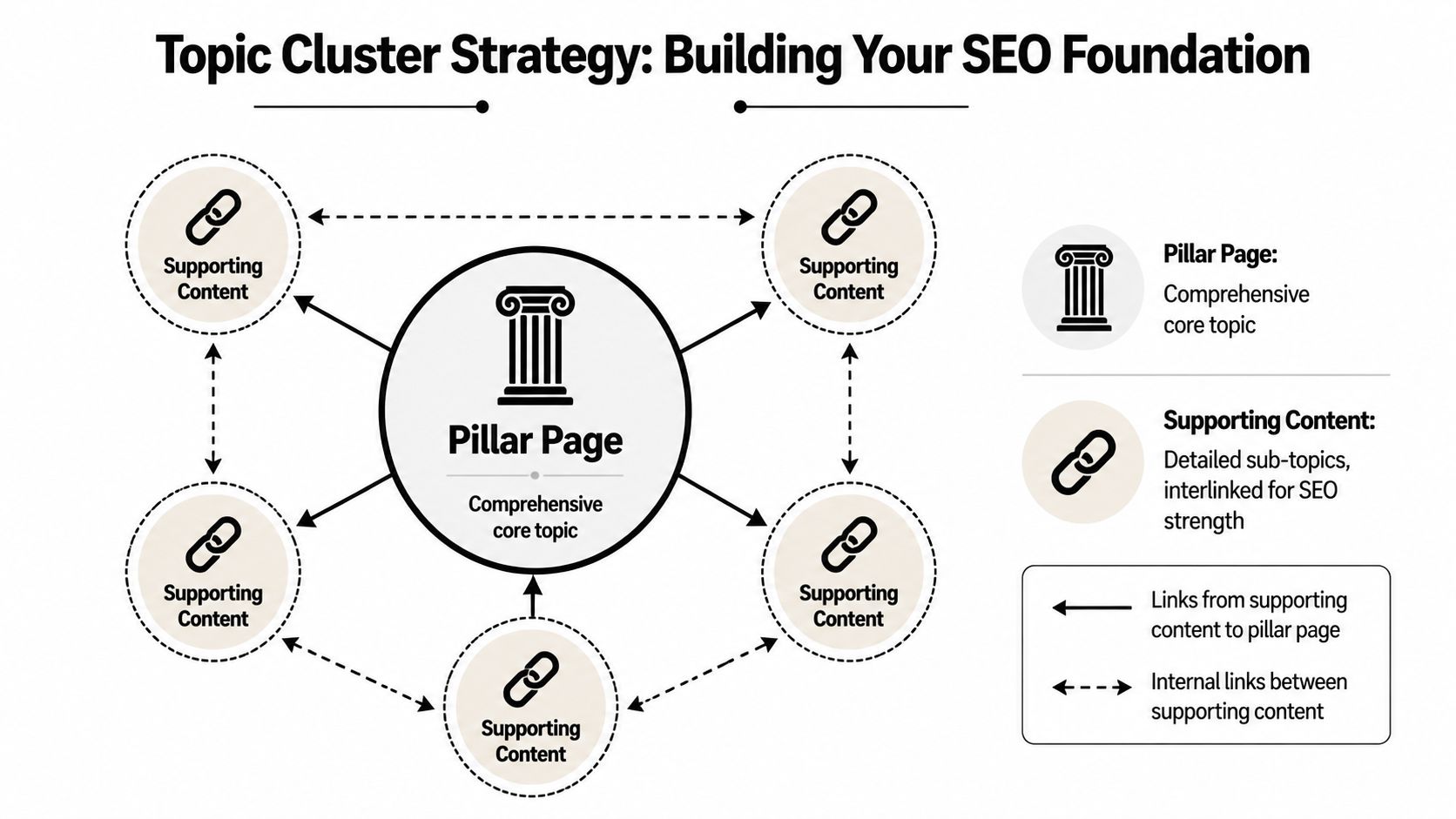
    A diagram illustrating the SEO topic cluster strategy featuring a central pillar page and supporting content pieces.

    Think like a library, not a blog

    A good cluster works like a small reference library. The pillar page is the main book on the shelf. It covers the broad subject in an all-encompassing way. The supporting articles are the specialist volumes. Each one expands a subtopic and links back to the pillar and to related pages.

    That internal structure matters. Search Engine Land’s guide to longform content notes that pillar pages of 2,000 to 5,000 words linking to 10 to 20 supporting articles can yield 40 to 50% higher domain authority scores. That's the kind of advantage small businesses need because it lets one focused content system do more work than disconnected posts ever can.

    Later in the section, watch this breakdown if you want a visual explanation of how clusters support SEO performance.

    What a usable cluster looks like

    Let's say you run a local dental clinic. Don't publish one article on “teeth whitening tips” and call it content strategy. Build a pillar around a broader commercial theme such as cosmetic dentistry or teeth whitening treatments. Then support it with articles that answer the decision-level questions buyers ask.

    A practical cluster might include:

    • Core pillar page: Your complete guide to teeth whitening options, candidates, risks, maintenance, and booking considerations.
    • Comparison article: In-office whitening versus take-home kits.
    • Concern-driven article: How long whitening results last.
    • Local intent article: What to ask a clinic before booking treatment in your city.
    • Eligibility article: Whether whitening works for stains, crowns, or sensitive teeth.

    A cluster gives Google context and gives buyers a path. Both matter.

    Many SMBs overcomplicate things. You don't need fifty topics. You need a few revenue-connected themes and the discipline to build depth around each one.

    Start with buyer intent. Pick topics tied to services, categories, or repeated sales questions. Then map the cluster before writing anything. When every article has a job, content stops feeling like a guessing game and starts behaving like infrastructure.

    The Anatomy of a Perfect Long Form Article

    Google’s first-page results average 1,447 words, according to Backlinko research cited in Network Solutions’ overview of long-form content. That number matters for one reason. Winning pages usually cover the topic with enough depth to satisfy the searcher and move them toward a decision.

    For an SMB, that changes how you should write. Stop treating long form content like a school assignment. Build each article like a sales asset you can repeat, templatize, and publish at scale with a tool like OutRank.

    A strong long form article does four jobs. It answers the core question fast, organizes the topic into clear decision points, proves credibility, and gives the reader a next step.

    Start with the answer

    Business owners often waste the first 200 words on scene-setting. That hurts rankings and conversions.

    Lead with the direct answer. If the search is “how long does commercial epoxy flooring last,” open with the actual range, then explain what changes the outcome. After that, break down traffic level, installation quality, maintenance, cost tradeoffs, and replacement timing.

    Your introduction should handle three things immediately:

    1. Confirm the reader is in the right place
    2. Give the short answer in plain language
    3. Show what the article will help them decide

    That structure improves engagement because the visitor gets value before they commit to reading the full page.

    Build the article around decision points

    Good long form content is structured around the questions a buyer asks before taking action. That is what keeps the article useful instead of bloated.

    Use sections that match real intent:

    • Definition or quick answer: What it is, who it is for, or the short verdict
    • Key variables: What affects the result, price, timeline, or outcome
    • Comparisons: Option A versus Option B
    • Common mistakes: What buyers get wrong
    • Proof and evidence: Experience, examples, specifications, cited sources
    • Next step: What to do now

    This is the difference between a page that ranks and a page that helps sell. For SMBs producing content consistently, this structure also gives you a repeatable template. You do not need to reinvent the article format every time. OutRank or a similar workflow can speed up drafting, but the underlying structure still needs to be sound.

    Format for skimming

    Readers scan first. If your page looks heavy, they leave before your best point shows up.

    Use formatting that makes the article easy to move through:

    • Clear H2 and H3 headings built from real sub-questions
    • Short paragraphs that keep one idea per block
    • Bullets and numbered lists for steps, comparisons, and checklists
    • Tables when the reader needs to compare options quickly
    • Trust signals such as firsthand experience, product details, expert input, and cited sources

    Put the strongest information high on the page and make it easy to spot. Summaries, subheads, and clean visual flow improve usability. They also make your content easier to scale because every article follows the same reading pattern.

    Long Form Content Best Practices Checklist

    Element Best Practice Why It Matters
    Headline Promise a clear outcome or answer Improves relevance and qualifies the click
    Introduction Answer the main query in the opening lines Reduces bounce and sets expectations fast
    Structure Use H2s and H3s based on sub-questions Makes the page easier to scan and understand
    Paragraphs Keep them short and focused Improves readability on desktop and mobile
    Evidence Use cited studies, product details, and real expertise Builds credibility and supports E-E-A-T
    Internal linking Link to related supporting pages naturally Strengthens topical relevance and supports deeper journeys
    Visual flow Break up text with bullets, tables, and callouts Helps scanners find useful information quickly
    Conclusion End with a decision, summary, or next step Turns attention into action

    One more rule. Every section must earn its place.

    Do not pad the article to hit an arbitrary word count. Do not repeat the same point in three different headings. Do not add generic FAQ fluff if it does not help the buyer decide. The best long form content feels complete because it is tightly organized, easy to scan, and built from a system your business can repeat every month.

    Your Scalable Workflow for Publishing High-Impact Content

    One excellent article won't change your business. A repeatable publishing system might.

    That's the difference between content as a project and content as a growth engine.

    Amra & Elma’s roundup of long-form marketing statistics says that by 2026, 61% of marketing strategies incorporate long-form content, up from 42% in 2023, and 74% of marketers rank long-form blogging as the top-performing format for lead generation. Treat that as a projection and a warning. If you wait until everyone around you has built a content engine, you'll be catching up from behind.

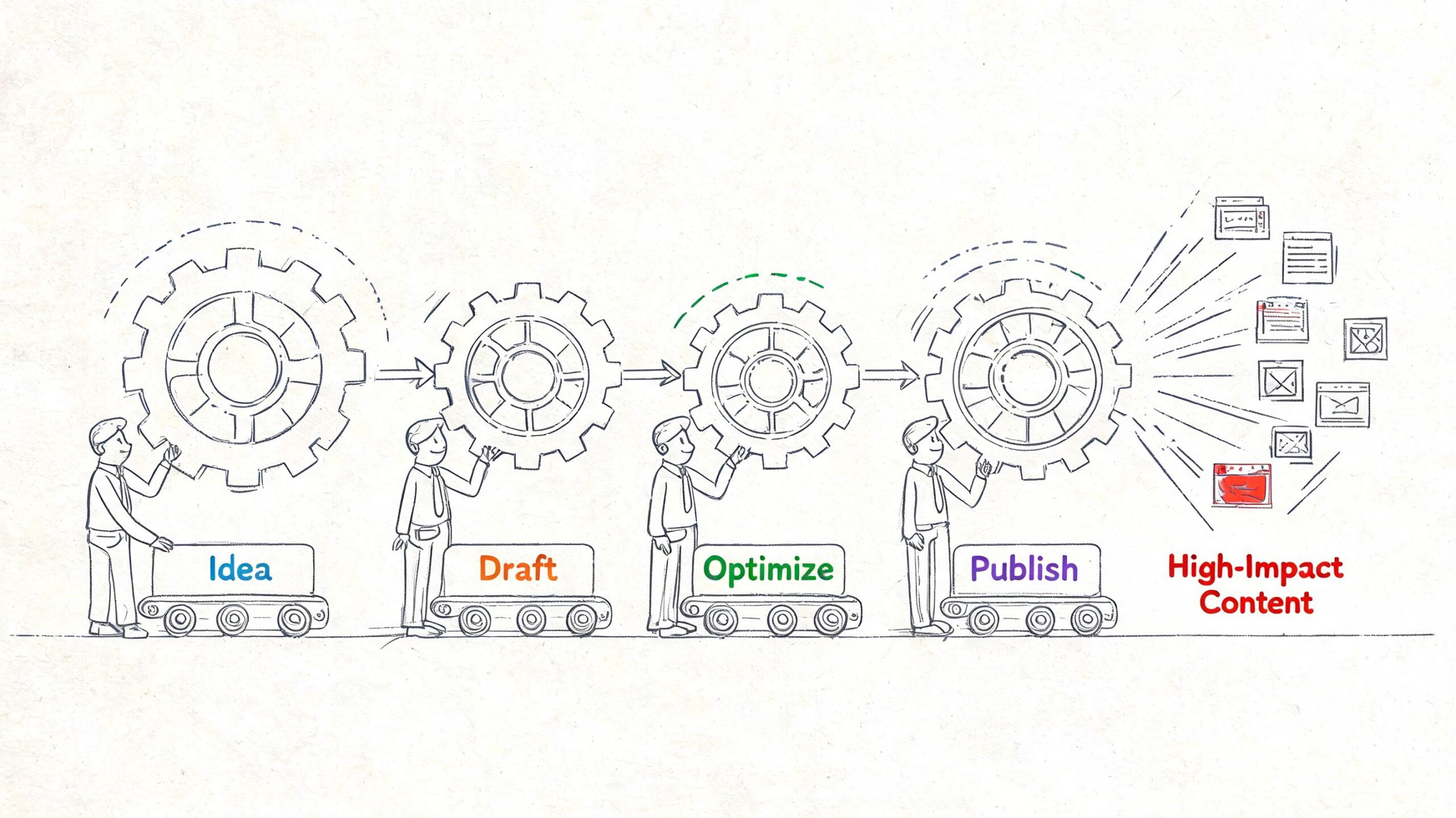
    An illustration showing a four-step content production process from idea generation to publishing high-impact content.

    The workflow that keeps you consistent

    A practical SMB workflow doesn't need a newsroom. It needs a sequence you can repeat without burning out.

    Here's the model I recommend:

    1. Choose one commercial theme

      Start with a service line, product category, or problem tied to revenue. Ignore vanity topics unless they support a money page.

    2. Build a content map

      Create one pillar topic and a list of supporting article angles. This removes guesswork before writing starts.

    3. Outline before drafting

      Your outline should include the primary question, major sub-questions, internal links to add, and the action you want the reader to take.

    4. Draft fast, edit hard

      Don't write and edit at the same time. Get the substance down, then tighten the structure, examples, and readability.

    5. Publish and interlink immediately

      New pages should connect to relevant existing pages on day one. A lonely post is wasted effort.

    Where automation actually helps

    Most founders don't fail because they lack ideas. They fail because the process is too heavy to sustain. Keyword research takes time. Outlining takes time. Drafting takes time. Publishing takes time. Link building takes time.

    Tools like OutRank become useful. Not because software replaces judgment, but because it removes repetitive work. If the platform can handle keyword discovery, draft generation, publishing support, competitor analysis, and backlink workflows, a small team can maintain output without turning content into a full-time internal job.

    Use automation for the repeatable parts:

    • Research support: Surface keyword opportunities and related subtopics.
    • Production speed: Generate structured drafts faster than starting from a blank page.
    • Publishing rhythm: Keep articles moving instead of leaving them stuck in a backlog.
    • Cluster expansion: Turn one strong topic into a planned series, not a one-off post.

    The real win isn't writing faster. It's publishing consistently enough that your site becomes difficult to ignore.

    If you're resource-strapped, that's the entire game. Not perfection. Not endless polishing. A reliable system that keeps producing strong long form content month after month.

    From Post to Powerhouse Repurposing Your Content

    Most businesses publish a long article, share it once, and abandon it. That's wasteful.

    A strong article should feed your email, social, sales enablement, and short-form content for weeks. Long form content is expensive in attention. Squeeze everything out of it.

    Turn one article into a content pack

    Take a finished guide and strip it for parts. Each subsection, objection, example, or checklist can become a distribution asset.

    Useful repurposing formats include:

    • Email sequence: Pull three to five sections into short educational emails that lead back to the full article.
    • LinkedIn post series: Turn one article into opinion posts, common-mistake posts, and buyer-question posts.
    • Sales follow-up asset: Send the article after discovery calls to handle objections at scale.
    • Carousel outline: Break the article into a step-by-step visual summary for social.
    • FAQ snippets: Rework subheadings into short answers for product pages or service pages.

    One article should create a small orbit of supporting content. That's how you increase reach without constantly inventing new ideas.

    Use a shorts-to-long-form funnel

    Short-form video gets attention quickly. It usually doesn't build the same value as a deep article. That's why the better play is to let short content attract interest and let long form content do the serious selling and ranking work.

    VirVid’s discussion of the Shorts-to-long-form funnel says YouTube Shorts have 5.91% engagement, but low monetization, and marketers use short clips to drive traffic into long-form assets. The same source describes this funnel as growing channels 41% faster. For a small business, the lesson is simple. Use short content for discovery. Use long form content for depth, trust, and conversion.

    A simple funnel looks like this:

    • Clip one strong insight: Pull a sharp claim, mistake, or myth from your article.
    • Create a short script: Keep it focused on one question only.
    • Use the article as the destination: Send viewers to the full guide, not your homepage.
    • Match the message: If the short talks about a specific problem, link to the article that solves that exact problem.

    This works especially well for local services and niche ecommerce because your short content can stay narrow and practical. You don't need to become a creator. You need to become useful.

    Measuring the True ROI of Your Content Engine

    If you measure long form content by likes, you'll miss the point and probably kill the strategy too early.

    Content should be judged by whether it brings the right visitors, improves search visibility, and helps produce leads or sales. These are the key metrics; everything else is secondary.

    Track business metrics, not vanity metrics

    The best content programs use a short list of hard metrics. Keep it simple enough that you'll review it.

    Focus on:

    • Keyword movement: Are your core buyer-intent pages climbing for the terms that matter?
    • Qualified organic traffic: Are the right pages attracting visitors from search?
    • Lead conversions: Are contact forms, calls, demo requests, or purchases tied to those visits?
    • Assisted conversions: Are people reading content before they convert later through another page?
    • Internal page flow: Are readers clicking deeper into service pages, category pages, or related guides?

    Traffic without commercial relevance is just activity. Track what helps revenue.

    Don't panic if a strong article takes time to mature. Long form content often compounds because one page can rank for many related searches and strengthen nearby pages through internal links.

    What to check in Search Console and GA4

    You don't need an expensive analytics stack to get useful answers. Google Search Console and GA4 are enough for most SMBs.

    In Search Console, check which queries trigger impressions for your long form pages. Look for signs that one article is starting to rank for a wider set of related searches than you originally targeted. That's usually a sign the topic is gaining traction.

    In GA4, create a habit of checking which landing pages bring organic sessions and what those users do next. Watch whether readers continue to service pages, product pages, contact pages, or checkout steps. If the article earns traffic but nobody moves deeper, the page may be attracting the wrong intent or failing to push the next action clearly enough.

    A practical review routine looks like this:

    • Monthly review: Check which articles gained visibility, clicks, and downstream actions.
    • Content refresh decisions: Improve pages that show promise but need better structure, stronger intros, or clearer internal links.
    • Pruning decisions: Merge or redirect weak overlap pages that dilute the cluster.
    • Expansion decisions: Double down on subtopics that start surfacing new relevant queries.

    This is how you prove ROI without guesswork. Not by asking whether content “feels valuable,” but by seeing whether your content engine is increasing search presence and moving prospects toward revenue.

    Your Final Playbook for Long Form Content Success

    Long form content is one of the few SEO plays that still gives small businesses a real structural advantage. It lets you compete on usefulness instead of budget. That matters because larger competitors usually win on brute force. You win on precision, depth, and consistency.

    The playbook is straightforward.

    Build around revenue-connected topics, not random blog ideas. Turn those topics into clusters, not isolated posts. Write articles that answer the main question early, cover the decision thoroughly, and guide readers toward the next step. Then stop treating publishing as the finish line. Repurpose the article, distribute it, and use short-form channels to bring more people back to the full asset.

    Most important, make the process repeatable. The businesses that get outsized SEO results aren't always the ones with the best writer in the room. They're the ones that keep publishing useful, structured, authoritative content without dropping the ball after three weeks.

    If you're a solo founder or lean in-house team, don't wait for ideal conditions. Start with one cluster. Publish one serious pillar. Add supporting content. Track outcomes. Tighten the workflow. Then scale with tools that remove bottlenecks and keep production moving.

    That's how long form content turns from “something we should do” into a durable acquisition channel.


    Agency Secrets gives small business owners a practical path to do exactly that. If you want an agency-free SEO system built around buyer-intent keyword research, authoritative article production, backlinks, and compounding evergreen growth, start with Agency Secrets. It’s the clearest next step if you want to build a long form content engine instead of publishing one-off posts.

  • Evergreen Content Strategy: Boost Traffic & Sales in 2026

    Evergreen Content Strategy: Boost Traffic & Sales in 2026

    Evergreen content generates three times more traffic than time-sensitive articles, according to a 2026 HubSpot finding summarized here. That should change how most small businesses think about content.

    A lot of owners are still trapped in a publishing cycle that looks productive but creates very little lasting value. They post a quick reaction piece, a seasonal update, a short promotional blog, then repeat the process next week because traffic falls off almost immediately. The work never stops, yet the asset base never grows.

    An evergreen content strategy fixes that by shifting the goal. You stop treating content as disposable output and start treating it as infrastructure. A useful guide, tutorial, checklist, or pillar page can keep attracting search traffic, assist sales conversations, support email nurture, and answer customer questions long after it’s published.

    That matters even more for lean teams. If you run a local service business, an e-commerce store, or a small B2B company, you probably don’t need more random posts. You need a content system that keeps working when you’re busy serving customers.

    Table of Contents

    Stop the Content Treadmill Start Building Assets

    Most small businesses don't have a content problem. They have an asset problem.

    They publish often enough, but too much of that work is tied to short-lived topics. A promotion expires. A platform update changes. A trend cools off. Then the post that took hours to write stops pulling its weight. The team moves on, but the workload stays.

    That cycle feels like momentum because something is always getting published. In practice, it acts more like rent than investment. You keep paying for attention, but you don't build much equity.

    Why more content often produces less leverage

    Time-sensitive content has a role. It can capture a spike of interest, support a launch, or give your brand a reason to comment on something current. The problem starts when it becomes the whole strategy.

    When every article depends on novelty, your calendar controls you. You have to keep feeding it. That usually creates three issues:

    • The archive loses value: Old posts stop helping because they were never built to last.
    • Sales teams get weak support: Reps can't keep reusing content that goes stale fast.
    • SEO compounds slowly: Search performance gets scattered across disconnected posts instead of strengthening a topic over time.

    Practical rule: If a piece won't still help a prospect months from now, it probably shouldn't be the core of your content plan.

    What an asset-first mindset looks like

    An evergreen asset does more than rank. It answers a durable question your customers keep asking. Think "how to choose the right HVAC system," "what affects shipping costs," or "how to compare bookkeeping software for a small business."

    Those topics don't depend on a news cycle. They map to recurring customer intent.

    A strong evergreen content strategy treats each piece as something that can serve multiple jobs:

    Content type Short-term role Long-term role
    Buyer guide Supports active prospects Keeps attracting search traffic
    Tutorial Reduces pre-sale friction Becomes a reusable support asset
    FAQ hub Helps conversion pages Builds topical relevance over time

    This is the shift that matters. You stop asking, "What can we post this week?" and start asking, "What can we publish once, improve over time, and use everywhere?"

    For a small business, that's a much better game.

    What Is an Evergreen Content Strategy

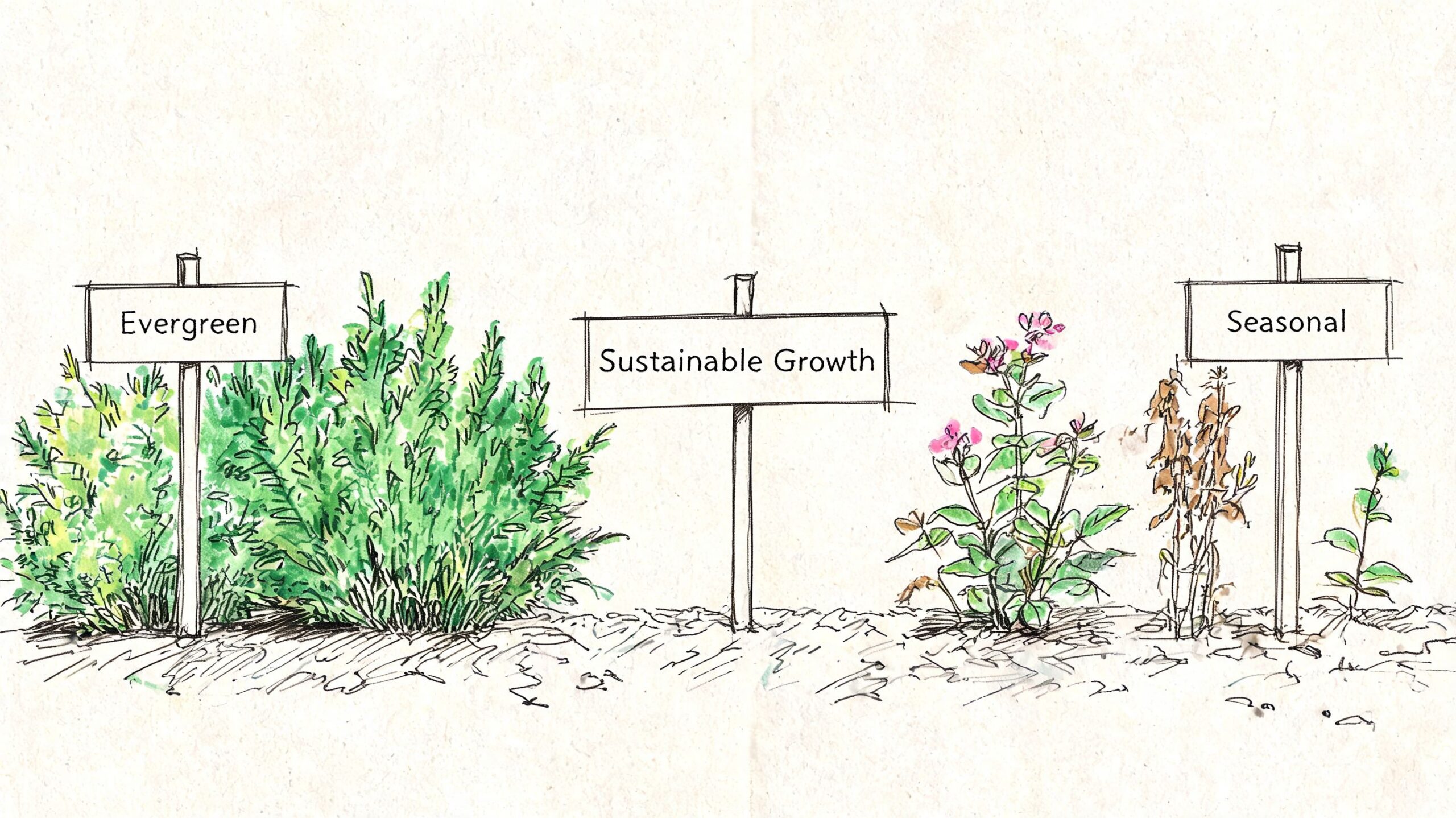
    Think of content like a garden.

    A trending content garden needs constant replanting. You get a burst of color, then it fades. If you stop planting, it stops producing. An evergreen content strategy works more like a perennial garden. You choose the right plants, put them in the right places, maintain them on a schedule, and they keep growing back stronger.

    A hand-drawn illustration depicting plants labeled Evergreen, Sustainable Growth, and Seasonal to contrast growth strategies.

    That analogy helps because evergreen isn't about age. It's about continued relevance. A page can be published today and still be evergreen if the topic stays useful over time.

    What counts as evergreen

    Evergreen topics solve recurring problems, explain stable concepts, or guide buyers through decisions that don't disappear. Good examples include:

    • How-to guides: step-by-step instructions tied to enduring needs
    • Beginner explainers: pages that answer foundational questions
    • Comparison resources: content that helps buyers evaluate options
    • Operational checklists: repeatable processes customers want to follow
    • Core FAQs: answers your team gives repeatedly in sales or support

    These formats work because they align with persistent intent. People keep searching for them, and businesses keep benefiting from having them published.

    What doesn't count

    Some content should never be mistaken for evergreen:

    • News reactions
    • Seasonal promotions
    • Year-specific trend posts
    • Short-lived platform updates
    • Announcements with an expiration date

    That content isn't bad. It's just not a durable foundation.

    Evergreen content should still feel useful after the original campaign ends.

    The strategy is bigger than the article

    A lot of teams misunderstand evergreen by treating it as a writing style. It isn't. It's an operating model.

    The strategy includes topic selection, keyword filtering, content format, internal linking, update cadence, and repurposing. It also includes deciding where current content fits. Some businesses need a few trend-driven pieces for social reach or launch support, but those should sit on top of a stable evergreen base, not replace it.

    A practical way to judge a topic is simple. Ask three questions:

    1. Will customers still care about this later?
    2. Can sales or support reuse it?
    3. Can it connect to other pages on the same topic?

    If the answer is yes to all three, you're probably looking at evergreen potential.

    The Compounding ROI of an Evergreen Approach

    The primary advantage of an evergreen content strategy isn't that it sounds disciplined. It's that the economics are better.

    A trending article often acts like a campaign expense. It gets attention, then tapers off. An evergreen asset behaves more like owned media. It can keep producing traffic, support conversions, and create linking opportunities long after publication. That changes the return profile of every hour you put into content.

    Start with the right content mix

    A useful baseline comes from Allied Insight's evergreen versus trending analysis, which states that an 80/20 evergreen-to-trending content ratio serves as the optimal baseline for B2B strategies, and that one original piece often generates five additional assets like infographics, videos, and case studies.

    That mix works because it protects both sides of the business. You keep enough timely content to stay relevant, but the bulk of your effort goes into pages that can keep earning results.

    For small businesses, that usually means your monthly calendar should be built around assets first, then topped up with reactive pieces only when they serve a clear purpose.

    Why the return compounds

    Evergreen content can improve performance in several ways at once:

    • Search value accumulates: A useful page can keep collecting impressions, clicks, and backlinks over time.
    • Sales enablement improves: One guide can answer objections in calls, emails, and landing pages.
    • Repurposing gets cheaper: A strong original article can become a short video, email series, lead magnet, or FAQ page without starting from zero.
    • Update costs stay lower than replacement costs: Improving an existing winner is usually more efficient than inventing a new post every week.

    That last point is where many owners miss the opportunity. They keep commissioning net-new content when a stronger move is often to expand, improve, and redistribute assets that already proved demand.

    Owner mindset: Don't ask whether a post performed in week one. Ask whether it can keep helping your business next quarter.

    Asset value versus activity value

    Here’s the trade-off in plain terms.

    Approach What you get fast What you keep later
    Trending-heavy publishing Short-term spikes and social hooks Limited residual value
    Evergreen-heavy publishing Slower early momentum in some cases Reusable assets and steadier search value

    This is why the system matters. If your team is always optimizing for immediate activity, you'll produce a lot and retain little. If you're building evergreen assets, each publication can strengthen the next one.

    A guide can become a cluster. A cluster can support a category page. A category page can help your whole domain rank better on a commercial theme. That isn't abstract theory. That's what sustainable content economics look like.

    The Core Components of a Winning Strategy

    A strong evergreen content strategy usually stands or falls before the writing starts. Most weak results come from one of three mistakes. The topic isn't durable, the format doesn't fit the intent, or the keyword target was chosen because it sounded good instead of because demand looked stable.

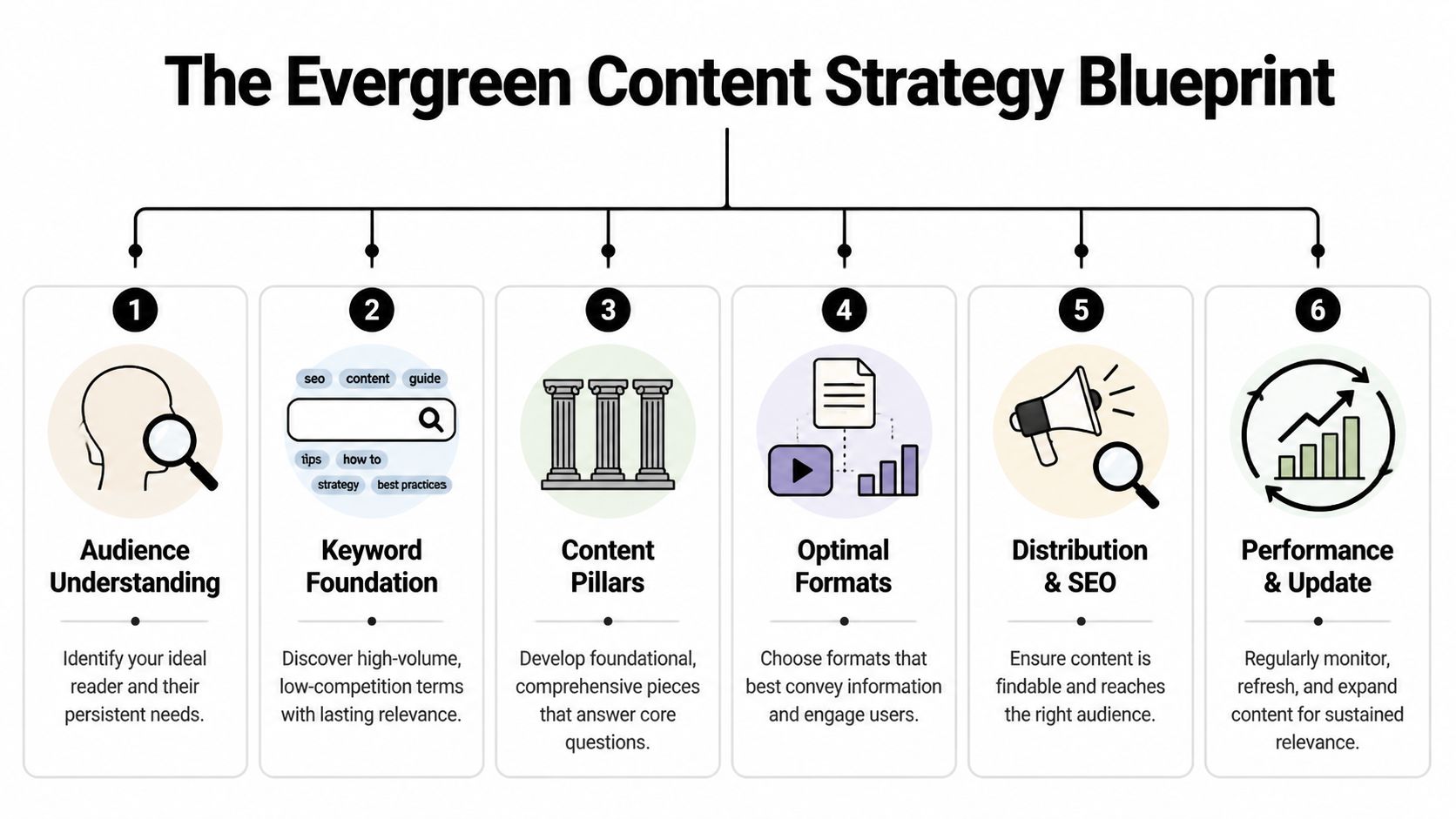
    A six-step infographic outlining a comprehensive evergreen content strategy blueprint for long-term marketing success and growth.

    Choose topics that survive your next campaign

    The best evergreen topics come from repeated customer questions. Look at sales call notes, chat transcripts, support tickets, quote requests, and product demos. If people keep asking the same thing, that topic has staying power.

    Good examples by business type:

    • Local services: repair timelines, cost factors, buying criteria, service comparisons
    • E-commerce: sizing guides, material care, compatibility, product selection help
    • B2B services: implementation steps, vendor evaluation, pricing models, common mistakes

    Bad topic selection usually sounds more exciting than useful. "Big changes in the market" gets attention for a minute. "How to compare payroll providers for a growing company" keeps earning its place.

    Pick formats built for long shelf life

    Format matters more than people think. Some formats naturally support skimming, updates, and internal links. Others age badly.

    The formats I trust most for evergreen work are:

    • Pillar guides for broad educational topics
    • Step-by-step tutorials for process-driven searches
    • Checklists for operational tasks
    • Comparison pages for evaluation-stage intent
    • FAQ libraries for recurring objections

    These formats hold up because they are modular. You can revise a section, add examples, improve structure, and keep the URL intact. That's hard to do with content built around novelty or opinion.

    A durable format makes maintenance easier. That becomes critical once your library grows.

    Filter keywords for staying power

    A simple technical filter can save you from a lot of wasted effort. Leadspanda's evergreen guidelines state that targeting keywords with sustained search volume of at least 1,000 monthly searches is a critical benchmark, because it signals durable interest rather than a short-lived spike.

    That doesn't mean every small business should ignore lower-volume terms. It means this threshold is a useful benchmark when you're evaluating whether a topic has broad, lasting demand.

    Use tools like Google Search Console, GA4, and your keyword platform of choice to check whether interest looks stable. Favor queries that are question-based, problem-based, or decision-based. Be careful with keywords that depend on dates, product releases, or temporary events.

    A practical planning table helps:

    Component What to look for What to avoid
    Topic Recurring customer problem Trend-driven curiosity
    Format Update-friendly structure One-off commentary
    Keyword Stable informational intent Short-term spike terms

    When those three line up, you don't just have an article idea. You have something worth building into a system.

    A Practical Playbook for Evergreen Execution

    Execution is where most evergreen plans fall apart. Teams either overcomplicate the process or they publish isolated articles with no structure behind them.

    A better approach is simple. Build one authoritative page, surround it with closely related support content, then maintain the cluster on a schedule.

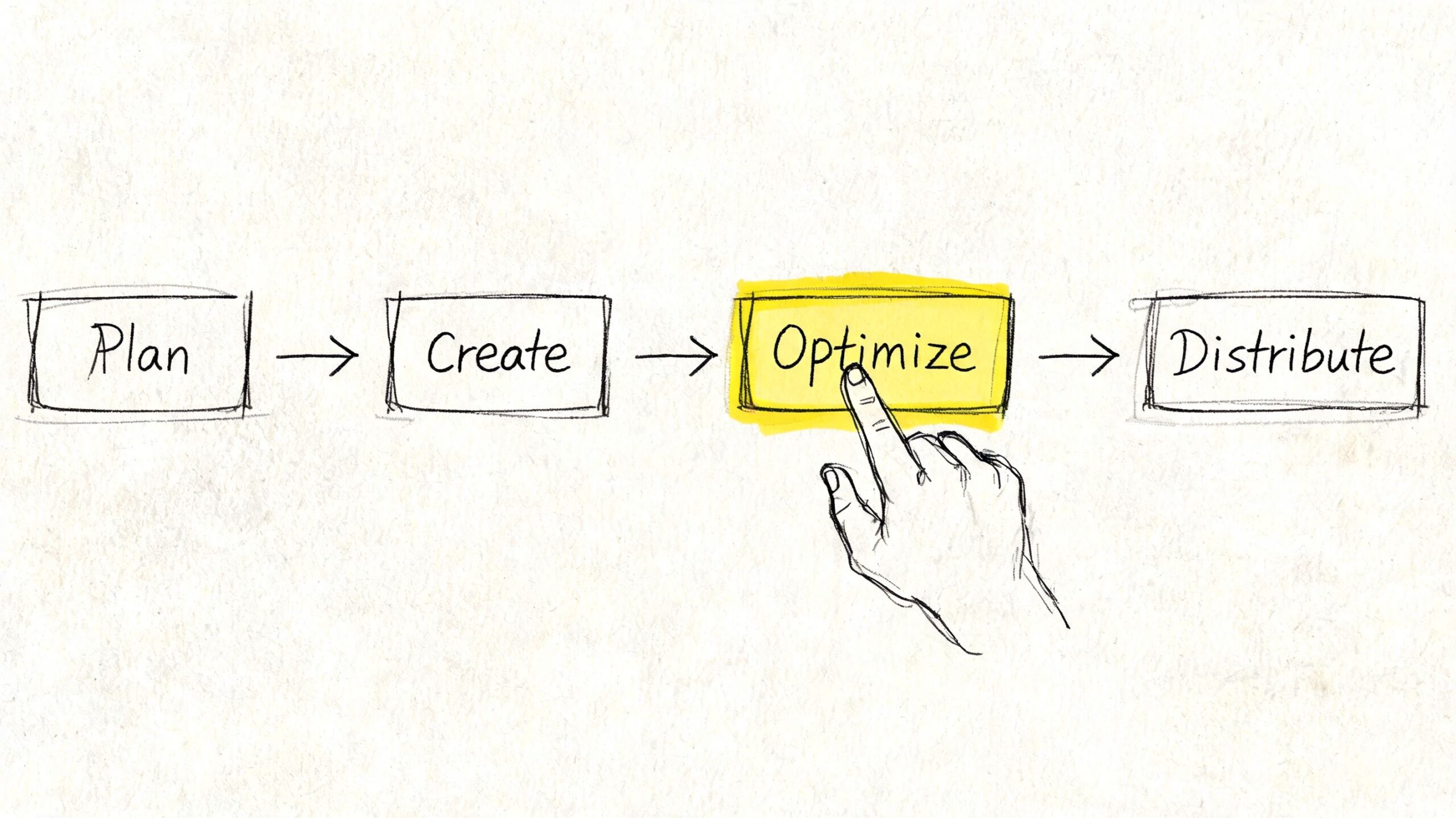
    A hand selecting the Optimize step within a four-part marketing workflow process diagram.

    Start with one pillar, not ten blog posts

    Most businesses should begin with a pillar page. This is the main resource on a core topic your audience cares about. It should be thorough, well structured, and designed to answer the major questions around that topic in one place.

    That structure isn't just neat. It's effective. According to GWI's evergreen content strategy write-up, employing topic clusters, with a central pillar page linking to supporting articles, can lift cluster rankings by 15-25% within 6 months, and longer formats of 2,000-4,000 words rank 2x higher for informational intent.

    That makes the choice pretty clear. Don't scatter effort across thin posts. Build one strong hub.

    Build the cluster around real buying questions

    Once the pillar exists, create supporting pages that go deeper on subtopics. Each one should answer a specific question and link back to the pillar with clear anchor text. The pillar should also link out to those supporting pages where relevant.

    A simple cluster might look like this:

    • Pillar page: Complete guide to choosing a home security system
    • Support article: Wired versus wireless systems
    • Support article: What installation typically involves
    • Support article: Common mistakes when comparing providers
    • Support article: Maintenance checklist for homeowners

    This model works because it matches how people search. Some want the broad overview. Others want one narrow answer. Your cluster lets both paths strengthen the same topic.

    Internal links should help readers finish a decision, not just satisfy an SEO checklist.

    Use a simple editorial calendar

    Small businesses don't need a fancy content operation. They need consistency.

    Here’s a practical monthly rhythm:

    Week Primary task Output
    Week 1 Research core topic and search intent Pillar outline
    Week 2 Publish pillar page Main evergreen asset
    Week 3 Publish support article Cluster expansion
    Week 4 Refresh older page and re-promote Maintenance and distribution

    If you have more capacity, add another support article. If you have less, keep the rhythm but slow the volume. The system still works.

    Later in the process, this video gives a useful view of how evergreen planning fits broader SEO execution:

    Refresh before content decays

    Publishing is only half the job. Evergreen content needs upkeep.

    A lightweight refresh checklist keeps pages useful:

    1. Review search intent: Does the page still match what searchers want?
    2. Update examples: Remove anything dated or unclear.
    3. Strengthen internal links: Add links to new supporting pages.
    4. Improve readability: Tighten headings, bullets, tables, and summaries.
    5. Check conversion paths: Make sure the next step is obvious.

    What doesn't work is random rewriting. Keep the core URL and topic stable. Improve the page without turning it into something else. That's how you preserve momentum while making the asset stronger.

    Automate and Scale Your Strategy with OutRank

    The biggest myth about evergreen content is that it's low-effort. It isn't. It's lower waste.

    That distinction matters. A good evergreen content strategy still needs research, production, internal linking, optimization, republishing, and refresh cycles. For a solo founder or a small in-house team, that workload becomes the bottleneck long before strategy becomes the problem.

    A hand presses a red OutRank button to transform complex SEO strategy and analytics into optimized content results.

    Manual upkeep is where small teams get stuck

    At this stage, many content plans frequently falter. The first few articles go live, then daily business pulls attention elsewhere. No one updates old pages. No one expands clusters. No one checks which rankings slipped.

    That problem isn't theoretical. Evergreen Feed's analysis notes that evergreen content requires "active maintenance" to preserve authority, as static assets can see 20-30% traffic drops after 12 months, and it specifically frames this as a challenge for SMEs.

    If you're running payroll, handling service delivery, and answering leads, manual maintenance usually loses.

    What automation should handle

    Here, a tool like OutRank becomes useful. Not because it replaces strategy, but because it removes repetitive production work that small businesses struggle to do consistently.

    The right automation layer should help with:

    • Keyword discovery: surface relevant search opportunities tied to stable intent
    • Content production: generate structured drafts at a consistent publishing pace
    • Competitor analysis: identify gaps and themes worth covering
    • Publishing workflow: reduce the friction between draft and live page
    • Update cycles: flag assets that need revision before they slide

    For a lean operator, that changes the math. You don't need to build a mini agency inside the business just to keep your evergreen system alive.

    Automation should take over repeatable steps. Humans should still decide positioning, accuracy, and commercial relevance.

    What not to automate blindly

    There are real trade-offs here.

    Don't hand your strategy to a tool and assume output equals authority. If your offers are poorly positioned, your topics are off-target, or your internal linking is sloppy, automation will produce more of the wrong thing faster.

    Use tools for speed, but keep editorial judgment on these points:

    • Topic priority
    • Brand voice
    • Offer alignment
    • Accuracy checks
    • Conversion paths

    The businesses that win with automation don't abandon discipline. They use automation to protect discipline. That's what makes an evergreen content strategy accessible to small teams instead of just large marketing departments.

    Build Your Traffic Engine for 2026 and Beyond

    The businesses that get the most from content don't act like publishers chasing constant novelty. They act like asset builders.

    That's the key lesson behind an evergreen content strategy. You choose durable topics. You package them in formats that hold up. You structure them into clusters. You maintain them before they lose value. Then you automate the repetitive parts so the system keeps moving even when the team is busy.

    This approach is better for ROI because it reduces waste. It is better for SEO because it builds topical depth. It is better for sales because prospects keep finding useful answers at the exact moment they need them. And it is better for small businesses because it doesn't require a giant budget to work.

    The trade-off is patience. Evergreen content usually asks for more planning up front and more discipline after publication. But the alternative is the treadmill. More posts, more scrambling, more short-lived spikes, and very little compounding value.

    A sustainable traffic engine isn't built from random output. It's built from a repeatable system.

    If you want content to keep helping your business months from now, start with one pillar page on a recurring customer problem. Build a cluster around it. Put a refresh date on the calendar. Then use automation where manual effort would otherwise stall the whole process.


    If you want a practical, agency-free way to put this into action, Agency Secrets shows small business owners how to build an SEO system around buyer-intent keywords, strong evergreen articles, relevant backlinks, and consistent publishing. It also points you to OutRank, which can automate large parts of that workflow so you can create, publish, and maintain search-driven assets without hiring a full team. Start there, test the system on one core topic, and build your traffic engine from the ground up.

    Refined using the Outrank tool