
Tired of keywords that don't drive traffic? You've spent hours in keyword tools, found terms that looked reasonable, published the article, and waited for the lift that never came. The page gets indexed, maybe even impressions, but the visits don't turn into leads, calls, demos, or sales.
That usually happens for one reason. The keyword wasn't wrong, but the strategy behind it was. Good keyword research examples don't stop at "find a phrase with volume." They connect query, intent, SERP format, page type, and business value. If one of those pieces is off, you can rank and still get nothing useful from the effort.
The other problem is scale. Most search demand lives in the long tail, not in flashy head terms. Ahrefs reports that 94.74% of keywords get 10 monthly searches or fewer, and only 0.0008% get more than 100,000 monthly searches. That is why broad vanity targets rarely carry a small business SEO plan by themselves.
What works is a repeatable blueprint. Start with a seed topic, expand into related terms and questions, inspect the SERP, assign one page per intent, and write a brief that gives the page a real chance to rank and convert. That's the practical shift from random keyword collection to a defensible content map.
Table of Contents
- 1. Long-Tail Keyword Research with Buyer Intent
- 2. Competitor Keyword Gap Analysis
- 3. Search Intent Segmentation
- 4. Question-Based Keyword Research
- 5. Local Keyword Research with Geographic Modifiers
- 6. Seasonal and Trending Keyword Research
- 7. Keyword Research for Content Clusters and Topic Authority
- 8. E-A-T Keyword Research and Expertise Positioning
- 8 Keyword Research Strategies Compared
- Your Actionable Keyword Research Playbook
1. Long-Tail Keyword Research with Buyer Intent
Long-tail keyword research is where most small businesses should start. Broad terms like "CRM software" or "plumber" look attractive, but they bundle too many intents together. A searcher who types "affordable project management tool for freelancers" is telling you far more about what page they want and how close they are to acting.

A practical workflow starts with one seed term, then expands outward. Ahrefs says its free keyword generator returns 20 related keywords and 20 related questions per seed keyword, which is enough to build an initial intent cluster instead of forcing one phrase into one page.
Why this blueprint works
Buyer-intent modifiers do the heavy lifting. Words like "best," "for freelancers," "near me," "same day," "size 9," or "open now" narrow the audience and usually sharpen the page type you need.
Practical rule: If the keyword contains a constraint, use that constraint in the page structure, not just the title.
For example, an ecommerce store selling hiking gear shouldn't target only "hiking boots." A stronger cluster could include "waterproof hiking boots for women," "lightweight hiking boots for wide feet," and "best hiking boots for wet trails." Those phrases don't belong on three random blog posts. They usually belong in a comparison guide, a filtered collection page, or a buying guide with product blocks.
Mini-case blueprint
Take a small SaaS tool serving independent consultants.
- Seed keyword: project management
- Target cluster: affordable project management tool for freelancers, best project management software for solo consultants, project tracker for client work
- Observed SERP pattern: comparison pages, product roundups, lightweight software lists, feature-focused landing pages
- Best page type: commercial comparison page with a clear product CTA
Content brief snippet
- Primary intent: commercial investigation
- Working title: Best Project Management Tools for Freelancers Who Manage Client Work
- Must-cover sections: pricing simplicity, client-facing features, invoicing or integrations, setup friction, best fit by use case
- Internal CTA: start trial, book demo, or view pricing
What doesn't work here is writing a generic "What Is Project Management?" article and hoping it leads to signups. That page may attract curiosity, but it won't satisfy a buyer comparing lightweight tools for solo work.
2. Competitor Keyword Gap Analysis
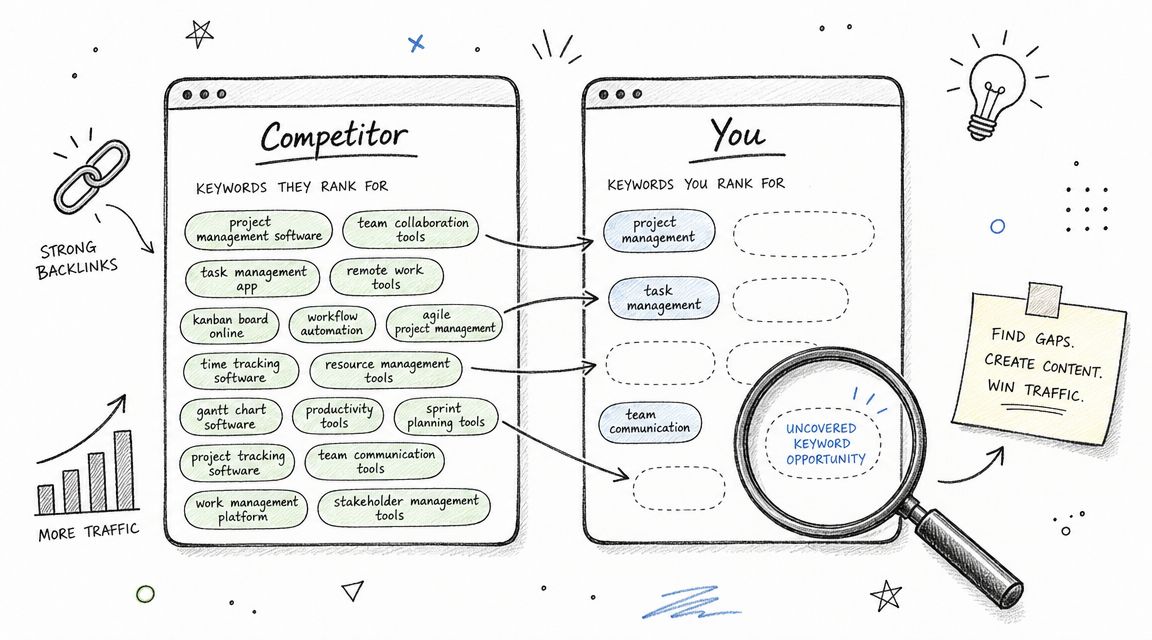
Competitor gap analysis works best when you stop treating the top-ranking giant as your only benchmark. The useful gaps often sit one layer below the market leader, inside the content libraries of direct competitors who serve the same buyers but haven't covered every use case cleanly.
Start with the companies a prospect would compare you against. Then inspect which keywords they rank for, which page types win, and where the SERP looks weak.
What to steal and what to ignore
Don't copy every ranking keyword. Copy patterns.
A local plumbing company might notice a competitor has a strong page for "drain cleaning near me" but weak or missing coverage for "emergency drain cleaning at night" or "clogged kitchen sink urgent repair." The gap isn't just a missing phrase. It's a missing service-intent page tied to urgency.
- Steal underserved intents: pages competitors almost rank for, but don't fully satisfy
- Ignore vanity terms: broad phrases that mainly reward brands with more authority
- Steal structural clues: pricing blocks, local proof, service-area language, FAQs, and review placement
Good gap analysis asks, "What intent is under-served?" not "What keyword did they rank for?"
Mini-case blueprint
Consider a DTC skincare brand competing in a crowded category.
- Competitor signals: rivals rank for ingredient pages and "best" listicles, but few have pages around use-case phrases
- Target cluster: niacinamide serum for oily skin, fragrance-free serum for sensitive acne-prone skin, beginner skincare serum for redness
- Observed SERP pattern: educational product pages, ingredient explainers, recommendation posts
- Best page type: hybrid collection and guide page
Content brief snippet
- Primary intent: commercial with educational support
- Working title: Best Serums for Oily and Sensitive Skin Without Harsh Fragrance
- Must-cover sections: who the product is for, ingredient rationale, how to layer, common irritation concerns, product recommendations
- Conversion element: shop module above the fold and "how to choose" section below
If you want a quick visual walkthrough of how SEOs inspect rival rankings and spot openings, this breakdown is useful before you build your own process.
What doesn't work is publishing a clone of the competitor's top page with a rewritten intro. If the SERP already has ten near-identical pages, your page needs a sharper angle, better alignment with a sub-intent, or a more useful format.
3. Search Intent Segmentation
Keyword lists get messy when every phrase sits in the same spreadsheet without an intent label. A term can look relevant and still be useless if you send it to the wrong page type. Search intent segmentation fixes that early.
The model I use is simple. Split keywords by what the searcher is trying to accomplish, then match that to the page that should exist. Google's own search results usually tell you the answer faster than any spreadsheet.
A simple intent model
You can use TIARA as a working frame:
- Topic-based: broad education and awareness
- Intent-driven: explicit need clarification
- Action-oriented: ready to compare or act
- Revenue-generating: product, service, or money pages
- Audience-building: useful educational content that attracts future buyers
Google Keyword Planner helped formalize this kind of workflow because it gives marketers average monthly search volume, three-month percentage change, and market targeting options. That shifted keyword research from guesswork toward a process built around measurable demand and page planning.
Mini-case blueprint
Take a bookkeeping service for freelancers.
- Topic keyword: how to separate business and personal expenses
- Intent keyword: do freelancers need bookkeeping software
- Action keyword: best bookkeeping service for freelancers
- Revenue keyword: freelance bookkeeping service monthly
- Audience keyword: tax basics for first-year freelancers
The SERP will usually split these into different winners. The first one tends to reward guides. The third often rewards comparison pages. The fourth belongs on a service landing page.
Content brief snippet
- Primary page: bookkeeping service for freelancers
- Supporting pages: educational guide, software comparison, FAQ article
- Internal links: guide to service page, comparison to service page, FAQ to consultation page
- SERP check: if page one is mostly service pages, don't force a blog post into that slot
What fails here is mixing intents on one page. A page that tries to be a beginner guide, software comparison, and sales page at once usually satisfies nobody.
4. Question-Based Keyword Research
Question-based keyword research is where you find language that tools often flatten into generic variants. Real buyers don't always search with polished category terms. They search with hesitation, context, and objections.
That makes FAQ mining valuable, especially if you serve buyers who need reassurance before they act. Questions often reveal the hidden blockers behind a sale.
Where the best questions come from
The best sources are usually visible in plain sight. Advanced keyword research guidance regularly points to Reddit, Quora, niche forums, People Also Ask, autocomplete, and related searches as places to surface real buyer questions and map them to awareness, consideration, and decision stages.
A dental clinic, for example, might see more value in "does teeth whitening damage enamel" than in another broad article about cosmetic dentistry. That question reveals fear. Fear is often what stops booking.
Most FAQ pages fail because they answer company questions, not customer questions.
Mini-case blueprint
Take a home security SaaS product for small retail shops.
- Seed topic: store security system
- Question cluster: can I monitor my shop from my phone, what's the best camera setup for a small retail store, do I need professional installation for store security cameras
- Observed SERP pattern: how-to explainers, software pages, YouTube walkthroughs, People Also Ask expansions
- Best page type: question-led resource hub that feeds product and demo pages
Content brief snippet
- Primary intent: informational with commercial progression
- Working title: Can You Monitor a Small Retail Store From Your Phone
- Must-cover sections: what setup is required, app features, installation paths, privacy concerns, when professional support helps
- CTA: compare plans or request a demo
This method also works well for ecommerce. A footwear brand can target "how do I know what shoe size I need" with a size guide that links directly into filtered collections. The trick is not to stop at the answer. The answer should naturally move the searcher toward the next logical page.
5. Local Keyword Research with Geographic Modifiers
Local keyword research isn't just city-name stuffing. Good local pages combine service, geography, urgency, and proof. Searchers don't want a generic service page with a neighborhood pasted into the headline. They want confirmation that you serve the area and can solve the exact problem there.
That changes the keyword list. "Plumber in Austin" and "emergency plumber South Austin open now" do not deserve the same page.
What local SERPs are really asking for
In local SEO, modifiers often signal different contexts:
- City terms: broad service discovery
- Neighborhood terms: stronger local relevance and often stronger service intent
- Near me terms: immediate need, especially on mobile
- ZIP or district terms: useful in large metros where service boundaries matter
A dental office might build separate assets around "family dentist in [city]," "same-day dentist near me," and "[service] near [neighborhood]." A home service company might need location-service combinations such as drain cleaning, water heater repair, and emergency repairs by area.
Mini-case blueprint
Take a locksmith serving a metro area with distinct neighborhoods.
- Target cluster: emergency locksmith near me, car locksmith in Midtown, house lockout service downtown
- Observed SERP pattern: local pack, service pages, map results, review-heavy business profiles
- Best page type: dedicated service-area landing pages supported by a strong Google Business Profile
Content brief snippet
- Primary intent: transactional local
- Working title: Emergency Locksmith in Midtown for Home, Car, and Office Lockouts
- Must-cover sections: response scenarios, areas served, common lockout cases, trust signals, call CTA, map and service hours
- Page rule: include local references that are real and useful, not decorative
What doesn't work is generating dozens of thin city pages with the same body copy. Local SERPs are unforgiving when every page feels templated and untrustworthy.
6. Seasonal and Trending Keyword Research
Some keywords don't need more authority. They need better timing. Seasonal research is less about finding a magical trend and more about publishing the right page early enough that it can settle into the SERP before demand peaks.
This matters for ecommerce, tax and finance services, clinics, home services, and any business tied to recurring events or weather-driven demand.
Timing matters more than volume
A retailer selling outdoor gear should not wait until peak winter shopping to create "best winter hiking gloves" pages. A tax preparer shouldn't start their filing-season content when everyone else has already published. Seasonal terms reward preparation and refresh cycles.
A strong workflow looks like this:
- Map recurring events: holidays, weather shifts, tax periods, school calendars, industry cycles
- Create evergreen-seasonal pairs: one stable guide plus one time-sensitive angle
- Refresh instead of replacing: update pages with current examples, revised intros, and new product blocks
- Check SERP freshness: if current-year pages dominate, stale pages struggle
Publish for the next demand wave, not the current one.
Mini-case blueprint
Take a landscaping company.
- Seasonal cluster: spring yard cleanup service, summer irrigation repair, fall leaf removal, holiday outdoor lighting installation
- Observed SERP pattern: local service pages, seasonal guides, image-heavy galleries
- Best page type: service landing page supported by seasonal blog content
Content brief snippet
- Primary intent: transactional with local urgency
- Working title: Spring Yard Cleanup Service for Overgrown Lawns and Garden Beds
- Must-cover sections: what's included, when to book, who it's for, before-and-after examples, estimate CTA
- Supporting content: spring prep checklist, common yard cleanup mistakes, when cleanup becomes a drainage issue
What fails here is building one generic "seasonal services" page and expecting it to rank for every spike. Searchers usually want the exact seasonal service, not a category summary.
7. Keyword Research for Content Clusters and Topic Authority
Content clusters work when each page earns a distinct job. They fail when teams call something a cluster but publish overlapping posts that all target the same core phrase with minor wording changes.
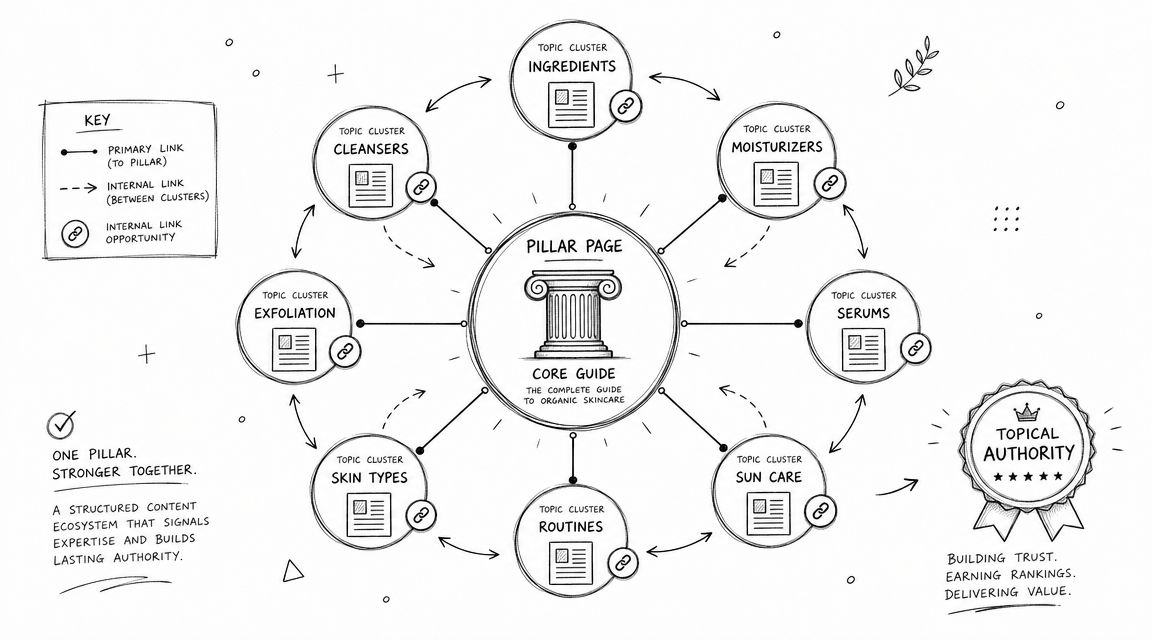
The upside is real. Since most useful opportunities sit across many specific phrases rather than a few giant terms, cluster planning is often the most practical way to cover a topic completely. That's especially true when your site doesn't have the authority to win broad head terms outright.
How to build the cluster without cannibalizing yourself
The page map matters more than the raw list. Evidence-based guidance stresses assigning one canonical page per intent to avoid self-competition and cannibalization, with search volume used as a tie-breaker rather than the main decision factor, as explained in this guide to mapping keywords to pages and avoiding overlap.
For a small business accounting site, that might look like this:
- Pillar page: small business accounting basics
- Cluster page: invoice templates for freelancers
- Cluster page: bookkeeping mistakes new founders make
- Cluster page: expense tracking for service businesses
- Cluster page: choosing between cash and accrual accounting
Mini-case blueprint
Take an agency serving local businesses with SEO services.
- Pillar keyword: SEO for small businesses
- Target clusters: keyword research for small business, local SEO basics, service page SEO, internal linking for SMB sites
- Observed SERP pattern: long guides, practical walkthroughs, beginner frameworks, downloadable templates
- Best page type: one pillar guide plus tightly scoped support articles
Content brief snippet
- Primary intent: informational with service qualification
- Working title: SEO for Small Businesses Without a Large Marketing Team
- Must-cover sections: keyword strategy, on-page basics, local SEO, content cadence, measurement
- Internal linking rule: every cluster page points back to the pillar, and the pillar clearly routes readers to the matching subtopic
What doesn't work is publishing "keyword research for small business," "small business keyword research tips," and "how small businesses do keyword research" as separate pages. That's one intent wearing three outfits.
8. E-A-T Keyword Research and Expertise Positioning
Some niches punish weak credibility harder than weak optimization. If you're in health, finance, legal, or any category where bad advice can cause real harm, keyword research has to start with expertise boundaries.
The mistake is assuming every commercially attractive keyword is fair game. Often it isn't. The SERP tells you whether Google expects recognized expertise, strong editorial signals, or institutional trust.
Where expertise changes the keyword list
In these spaces, the smartest keyword research examples usually narrow the topic until the brand can speak with authority. A fitness coach may have no business targeting a page that reads like medical treatment advice. That same coach may be credible on habit-building, recovery routines, sleep hygiene basics, or beginner exercise planning.
A financial educator may struggle to rank for highly sensitive investment terms but can earn traction with grounded budgeting topics for a defined audience. The point is not to think small. It's to align the keyword set with what the business can defend.
Credibility is part of keyword difficulty, even when tools don't score it directly.
Mini-case blueprint
Take a freelance financial coach serving self-employed creatives.
- Target cluster: budgeting tips for freelancers, irregular income budgeting method, how to pay yourself as a freelancer
- Avoided cluster: complex investing advice and highly regulated financial topics
- Observed SERP pattern: expert explainers, publication-style guides, templates, calculators
- Best page type: educational guide with clear author bio and practical examples
Content brief snippet
- Primary intent: informational with trust qualification
- Working title: Budgeting Tips for Freelancers With Irregular Monthly Income
- Must-cover sections: income smoothing, expense categories, tax set-asides, pay-yourself method, worksheet or template
- Trust elements: clear author background, methodology, practical implementation examples, careful scope boundaries
What doesn't work is trying to "sound authoritative" on topics the business can't credibly support. In E-A-T-sensitive SERPs, shallow confidence is easy to spot.
8 Keyword Research Strategies Compared
| Strategy | Implementation Complexity 🔄 | Resource Requirements 💡 | Speed / Time-to-impact ⚡ | Expected Outcomes ⭐📊 | Ideal Use Cases |
|---|---|---|---|---|---|
| Long-Tail Keyword Research with Buyer Intent | Moderate, focused, granular research 🔄 | Low–Medium, keyword tools + time 💡 | Fast–Medium, quicker wins for new domains ⚡ | Higher conversion, qualified traffic; easier to rank (⭐⭐⭐) 📊 | Small businesses, bootstrapped teams, niche product pages |
| Competitor Keyword Gap Analysis | Medium–High, comparative multi-site analysis 🔄 | Medium–High, paid tools (Ahrefs/SEMrush), time 💡 | Medium, faster validation but execution takes effort ⚡ | Reveals proven opportunities; prioritizes high-impact content (⭐⭐⭐) 📊 | Businesses entering competitive markets or chasing rivals |
| Search Intent Segmentation (TIARA Framework) | High, requires classification and mapping 🔄 | Medium, tools + manual SERP and audience research 💡 | Medium, improves ROI as content aligns with intent ⚡ | Better conversion alignment; clearer content priorities (⭐⭐⭐) 📊 | Content strategy planning, ROI-focused small businesses |
| Question-Based Keyword Research (FAQ Mining) | Low–Medium, extract and structure queries 🔄 | Low–Medium, PAA, forums, AnswerThePublic 💡 | Medium, featured snippets can deliver quick visibility ⚡ | Improved authority, featured-snippet potential, engagement (⭐⭐) 📊 | Educational content, top-of-funnel awareness, authority building |
| Local Keyword Research with Geographic Modifiers | Low–Medium, local optimization + GBP setup 🔄 | Low–Medium, GBP, local citation tools, landing pages 💡 | Fast, quick local rankings and Map Pack opportunities ⚡ | Higher local conversions; easier to dominate local SERPs (⭐⭐⭐) 📊 | Trades, clinics, franchises, local e‑commerce pickup |
| Seasonal and Trending Keyword Research | Medium, trend monitoring and timing planning 🔄 | Low–Medium, Google Trends, editorial calendar 💡 | Fast, large short-term traffic spikes if timed well ⚡ | Big temporary traffic surges; time-bound conversions (⭐⭐) 📊 | E‑commerce campaigns, holiday promos, event-driven content |
| Keyword Research for Content Clusters & Topic Authority | High, extensive planning and linking strategy 🔄 | High, substantial content creation and monitoring 💡 | Slow, long-term authority build (6–12+ months) ⚡ | Strong topical authority, sustained rankings, better UX (⭐⭐⭐) 📊 | Sites aiming for niche dominance, E‑E‑A‑T and content hubs |
| E-A-T Keyword Research & Expertise Positioning | High, credential alignment and credibility work 🔄 | High, expert content, citations, PR/backlinks 💡 | Slow, authority and trust take time to establish ⚡ | Sustainable high-authority rankings; higher quality leads (⭐⭐⭐) 📊 | YMYL niches (health/finance/legal), expert-led organizations |
Your Actionable Keyword Research Playbook
Effective keyword research isn't about collecting the longest spreadsheet. It's about making fewer, better decisions. The teams that get results usually follow the same sequence. They choose a seed topic tied to revenue, expand it into related terms and questions, inspect the SERP to see what Google rewards, then map one intent to one page.
That page mapping step is where most weak SEO plans fall apart. People gather a pile of ideas, then publish whatever feels easiest first. Months later, they have overlapping blog posts, no clear route to money pages, and no way to explain why one article exists instead of another. Better keyword research examples solve that problem up front. They force a decision about page type, intent, and business value before content production starts.
If you're doing this with a small team, don't try to run all eight blueprints at once. Pick the one that matches your immediate constraint.
- If you're new or underpowered, start with long-tail buyer intent.
- If competitors keep outranking you, run a gap analysis.
- If traffic comes but conversions don't, segment by intent.
- If buyers ask the same objections repeatedly, mine question-based terms.
- If you serve a physical area, build local keyword combinations.
- If your revenue swings through the year, work the seasonal calendar.
- If your site feels scattered, build clusters with one canonical page per intent.
- If trust is the bottleneck, narrow your keyword universe to what your expertise can support.
There's also a practical trade-off to remember. Volume alone is a poor decision-maker. Relevance, SERP fit, and business potential usually matter more. A smaller keyword with a clean intent match and a page designed to convert will beat a broader keyword that attracts the wrong audience. This is especially true for small businesses, local operators, and bootstrapped SaaS teams that can't afford to waste six months on vanity topics.
My advice is to build every keyword target as a mini brief, not a row in a sheet. Include the primary keyword, supporting phrases, search intent, page type, SERP notes, internal links, and the action you want the reader to take. That one habit prevents a lot of bad content.
If you want to automate more of this workflow, platforms like OutRank can help execute the mechanics, from research to article production and publication. That doesn't remove the need for strategy. It removes some of the manual overhead that slows small teams down. Used well, that gives you more time to make the decisions that change rankings and revenue.
Agency Secrets gives small business owners a practical way to apply these keyword research examples without hiring an agency-sized team. If you want a clearer SEO playbook built around buyer-intent keywords, consistent publishing, backlinks, and evergreen growth, explore Agency Secrets. It also points you toward OutRank if you want help handling the heavy lifting from keyword research through publication.