You've probably tried to make SEO work with a patchwork stack. One tool for keywords. Another for writing. A spreadsheet for internal links. A freelancer for blog posts. Maybe an agency that promised strategy but mostly sent reports. Months later, you've got content published, money spent, and no clear sense of what moved rankings or leads.
That's where a SaaS SEO platform changes the game. Not because software magically ranks pages, but because the right platform turns SEO into a repeatable operating system. It connects research, content, site structure, publishing, links, and tracking into one workflow that a small team can run without chaos.
The businesses that win with SEO now aren't always the ones with the biggest team. They're the ones with the cleanest system.
Table of Contents
- Why Traditional SEO Fails Most Businesses
- What Is a SaaS SEO Platform
- The Four Pillars of an Automated SEO Engine
- Who Wins with an All-in-One SEO Platform
- Your Evaluation Checklist for Choosing the Right Platform
- The Agency Secrets Playbook for Implementation
- Measuring Success and Calculating Your ROI
Why Traditional SEO Fails Most Businesses
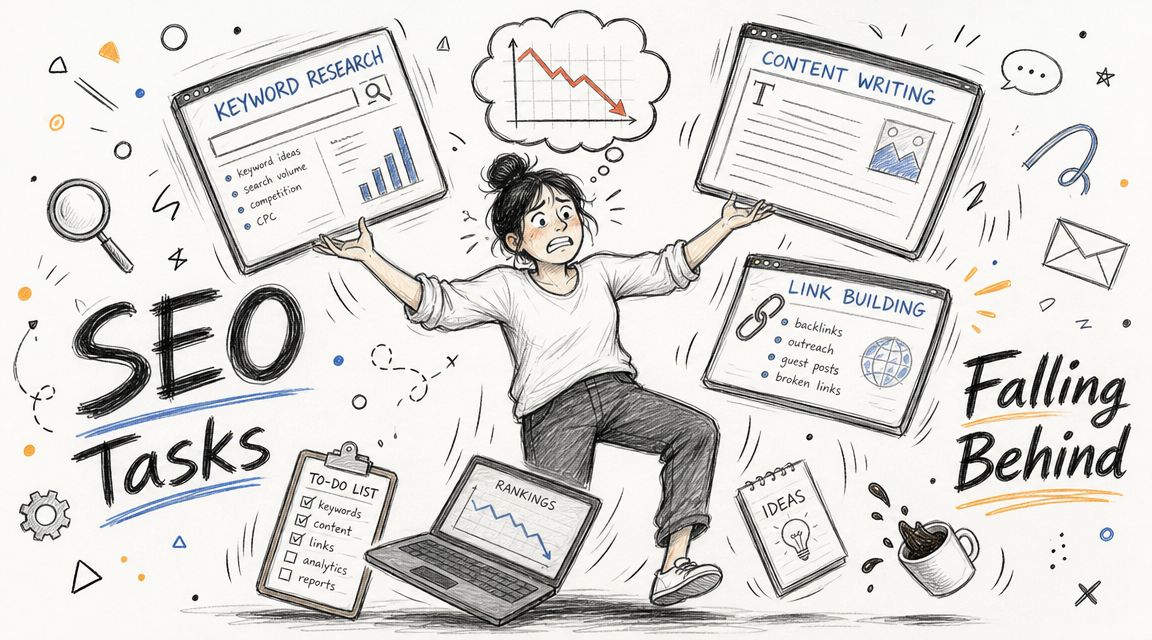
Most small businesses don't fail at SEO because they're lazy. They fail because the work is fragmented, slow, and easy to do in the wrong order.
A founder writes blog posts without a keyword map. A marketer publishes service pages but never builds supporting content. An agency delivers a content calendar but ignores technical issues. A writer produces articles that never link to money pages. Everything gets done in isolation, and the results stay isolated too.
The market doesn't forgive that kind of inconsistency. An industry summary cited by SmartClick's SaaS SEO statistics estimates the worldwide SaaS market at $466 billion and projects it to reach $793.10 billion by 2029, with 33,200+ SaaS companies globally. That matters because buyers compare, search, and shortlist online long before they talk to sales or submit a form.
Manual SEO breaks in predictable ways
A traditional approach usually stalls for one of these reasons:
- Research stays shallow: Teams target broad topics because they're easy to brainstorm, not because they match buyer intent.
- Publishing becomes irregular: Content depends on whoever has time that week.
- Links become an afterthought: The site publishes pages but never builds the authority needed to rank them.
- No one owns the system: One person handles content, another checks rankings, and nobody sees the full picture.
Practical rule: If your SEO process depends on memory, Slack messages, and a spreadsheet only one person understands, it won't scale.
Bigger competitors aren't always smarter
They're often just more systematic. They've got repeatable briefs, better page templates, cleaner internal linking, and a process for improving pages after publication. Small teams can compete, but not with random acts of content marketing.
That's why a SaaS SEO platform matters. It reduces coordination overhead. It gives one place to manage demand research, content production, publishing flow, link support, and reporting. Instead of asking, “What should we do next?” every week, you run a workflow that already answers the question.
What Is a SaaS SEO Platform
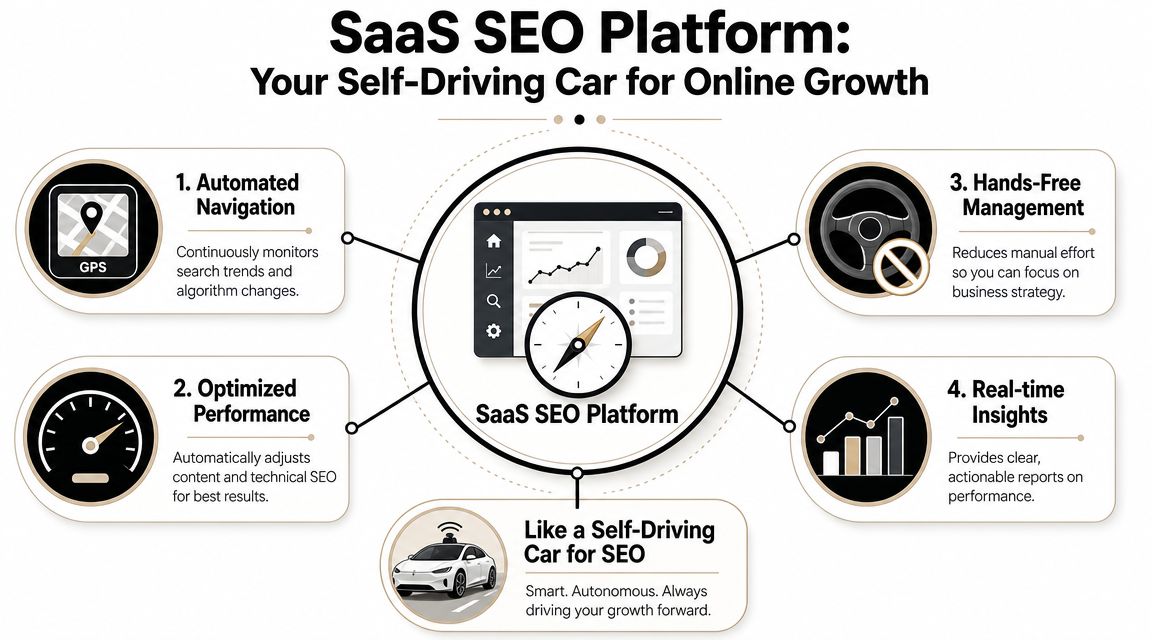
A SaaS SEO platform is software that runs the full SEO workflow inside one system. The easiest way to think about it is this: it's the self-driving car for content-led growth. You still choose the destination, but the platform handles navigation, route corrections, and a lot of the repetitive driving.
That's very different from buying a keyword tool, an AI writer, and a rank tracker separately.
Why disconnected tools break momentum
Point solutions can be useful. Ahrefs can help with research. Surfer can support optimization. Google Search Console is essential for visibility checks. But disconnected tools create handoff problems.
You research in one place, export to a doc, brief a writer elsewhere, paste content into your CMS, then try to remember which pages should link to what. By the time the article is live, the original strategy is already diluted.
That's where many businesses lose momentum:
- The keyword target gets softened during writing.
- The page structure gets weakened during editing.
- Internal links get skipped during publishing.
- Performance review happens too late to fix weak pages quickly.
A real platform closes those gaps.
Here's a quick visual on the idea in action:
What a real platform actually does
A mature SaaS SEO platform usually combines these functions:
- Demand discovery: It identifies keyword opportunities, clusters related topics, and helps you prioritize pages by intent.
- Content operations: It creates briefs, drafts content, applies on-page optimization, and supports direct publishing.
- Authority support: It tracks backlink needs or integrates link acquisition into the workflow.
- Measurement: It shows which pages are gaining rankings, which topics are underperforming, and where competitors are pulling ahead.
The point isn't automation for its own sake. The point is removing the lag between strategy and execution.
The strongest platforms also don't treat SEO as “blog production.” They act more like an operating layer for growth. That means they help you choose the right pages, publish in the right sequence, and reinforce those pages with links and internal architecture so the work compounds.
When people buy the wrong tool, they usually buy for output. More articles. Faster drafts. Easier reporting. When they buy the right platform, they're buying a machine that turns SEO into a controlled process.
The Four Pillars of an Automated SEO Engine
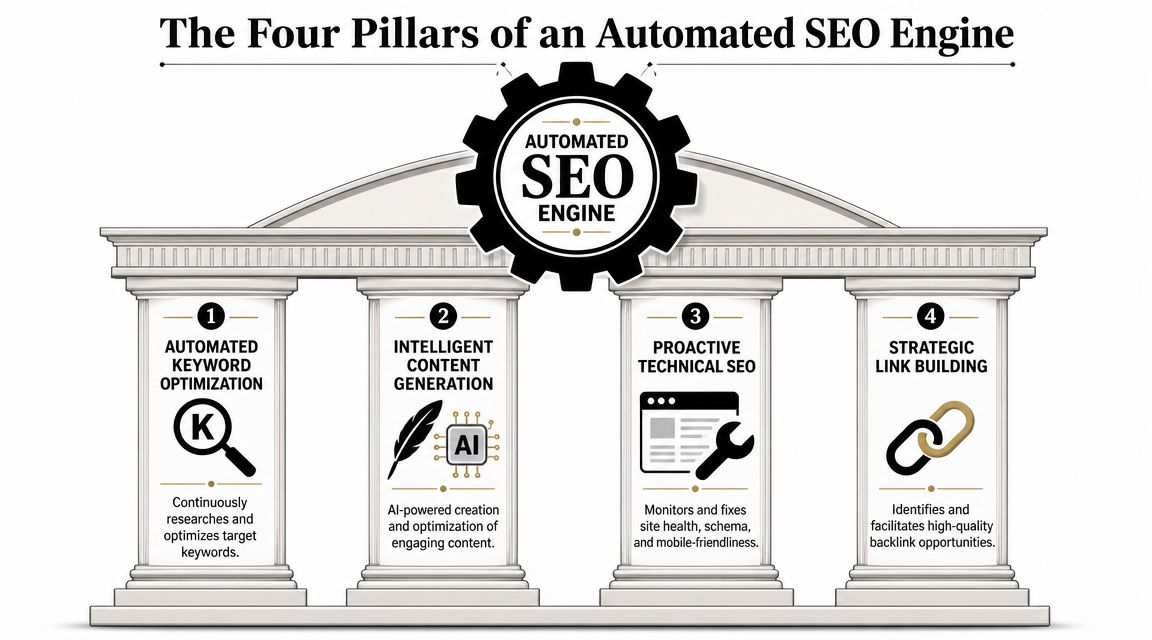
A platform only works if it supports a complete method. The Agency Secrets approach is practical because it doesn't treat SEO as a pile of tasks. It treats it as a system with four connected pillars.
Pillar one keyword and topic clustering
The essential need isn't for more keywords; it's for improved organization.
A good platform groups related queries into clusters so you can build one strong page, then support it with adjacent content instead of publishing five weak pages that cannibalize each other. As a result, strategy stops being abstract. You can see which page is the hub, which articles support it, and how each asset fits the buyer journey.
This also matters technically. Enterprise SaaS SEO guidance from SERPsculpt on technical SEO for enterprise SaaS emphasizes consolidating fragmented URLs into fewer, stronger pages through a hub-and-spoke architecture to improve crawl efficiency and indexability across large content inventories.
A platform that automates clustering does more than save research time. It protects your site from becoming bloated and disorganized.
Pillar two content generation and publishing
Most automation tools stop too early. They draft content, then leave the rest to you.
A stronger platform handles the full editorial chain:
- Brief creation: It frames the topic, angle, headings, and likely supporting entities.
- Draft production: It generates a first version that can be edited to match your offer and voice.
- On-page formatting: It structures headings, FAQs, internal links, and metadata.
- Publishing workflow: It pushes content into WordPress, Webflow, Shopify, or your chosen CMS.
The key trade-off is speed versus control. Full automation is fast, but it can flatten nuance. Human-only workflows protect voice, but they're slow and expensive. The sweet spot is assisted automation. Let the platform handle structure and repetition, then use editorial review for positioning, examples, and conversion clarity.
Pillar three backlink acquisition
Content without authority often just sits there.
Most businesses underinvest in links because outreach is tedious and agency retainers are expensive. A useful platform either manages backlink acquisition directly or makes link opportunities easier to identify and track. What matters is relevance. A page about pricing software doesn't need random links. It needs contextually sensible links that strengthen the exact topic and page group you want to rank.
If the platform can publish pages but can't support authority growth, you're only solving half the problem.
This is also where the workflow matters more than the feature list. Link building should support your most commercially important clusters first, not your least important blog posts.
Pillar four analytics and competitor tracking
SEO gets expensive when you can't tell what's working.
A proper platform should show:
- Which target pages are moving
- Which clusters are gaining traction
- Where rankings are stuck
- Which competitors own the terms you need
- What to update next
The best reporting doesn't drown you in charts. It tells you what action to take. Refresh this page. Add links to that cluster. Expand this comparison page. Consolidate those overlapping URLs.
That's what makes the platform an engine instead of a dashboard. It doesn't just display performance. It supports the next decision.
Who Wins with an All-in-One SEO Platform
Not every business needs the same SEO stack, but certain operators get a huge advantage from an all-in-one system because they can't afford waste.
The solo founder
A solo founder usually has the right instincts and no spare time. They know they need pages for problems, features, comparisons, and use cases. What they don't have is the bandwidth to research terms, brief writers, edit drafts, publish consistently, and monitor results every week.
With a platform, they can turn one afternoon of planning into a repeatable queue. Topics get prioritized. drafts move faster. Internal links aren't forgotten. The founder stays focused on product and sales instead of spending nights patching together SEO tasks.
The e-commerce operator
An e-commerce business has a different problem. Product and collection pages often exist, but supporting search demand is scattered across category descriptions, buying guides, and comparison content. Rankings get split across too many thin pages or ignored because the team treats SEO like merchandising copy.
An all-in-one platform helps by creating structure around product-adjacent content. It supports category hubs, problem-solving pages, and question-based content that feeds revenue pages instead of living in a disconnected blog archive.
The local service business
A clinic, contractor, legal practice, or home service company doesn't need a hundred random articles. It needs location pages, service pages, and trust-building content that answers the exact questions buyers ask before calling.
The wrong setup leads to generic city pages and blog posts nobody reads. The right platform helps the business build a clean footprint around real service intent. That means tighter page targeting, better internal linking between service and location pages, and a publishing cadence that doesn't depend on a busy owner remembering to “do SEO.”
Small local teams often don't lose because they lack expertise. They lose because they never turn that expertise into searchable pages.
The in-house generalist
This is the most common profile in growing SMEs. One marketing manager owns paid, email, web updates, content, and reporting. SEO gets pushed down the list because it takes too many moving parts.
A platform gives that person leverage. Instead of managing vendors, chasing drafts, and stitching reports together, they can run a centralized workflow. They still need judgment. They don't need more admin.
The businesses that win here aren't the ones chasing every feature. They're the ones reducing friction enough to execute every week.
Your Evaluation Checklist for Choosing the Right Platform
A lot of SEO software demos look convincing because they show output. They show keyword lists, article drafts, colorful graphs, and a publishing button. None of that tells you whether the platform can help you rank pages that matter to revenue.
The right way to evaluate a SaaS SEO platform is to ask questions that expose workflow quality, not just features.
Questions that expose weak platforms fast
Start with content quality. Ask how briefs are built, how search intent is handled, and what controls exist for voice, structure, and internal links. If the answer is mostly about generating volume, that's a warning sign.
Then ask about technical performance. Google's mobile-first indexing and Core Web Vitals make page experience a critical factor, and SEOmator's SaaS technical SEO guidance says a good platform should ensure efficient delivery with TTFB at or below 800 ms and optimized assets. If a provider can publish content but has no view on asset weight, render-blocking resources, or script bloat, the workflow is incomplete.
You should also ask how the platform handles these trade-offs:
- Content scale versus content usefulness
- Automation versus editorial control
- Publishing speed versus technical cleanliness
- Ranking reports versus business reporting
Good platforms reduce manual work. Weak platforms relocate it.
SaaS SEO Platform Evaluation Checklist
| Evaluation Area | Key Question to Ask | Why It Matters |
|---|---|---|
| Content strategy | How do you decide which pages to create first? | You need buyer-intent prioritization, not random topic generation. |
| Brief quality | How are headings, entities, and internal links planned? | Poor briefs create generic pages that are hard to rank. |
| CMS workflow | Can content move from draft to publish without copy-paste chaos? | Friction slows consistency and creates formatting errors. |
| Technical SEO | How do you handle site speed, rendering, schema, and indexability? | More pages only help if search engines can crawl and process them well. |
| Site architecture | Can the platform support clusters, hubs, and page consolidation? | Authority builds faster when related pages reinforce each other. |
| Link support | What's the backlink process for priority pages? | Ranking competitive terms usually requires authority, not just content. |
| Reporting | Do reports connect rankings to leads, trials, or sales? | Traffic without business context leads to bad decisions. |
| Workflow ownership | Who is this platform built for day to day? | If it assumes a full SEO team, it may fail inside a small business. |
A provider doesn't need perfect answers to every question. But if they can't explain the system clearly, they probably don't have one.
The Agency Secrets Playbook for Implementation
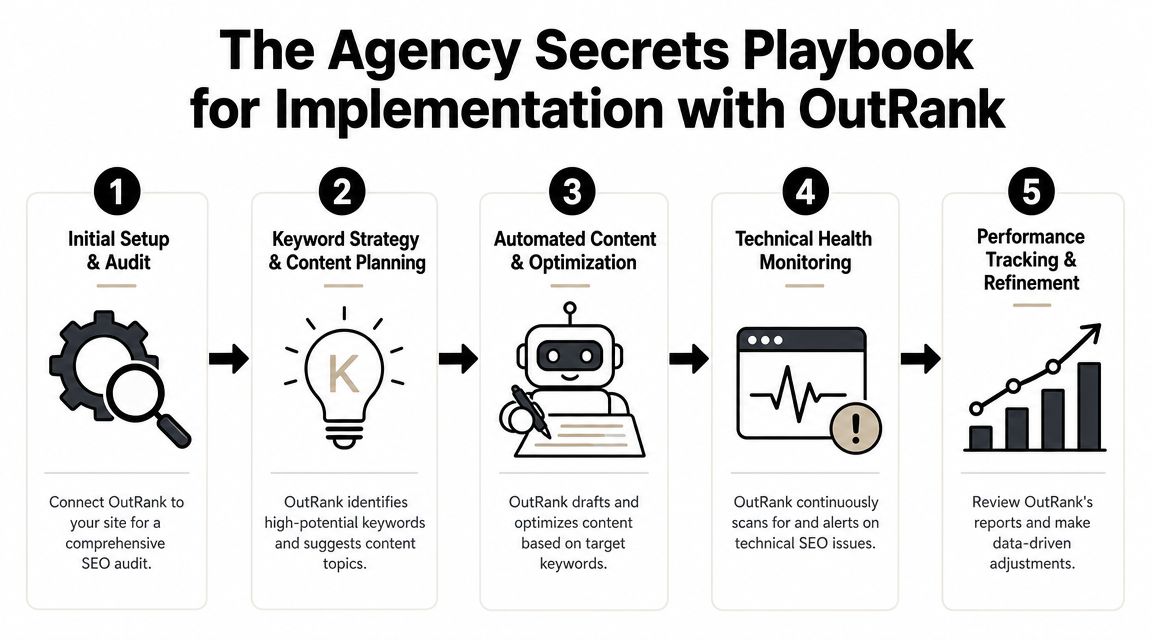
Most businesses don't need a bigger SEO plan. They need a sequence they can stick to. That's the core value behind the Agency Secrets method. It turns SEO into a weekly operating rhythm instead of a burst of disconnected projects.
Start with revenue pages not vanity traffic
One of the biggest mistakes in SaaS SEO is overinvesting in broad educational blogs while neglecting comparison pages, problem-specific landing pages, and other commercial assets. RankScience's SaaS guidance specifically notes that many teams neglect comparison pages and problem-specific landing pages that map more directly to buyer intent and conversion.
That insight changes implementation order.
Start by listing the pages closest to revenue:
- Comparison pages for alternatives and competitor-adjacent searches
- Use-case pages tied to specific buyer problems
- Feature or solution pages aligned to core product value
- Documentation or help content that answers pre-purchase questions
- Supporting educational content that feeds authority into those pages
This is the part many agencies get backward. They build a blog first because it's easier to produce. The smarter move is to build the pages that can convert first, then support them with topic clusters.
Build the system before you chase scale
Once the priority pages are defined, run the playbook in order:
- Map one core cluster: Choose a high-intent topic and define the main page plus supporting articles.
- Publish with internal links from day one: Don't wait until later to connect the cluster.
- Set a realistic cadence: Consistency beats bursts. A sustainable publishing rhythm matters more than occasional content sprints.
- Review winners and laggards monthly: Expand the pages that gain traction. Rework the ones that miss intent.
- Add links to the pages that matter most: Support commercial pages and their nearest supporting content first.
A tool like OutRank fits naturally. It's built to automate keyword research, article generation and publishing, backlink support, and competitor analysis inside one workflow, which makes this agency-free system easier for a small team to execute without stitching together separate vendors and tools.
A practical SEO playbook should tell you what to publish first, what to reinforce next, and what to ignore for now.
The businesses that get traction don't publish everything. They publish in sequence. That's what makes growth more predictable.
Measuring Success and Calculating Your ROI
The simplest way to know whether your platform is working is to watch the metrics in the right order.
First, track visibility on the pages tied to buyer intent. Then track organic traffic to those pages. After that, measure leads, demos, trials, or sales generated from organic visits. If rankings rise but the wrong pages get traffic, your targeting is off. If traffic rises but conversions don't, your page intent or offer alignment needs work.
You also need patience with a standard. According to SeoProfy's SaaS marketing statistics, B2B SaaS SEO delivers about 702% ROI, with a break-even period of roughly 7 months. The same source notes that the #1 result in Google gets nearly 27.6% of all clicks. That's why even modest ranking improvements on high-intent terms can have outsized business value.
Focus on a short scoreboard:
- Commercial keyword rankings
- Organic traffic to revenue pages
- Conversions from organic search
- Page-level improvement after updates
- Cost versus revenue contribution over time
SEO becomes far easier to defend when you measure it like an acquisition channel instead of a publishing program.
If you want an agency-free system instead of another pile of SEO tasks, Agency Secrets lays out a practical playbook you can run. It's built for owners, operators, and lean marketing teams that want a clear workflow for keywords, content, links, and compounding organic growth without hiring a full agency.