
Most advice about SEO auto pilot is wrong in the way that matters most to a small business owner. It sells a fantasy: turn on a tool, publish at scale, watch rankings climb. That version is attractive because it promises amplified results without involvement. It also creates some of the messiest SEO cleanups I see.
The useful version of automation is narrower and better. It doesn't replace judgment. It removes repetitive execution, keeps your team from missing obvious opportunities, and creates a system that can run every week without depending on memory or spare time. That's a very different promise from "set it and forget it."
If you want sustainable organic growth, the winning model is governed automation. Machines handle the routine work they're good at. A person still decides what deserves to be published, what matches buyer intent, what sounds credible, and what supports the business.
Table of Contents
- Putting Your SEO on Auto Pilot Is a Myth
- What SEO Auto Pilot Really Means
- The Reality Check What Automation Can and Cannot Do
- Comparing Manual SEO and Automated Workflows
- The SEO Auto Pilot Playbook for Small Businesses
- Measuring Success and Implementing Guardrails
- Choosing Your Tools and Taking Command
Putting Your SEO on Auto Pilot Is a Myth
Most blog posts about SEO auto pilot get the promise backward. The problem is not whether software can do SEO tasks. The problem is whether anyone is steering the system.
SEO is a chain of decisions tied to revenue, lead quality, and brand trust. Some of those decisions are repetitive and easy to standardize. Others require judgment about what your business should rank for, what a customer needs to see before contacting you, and which pages deserve more investment.
That is where the fully automated pitch falls apart. A tool can draft pages, monitor rankings, flag technical issues, suggest internal links, and push some updates live. It still cannot judge whether a service page matches your actual offer, whether a claim is credible, or whether the copy sounds like it came from a contractor, dentist, lawyer, or agency that has done the work.
For local businesses, that distinction carries weight. Search demand is often high intent, close to purchase, and tied to specific services and places. Publishing more pages does not solve that on its own. Covering the right topics, in the right geography, with the right proof does.
Practical rule: Use automation to increase coverage of commercially relevant searches. Do not use it to mass-produce thin pages.
This is why governed automation works better than "set it and forget it." The system handles the repeatable work so a small team can keep pace. The owner, marketer, or consultant reviews what affects positioning, trust, and conversion. That split is what makes automation useful instead of expensive.
I have seen both outcomes. A governed workflow helps a small business refresh aging pages, catch technical problems early, improve internal linking, and keep reporting consistent. An ungoverned workflow publishes weak content at scale, targets terms that never convert, and creates a cleanup project six months later.
SEO auto pilot works best as supervised execution. The upside is speed, consistency, and broader coverage. The risk is scaling the wrong decision faster.
What SEO Auto Pilot Really Means
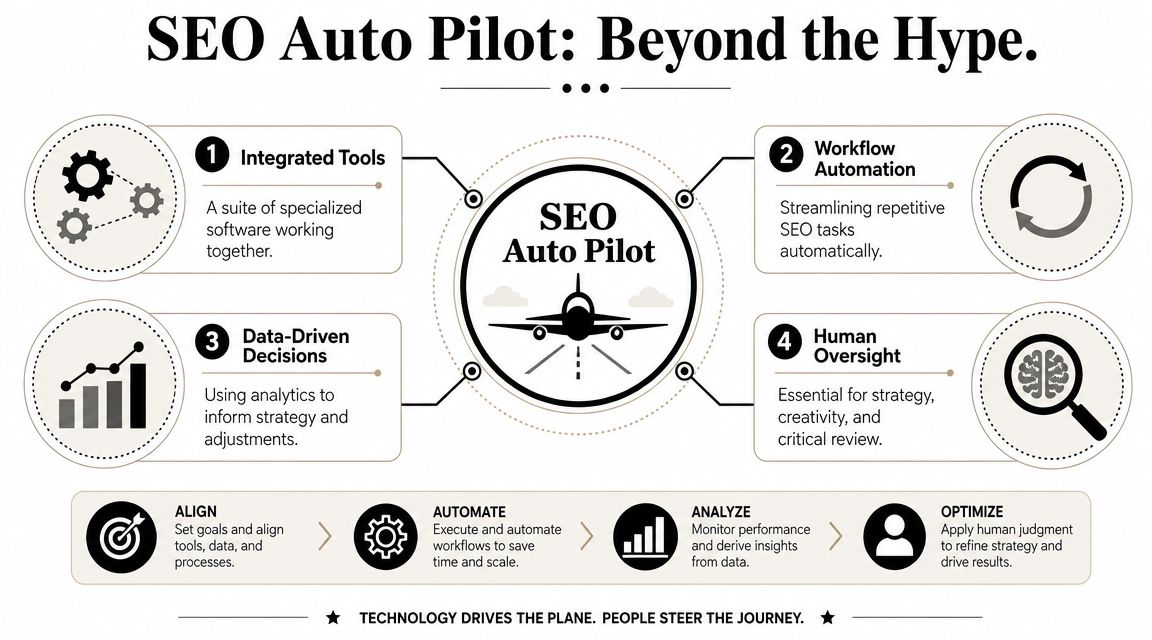
The term is often used loosely. In practice, SEO auto pilot means a connected workflow where software handles repeatable SEO actions, then feeds the results back into the next round of decisions.
It is a workflow, not a button
A capable setup usually follows a closed-loop workflow. It crawls the site, pulls performance data, prioritizes issues, generates fixes, deploys changes, and watches what happens next. That structure is described in this Search Atlas explanation of SEO autopilot workflows.
That matters because it turns SEO from a pile of disconnected tasks into a system. Instead of manually checking rankings, scanning pages, rewriting metadata, and remembering what changed, the system keeps the loop moving.
Common autopilot actions inside that loop include:
- Page-level updates: title rewrites, meta description changes, and content expansion prompts.
- Internal architecture work: internal link insertion with controlled anchor text.
- Technical cleanup: schema.org JSON-LD updates, canonical corrections, noindex fixes, redirect-rule changes, and hreflang annotations.
- Performance triage: surfacing pages that are close to page-one visibility and likely worth improving.
A useful setup also connects to the tools that already hold your real search signals. Google Search Console is the big one. Platforms often use it to pull impressions, clicks, and average position so the backlog isn't based on guesswork. Distribb's overview of SEO autopilot software describes that operating model clearly.
The airplane analogy is useful if you use it correctly
The airplane comparison gets overused, but it helps if you keep it grounded. On a commercial flight, autopilot handles stable cruising conditions. Pilots still manage takeoff, landing, route changes, and anything unusual.
SEO works the same way.
The machine is good at stable, rules-based execution:
- crawling sites on a schedule
- flagging broken pages
- validating schema
- collecting ranking changes
- surfacing quick-win pages
- applying templated on-page improvements
The human still owns the risky parts:
- choosing which topics deserve resources
- deciding what the page should say
- making claims responsibly
- protecting brand voice
- rejecting low-value output
- changing direction when the market shifts
A healthy SEO system doesn't ask, "How can we automate everything?" It asks, "Which work is repetitive enough to automate, and which decisions are too valuable to hand off?"
If you keep that distinction clear, the term SEO auto pilot stops sounding like hype and starts sounding like operations. That's where it earns its keep.
The Reality Check What Automation Can and Cannot Do
The fastest way to waste money on SEO automation is to ask software to do judgment-heavy work without supervision. The fastest way to get value from it is to use it where the rules are clear and the feedback loop is frequent.
A useful benchmark comes from a 2026 industry analysis of SEO autopilot software. It found that only 23% of SEO tasks can be fully automated without quality degradation, while technical monitoring such as daily rank tracking, weekly crawls, broken-link detection, and schema validation is 95–100% suitable for automation. The same analysis notes that base automation tools often cost $50–150 per month, while the true monthly cost of ownership can rise to $150–250 once supporting services are added.

Where automation earns its keep
The best candidates for automation have three traits. They are repetitive, rules-based, and easy to verify.
That includes work like:
- Monitoring routines: rank tracking, crawl scheduling, broken-link detection, schema validation, and alerting.
- Backlog generation: finding pages that slipped, pages stuck just outside stronger visibility, and pages missing obvious on-page elements.
- Controlled edits: metadata rewrites, internal linking suggestions, canonical cleanup, and templated schema updates.
- Reporting hygiene: collecting recurring visibility data so you don't rebuild the same report every week.
This is the part many owners underestimate. The value isn't glamorous. It's operational consistency. A small company usually doesn't lose because it lacked one genius insight. It loses because nobody ran the basics often enough.
Where human judgment still wins
Automation struggles when the task depends on nuance, originality, or context that lives outside the tool.
That includes:
- Intent interpretation: deciding whether a keyword maps to a service page, a comparison page, a local landing page, or a post that shouldn't be written at all.
- Commercial fit: separating traffic terms from buyer terms.
- Differentiation: adding first-hand detail, edge cases, objections, pricing context, operational constraints, and trust signals.
- Relationship work: earning strong backlinks through actual outreach, partnerships, PR, referrals, and reputation.
- Final QA: spotting factual sloppiness, duplicated angles, awkward claims, and pages that sound polished but empty.
Reality check: If a draft could be written for any company in your industry, it probably won't become an asset for yours without editing.
A lot of small businesses hear "AI content" and think the bottleneck is writing speed. It usually isn't. The bottleneck is knowing what deserves to exist, what should be combined, what should be left unpublished, and what needs a real operator's insight before it goes live.
So the answer isn't manual-only or automated-only. It's a hybrid workflow with a firm boundary between machine execution and human responsibility.
Comparing Manual SEO and Automated Workflows
The choice isn't between old-school discipline and shiny software. The essential choice is how you want work to move through your business. Manual SEO gives you control but often stalls. Automated workflows create momentum but can drift if nobody sets boundaries.
Manual vs. Automated SEO A Head-to-Head Comparison
| Factor | Manual SEO Workflow | Automated SEO Workflow |
|---|---|---|
| Speed | Slower. Progress depends on available time and staff attention. | Faster. Recurring tasks run on schedule and surface issues quickly. |
| Scale | Hard to maintain across many pages, locations, or product lines. | Better for larger page sets and recurring optimizations. |
| Consistency | Quality may be high, but execution often varies week to week. | Strong for repeatable routines, templates, and monitoring cycles. |
| Cost | Lower software complexity, higher labor burden over time. | More efficient for repetitive work, but tool sprawl can raise operating cost. |
| Strategic depth | Strong when led by an experienced operator. | Weak if left unguided. Better when paired with a human reviewer. |
| Content quality | Usually better when subject knowledge is applied directly. | Useful for drafts and scale, risky if published without review. |
| Technical hygiene | Often delayed because it competes with everything else. | Better suited to scheduled crawls, alerts, and recurring fixes. |
| Reporting | Frequently manual and inconsistent. | Easier to standardize and repeat. |
The table makes one thing obvious. Each model solves the other model's weakness. Manual work protects quality and context. Automation protects cadence and coverage.
The hybrid model is usually the right answer
For most small businesses, fully manual SEO is too fragile. It depends on spare time, and spare time disappears. Fully automated SEO is too loose. It tends to overproduce and underthink.
The practical middle looks like this:
- Automate discovery: keyword clustering, technical scans, rank monitoring, issue alerts.
- Automate controlled execution: internal links, metadata suggestions, refresh prompts, structured technical fixes.
- Keep humans on decisions: keyword selection, page purpose, content review, service positioning, trust elements, and publish approval.
That model also changes how you think about cost. Cheap software isn't cheap if it creates a cleanup project. Manual effort isn't efficient if skilled staff spend their time gathering data instead of making decisions.
A governed setup usually wins because it lets software do what software does best while preserving the parts of SEO that still need someone who understands the business.
The SEO Auto Pilot Playbook for Small Businesses
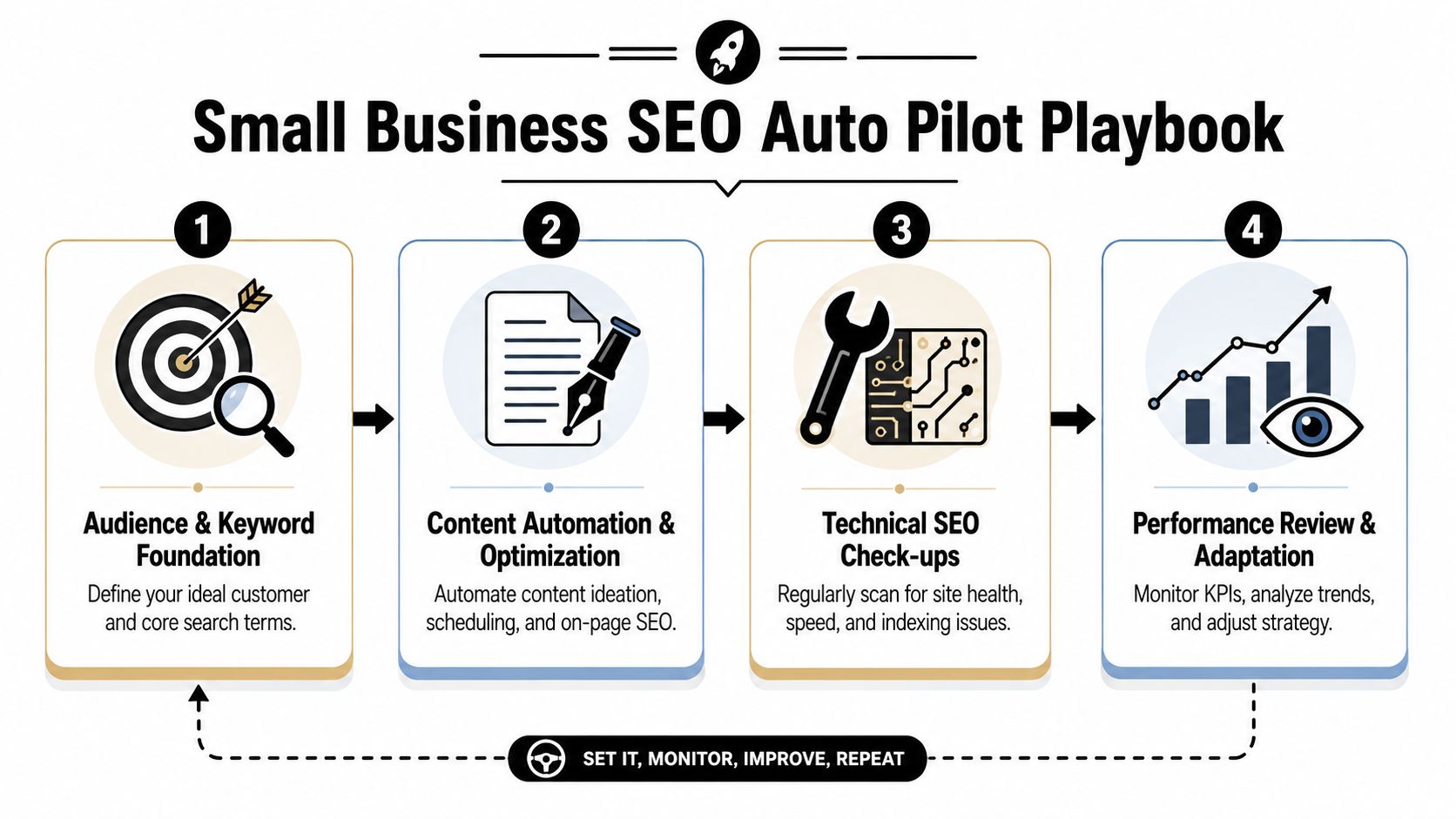
Small businesses do not need an SEO machine that runs unattended. They need a system that keeps work moving without lowering the standard. The version that holds up in practice has four jobs: find demand, publish pages that can win business, earn credible links, and revisit pages based on real signals.
Start with buyer-intent keyword discovery
For a small business, bad keyword targeting creates expensive busywork. You end up publishing pages that attract impressions but not calls, bookings, or quote requests. A governed system starts closer to revenue.
That usually means building keyword clusters around commercial intent and local relevance, then filtering hard before anything gets written. The tool can collect patterns quickly. A person still needs to decide which terms belong on service pages, which deserve supporting content, and which are a distraction.
Use your workflow to surface clusters such as:
- Service modifiers: emergency, same-day, affordable, specialist, pediatric, commercial.
- Location patterns: city pages, neighborhood terms, nearby intent, regional variants.
- Comparison intent: best option, alternative, versus pages, cost and timing questions.
- Problem-aware searches: symptoms, warning signs, repair indicators, when to replace, when to book.
The goal is coverage with intent, not volume for its own sake.
Use AI drafts, then add operator knowledge
Many small teams either save serious time or create a cleanup problem.
AI is useful for structure. It can draft headings, pull together common questions, and give a writer a workable starting point. That is a productivity gain. It is not quality control.
The pages that perform for service businesses usually include details a generic model will miss: what the job involves, who it is for, what it costs, what can delay service, what your team does differently, what proof supports the claim, and what a buyer should do next. Those details often decide whether a page ranks well and converts once it does.
A governed content workflow usually includes:
- An approved brief with target intent, page type, audience, angle, and required sections.
- A machine-generated draft based on that brief.
- A human edit that adds specifics, examples, objections, local details, photos, policies, service constraints, and trust signals.
- A final review before publishing.
"Automation should produce a stronger first draft, not remove editorial responsibility."
I have seen small businesses publish dozens of AI pages in a month and then spend the next quarter fixing thin copy, duplicate intent, and weak conversion paths. The faster route was slower because nobody set publishing standards upfront.
A short walkthrough helps if you're evaluating workflow design in practice:
Build links in two lanes
Link building is another area where automation helps, then quickly becomes risky if left alone.
Split it into two lanes. The first lane is repeatable and operational. Use software to find citations, unlinked brand mentions, reclaimable links, supplier mentions, directories worth having, and straightforward partner opportunities. The second lane is reputation-driven. Handle sponsorships, local associations, guest contributions, digital PR, and referral relationships manually because context matters and templated outreach burns goodwill fast.
That division keeps the system honest. Software handles prospecting and tracking. People handle trust.
Let monitoring trigger the next action
Publishing is the midpoint, not the finish line.
A useful autopilot setup watches for conditions that justify intervention. That includes pages gaining impressions but losing clicks, URLs stuck just below stronger rankings, local pages with weak internal links, aging content that no longer reflects the offer, and technical issues that interfere with crawling or indexing.
The important shift is operational. Instead of asking, "What should we publish next?" every week, the system also asks, "What already exists that deserves a better result?" That is how small businesses get more out of limited resources.
SEO auto pilot works when automation creates the next best action and someone is accountable for approving it. That is the playbook. Controlled scale, clear ownership, and fewer expensive mistakes.
Measuring Success and Implementing Guardrails
A lot of SEO automation fails unnoticed because teams measure output instead of impact. They count pages, briefs, or tasks completed. None of those prove the system is helping the business.
A stronger framework starts with search visibility signals and connects them to business outcomes. SEO Scout's guidance on tracking SEO data on autopilot points to a practical base: use Google Search Console to track impressions and average position, then relate those changes to the actions your workflow took.
Measure movement, not just output
For a small business, the cleanest scoreboard usually includes:
- Visibility indicators: impressions, average position, and page-level movement in Search Console.
- Engagement signals: whether searchers are clicking and interacting with the right pages.
- Business response: leads, calls, bookings, quote requests, or sales that can be tied back to relevant pages.
- Refresh cadence: whether the system improves existing winners instead of only creating new URLs.
That last point matters. A lot of tools are built to produce more. Mature SEO systems are built to learn what to improve next.
Operator note: If reporting can't show which automated action preceded a visibility gain, the system is running, but it isn't being managed.
Guardrails that prevent expensive drift
The biggest operational risk in SEO auto pilot isn't usually immediate failure. It's unmanaged success. You create more pages, more edits, more moving parts, and the system slowly drifts away from strategy. This field guide on governed automation puts the emphasis in the right place: use one-page briefs, cluster keywords by intent, and require a human edit step.
Those guardrails are not bureaucracy. They're protection.
Use them aggressively:
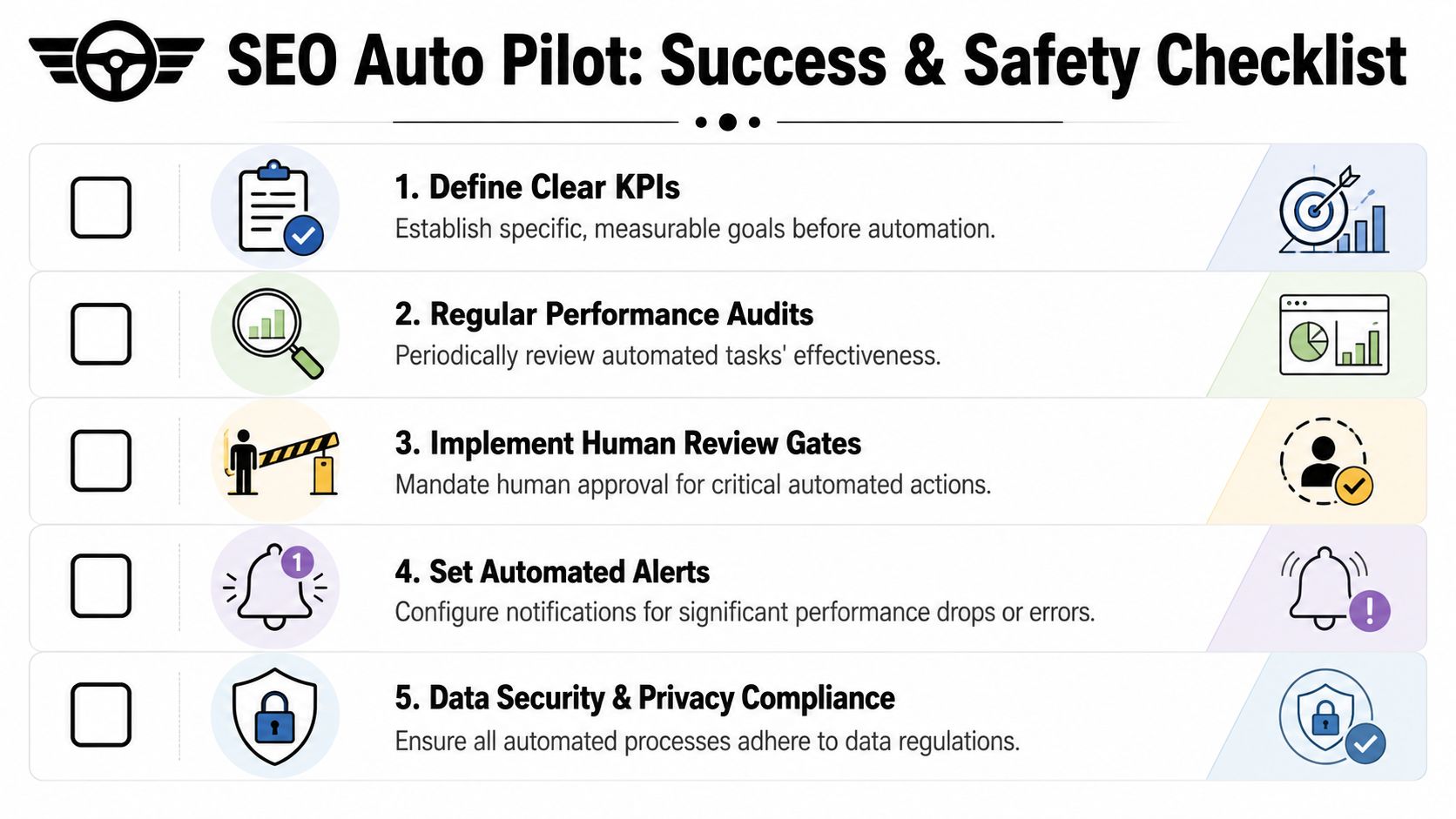
- One-page briefs: define target intent, page type, required proof points, and what makes the page different.
- Intent-based clustering: don't let one topic spawn multiple weak pages that compete with each other.
- Human review gates: require approval before publication and before high-impact sitewide changes.
- Change logs: record what the system changed so wins and losses can be traced back to actions.
- Alert thresholds: flag sudden drops, indexing problems, or unusual output volume before they become bigger problems.
The businesses that get the most from automation don't trust it blindly. They govern it well.
Choosing Your Tools and Taking Command
The right tool stack depends on your bottleneck. If your team misses technical issues, start there. If keyword discovery is inconsistent, fix research and clustering first. If content production keeps stalling, choose a platform that can move briefs, drafts, optimization, and publishing through one controlled workflow.
In general, you're choosing between point solutions and integrated platforms. Point solutions can work well when you already have strong internal process. Integrated platforms are often better for small businesses because they reduce handoffs and keep data in one place.
What matters most is control. You want software that can connect to Search Console, surface real opportunities, support review steps, and make it easy to see whether automated actions are improving visibility. That's the core measurement challenge, and it matters more than fancy dashboards. As noted in the earlier section, the system has to prove itself through movement in impressions and average position, not just a higher publishing count.
SEO auto pilot works when you stay in command. Let the machine handle repetition. Keep strategy, quality, and commercial judgment in human hands. That's how a small business gets scale without losing its grip on what makes the business worth choosing.
If you want a practical way to apply this governed-automation approach, Agency Secrets is built for exactly that kind of operator. It focuses on the core SEO levers that matter to small businesses: buyer-intent keyword research, consistent authoritative publishing, relevant backlinks, and evergreen content that compounds over time. If you want agency-style execution without hiring an agency-sized team, it's a smart place to start.